
Feeds:
Posts
Comments

Posts Tagged ‘Wisdom’

Image Generated by WordPress AI

This week’s readings:

  1. Wisdom 7:7–11
  2. Psalm 90:12–13, 14–15, 16–17
  3. Hebrews 4:12–13
  4. Mark 10:17–30

What this week’s readings say to me:

The first reading shares characteristics with a love poem. Someone prays for a beloved one to come into his life. The prayer is answered. The one praying chooses the beloved over power. The beloved is more valuable to the one praying than jewels are. Compared to the beloved, gold might as well be dust, and silver is no better than mud. The beloved is more important to the one praying than health or physical attractiveness. Unlike the sun, the beloved’s brilliance never fades. The narrator chooses the beloved over all the visible things I mentioned before. However, the beloved brings all of the above with her.

Who is the beloved? Prudence, the passage says. This quality is personified as a woman in this week’s Old Testament passage. Merriam-Webster.com defines the quality as follows:

  1.  the ability to govern and discipline oneself by the use of reason
  2. sagacity or shrewdness in the management of affairs
  3. skill and good judgment in the use of resources
  4. caution or circumspection as to danger or risk

Breaking down this definition even further offers insight. Sagacity is the state of being sagacious. Miriam-Webster online defines sagacious as:

  1. of keen and farsighted penetration and judgmentdiscerning
  2. caused by or indicating acute discernment

The same dictionary defines discernment as “the quality of being able to comprehend what is obscure”. It defines “obscure” as “dark, dim,” or “not readily understood or clearly expressed.”

One of the ways it defines “shrewd” is “given to wily and artful ways of dealing” and “wily” as “crafty.”

So to have wisdom in decision-making is not to rush the process. Wisdom slices through superficial concerns that cloud the process. To be open to wisdom is to be open to giving love, even though this Divine Love is difficult to understand and practice. Nonetheless, God loves wisdom, and wisdom loves God.

God sees the potential in each of us to be open to wisdom and love. God loves us for that potential. God loves us, too, in the midst of our struggle to be open to that potential.

The psalm prays for wisdom. It then offers a vision of what being open to that wisdom looks and feels like. Sometimes the experience of being open to wisdom isn’t easy. But the narrator suggests that a difficult experience is preferable if it helps him grow. He prefers it over having a pleasant experience that doesn’t contribute to growth.

The epistle uses sharp language to describe just how discerning God’s wisdom is. A paraphrase of it might be God’s wisdom is deeper and wider than any x-ray vision a person could imagine. Each of us will one day see ourselves and our actions the way God sees them.

The Gospel passage says that receiving the wisdom of God means more than just following the letter of God’s wisdom. It means letting go of whatever tries to stand in the way of that wisdom’s active spirit. The passage acknowledges that we need help to let go. It also promises that when we remove obstacles to the spirit’s movement, wisdom operates more freely within us. We will receive more than we let go of.

What someone else is sharing about this week’s readings:

This week’s readings inspire Donna Orsuto to pray and to issue a challenge.

This week’s prayer:

Lord, help me to remember that authentic wisdom comes with humility and without superficiality. Help me to take an honest look at my priorities. Enable me to make well-reasoned decisions. Let wisdom guide me. Amen.

Work cited (but not linked to):

Confraternity of Christian Doctrine, Inc. ” 28th Sunday in Ordinary Time — 13 Oct. 2024: Readings at Mass.” The New American Bible, 2001. Universalis for Windows, Version 2.193, Universalis Publishing Ltd., 23 Sept. 2024, https://universalis.com/n-app-windows.htm.
Read Full Post »

Photo by Thays Orrico on Unsplash

Readings for August 11:

  1. Proverbs 9:1–6
  2. Psalm 34:2–3, 4–5, 6–7 (and 9)
  3. Ephesians 5:15–20
  4. John 6:51–58

What this week’s readings say to me:

The first reading presents wisdom as a nurturing homemaker, someone who provides shelter and food. Perhaps the extended metaphor of the passage says something about how practical wisdom is necessary for meeting basic needs and how having basic needs met is necessary for a person to grow in “understanding” (Prov. 9:6).

This week’s psalm, the same as last week’s, continues to call us to recognize that God provides for our physical, emotional, and spiritual needs. God doesn’t run out all the means to provide for all of these needs. Ever.

Maybe because I focused on some of the psalm verses last week, the psalm refrain stands out to me more than the verses this week: “Taste and see the goodness of the Lord (Psalm 34:9). It invites us to use our physical senses — particularly taste and vision — to receive “the goodness of the Lord . . .” (Psalm 34:9).

Now there’s the old cliché “seeing is believing.” While it is cliché, it’s also often true for people. So it’s powerful to be able to see concrete signs of God’s goodness around us. How can the way each of us lives offer those concrete signs, not just by showing compassion, helping people see it, but by helping people experience it with their other senses.

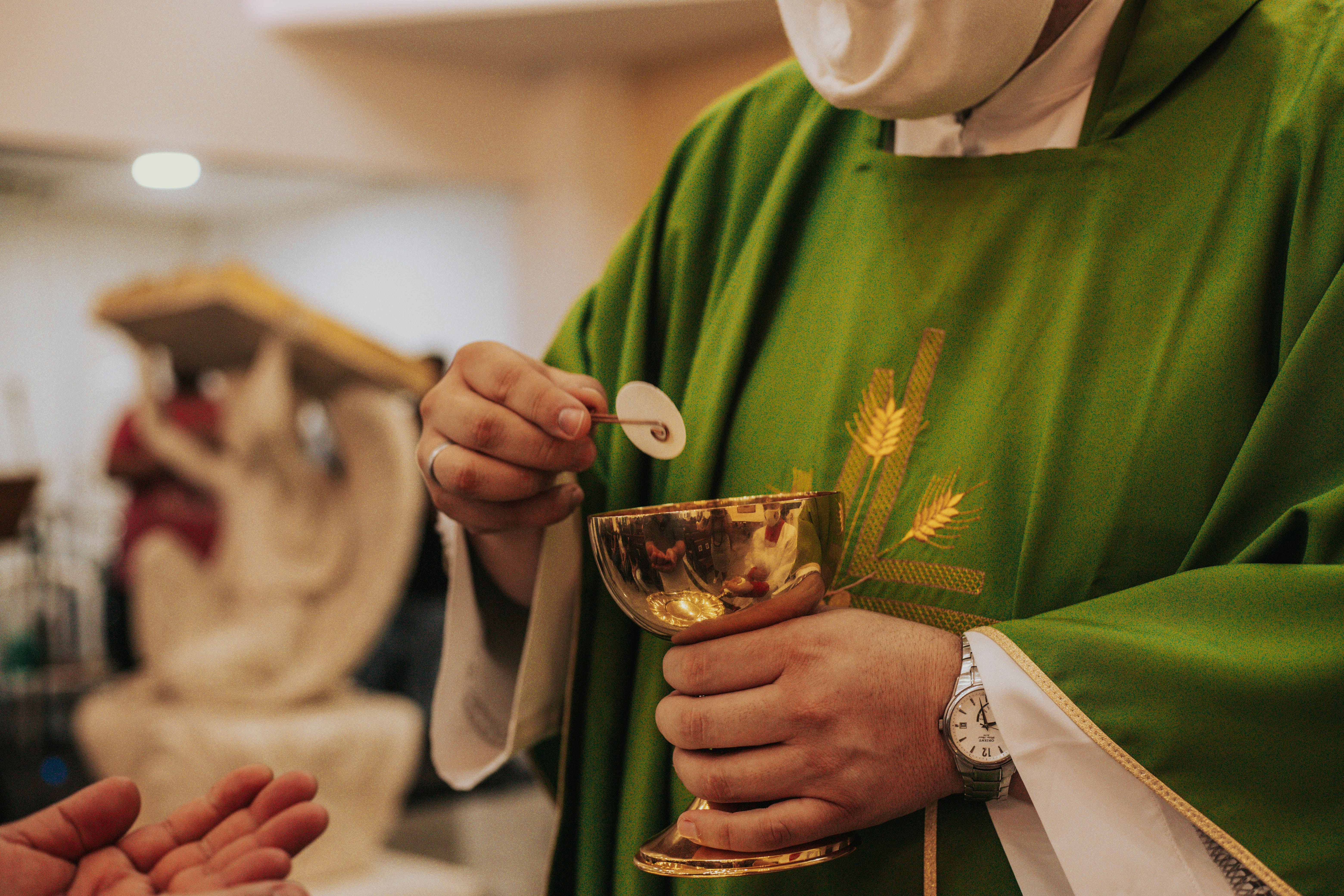
Think what a powerful sense taste is. It’s inextricably linked to smell. Think of what emotions can be invoked by the taste and smell of a meal that reminds a person of a past special occasion. Without smell, it’s very difficult, if not impossible to taste. Think of how powerful it is to smell or taste something that you smelled or taste in the past not long before becoming sick. Given the power of these associations, the psalm refrain says to me that truly engaging with God and what God gives involves all the senses. This reality is why the celebration of the Eucharist and other sacraments engages all the senses.

This week’s epistle urges readers and listeners to engage all the senses as well and to be careful to engage all of them in the movement of the spirit, and the pursuit of wisdom, rather than dulling the senses with activities that make it more difficult for the spirit to move within and among us.

The Gospel passage reminds readers that Christ’s message engages all the senses, and in doing so, challenges them. To the crowds, he says that he’s bread, and that whoever eats this bread “will live forever” (John 6:51). The crowds see a man speaking to them. They were already wondering how this could be, and he was going to challenge them even further (John 6:52). He goes on to say that “the bread that [He] will give is [His] flesh for the life of the world and that “[w]hoever eats [His] flesh and drinks [His] blood remains in me and I in him” (John 6:51 and 56).

Christ had to give all of himself — body, blood, soul, and divinity, “for the life of the world” and for every individual in the world who will receive that life (Jon 6:56). Receiving that life in its fullness will involve all the physical senses — taste, touch, sight, and hearing — of individuals open to receiving it. It will also engage the mind and the spirit. It will challenge all of these by inviting them to enter into what self-preservation instincts tell us to run away from.

What someone else is sharing about this week’s readings:

Sarah Hart’s reflection on this week’s readings looks at different ways to “remain in” Christ, as the Gospel passage asks us to do, with none of the ways of doing so being separate from each other or less essential than another (John 6:56).

Beyond this week’s readings:

Thinking about how important smell is for taste and how important engaging all the senses is to relationship with God and others reminds me of a phrase from last week’s excerpt from Ephesians about being “imitators of God,” liv[ing] in love” (Eph. 5:1-2). This way of living that Christ modeled is described as making oneself a “sacrificial offering to God for a fragrant aroma” (Eph. 5:2).

This week’s prayer:

Lord, grant me the grace of courage to remain in You as You remain in the Father. Help me not to turn away when You challenge me with what You offer and with Your vision for the Kingdom of God. Amen (John 6:56-58).

Work cited:

Confraternity of Christian Doctrine, Inc. ” 20th Sunday in Ordinary Time — 18 Aug. 2024: Readings at Mass.” The New American Bible, 2001. Universalis for Windows, Version 2.192, Universalis Publishing Ltd., 30 July 2024, https://universalis.com/n-app-windows.htm.

Read Full Post »

Photo by Gadiel Lazcano on Unsplash

This week’s readings:

  1. Wisdom 6:12–16 
  2. Psalm 63:2, 3–4, 5–6, 7–8
  3. 1 Thessalonians 4:13–18
  4. Matthew 24:42a, 44

What this week’s readings say to me:

This week’s readings say to me that God’s wisdom, born of God’s unconditional, self-emptying love transcends gender, time, and even death. It’s alive, a guiding light and a relationship sought and found through alertness, preparation, perseverance and patience. It can’t be faked or borrowed and returned. It has to be kept and nurtured. The path to it cannot be rushed, and the process of encountering and journeying with it comes with a cost that’s worth paying to make it my own. Knowing and not knowing it affect my mind, body, and soul. Being open to it, living with it, and following words leads would make me the undistorted version of myself, while closing my mind, body, and soul to it would leave me lonely and unrecognizable to anyone acquainted with the best version of me.

What someone else is sharing about this week’s readings:

Paula Rush explores what the symbolism of this week’s readings has to say. I found her perspective on the parable in the Gospel reading particularly refreshing and inspiring. I would say her reflection ends with a twist. Go to this page out to find out what her hope-filled perspective on the foolish virgin is.

Beyond this week’s readings:

Until the evening two days ago, I was traveling, and I got sick at both the beginning and the end of my trip. Then I came to my desk to work on this post yesterday. I didn’t feel like moving a muscle, and congestion meant talking to my dictation software wasn’t as comfortable as usual, not to mention that the software probably wouldn’t have understood me as well as it usually does. I set my timer, and when it went off, only the headings and the locations of the Scripture passages had been added to this post. I decided to spend the rest of the day catching up on shows I missed while I was gone and playing games on my phone. And when I got up this morning, I still felt like I had nothing to offer.

Then I let Hallow app guide me through an imaginative prayer session and a St. Jude novena centering around the feeding of the 5,000, a.k.a. the multiplication of loaves and fishes (Matt. 14:13-21; Mark 6:30-44; Luke 9:10-17; and John 6:1-15). When the apostles thought there was no way they had enough food to feed the crowd who had been listening to Jesus was so long, that’s when I realized I could relate, in a way.

As I write, I’m wrestling with doubts that anything I put in this post will feed you intellectually, spiritually, or emotionally. If something I’ve included here does resonate with you, I’d be interested to know what, if you’d like to share a comment.

But also as I write this after sitting with the readings, I’m reminded that it isn’t I who do the feeding. It’s God. I have only to desire God’s wisdom and to take one step at a time to prepare for and to receive its movement.

Come to me, Oil for my lamp, Wisdom of God. Give me the wisdom to recognize You so You can recognize in me the person I am in You. Amen.

Read Full Post »

Photo by Ashin K Suresh on Unsplash

This week’s readings:

  1. 1 Kings 3:5, 7–12
  2. Psalm 119:57, 72, 76–77, 127–128, 129–130
  3. Romans 8:28–30
  4. Matthew 13:44–52

This week’s readings are about the value of wisdom, what wisdom looks like — and what it doesn’t look like. They tell me that wisdom means wanting to know right from wrong. It also means knowing that without God’s grace, I can’t know right from wrong. It means having hope because the ultimate form of the many forms this grace takes is that God was carried and delivered by a woman, entering personally into the human experience. God entered into the darkest parts of that experience, giving everything possible to those darkest experiences so the Light could overpower them. Nowhere the Light breaks through can remain as dark as it was before Light’s entry, and the more Light is allowed in, the more darkness is pushed out. The way I’m thinking about this in terms of Jesus is that once the Spirit had left his human body, suffering and death no longer had metaphorical fingers on God.

They still have fingers on God’s creation, but those fingers no longer have a chokehold on it because the darkness cannot be stronger than unfettered Light. Because Light’s now unfettered, it shines on all of creation — or it would if it could shine through everyone.

But we all block the Light in some ways; I know I do. My desire to have only what I want when I want it and nothing I don’t gets in the way of the light shining through me. This desire lets ingratitude and covetousness spread in my heart. From my heart, it spreads to my mouth and comes out as criticism and self-righteousness fueled by unchecked anger and resentment. Fears about not getting only what I want when I want also get in the way of me being a conduit for the Light.

Such desire and fear is selfishness. It’s the result of looking at myself, others, and God only through the lens of my own pain and my desire to avoid it. I can’t honestly say I’m willing to sell everything that seems to allow me to avoid it so that I can make room for the Kingdom of God that Jesus has purchased for me. I don’t honestly trust myself to protect the treasure of the kingdom that is within and around me. I’m not even sure I can honestly say I want to. But I know that I want to want to. So my prayer for this week is for the Spirit to give me true wisdom so that I can recognize in a personal, heart-based way what a treasure the Kingdom of God is. Amen.

I sense that I received one answer to this prayer before putting it into words here. I sense that I may find what I’m seeking by approaching this blog differently in the future. One part of my idea – we’ll see if it’s God’s idea too — is to post links to others’ reflections on the readings each Sunday after this one. I don’t mean to say that I envision this blog becoming merely a place where I post links to other people’s writing and videos. On the contrary, the other part of my idea is to make this blog a place where I journal and pray through what ever form of expression seems most meaningful at a given time.

I feel called to shift what I write here from being focused on interpretation and application to being focused on conversation with God and with you. I suspect I’ll find it helpful to use prayer journaling prompts as inspiration for some future posts here. I hope they’ll inspire me to ask questions and to listen to and look for God. I also hope my exploration will encourage you to explore with God too. I’m discerning that I need more time for this exploration.

Taking this time may mean posting links to weekly reflections from others here and sharing journaling prompts and responses of my own more or less often than I have posted so far. I don’t know which. How often I post will probably vary what I’m wrestling with or sitting with. I’m looking forward to this new approach, this approach of noticing how the Spirit moves within and around me and not being in a rush to interpret what I notice or to tie it up in a very defined bow. Join me on this new adventure of following where the Wind blows and seeking the Light within and at each end of every tunnel. Lead me, Lord. Help me to dive deeper into love of You and everything and everyone that You love. Amen.

Read Full Post »