Feeds:
Posts
Comments

Posts Tagged ‘Who Am I in God’

This week’s readings:

  1. Sirach 27:30—28:7
  2. Psalm 103:1–2, 3–4, 9–10, 11–12
  3. Romans 14:7–9
  4. John 13:34

What this week’s readings say to me:

The theme of this week’s readings is forgiveness — how it’s God’s nature and why extending it to others is important. The first reading asks me a question: how can I expect forgiveness if I can’t forgive others, especially considering that they are subject to the same weaknesses I struggle with? The second reading offers reassurance, conveying that God isn’t like me. God is “slow to anger” (Ps. 103: 9). God doesn’t “requite us according to our crimes” (103:10). “As far as the east is from the west/so far has he put our transgressions from us” (103: 11). “[S]o surpassing is his kindness toward those who fear him” (103: 13).

Now I don’t believe in being asked to be afraid of God. What I am being asked is to recognize that I’m not God. God shares some knowledge with me, but not all knowledge. God’s ways are not my ways (Isa. 55:8).

The third reading offers a lesson in how to respond to this reality: remember whom you and everyone else around you was created in the image of — God. So I ask God to help that image be reflected in me. The result of allowing God’s image to be reflected in me would be living for God and for others in God rather than for myself. It would mean forgiving others because I want God to forgive me. And He does if I acknowledge my sins to Him. Doing so hands might sin-wounded soul over to Him for healing. Confessing my sins to someone who has been given the ministry of this healing helps me hand my sins over. I’m more likely to struggle with the weight of something when I carry it without the help of someone who is being God’s ears and voice. In the Gospel reading, Jesus tells a parable with a tough message for anyone who doesn’t approach the wrongdoings and shortcomings of others with God’s forgiving ears and voice.

Let’s see what someone else has to say about that message.

What someone else is sharing about this week’s readings:

Caitlin Morneau’s reflection reminds me that forgiveness isn’t something a person can snap his or her fingers and make happen. It takes a conscious decision to forgive, and then even once the decision to forgive is made, it takes time and effort to put into practice. Her perspective also reminds me that not being able to take that time and make that effort is a punishment in and of itself.

Beyond this week’s readings:

As I typed that last reminder, I wondered if there would be a way to reconcile it with the message of the Gospel reading. I had my doubts. I remembered the message of the Gospel reading being that I needed to forgive others as God has forgiven me, and if I don’t, God won’t forgive me.

I struggled with this understanding because I couldn’t make it mesh with the message I was getting from the psalm. I didn’t expect the tension I was experiencing from the struggle to resolve because, let’s face it, sometimes passages in the Bible just don’t agree with each other. Different scriptures were written at different times. Even within a single culture, understandings of God and God’s will evolve over time, and the differences between passages may reflect that evolution. Different books that are included within the biblical canon were also written with different audiences and purposes in mind. Some of them are poems; some of them are more like folktales. They have morals just like an Aesop’s fable or a Grimm’s fairy tale does. Others have more in common with legal documents than with a poem or a story.

So sometimes the differences between Scripture passages just are what they are, and I have to sit with the tension, the unanswered question, or the challenging lesson, and ask myself what words from a reading session stand out for me on a given day. I use the answer to that question to help me discern what God has to say to me at that moment.

Surprisingly though, when I went back to the Gospel after reading Caitlin Morneau’s reflection, the king in the parable no longer seemed as punitive. It isn’t the king who punishes the servant who doesn’t forgive the debts of others. Rather, the translation I’m using says that the king “handed [the servant] over to torturers (Mat. 18:34) What are the torturers? What is the debt but the effects of unforgiveness on the person who shoulders them?

Unforgiveness might be the sin I struggle with the most. In God I Have Issues: 50 Ways to Pray No Matter How You Feel, Fr. Mark Thibodeaux describes an approach he learned to use to free himself from the torture of unforgiveness:

Adapting the insights from a particular style of psychological therapy called Gestalt, I prayed in my chair with two other chairs in front of me. I sat Jesus in one of those chairs and my offender in the other. With Jesus present, I would say anything that I wanted to my offender. I might yell at him or curse him or tell him all sorts of despicable things. But at the end of my prayer time, I allowed both of my two guests to speak to me as well. At the end of our conversation, regardless of whether my heart felt it or not, I told my offender, “You hurt me, but I forgive you and I love you.” And one beautiful sunny morning, I said it and realized that there was no part of me that didn’t genuinely mean it, not even my heart!

loc. 1149-1157

A book I just finished, Things You Save in a Fire, by Katherine Center, offers other tips for practicing forgiveness:

“Just saying the words ‘I forgive you,’ even to yourself, can be a powerful start…” “Forgiveness is about a mind-set of letting go… “It’s about acknowledging to yourself that someone hurt you, and accepting that… Then it’s about accepting that the person who hurt you is flawed, like all people are, and letting that guide you to a better, more nuanced understanding of what happened. … And then there’s a third part… that involves trying to look at the aftermath of what happened and find ways that you benefited, not just ways you were harmed.”

112

I can imagine some people saying the above approaches and tips aren’t applicable to all situations, and I understand that reaction. All feelings are valid. It’s what we do with them, and what we let them do to us that matters. No one’s journey is exactly the same, and everyone’s journey unfolds at a different pace. However, these excerpts resonate with me. They’re applicable to my situation.

Lord, I invite you into the process of making these steps to forgiveness part of my life. Amen

Works cited

Confraternity of Christian Doctrine, Inc. “Sunday 17 September 2023: Readings at Mass.” The New American Bible, 2001. Universalis for Windows, Version 2.181, Universalis Publishing Ltd., 8 Aug. 2023, https://universalis.com/n-app-windows.htm.

Center, Katherine. Things You Save in a Fire. Kindle edition, St. Martin’s Press, 13 Aug. 2019.

Thibodeaux, Mark E. God, I Have Issues: 50 Ways to Pray No Matter How You Feel, Kindle edition, St. Anthony Messenger Press, 2005.

Read Full Post »

Photo by Sammie Chaffin on Unsplash

This week’s readings:

  1. Jeremiah 20:7–9
  2. Psalm 63:2, 3–4, 5–6, 8–9
  3. Romans 12:1–2
  4. Matthew 16:21–27

What this week’s readings say to me:

This week’s readings say to me that the room within me created for faith by humility and perseverance is not a comfortable space. It’s a space the Holy Spirit fills with its fire, and fire burns, and this fire cannot be contained. So it doesn’t let people who carry it be still in the place where they were before the fire sparked. People within whom it burns cannot help but move as it moves. They can’t help but spread it because their movement feeds it, and they give it room to spread. Spreading it means the next person who makes room for and fuels the fire can’t stay where he or she is either. As we witness this these effects of the spread, our inclinations toward convenience and self-preservation tell us to stop it. We don’t want to move. We don’t want to change. We don’t want to be different from earlier versions of ourselves or from the people around us. And we can’t stop these processes. We can increase our discomfort with the Spirit’s transformative power by resisting it, or we can find a peace that comes from freedom by accepting and participating in its transformative power.

The Good News is this transformative power. Its burning isn’t one that destroys but one that gives life. That life just won’t look the way our desires for convenience and self-preservation want it to because it changes us from the inside out and changes our relationship with our surroundings, including how we think about them, see them, and interact them. This change won’t let a person blend in, and the reading from Romans encourages us to ask for the grace not to want to blend in — at least not just for the sake of blending in. Any blending a person might do must be done for the Spirit. And any work done for the Spirit can only be done in cooperation with the movement of the Spirit.

The Gospel tells us not even to let fear for our lives get in the way of the movement of the Spirit. It says caving to such fear won’t save us, even though we may feel as if listening to fear will save us.

I used to think of this reading as being only about the importance of living faith and sharing it regardless of any risks that living it and sharing it might pose to my life. Of course, this is the literal message of the reading. However, I’ve come to want to apply it more broadly to life’s difficult situations. I wonder if my broader understanding will relate to someone else’s reflection on these readings. Let’s find out in the next two sections.

What someone else is sharing about this week’s readings:

These days, I interpret the Gospel reading as telling me “to be and to do what God calls [me] to be and to do,” as Dr. Phyllis Zagano says. Follow this link to read or watch her reflection on how Sts. Phoebe and Gregory did just that and how their stories relate to this week’s readings.

Beyond this week’s readings:

God called Phoebe and Gregory to bring the Gospel to others in word and action. We are called to do the same, though not always by using the texts and trappings of our faith.

There are people all over the world for whom living their faith costs them their freedom and even their earthly lives. I hope none of us seeing these words ever have to pay those prices.

But even if we never have to, each of us dies and finds life regularly, but if we don’t surrender to these smaller deaths, we miss opportunities to find life.

For me, as a person with anxiety and cerebral palsy, one of these smaller deaths can mean doing things my mind says are not safe to do, such as:

  • Joining a group with whom I might share an interest or a goal when I don’t know any of the members or when I don’t know how accessible the place where then be is going to be
  • Having the courage to be who I am and share my perspective when I don’t fit totally into one camp or another in a world that’s divided and subdivided into camps.
  • Having the courage to get to know someone whose experience is different from my own and may make me uncomfortable and encourage me to ask myself questions about my own views.
  • Not avoiding situations that remind me of difficult ones I have faced in the past. Please understand that with this example, I’m not advocating that anyone stay in abusive situations. I’m saying that there’s a difference between an unpleasant or uncomfortable situation and an unhealthy or unsafe one. I’m also saying that anxiety likes to lie to me and tell me that these two types of situations are the same. They aren’t.

I’ve also come to believe that losing my life to save it encompasses surrendering control and ideas of what I want various situations and people to be like. I think this is such a difficult thing for all of us to do. I don’t know whether the difficulty of doing this increases depending on how great a sense of independence a person is used to having or if the desire and frustration are equally strong regardless of a person’s circumstances.

Either way, I can think of a few different ways to express the ironic truth in this week’s Gospel passage:

  • However tightly I cling to life on earth I cannot make it last forever.
  • Surrounding myself with different types of walls or with metaphorical bubblewrap might save my body, for a time, but these actions won’t save my soul. In fact, they might kill it. Furthermore, a withering soul withers the body, eventually – in one way or another. (I’m pretty sure too much isolation and too few contacts are unhealthy for the body and the soul. And eating one’s emotions, an attempt at treating the pain of the soul, I’d say, can kill the body if it isn’t moderated.)
  • Staying alive is not the same as living; surviving is not the same as thriving.

Lord, help me neither to fear my death to earthly life, nor the precursors to this death that I face each day so that I can live in the freedom of the life you have planned for me. Amen.

Read Full Post »

Photo by Elena Joland on Unsplash

That’s what the Transfiguration is, according to Julie Vieira, IHM, MA. Click here to read her explanation and reflection on this week’s Gospel passage.

The question I’m currently wrestling with, courtesy of the daily spiritual writing prompts from the Hallow app is:


Where do you need the light and grace of the Holy Spirit in Your life today? Write to yourself as if you are God. What does He tell you? What do you want to say back?

I’m going to copy these questions and paste them into a blank post, so I can begin using writing to reflect on them there. Perhaps you’ll find it helpful to reflect on this prompt and/or to journal about it along with me.

Read Full Post »

Photo by Ashin K Suresh on Unsplash

This week’s readings:

  1. 1 Kings 3:5, 7–12
  2. Psalm 119:57, 72, 76–77, 127–128, 129–130
  3. Romans 8:28–30
  4. Matthew 13:44–52

This week’s readings are about the value of wisdom, what wisdom looks like — and what it doesn’t look like. They tell me that wisdom means wanting to know right from wrong. It also means knowing that without God’s grace, I can’t know right from wrong. It means having hope because the ultimate form of the many forms this grace takes is that God was carried and delivered by a woman, entering personally into the human experience. God entered into the darkest parts of that experience, giving everything possible to those darkest experiences so the Light could overpower them. Nowhere the Light breaks through can remain as dark as it was before Light’s entry, and the more Light is allowed in, the more darkness is pushed out. The way I’m thinking about this in terms of Jesus is that once the Spirit had left his human body, suffering and death no longer had metaphorical fingers on God.

They still have fingers on God’s creation, but those fingers no longer have a chokehold on it because the darkness cannot be stronger than unfettered Light. Because Light’s now unfettered, it shines on all of creation — or it would if it could shine through everyone.

But we all block the Light in some ways; I know I do. My desire to have only what I want when I want it and nothing I don’t gets in the way of the light shining through me. This desire lets ingratitude and covetousness spread in my heart. From my heart, it spreads to my mouth and comes out as criticism and self-righteousness fueled by unchecked anger and resentment. Fears about not getting only what I want when I want also get in the way of me being a conduit for the Light.

Such desire and fear is selfishness. It’s the result of looking at myself, others, and God only through the lens of my own pain and my desire to avoid it. I can’t honestly say I’m willing to sell everything that seems to allow me to avoid it so that I can make room for the Kingdom of God that Jesus has purchased for me. I don’t honestly trust myself to protect the treasure of the kingdom that is within and around me. I’m not even sure I can honestly say I want to. But I know that I want to want to. So my prayer for this week is for the Spirit to give me true wisdom so that I can recognize in a personal, heart-based way what a treasure the Kingdom of God is. Amen.

I sense that I received one answer to this prayer before putting it into words here. I sense that I may find what I’m seeking by approaching this blog differently in the future. One part of my idea – we’ll see if it’s God’s idea too — is to post links to others’ reflections on the readings each Sunday after this one. I don’t mean to say that I envision this blog becoming merely a place where I post links to other people’s writing and videos. On the contrary, the other part of my idea is to make this blog a place where I journal and pray through what ever form of expression seems most meaningful at a given time.

I feel called to shift what I write here from being focused on interpretation and application to being focused on conversation with God and with you. I suspect I’ll find it helpful to use prayer journaling prompts as inspiration for some future posts here. I hope they’ll inspire me to ask questions and to listen to and look for God. I also hope my exploration will encourage you to explore with God too. I’m discerning that I need more time for this exploration.

Taking this time may mean posting links to weekly reflections from others here and sharing journaling prompts and responses of my own more or less often than I have posted so far. I don’t know which. How often I post will probably vary what I’m wrestling with or sitting with. I’m looking forward to this new approach, this approach of noticing how the Spirit moves within and around me and not being in a rush to interpret what I notice or to tie it up in a very defined bow. Join me on this new adventure of following where the Wind blows and seeking the Light within and at each end of every tunnel. Lead me, Lord. Help me to dive deeper into love of You and everything and everyone that You love. Amen.

Read Full Post »

Photo by Janine Meuche on Unsplash

The grace of the Lord Jesus Christ and the love of God and the fellowship of the Holy Spirit be with all of you.

2 Corinthians 13:13

Today, we arrive again at Trinity Sunday. Here’s what I posted in honor of Trinity Sunday last year. I wanted to link to it because Richard Rohr’s reflection on the Trinity, which I included in the post, is insightful and helpful. But my plan from here on out is not simply to repost or to link to other posts.

This year, I feel prompted to sit with the Trinity by reflecting on 2 Corinthians 13:13. As I revisit this verse, it’s tempting to put dividers that are too solid between the Persons of the Trinity, to get the impression that the Lord Jesus Christ offers grace, God offers love, and the Holy Spirit offers fellowship, as if each of the Persons has a separate role. Yet I trust that my Creator, my Redeemer, and my sanctifier, a.k.a. my Father, my Brother, and the “love between them” extend grace, sacrificial love, and fellowship (Rohr). This one God in three Persons always has. The redemption began as soon as sin did. I trust that no part of God’s nature has ever not existed, and that the very nature of the Divine Being is grace, love, and fellowship. The theology of the Trinity reminds me that God is so intimate with me as to abide in my soul and body. At the same time, it reminds me that God’s nature and ways are above mine because God is the source and sustainer of all that lives and/or provides, all that is good. God is the ultimate intimacy and the ultimate transcendence. I’d say the way these qualities are entwined with each other like the strands of a braid is expressed as the Trinity.

What can this entwinning of seemingly opposite qualities, this Trinity, mean for my life and yours? As I’ve been mulling over this post the last couple of weeks, John 17 has been among the Gospel readings for each day. In this chapter, Jesus prays and teaches us what the Trinity can do and mean in our lives because of what it does and means in His. It means there’s no distance between Him and His father. is in His father and His father is in him. ( John 14:11). This abiding allows him to draw as near to other people as they will allow. If they don’t put up walls between themselves and him, and thus between themselves and the Father, they will be one with each other and will do God’s work. Their reflection of God and doing of God’s work will glorify the Father, and through the reflection and work the Father will glorify them.

Such glorification will result in those who allow the oneness standing out from whatever isn’t compatible with the life-giving, growth-supporting nature of the oneness. Whatever and whoever embraces and is embraced by this oneness opposes what is not embraced by it and is opposed by whatever or whoever doesn’t welcome the Divine Embrace that is the Trinity. Because Jesus knows the world needs the ones the Father has given to him and that they will face opposition both inside and outside themselves, He asks the Father not “to take [the ones He has given to the Son] out of the world but to keep them “from the evil one” because “[t]hey do not belong to the world anymore than [the Son] belong[s] to the world (John 17:9, 15).

The Son opened the Way to eternal life, and He leads us to it by his life, death, and resurrection. Thanks to his life, death, and resurrection, we are invited into the same embrace of the Trinity in which He lives. I invite this Love of the Trinity into my heart as I join my prayer to the one Jesus offers in John 17.

As another closing prayer, I’m looking to what is sometimes called “St. Patrick’s Breastplate Prayer” because, according to the version of this prayer that’s included with the Hallow app, it is prayed in Ireland not only on St. Patrick’s Day but on Trinity Sunday.

Deliver us deliver us from evil, Lord and protect us in times of temptation. Amen.

The Bible. The New American Bible Revised Edition, Kindle edition, Fairbrother, 2011.

Confraternity of Christian Doctrine, Inc. “Sunday July, 2 2023: Readings at Mass.” The New American Bible, 2001. Universalis for Windows, Version 2.179, Universalis Publishing Ltd., 26 Feb. 2023, https://universalis.com/n-app-windows.htm

Slanz, Julianne, “Lorica of St. Patrick.” Hallow, 17 March 2023, https://hallow.com/prayers/1016394.

Read Full Post »

Confession (or a peek behind the curtain): as I’m writing these words, it’s May 9. Since my Lenten Stations of the Cross series wrapped up, I’ve been writing the posts ahead. I hoped that by doing this, I’d have more time to reflect on the readings, and I’d be able to publish reflections that refer to the Mass readings for the day

Well, I got the first benefit with this post, but not the second. This post isn’t going to refer to this week’s readings because I just realized I looked at the wrong day’s readings when I started working on this post. The result is that this post makes a connection to last week’s readings — the readings for May 7 — not the readings for May 14.

Still, I enjoyed the connection I encountered between a verse in the May 7 Gospel reading and Psalm 23. So, with the exception of this introduction, I’m going to publish this post in what I previously thought would be its final form. The next post may relate to the readings for May 21, but then again, knowing me, it may not. Thanks for coming along with me on the adventure that is this blog.

Photo by Jed Owen on Unsplash

“Believe me that I am in the Father and the Father is in me, or else, believe because of the works themselves”

John 14:11

You spread the table before me
in the sight of my foes;
you anoint my head with oil;
my cup overflows.
Indeed, goodness and mercy* will pursue me
all the days of my life;
I will dwell in the house of the LORD
for endless days.

Psalm 23:5-6, The New American Bible Revised Edition

The readings for this Sunday don’t include Psalm 23, but I’ve found a point of intersection between the next two verses of the psalm and John 14:11, a verse from today’s Gospel reading. To me, verses 5 and 6 of Psalm 23 have something to say about how the Shepherd’s service shows even those who are not members of His fold just how powerful authority employed for care is. This care holds a power that everyone recognizes and wants to benefit from, even though not everyone recognizes the Foremost and Ultimate Shepherd and Host for who He is. Few people wouldn’t marvel at a host setting a banquet before a guest. According to the New American Bible Revised Edition, the banquet would signal to the psalmist’s enemies that he’s a “friend and guest” of God (Psalm 23: 5n).

But this host doesn’t just prepare a feast that would be enticing to anyone. He prepares his guests for this feast the likes of which they’ve never seen and can’t imagine or prepare themselves for. He helps them present the best version of ourselves to the world by anoint[ing] [their] head[s] with oil” (Psalm 23:5). The New American Bible Revised Edition says “a perfumed ointment made from olive [was] used especially at banquets” (23:5n). The third line of verse 5 and the note that accompanies it remind me of how someone is anointed with oil at baptism. According to information about the liturgy of baptism from the Diocese of Savannah, Georgia, “The celebrant anoints the person to be baptized with the Oil of Catechumens (an oil that has been blessed by the bishop for the candidates for Baptism) or imposes hands on the person. In this way, the person is being called to renounce sin and to leave behind the domination of the power of evil.” Artza adds that “Biblically, to be anointed was something of great significance, as it symbolized the Lord’s favor.” This Divine call and favor prepares the person for the heavenly feast, a gathering (communion) of the Host and His guests that satisfies their every desire and fills them with joy they can’t contain. I imagine it overflowing so that it can be shared among the guests and the host.

Many guests haven’t yet arrived at this feast, yet they aren’t totally cut off from its delights. They encounter “green pastures” and “still waters” that restore their souls after they’ve walked through “dark valley[s],” “the valley of the shadow of death” even (Psalm 23:2 and 4, The New American Bible Revised Edition; New American Bible, 2001 edition). These gifts help them endure the next valley they must pass through on the way to the feast as well. He doesn’t just lead them to these delights, either. These delights are both behind and ahead — for looking forward to and back upon for reassurance. They are ahead and behind because the Shepherd is always ahead, beside, and behind the members of His flock (Psalm 23: 4, The New American Bible Revised Edition). He is with them, and He “pursue[s]” them (Psalm 23:6, The New American Bible Revised Edition). [They are] “in the father, and the father is in [then]” (John 14:11).

Lord, remind me to look for You behind me, beside me, and ahead of me so that I may abide in You and so that You and Your works may be glorified because of my life. Amen.

Works cited

Bassett, Alice. “What Does ‘To Be Anointed’ Mean in the Bible.” Artza, 29 Nov. 2021, https://www.artzabox.com/a/blog/what-does-to-be-anointed-mean-in-the-bible.

Confraternity of Christian Doctrine, Inc. “Sunday 30 April 2023: Readings at Mass.” The New American Bible, 2001. Universalis for Windows, Version 2.179, Universalis Publishing Ltd., 26 Feb. 2023, https://universalis.com/n-app-windows.htm.

Diocese of Savannah. “The Liturgy of Baptism.”2023, https://diosav.org/resources/sacraments-of-initiation/baptism/the-liturgy-of-baptism#:~:text=The%20celebrant%20anoints%20the%20person,of%20the%20power%20of%20evil.

 The New American Bible Revised Edition, Kindle edition, Fairbrother, 2011.

Read Full Post »

Photo by Michael Maasen on Unsplash

This week’s readings:

  • Isaiah 11:1–10
  • Psalm 72:1–2, 7–8, 12–13, 17
  • Romans 15:4–9
  • Matthew 3:1–12

Also cited:

  • Isaiah 40:4
  • 1 Corinthians 12:4
  • Philippians 2 2

I want to go to the place described in Isaiah 11:1-10. The passage describes what a kingdom united to one on whom “the spirit of the Lord shall rest” will look like (Isa. 11:2). I’ve just quoted a single verse from the passage, but the excerpt in its entirety offers such beautiful imagery. Read the entire passage. If you’re like me, you’ll come away feeling all kinds of warm fuzzies.

In case you don’t have time to look the passage up right now, I still want this post to make sense, so I’ll summarize the verses. The Anointed One is wise, humble, and just. He “lifts up” every valley and makes every hill “low” (Isa. 40:4). In other words, he smooths everything out. His virtues effect eternal peace among and within all that is. The psalm further expands on the presentation of what this peace will look and feel like.

So does the third reading, even though it doesn’t paint an idyllic picture of the future and instead instructs the members of the early Christian community in Rome about how to conduct themselves. They are to look to the Scriptures for “encouragement that [they] might have hope” as they endure successive present moments that fall short of the promises that the first two readings make (Rom. 15:4).

When I first heard the third reading this time around, I don’t think I actually got its message. I found it difficult to see Paul’s instructions as part of fulfilling those promises. Romans 15:5 says to “think in harmony with one another, in keeping with Christ Jesus that with one accord you may with one voice glorify the God and Father of our Lord Jesus Christ.” The source of my struggle was that between most recently hearing this reading and returning to it as I prepared to write this post, I remembered it including a verse that tells Christians to be “of one mind.” These aren’t the words I’m seeing either in publications of the Sunday Readings or in my Bible. Nevertheless, a quick Google search for where “of one mind” appears in the New Testament letters brings up Philippians 2:2, whose message is very similar to Romans: 15:5.

I’m glad the epistle for this week was the passage from Romans and wasn’t a passage including Philippians 2:2. My gut reaction is that the instruction to be “of one mind” means that to be united with God and with each other means to agree about everything, to be essentially the same person, or maybe to be multiple robots produced by following one blueprint. But contrary to this (lack of) understanding, Paul assures the flock in Corinth that “there are different kinds of spiritual gifts but the same Spirit” (1 Cor. 12:4).When I went back to Romans 5:5 in light of this message, I noticed that the verse wants us to be in “harmony with one another. [Italics mine]”

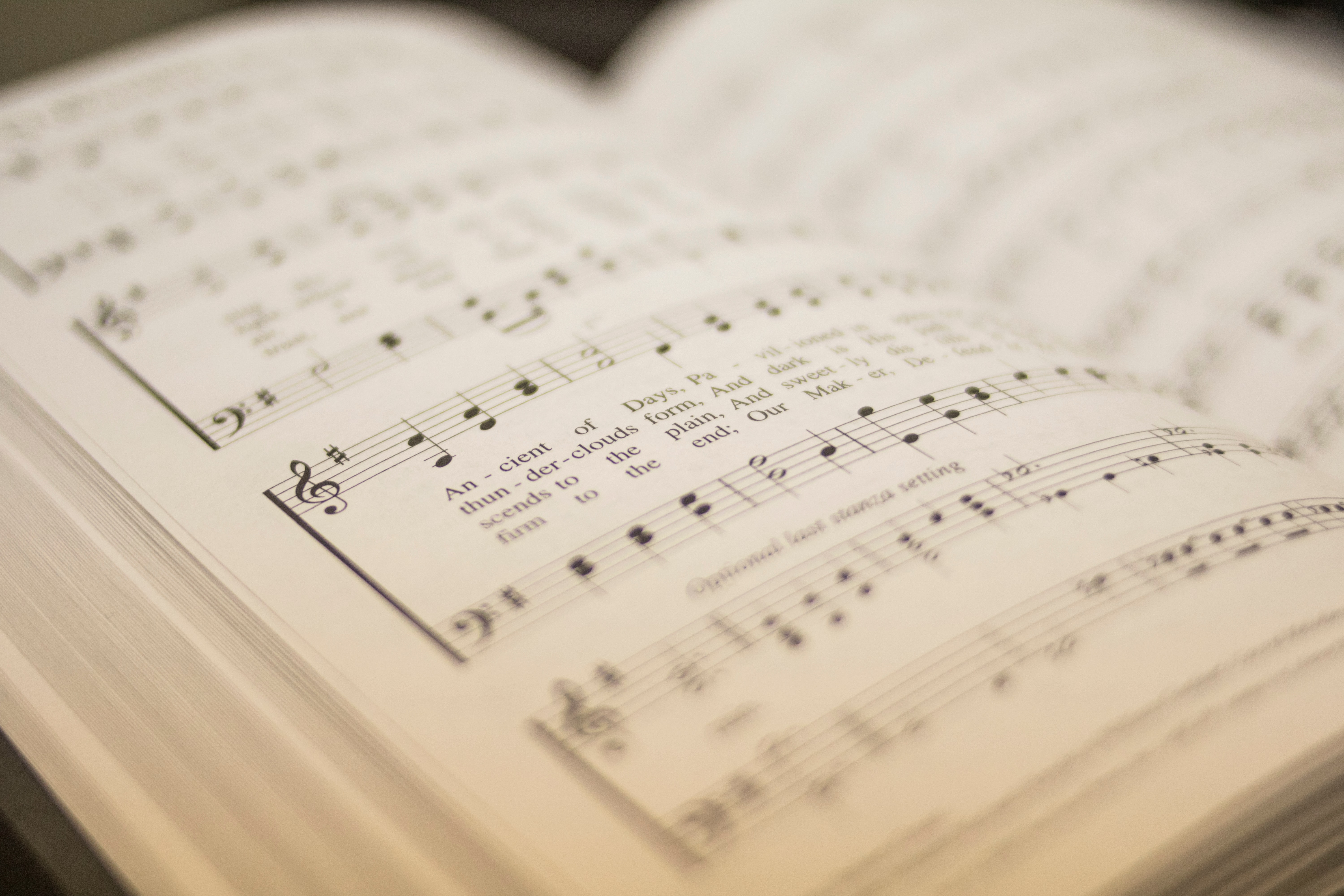
Here’s what I’ve learned from my time in school and church choirs about what it means to be in harmony: it means one singing part blending with another so that the parts enrich each other’s qualities. When I hear a choir, my ears don’t perceive the parts as separate components unless I work hard to distinguish the individual parts. Instead, I perceive the components as one, rich sound that would be missing something without each part. Harmony fills out a musical competition, giving it movement, depth, and nuance. A musical composition without harmony sounds thinner and flimsier than one with it.

Applying my limited musical knowledge and skills to the third reading reminds me that being in harmony doesn’t mean that we must never disagree, nor does it mean that we should all be the same. Rather, it means being open to each other’s gifts. Being open to each other’s gifts is essential for each of us to reflect who we are in God. We can think differently and be different from each other and still “[w]elcome one another” (Rom. 15:7). We don’t have to distance ourselves from those who are different from us. To “welcome one another” is not to let fear disrupt the harmony God wants us to enjoy with each other and with Him. It is to recognize the truth that God works through each of us because of our differences — differences that, when employed for “produc[ing] good fruit,” blend to make one sound that’s all the richer for being layered (Mat. 3:8).

The Bible. The New American Bible Revised Edition, Kindle edition, Fairbrother, 2011.

Confraternity of Christian Doctrine, Inc. “Sunday July, 2 2023: Readings at Mass.” The New American Bible, 2001. Universalis for Windows, Version 2.179, Universalis Publishing Ltd., 26 Feb. 2023, https://universalis.com/n-app-windows.htm

Read Full Post »

« Newer Posts