The theme I’m getting from this week’s readings is that God understands us. However, we don’t understand God, at least not fully.
The first reading is a reminder to me that Christ experienced the frailty that is inherent to the human condition. In the crucifixion, He also endured suffering that comparatively few have experienced. But His suffering isn’t in vain. His entry into death defeats death by because He’s life in the flesh. Because of this, he conquers his death and ours. This defeat of our deaths occurs when we surrender to Christ whatever comes between us and life.
The passage reminds me that Christ offered his life to God and to us as a healing balm for the effects of sin. I can do the same. I can offer my life and what I value for the same purpose.
The psalm reminds me that God is “trustworthy” (Psalm 33:4). The gifts that come from God’s goodness are everywhere. It also promises that the more I’m open to God’s presence and guidance, the more I’ll experience it. As I experience it more, I’ll become more open to it. This openness will continue regardless of the circumstances I find myself in. It reminds me to seek faith and to ask God for help in recognizing God’s care.
The epistle reminds me that God understands my weaknesses and is waiting for me to turn to Him so that I don’t mistake those weaknesses for sources of freedom. He recognizes that I need his help not to confuse those weaknesses for him, in other words.
The Gospel passage reminds me that while I want to experience Christ’s presence, I tend not prepared to do what it takes to experience that presence. I’m prone to confusing being in God’s presence with bowing to the imposter god of human pride.
The gospel passage shows the sons of Zebedee having the same tendency. This tendency means they don’t understand what their wants and needs will ask of them and of God. They understand that abiding in God with Christ will satisfy those wants and needs. But they don’t understand that abiding in God with Christ requires surrender more than attainment. And surrender is often uncomfortable to the human ego. Surrender often feels impossible.
What someone else is sharing about this week’s readings:
The first reading presents someone who trusts receives God’s guidance and doesn’t rebel against it. He goes where God’s Spirit prompts him to go, and he hasn’t “turned back” (New American Bible Isa. 50:5). He hasn’t “turned back” even though he’s treated the way Christ will be treated during his passion (New American Bible Isa. 50:5). He never wavers from the path God leads him on despite his being treated this way. Why? Because, as a newer translation of the same addition of the Bible says, “He who declares my innocence is near” (New American Bible Revised Edition, Isa. 50:8). So in this passage, God is the best defense attorney. God knows God’s own law better than the people who are wrongly accusing and abusing Isaiah. The case of the accusers has no foundation.
In the psalm, the narrator explains why he loves the Lord. He says he loves the Lord because the Lord has heard his cries for help. He was in danger of death. His spirit was threatened by other spirits that have rebelled against the Holy Spirit. God saw how vulnerable he was in the face of these forces and stopped them from causing him to stumble and from weeping in hopelessness (New American Bible Revised Edition, Psalm 116:8). As a result, [he] “shall walk before the Lord in the land of the living” (New American Bible Revised Edition, Psalm 116:9). According to a note in the New American Bible Revised Edition, “walk[ing] before the Lord in the land of the living” “probably refers to being present to God in the Temple” (Psalm 116:9; 116:9n). This explanation prompts me to ask the question: what can we do to be active in living with faith?
The first two verses of the Old Testament reading give one answer and the third reading, the epistle, develops that answer further, telling us that wanting others to have what they need doesn’t bring faith to life. It’s taking part in providing what others need that brings faith to life. Faith isn’t demonstrated by prayer alone. Prayer opens us to the guidance that helps us discern how best to respond to the needs around us. Whatever the needs are, God brought us into being to meet them, even in the face of extreme opposition, as is the case in the Old Testament passage.
None of us is alone and having been given this work to do. God has done this work first and has called prophets to take part in it. God has also taken on a human life and suffered for it.
We will struggle. and sometimes suffer when we imitate Him. Why? Because humans have a tendency to want to hold onto power by keeping it to themselves and using it for themselves. Christ’s power, on the other hand, comes from his willingness to share and to surrender it. If we trust that surrendering is the true source of power, we receive that power as well. We receive that life. Turning inward in fear and holding on tightly to what we have isn’t the source of life, the Gospel passage says. Being able to hold loosely to what we have because we trust in God is the source of life.
What I’m saying (to the readings and beyond) this week:
To the first reading I say that I wonder if it’s my experience that “God opens my ear” (New American Bible, Isa. 50-4c). Maybe God does but like a door, I close it again because when my spiritual ear is open, so many voices come in and none of them is perfect, and that includes my own, of course. So when I choose what voices to listen to when and I act accordingly, I’m not sure it’s God or everything less than God that I rebel against.
Because of this experience, I take comfort that Christ encountered both opposition and support from every corner. He didn’t encounter opposition or support from only one group or another that He seemed to belong to or not to belong to or that seemed to some of his contemporaries to have spiritual and/or temporal authority over Him.
It’s a challenge to internalize that God defends me and that “I am not disgraced” when I have trouble recognizing this (New American Bible Revised Edition, Isa. 50:7). It’s a challenge not to be controlled by fear and not to be held back by walls in my mind and the walls I want to build around me to protect myself.
As I reread the psalm excerpt, I see that it’s written from the perspective of someone who feels trapped — “helpless” even (New American Bible Revised Edition Psalm 116: 6). It’s God who saves this person when he cries out to God. This person alone can’t save his own life.
Reaching out to God in the midst of fear is the key to not letting the fear kill the soul. It’s a key that’s most difficult to take hold of in life’s most difficult times, but that’s why God became one of us and then allowed Himself to be killed. He took the worst parts of us onto Himself so that we could become our best selves, so that we could become more and more like Him. That’s why the name for Christ that resonates most deeply with me is “God with us” (New American Bible Revised Edition, Mat. 1:23).
What someone else is sharing about this week’s readings:
Zulma Tellez reflects on Christ on the cross as a profound a profound expression of God with us.
This week’s prayer:
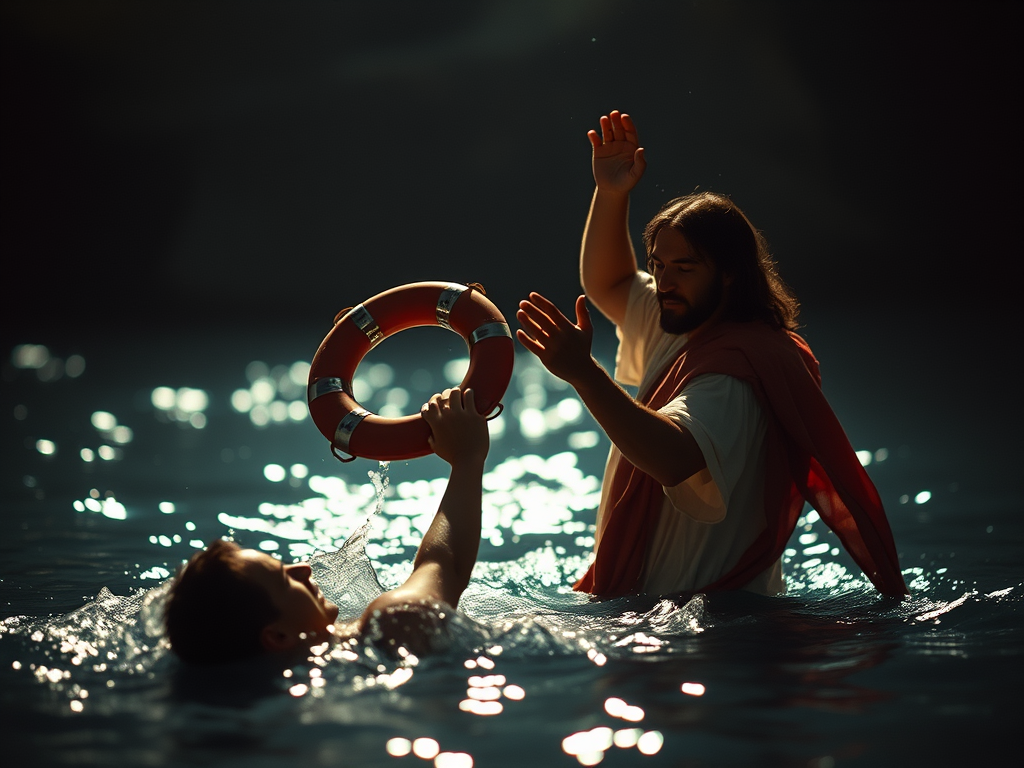
Lord, You have thrown me many spiritual life preservers, the greatest of which is Your sacrifice on the cross. Don’t let me close my spiritual ears to the sound of your voice. Instead, help me tear down any walls that fear has built in my mind and heart to keep me from reaching out to You and my neighbors. Amen.
He guides me in right paths for his name’s sake. Even though I walk in the dark valley I fear no evil; for you are at my side, with your rod and your staff that give me courage.
— New American Bible, 2001 Edition
He guides me along right paths* for the sake of his name. Even though I walk through the valley of the shadow of death, I will fear no evil, for you are with me; your rod and your staff comfort me.
— New American Bible Revised Edition, 2011
Psalm 23: 3b-4
He guides me in right paths for his name’s sake. Even though I walk in the dark valley I fear no evil; for you are at my side, with your rod and your staff that give me courage.
— New American Bible, 2001 Edition
He guides me along right paths* for the sake of his name. Even though I walk through the valley of the shadow of death, I will fear no evil, for you are with me; your rod and your staff comfort me.
— New American Bible Revised Edition, 2011
As I announced at the end of last week’s post, I’m continuing to sit with Psalm 23 this week. The first line of this week’s excerpt paints a different picture in my mind than the “green pastures” or “still waters” of last week (Psalm 23: 2). I picture Jesus walking with me in a canyon. He’s behind me, actually. He has one hand on each shoulder, and I know that, using power I trust though I don’t understand it, he will guide me along the often steep, rocky path between the river at the bottom of this canyon and its rim. There will be times when I roll backwards (I use a wheelchair, remember?), many times, but he won’t let me fall the several stories into the raging river that carved the canyon. I won’t get lost in this place and be trapped forever. This is what being guided “in” or “along right paths” looks like to me (New American Bible, 2001 Edition; New American Bible Revised Edition). Maybe the canyon is this life.
So what’s with this line about “for his name’s sake”? (New American Bible, 2001 Edition).
To me, this phrase is a reminder of who God is. God is all that’s good: God is presence rather than absence, truth rather than lies, self-giving love rather than apathy. God cannot be what and who God isn’t, so the Shepherd of Psalm 23 can only lead sheep along the path that not only protects them but also allows them to thrive.
The path that allows them to thrive is often not well lit. The sheep’s view of the Light Source is blocked by the high canyon walls that surround the valleys through which the Shepherd leads them. Yet being surrounded by darkness is no reason to fear it because the Shepherd is with them in it. He isn’t guiding the herd through the darkness from a distance. He became a sheep himself and allowed himself to be slaughtered so he could walk alongside others facing slaughter and show them how to avoid this fate.
The rod was used to fight off wild animals and to count the sheep and direct them. The rod prodded them during the day in the fields and at night into the sheepfold. A willing sheep would respond to the prodding, but a stubborn, strong-willed sheep would not.
While sheep might not be as dumb as often suggested, they do have characteristics that give some merit to that claim. They’ll indiscriminately eat just about anything, regardless whether it is something that could harm or kill them. They endlessly wander, seemingly without direction. And many sheep stubbornly resist the shepherd’s prodding. That’s why the staff, with a crook at the end, is needed. The shepherd uses the staff to more strongly exert his authority and to gently, but firmly, pull the sheep back to the fold and keep the sheep moving in the right direction. He can also use the crook of the staff to pull the sheep from harm.
You can view a picture of these tools here. I think of a staff as a support for something else, but it’s apparently not just a supportive device, such as a cane is. It can be used to grasp and pull wandering sheep back to the shepherd if they won’t come back on their own, Abbot writes.
Being prodded back to the right path or pulled to it may not feel very comforting or courage-infusing when it happens. But sometimes it’s necessary to endure temporary pain to prevent longer-term pain. The cross is the ultimate example of this truth. The Shepherd submitted to it to deliver us from eternal pain, and because he didn’t want the pain of being eternally separated from us. In accepting the cross, he promised that any pain we face won’t last forever if we also accept his cross. In surrendering to the cross, he offers us courage and comfort through it, despite the pain it inflicts.
Other ways life follows the pattern of this truth come to my mind:
A medical treatment has difficult side effects but slows or halts the process of a life-threatening disease.
A Good Samaritan performs CPR, and this action causes bruising or popped ribs, (This can happen. Click here to see my source for this example.) but a person’s life is saved, and he or she eventually makes a full recovery.
Parents set boundaries for their children’s technology and media usage, or we set boundaries for our own indulgence in the things we enjoy, and the boundaries aren’t enjoyable in the short term, but living within them makes for healthier lives and means having time to learn important lessons and to build, repair, and strengthen relationships.
Someone misses an occasion he or she is look forward to, choosing instead to get started on a school project or to look after his or her health or someone else’s. Missing out is unpleasant but serves a greater good and pays off in the long term.
So the rods and the staffs of life keep us, the sheep, from wandering off, getting lost and likely getting attacked and killed in the process. We may not experience the rod or the staff as pleasant, but the Shepherd is aware of dangers that sheep aren’t. The shepherd knows the rod and the staff protect his sheep from the greater suffering — or worse — that they’d face if he didn’t use them.
And sometimes, even at the times they’re used, the rod and the staff don’t feel like punishments to the sheep, according to Jack Albright, retired clinical chaplain and freelance writer:
It is used in drawing sheep together into an intimate relationship. He will use his staff to gently lift a newborn lamb and bring it to its mother if they become separated. He does not use his bare hands for fear that the ewe will reject her offspring if it bears the odor of his hands upon it.
“[The staff] is also used for guiding sheep through a new gate or along a dangerous, difficult route. He will use the slender stick to press gently against the animal’s side, and this pressure guides the sheep in the way the owner wants it to go. Thus the sheep is reassured of its proper path . . .”The staff is also used for guiding sheep through a new gate or along a dangerous, difficult route. He will use the slender stick to press gently against the animal’s side, and this pressure guides the sheep in the way the owner wants it to go. Thus the sheep is reassured of its proper path . . . Keller says that he has seen a shepherd walk beside a pet or favorite sheep with his staff gently resting on its back. It appears that they are in touch or walking hand-in-hand. Sheep are not easily trained but this may be a method of training her as a leader.
The Shepherd’s staff – a source of comfort
This excerpt reminds me that, yes, a shepherd reassures his or her sheep. The Good Shepherd does this better than any other. It also reminds me that the Good Shepherd came not just to walk alongside us, amid his flock, but to teach us to be a leader like him. Thank You, Lord, for being the Foremost and Ultimate Shepherd.
And Lord, even when Your protection and your training aren’t experiences I’d like to repeat, help me to recognize You loving me through these difficult times. Help me to respond eagerly to Your efforts to shape me into a leader with Your eyes, Your heart, Your mind, and Your will. Amen.
The Bible. The New American Bible Revised Edition, Kindle edition, Fairbrother, 2011.
Confraternity of Christian Doctrine, Inc. “Sunday, 7 May 2023: Readings at Mass.” The New American Bible, 2001. Universalis for Windows, Version 2.179, Universalis Publishing Ltd., 26 Feb. 2023, https://universalis.com/n-app-windows.htm.
Psalm 146:6-10 presents a word tapestry about the loving care of God. But given the disappointment, resentment, and selfishness that weigh down my own heart despite my desire to let go of these burdens, I find it a challenge to see this tapestry as anything more than an eloquent wish. Much of what I see in the news doesn’t help make the tapestry come alive either.
However, this post isn’t dedicated to bashing news media or news watching. My undergraduate major was mass communications. I wrote and edited for the university newspaper and took courses in other forms of information dissemination, including broadcast journalism and public relations.
I think it’s important (without consuming news all day) to follow current events every day. I also think it’s useful to consult different well-established new sources on different days, not just the ones that confirm the views I already hold. For me, this is one example of what it means to be in the world but not of it. (See John 17:14-15). News may not show me the world I want to see, but that doesn’t mean I should avoid seeing it — much the opposite. I have to know what’s going on in the world to have any hope of bringing the Good News to that world or indeed, communicating at all in a way that resonates.
Violence is very prevalent around us, and news sources reflect this reality because their job is not to reflect back to us our day-to-day routines or anyone else’s. The way I see it, this function of journalism is why it’s called “the news” and not “the expected” or “the desired.” This function is why a common phrase in journalism education (at least when I was receiving it) was “if it bleeds, it leads.” So often it’s violence, whether on the part of nature or humanity, that interrupts the status quo. This disruption is not the fault of news sources. Do inspiring events occur as well as tragic ones? Absolutely! News sources report on these too. Pretty much every television news broadcast I’ve ever seen ends with a positive story. I think this is done with the idea of leaving viewers with something positive to take away.
I see some common ground and some differences between news broadcasts and the Beatitudes. The Beatitudes acknowledge the difficult and often unjust realities of life, while at the same time, each one begins and ends by offering hope, For example, Jesus says that “those who mourn” are “blessed” (Matt. 5:4). Does this mean that someone should desire mourning over joy? I don’t think so. Does this mean that someone mourning should feel blessed? No. I hear this Beatitude as a promise that regardless of what someone who is mourning feels, they are blessed because Christ is close to them in a special way, as he is to anyone in need or going through a difficult time. He struggled and mourned during his passion, and when we join our suffering to the suffering of the cross, our suffering takes on the redemptive power of the cross, even in the many times when we can’t see how.
I’m not saying that everything happens for a reason, or that God pushes us around like pieces on a chessboard. We have free will. We also have bodies that come with a lot of biology and chemistry — survival instincts that sometimes end up translating into domination over others, physically, emotionally, and psychologically. Everyone around us is also influenced by these factors, to varying degrees. The Spirit and its domain, spirituality are about not letting these factors overtake the Spirit in us. This is not to say that our bodies and minds are bad and our souls are good. To say that would be heresy. I look at the relationship between physical and spiritual matters this way: God designed them to work together, as they do in Jesus and his gift of his body, blood, soul and divinity in his ministry, on the cross, and hidden within the forms of bread and wine. I’m saying that, thanks to Jesus’s life, death, and resurrection and his example during these stages of his mission, no difficulty, suffering, or instance of a situation not working out the way we wanted has to destroy our hope. As I think I’ve written before, we can use our experiences to prevent others from suffering similarly, we can accompany others going through similar experiences, or in the most challenging of circumstances, when neither of these opportunities seem available to us, we can choose to trust that the offering of our circumstances to God is redemptive in those ways I mentioned earlier, the ones we can’t see — yet.
Like most people, I’d like to see nothing but righteousness, mercy, satisfaction, comfort, and peace around me and within me right now. But to experience that would be to experience heaven, and I’m not there. Because I’m not already there, I take comfort in the fact that the second half of each Beatitude, offers a future blessing, not a present one. If the Beatitudes were presented to me in nothing but present tense, I would struggle with faith even more than I do I would wonder why God hadn’t kept the promises of the Beatitudes. After all, I look around me and within me and see not only the qualities opposites of the positive ones included in the Beatitudes but also imperfect versions of those positive qualities. In our broken humanity we thirst for righteousness without allowing for meekness or mercy, and we seek comfort and satisfaction without first being poor in spirit, without having a clear enough vision of reality to mourn with those around us. I think each positive quality included in the Beatitudes needs all the others to reach its fulfillment.
I don’t believe such ultimate fulfillment comes in this life. Our mission is to thirst for it, to do what we can to embody the combined Beatitudes, all the while knowing we do and will fall short. I find pain and comfort in this falling short — pain because I want to experience Heaven now, and comfort because in acknowledging that I fall short, I recognize poverty of spirit. I recognize that I need God and others, that I don’t have all the answers, and that nobody but God does.
Lord, help me to be more at ease with my lack of understanding and control and Your total understanding. Help me to turn to you and let you work in me as I thirst for the fulfillment of your promises. Amen.
Confraternity of Christian Doctrine, Inc. “Sunday July, 2 2023: Readings at Mass.” The New American Bible, 2001. Universalis for Windows, Version 2.179, Universalis Publishing Ltd., 26 Feb. 2023, https://universalis.com/n-app-windows.htm


 Sitting with the Sacred