The theme I’m getting from this week’s readings is that God understands us. However, we don’t understand God, at least not fully.
The first reading is a reminder to me that Christ experienced the frailty that is inherent to the human condition. In the crucifixion, He also endured suffering that comparatively few have experienced. But His suffering isn’t in vain. His entry into death defeats death by because He’s life in the flesh. Because of this, he conquers his death and ours. This defeat of our deaths occurs when we surrender to Christ whatever comes between us and life.
The passage reminds me that Christ offered his life to God and to us as a healing balm for the effects of sin. I can do the same. I can offer my life and what I value for the same purpose.
The psalm reminds me that God is “trustworthy” (Psalm 33:4). The gifts that come from God’s goodness are everywhere. It also promises that the more I’m open to God’s presence and guidance, the more I’ll experience it. As I experience it more, I’ll become more open to it. This openness will continue regardless of the circumstances I find myself in. It reminds me to seek faith and to ask God for help in recognizing God’s care.
The epistle reminds me that God understands my weaknesses and is waiting for me to turn to Him so that I don’t mistake those weaknesses for sources of freedom. He recognizes that I need his help not to confuse those weaknesses for him, in other words.
The Gospel passage reminds me that while I want to experience Christ’s presence, I tend not prepared to do what it takes to experience that presence. I’m prone to confusing being in God’s presence with bowing to the imposter god of human pride.
The gospel passage shows the sons of Zebedee having the same tendency. This tendency means they don’t understand what their wants and needs will ask of them and of God. They understand that abiding in God with Christ will satisfy those wants and needs. But they don’t understand that abiding in God with Christ requires surrender more than attainment. And surrender is often uncomfortable to the human ego. Surrender often feels impossible.
What someone else is sharing about this week’s readings:
The first reading presents someone who trusts receives God’s guidance and doesn’t rebel against it. He goes where God’s Spirit prompts him to go, and he hasn’t “turned back” (New American Bible Isa. 50:5). He hasn’t “turned back” even though he’s treated the way Christ will be treated during his passion (New American Bible Isa. 50:5). He never wavers from the path God leads him on despite his being treated this way. Why? Because, as a newer translation of the same addition of the Bible says, “He who declares my innocence is near” (New American Bible Revised Edition, Isa. 50:8). So in this passage, God is the best defense attorney. God knows God’s own law better than the people who are wrongly accusing and abusing Isaiah. The case of the accusers has no foundation.
In the psalm, the narrator explains why he loves the Lord. He says he loves the Lord because the Lord has heard his cries for help. He was in danger of death. His spirit was threatened by other spirits that have rebelled against the Holy Spirit. God saw how vulnerable he was in the face of these forces and stopped them from causing him to stumble and from weeping in hopelessness (New American Bible Revised Edition, Psalm 116:8). As a result, [he] “shall walk before the Lord in the land of the living” (New American Bible Revised Edition, Psalm 116:9). According to a note in the New American Bible Revised Edition, “walk[ing] before the Lord in the land of the living” “probably refers to being present to God in the Temple” (Psalm 116:9; 116:9n). This explanation prompts me to ask the question: what can we do to be active in living with faith?
The first two verses of the Old Testament reading give one answer and the third reading, the epistle, develops that answer further, telling us that wanting others to have what they need doesn’t bring faith to life. It’s taking part in providing what others need that brings faith to life. Faith isn’t demonstrated by prayer alone. Prayer opens us to the guidance that helps us discern how best to respond to the needs around us. Whatever the needs are, God brought us into being to meet them, even in the face of extreme opposition, as is the case in the Old Testament passage.
None of us is alone and having been given this work to do. God has done this work first and has called prophets to take part in it. God has also taken on a human life and suffered for it.
We will struggle. and sometimes suffer when we imitate Him. Why? Because humans have a tendency to want to hold onto power by keeping it to themselves and using it for themselves. Christ’s power, on the other hand, comes from his willingness to share and to surrender it. If we trust that surrendering is the true source of power, we receive that power as well. We receive that life. Turning inward in fear and holding on tightly to what we have isn’t the source of life, the Gospel passage says. Being able to hold loosely to what we have because we trust in God is the source of life.
What I’m saying (to the readings and beyond) this week:
To the first reading I say that I wonder if it’s my experience that “God opens my ear” (New American Bible, Isa. 50-4c). Maybe God does but like a door, I close it again because when my spiritual ear is open, so many voices come in and none of them is perfect, and that includes my own, of course. So when I choose what voices to listen to when and I act accordingly, I’m not sure it’s God or everything less than God that I rebel against.
Because of this experience, I take comfort that Christ encountered both opposition and support from every corner. He didn’t encounter opposition or support from only one group or another that He seemed to belong to or not to belong to or that seemed to some of his contemporaries to have spiritual and/or temporal authority over Him.
It’s a challenge to internalize that God defends me and that “I am not disgraced” when I have trouble recognizing this (New American Bible Revised Edition, Isa. 50:7). It’s a challenge not to be controlled by fear and not to be held back by walls in my mind and the walls I want to build around me to protect myself.
As I reread the psalm excerpt, I see that it’s written from the perspective of someone who feels trapped — “helpless” even (New American Bible Revised Edition Psalm 116: 6). It’s God who saves this person when he cries out to God. This person alone can’t save his own life.
Reaching out to God in the midst of fear is the key to not letting the fear kill the soul. It’s a key that’s most difficult to take hold of in life’s most difficult times, but that’s why God became one of us and then allowed Himself to be killed. He took the worst parts of us onto Himself so that we could become our best selves, so that we could become more and more like Him. That’s why the name for Christ that resonates most deeply with me is “God with us” (New American Bible Revised Edition, Mat. 1:23).
What someone else is sharing about this week’s readings:
Zulma Tellez reflects on Christ on the cross as a profound a profound expression of God with us.
This week’s prayer:
Lord, You have thrown me many spiritual life preservers, the greatest of which is Your sacrifice on the cross. Don’t let me close my spiritual ears to the sound of your voice. Instead, help me tear down any walls that fear has built in my mind and heart to keep me from reaching out to You and my neighbors. Amen.
This week’s readings are about being in exile — far from home, the place where one belongs. The first reading and the psalm teach that God can work, even through those in exile — perhaps especially through the exiled, provided that those in exile don’t lose sight of who they are and where they come from. God works through those in exile precisely because while they hopefully can live in harmony with the people native to the place they now find themselves, they stand out. They can use their visibility to be examples of authenticity and charity. Humility is necessary for authenticity, and authenticity makes room for charity, which is service toward and cooperation with others.
The third reading teaches that we can be neither authentic nor humble if we’re under the illusion that anything we are or anything we do comes from us alone. Setting aside any environmental factors that contribute to who each of us is, none of us would exist without the combined DNA of other people, and none of the people who make up who we are would exist without God’s life giving, sustaining, and restoring love. All that is exists to magnify and to be a channel for that love.
Unfortunately, the magnifying glass or prism that each of us is meant to be gets clouded by things we get tricked into thinking are God. These idols block our ability to see God’s light, to feel its warmth, through and beyond them. Blockers of God’s light that come to my mind are fear, shame, anger, and envy.
This week’s Gospel reading reassures us that Jesus didn’t come into the world to condemn us for the very human experiences that I just listed. He came into the world to bear the weight of all our sins, our weaknesses and our pain, to surrender himself entirely to these, going so far as to engage with death itself so that He could neutralize its power and along with it, the power of every other human frailty. The key to experiencing that, as evidenced by His victory over death, He’s stronger than every idol is to hand over the imposters to His custody so they don’t take custody of us. This handing over is so much harder to do than the writing about it was. The imposters still feel powerful, no matter how many times we hear that God has rescued us from them. We let ourselves get trapped by them into believing we should hide from the light because we belong to the seemingly stronger darkness, and that we’ll be set adrift and alone if we come into the light’s embrace and expose the distortions darkness creates as the illusions they are.
What someone else is sharing about this week’s readings:
It’s one thing to write about not hiding from the light and instead moving forward into its healing rays. It’s another matter to take the risk of coming out of hiding and to trust. One step toward allowing God to embrace me in my weakness and with all the I’m ashamed of is to bring what I’m tempted to hide to God in prayer. Doing this feels like coming to God and asking God to put a spotlight on me. In this situation, I may confront what I’d rather hide, even from myself. But I’ve also been known in times like this to be confused about what God wants me to bring to light. These tendencies are the reason why I need at least one other person to help me lift to God what I’d rather not acknowledge. The first three readings support my need for healing to have a relational component I can perceive with my physical senses.
And yet it’s so hard to seek this help, to put into words what fear warns me keep silent. After all, everyone else is imperfect too, and no one has the unlimited perspective of God. Will my frailty, my failings be understood if I share them? Will they be judged? Can I even put them into words? Will doing so ever bring me closer to spiritual wellness? After years of struggling in the same ways, believing I can be spiritually free and comfortable in the light is so difficult.
Nonetheless, “I do believe,” Lord, [H]elp my unbelief. (Mark 9-24). Help me not to carry burdens you are waiting to take from me. Grant me the grace to seek and to find refuge in Your light along with and in the sight of all your children. Amen.
Work cited
The New American Bible Revised Edition, Kindle edition, Fairbrother, 2011.
This week’s readings say to me that the room within me created for faith by humility and perseverance is not a comfortable space. It’s a space the Holy Spirit fills with its fire, and fire burns, and this fire cannot be contained. So it doesn’t let people who carry it be still in the place where they were before the fire sparked. People within whom it burns cannot help but move as it moves. They can’t help but spread it because their movement feeds it, and they give it room to spread. Spreading it means the next person who makes room for and fuels the fire can’t stay where he or she is either. As we witness this these effects of the spread, our inclinations toward convenience and self-preservation tell us to stop it. We don’t want to move. We don’t want to change. We don’t want to be different from earlier versions of ourselves or from the people around us. And we can’t stop these processes. We can increase our discomfort with the Spirit’s transformative power by resisting it, or we can find a peace that comes from freedom by accepting and participating in its transformative power.
The Good News is this transformative power. Its burning isn’t one that destroys but one that gives life. That life just won’t look the way our desires for convenience and self-preservation want it to because it changes us from the inside out and changes our relationship with our surroundings, including how we think about them, see them, and interact them. This change won’t let a person blend in, and the reading from Romans encourages us to ask for the grace not to want to blend in — at least not just for the sake of blending in. Any blending a person might do must be done for the Spirit. And any work done for the Spirit can only be done in cooperation with the movement of the Spirit.
The Gospel tells us not even to let fear for our lives get in the way of the movement of the Spirit. It says caving to such fear won’t save us, even though we may feel as if listening to fear will save us.
I used to think of this reading as being only about the importance of living faith and sharing it regardless of any risks that living it and sharing it might pose to my life. Of course, this is the literal message of the reading. However, I’ve come to want to apply it more broadly to life’s difficult situations. I wonder if my broader understanding will relate to someone else’s reflection on these readings. Let’s find out in the next two sections.
What someone else is sharing about this week’s readings:
God called Phoebe and Gregory to bring the Gospel to others in word and action. We are called to do the same, though not always by using the texts and trappings of our faith.
There are people all over the world for whom living their faith costs them their freedom and even their earthly lives. I hope none of us seeing these words ever have to pay those prices.
But even if we never have to, each of us dies and finds life regularly, but if we don’t surrender to these smaller deaths, we miss opportunities to find life.
For me, as a person with anxiety and cerebral palsy, one of these smaller deaths can mean doing things my mind says are not safe to do, such as:
Joining a group with whom I might share an interest or a goal when I don’t know any of the members or when I don’t know how accessible the place where then be is going to be
Having the courage to be who I am and share my perspective when I don’t fit totally into one camp or another in a world that’s divided and subdivided into camps.
Having the courage to get to know someone whose experience is different from my own and may make me uncomfortable and encourage me to ask myself questions about my own views.
Not avoiding situations that remind me of difficult ones I have faced in the past. Please understand that with this example, I’m not advocating that anyone stay in abusive situations. I’m saying that there’s a difference between an unpleasant or uncomfortable situation and an unhealthy or unsafe one. I’m also saying that anxiety likes to lie to me and tell me that these two types of situations are the same. They aren’t.
I’ve also come to believe that losing my life to save it encompasses surrendering control and ideas of what I want various situations and people to be like. I think this is such a difficult thing for all of us to do. I don’t know whether the difficulty of doing this increases depending on how great a sense of independence a person is used to having or if the desire and frustration are equally strong regardless of a person’s circumstances.
Either way, I can think of a few different ways to express the ironic truth in this week’s Gospel passage:
However tightly I cling to life on earth I cannot make it last forever.
Surrounding myself with different types of walls or with metaphorical bubblewrap might save my body, for a time, but these actions won’t save my soul. In fact, they might kill it. Furthermore, a withering soul withers the body, eventually – in one way or another. (I’m pretty sure too much isolation and too few contacts are unhealthy for the body and the soul. And eating one’s emotions, an attempt at treating the pain of the soul, I’d say, can kill the body if it isn’t moderated.)
Staying alive is not the same as living; surviving is not the same as thriving.
Lord, help me neither to fear my death to earthly life, nor the precursors to this death that I face each day so that I can live in the freedom of the life you have planned for me. Amen.
But you will receive power when the Holy Spirit comes upon you, and you will be my witnesses in Jerusalem, throughout Judea and Samaria, and to the ends of the earth.”
Acts 1:8
May the eyes of your hearts be enlightened, that you may know what is the hope that belongs to his call. . .
Ephesians 1:18
In the first verse that jumped out at me from this week’s readings, we’re given a promise that I’ve long interpreted as a command that I was constantly failing to fulfill, a command that felt pretty close to impossible to fulfill.
The first verse does give us a mission, the mission — but not one that belongs to any one of us by ourselves. It’s one we fulfill in ways we don’t always understand because it is fulfilled not by us alone but by the Holy Spirit working through us. The reading from Ephesians reminds us of
the surpassing greatness of his power for us who believe, in accord with the exercise of his great might, which he worked in Christ, raising him from the dead and seating him at his right hand in the heavens, far above every principality, authority, power, and dominion, and every name that is named not only in this age but also in the one to come. And he put all things beneath his feet and gave him as head over all things to the church, which is his body, the fullness of the one who fills all things in every way [italics mine].
Ephesians 1:19-23
This letter is written to a group of people who have allowed Christ to have dominion over their lives and who rejoice in the power and the hope of being members of his body. They are members of the early church because they’ve learned and experienced that Jesus came to be the first resurrected one among them but not the last. Their destiny is to be resurrected like him, provided they empty themselves as he emptied himself.
I imagine they knew they needed to surrender whatever blocked the movement of the Holy Spirit within and among them.. I imagine they knew “the fullness of the one fills all things in every way,” who works where he has room to work and they wanted to give him lots of room because they were excited to be the body tasked with putting that faith that the Spirit inspires into action so that the body can thrive (Eph. 1:23). (It’s weird to me to use a gendered pronoun to describe the Spirit, which has nobody, but because Jesus does so in John 14:15-21, I’ve done so here.) To me, to thrive means to remain open and to grow, not to stagnate.
I feel the most open, the most consistently on a path of growth when I’m not settling for recounting someone else’s experience of the Spirit’s movement but looking for its movement within and around me and sharing what I experience and see. This sharing what I experience is my current understanding have of what it means to be a witness. A friend of mine once said that this understanding wasn’t completely different from being a witness in court or the witness of an accident. Should I find myself in these situations, I’m not called to repeat what I haven’t personally experienced.
So how can I experience the movement of the Holy Spirit within and around me so that I can be a witness to the life he offers? For me, this is where the second verse I started this post with comes in. I ask the Spirit “to enlighten [my] heart, that [I] may know the hope that belongs to his call” [italics mine] (Eph.1:18).
This knowing isn’t merely a process of the mind. It isn’t the result of memorization, though memorization can lay the groundwork for knowing with the heart. What we receive from those who came before us and those who journey with us, which is partly head knowledge, gives us words for naming our experiences and names for how those experiences relate to each other. This language gives us a means for interpreting our experiences and for putting them into perspective. Without the words we’ve been taught, we couldn’t share our heart knowing with one another. We would neither be able to name the heart knowledge we had in common, nor what is unique to each of our callings. And both the unique aspects and the shared ones are important facets of each person’s vocation and effectiveness as a witness.
Lord, teach me to have a humble spirit that’s open to Your wisdom and beauty so I can recognize and experience both in the people and places around me and share my experience of You with others. Amen.
The Bible.The New American Bible Revised Edition, Kindle edition, Fairbrother, 2011.
Confraternity of Christian Doctrine, Inc. “Sunday July, 2 2023: Readings at Mass.” The New American Bible, 2001. Universalis for Windows, Version 2.179, Universalis Publishing Ltd., 26 Feb. 2023, https://universalis.com/n-app-windows.htm
He guides me in right paths for his name’s sake. Even though I walk in the dark valley I fear no evil; for you are at my side, with your rod and your staff that give me courage.
— New American Bible, 2001 Edition
He guides me along right paths* for the sake of his name. Even though I walk through the valley of the shadow of death, I will fear no evil, for you are with me; your rod and your staff comfort me.
— New American Bible Revised Edition, 2011
Psalm 23: 3b-4
He guides me in right paths for his name’s sake. Even though I walk in the dark valley I fear no evil; for you are at my side, with your rod and your staff that give me courage.
— New American Bible, 2001 Edition
He guides me along right paths* for the sake of his name. Even though I walk through the valley of the shadow of death, I will fear no evil, for you are with me; your rod and your staff comfort me.
— New American Bible Revised Edition, 2011
As I announced at the end of last week’s post, I’m continuing to sit with Psalm 23 this week. The first line of this week’s excerpt paints a different picture in my mind than the “green pastures” or “still waters” of last week (Psalm 23: 2). I picture Jesus walking with me in a canyon. He’s behind me, actually. He has one hand on each shoulder, and I know that, using power I trust though I don’t understand it, he will guide me along the often steep, rocky path between the river at the bottom of this canyon and its rim. There will be times when I roll backwards (I use a wheelchair, remember?), many times, but he won’t let me fall the several stories into the raging river that carved the canyon. I won’t get lost in this place and be trapped forever. This is what being guided “in” or “along right paths” looks like to me (New American Bible, 2001 Edition; New American Bible Revised Edition). Maybe the canyon is this life.
So what’s with this line about “for his name’s sake”? (New American Bible, 2001 Edition).
To me, this phrase is a reminder of who God is. God is all that’s good: God is presence rather than absence, truth rather than lies, self-giving love rather than apathy. God cannot be what and who God isn’t, so the Shepherd of Psalm 23 can only lead sheep along the path that not only protects them but also allows them to thrive.
The path that allows them to thrive is often not well lit. The sheep’s view of the Light Source is blocked by the high canyon walls that surround the valleys through which the Shepherd leads them. Yet being surrounded by darkness is no reason to fear it because the Shepherd is with them in it. He isn’t guiding the herd through the darkness from a distance. He became a sheep himself and allowed himself to be slaughtered so he could walk alongside others facing slaughter and show them how to avoid this fate.
The rod was used to fight off wild animals and to count the sheep and direct them. The rod prodded them during the day in the fields and at night into the sheepfold. A willing sheep would respond to the prodding, but a stubborn, strong-willed sheep would not.
While sheep might not be as dumb as often suggested, they do have characteristics that give some merit to that claim. They’ll indiscriminately eat just about anything, regardless whether it is something that could harm or kill them. They endlessly wander, seemingly without direction. And many sheep stubbornly resist the shepherd’s prodding. That’s why the staff, with a crook at the end, is needed. The shepherd uses the staff to more strongly exert his authority and to gently, but firmly, pull the sheep back to the fold and keep the sheep moving in the right direction. He can also use the crook of the staff to pull the sheep from harm.
You can view a picture of these tools here. I think of a staff as a support for something else, but it’s apparently not just a supportive device, such as a cane is. It can be used to grasp and pull wandering sheep back to the shepherd if they won’t come back on their own, Abbot writes.
Being prodded back to the right path or pulled to it may not feel very comforting or courage-infusing when it happens. But sometimes it’s necessary to endure temporary pain to prevent longer-term pain. The cross is the ultimate example of this truth. The Shepherd submitted to it to deliver us from eternal pain, and because he didn’t want the pain of being eternally separated from us. In accepting the cross, he promised that any pain we face won’t last forever if we also accept his cross. In surrendering to the cross, he offers us courage and comfort through it, despite the pain it inflicts.
Other ways life follows the pattern of this truth come to my mind:
A medical treatment has difficult side effects but slows or halts the process of a life-threatening disease.
A Good Samaritan performs CPR, and this action causes bruising or popped ribs, (This can happen. Click here to see my source for this example.) but a person’s life is saved, and he or she eventually makes a full recovery.
Parents set boundaries for their children’s technology and media usage, or we set boundaries for our own indulgence in the things we enjoy, and the boundaries aren’t enjoyable in the short term, but living within them makes for healthier lives and means having time to learn important lessons and to build, repair, and strengthen relationships.
Someone misses an occasion he or she is look forward to, choosing instead to get started on a school project or to look after his or her health or someone else’s. Missing out is unpleasant but serves a greater good and pays off in the long term.
So the rods and the staffs of life keep us, the sheep, from wandering off, getting lost and likely getting attacked and killed in the process. We may not experience the rod or the staff as pleasant, but the Shepherd is aware of dangers that sheep aren’t. The shepherd knows the rod and the staff protect his sheep from the greater suffering — or worse — that they’d face if he didn’t use them.
And sometimes, even at the times they’re used, the rod and the staff don’t feel like punishments to the sheep, according to Jack Albright, retired clinical chaplain and freelance writer:
It is used in drawing sheep together into an intimate relationship. He will use his staff to gently lift a newborn lamb and bring it to its mother if they become separated. He does not use his bare hands for fear that the ewe will reject her offspring if it bears the odor of his hands upon it.
“[The staff] is also used for guiding sheep through a new gate or along a dangerous, difficult route. He will use the slender stick to press gently against the animal’s side, and this pressure guides the sheep in the way the owner wants it to go. Thus the sheep is reassured of its proper path . . .”The staff is also used for guiding sheep through a new gate or along a dangerous, difficult route. He will use the slender stick to press gently against the animal’s side, and this pressure guides the sheep in the way the owner wants it to go. Thus the sheep is reassured of its proper path . . . Keller says that he has seen a shepherd walk beside a pet or favorite sheep with his staff gently resting on its back. It appears that they are in touch or walking hand-in-hand. Sheep are not easily trained but this may be a method of training her as a leader.
The Shepherd’s staff – a source of comfort
This excerpt reminds me that, yes, a shepherd reassures his or her sheep. The Good Shepherd does this better than any other. It also reminds me that the Good Shepherd came not just to walk alongside us, amid his flock, but to teach us to be a leader like him. Thank You, Lord, for being the Foremost and Ultimate Shepherd.
And Lord, even when Your protection and your training aren’t experiences I’d like to repeat, help me to recognize You loving me through these difficult times. Help me to respond eagerly to Your efforts to shape me into a leader with Your eyes, Your heart, Your mind, and Your will. Amen.
The Bible. The New American Bible Revised Edition, Kindle edition, Fairbrother, 2011.
Confraternity of Christian Doctrine, Inc. “Sunday, 7 May 2023: Readings at Mass.” The New American Bible, 2001. Universalis for Windows, Version 2.179, Universalis Publishing Ltd., 26 Feb. 2023, https://universalis.com/n-app-windows.htm.
This post is a continuation of my Lenten reflections on the Scriptural Stations of the Cross. The station titles and scripture and verse citations, except where otherwise noted, are published on USCCB.org.
Thirteenth Station: Jesus Dies on the Cross
(Luke 23: 44-46)
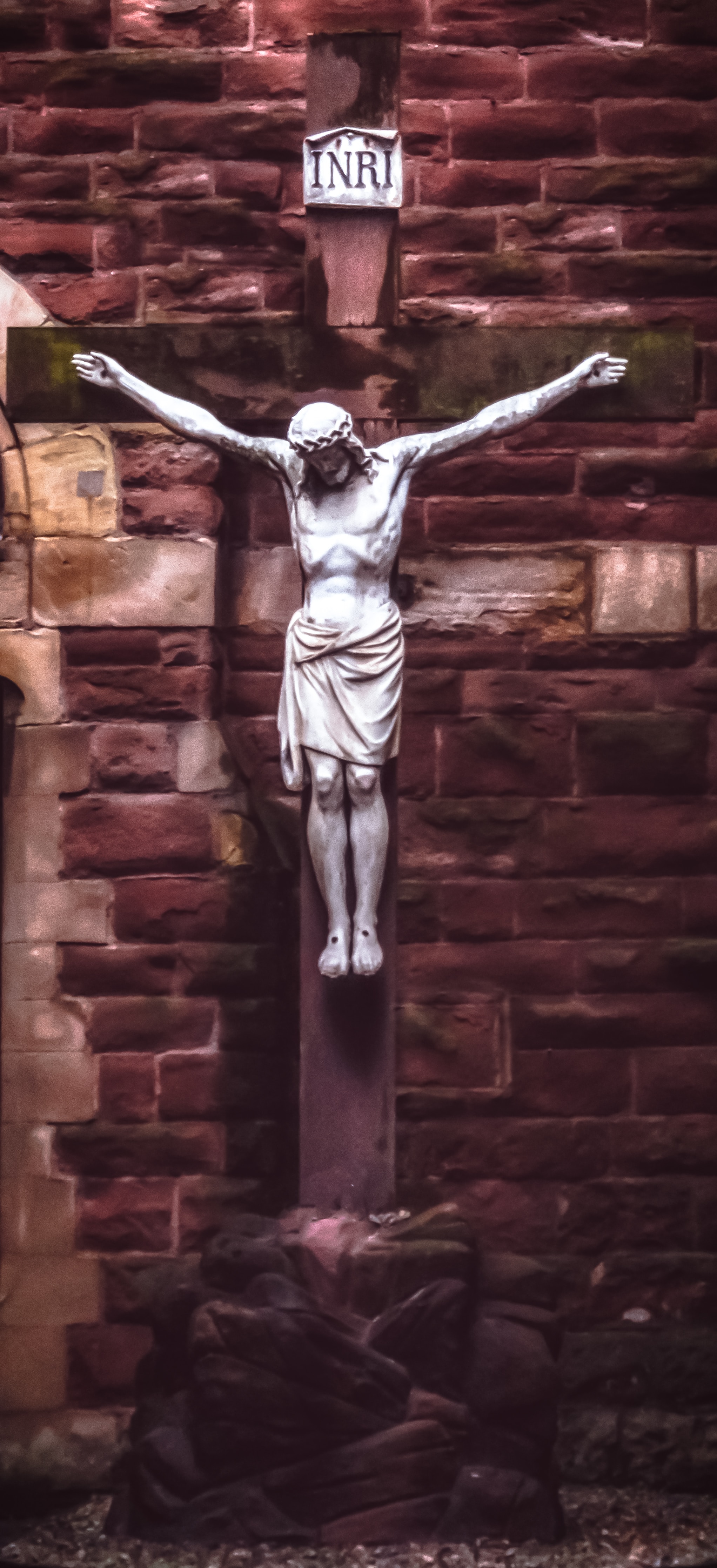
Photo by K. Mitch Hodge on Unsplash —Crucifix in the alleyway next to St. Patrick’s Church in Belfast (Jan., 2020)
Jesus, You began Your journey to the cross, in one sense, in the desert at the start of Your public ministry, and in another sense, in the Garden of Gethsemane. In both places, You let the Spirit lead you away from other people and from material comforts so that You could nurture Your relationship with the One who created You and sent You on Your mission. Times of retreat such as these allowed You to seek and to find the strength You needed to offer Yourself to Your brothers and sisters in the human family despite their spiritual blindness, weakness, greed, lust, fear, and impatience. You were able to surrender Yourself to others because You trusted Your Father would use their sins and frailties to accomplish the work of redemption. You knew that, ultimately, You were surrendering not to evil but to the Good of Your Father. For that purpose, You gave back to Your Father everything You received — Your desires, Your will, Your body, Your blood — every drop of it — and, in the moment to which I now turn my attention, Your spirit. You knew that only by dying, only by commending everything You had received to the Father, would You be free from the grip death had on You.
I, too, must embark on a lifelong journey of surrendering everything I have to Divine Love in order to receive Divine Life. I couldn’t travel this path if You hadn’t done so before me and didn’t continue to do so beside me and within me. I forget the sight and the feel of Your Way again and again, and You are with me to guide me back to it. Thank You for doing for me, with me, and in me what I cannot do by myself. Thank you for creating me for relationship in all its forms. Amen.
Jesus, in honor of the care Joseph of Arimathea showed You when You could not express Your gratitude, I offer prayers of thanksgiving.
for those who share what they have
for those who give of themselves and their possessions without expecting compensation or a reward
for those who cannot express their gratitude for the care they receive
for those who look after the dignity of the dignity of members of the human family who have died.
I’m grateful that You call to Yourself people from all walks of life.
I pray for those who have died, for those who mourn, for those who wait, and for all of us who grapple with anxiety amid the uncertainty of life. I bring to You Your beloved ones who face situations that seem hopeless.
And I pray for the virtues of patience and charity. Help me to recognize and to accept opportunities to practice these virtues. Teach me to rest in You. Amen.




 Sitting with the Sacred