We read more than once in this week’s Gospel that the disciples find Jesus in their midst, even though they’re behind locked doors. It also stands out that Jesus greets the disciples by saying “Peace be with you” and by showing them his wounds.
What I’m saying (about the readings and beyond) this week:
About the Readings
It’s as if Jesus is saying,” Don’t be afraid. It’s me. I’m here with you, and nothing can stop me from being with you now. I’ve gone to battle with everything that pushes you away from me. I won. See these wounds? They’re an everlasting reminder of my victory over suffering and death. This victory gives new meaning to your suffering and death. United to mine, your suffering will transform you. Like me, you’ll be someone new. And you’ll be that someone because of what you went through — what we went through — before.”
And beyond
We’ve lost, in Pope Francis, someone I would call the world’s pastor. From what I’ve seen, this is true, to some extent among people of various beliefs.
And here we are in the Easter season. Face tells me that the Easter he is experiencing now is different from the one that I’m experiencing. And my Easter share similarities and differences with the Easter you’re experiencing. You may not be experiencing the emotions you think of when you think of Easter. I’m not. I’m sad and uncomfortable with the unknowns the Church and the world faces. I grieve because of the many forms of violence (greed and selfishness, for example) and loss in the world.
Last Sunday’s readings and this Sunday’s readings tell me the experiences of Jesus’ followers on the first Easter were no different. They tell me the cross and the resurrection are two sides of the same coin. And neither experience is something only Christ goes through. Rather, we all share in both experiences again and we can’t have one without the other. When we have both, nothing can separate us from each other and from God — no suffering — not even death.
Still, sometimes a living sense of communion is hard to perceive on the earthly side of life. Jesus and his first spiritual family members understand that as well as anyone.
What someone else is sharing about this week’s readings:
Jesus, help us to see You and to touch You in our midst despite any obstacles to being enlivened by Your presence. Renew us to do Your work in the world, and bring us to rest together with You and all Your beloved departed in eternity. Amen.
Works cited:
“Second Sunday of Easter, Sunday of Divine Mercy — Lectionary: 45.” Daily Readings, Lectionary for Mass for Use in the Dioceses of the United States, Confraternity of Christian Doctrine, 2nd typical ed, United States Conference of Catholic Bishops, 2025, https://bible.usccb.org/bible/readings/042725.cfm.
As I sit with these passages again this year, I find myself paraphrasing something my pastor said. It was in 2021, I think. He said that at various moments in our lives, we are every character in the passion story. I’ve been many of them. I’ve been open about my faith when I was in a crowd who made it easy to be open because they were being just as open. I’ve been silent about my faith when being open felt threatening — even just socially. I’ve asked God to get me out of a difficult situation, and God didn’t. I’ve said, “Thy will be done,” though I doubt I’ve ever been able to mean it without reservation as Jesus did.
Simon of Cyrene was “pressed into service” to help Jesus carry the cross (Mark 15:21). At most, I’ve been volunteered for some tasks I wouldn’t have chosen to do on my own. They were a lot less strenuous and my circumstances a lot less dangerous, yet I doubt I allow myself to be changed for the better as much as Simon must have allowed himself to be for his name to be remembered in accounts of Jesus’ passion (Matt.27:32; Mark 15:21; Luke 23:26). I’ve betrayed people in my life and been betrayed by them. I’ve thought that if God is real and cares about His children and His creation, why doesn’t He save them from harm in easily recognizable ways all the time? Why would he allow them to suffer? I’ve also been asked the same questions when I’ve undertaken something or accepted a circumstance, and someone else didn’t understand why. I’ve asked now and then why God has abandoned me.
I’ve never been accused and/or sentenced unjustly by anyone charged with enforcing laws, but too many people have been. So many others have stood by someone unjustly sentenced and/or condemned, just as the people at the foot of the cross did for Jesus.
In this week’s readings shows the power of knowing who we are and what our purpose is in pursuing a purpose, regardless of the cost of doing so. The path of learning who we are, of fulfilling that purpose, of sacrificing for it looks different for everyone.
For Jesus, this path meant giving of Himself again and again in prayer, teaching, feeding, and healing. The darkest part of his journey brought him every kind of suffering brought him death. Why did He surrender to suffering and death? Not because God required His suffering and death to save us, but because we required his suffering and death to bring us back into union with God. We walk away from that relationship. God doesn’t. In fact, He never stops pursuing a relationship with us. The cross was the ultimate example of that pursuit, of going after us as we are — in all our fears, doubts, greed, fickleness, cruelty, violence, and even in our mortality.
What someone else is sharing about this week’s readings:
Another reflection, “Jesus Did Not Die to Appease an Angry God,” even though it was published as a reflection on earlier Lenten readings, helps me make sense of this week’s readings in light of one core belief that’s been handed on to me — that God is love.
In the last few years, I’ve made my own the prospective on atonement and on the crucifixion that Fr. Terrance Klein expresses in the previous paragraph’s link. It’s been more than a week now since I first read his reflection, but I may have used some of his words in my reflection without realizing it. He explains so well, in my opinion, what I’ve wanted to communicate on this blog, but I never thought my way of communicating it made as much sense.
I hope you can access Fr. Klein’s reflection. I came across it on the website of America Magazine. I think viewing a certain number of articles on that website is free each month before the website invites visitors to subscribe to read more. I’ve tried to put this perspective into my own words at the end of the first section in case you are unable to read Fr. Klein’s words, but I hope you’ll be able to. If you are able to, I encourage you to do so. Fr Klein isn’t the only person I’ve encountered who offers this perspective or a similar one on atonement and the crucifixion, but his article is the one I have most recently encountered on the subject.
This perspective is important because it has the potential to recast who we say God is, what God does, and how God sees us. This perspective helps me see God as a rescuer and a healer, someone who wants to save us from what our own distorted vision, weaknesses and injustices do to us, rather than someone who punishes out of anger, jealousy, or a desire to exact revenge upon us for our lack of obedience. It’s a perspective on the relationship between God and humanity that has taken humanity time to develop. By using the word “develop,” I don’t tend to suggest that humans came up with it, but that each of us is on an ongoing journey to understand reality more fully and thus to know God better.
I also don’t mean to suggest that sins don’t matter to God. I think they matter to God precisely because God understands better than we do how sin hurts the sinner and others affected by the sin. It’s precisely because of this supreme understanding that God goes to battle with all of sin’s damage in the generations before Christ and during Christ’s conception, hidden life, ministry, and passion. God wills restorative justice.
Thank you, Lord for coming to rescue us by living a human life so You could be an example for us and could heal us through Your Divinity, Your human relationships with others, Your ministry, Your intercession, Your suffering, and Your death. Amen.
The message I first get from the first reading is that the one who withholds nothing from God receives blessings now and into eternity.
The message of the psalm is a challenge to trust God, especially when doing so is most difficult. Actually, the first and third readings issue this challenge as well. The third reading also asserts that God blesses and saves whomever trusts God. And the Transfiguration in the Gospel promises the same. It also reminds us who Jesus is, and who we are. When we listen to Jesus and show that we’ve been paying attention by following Him, we regain a clear perspective of who we are, the perspective that Jesus shared about himself and about us. When we live this perspective, acting as beloved sons and daughters of God, we’re family members connected by more than DNA or choice, and someday, neither time nor any other force will be able to limit the reach of our light or our love. This is a promise that runs through each of this week’s readings.
What someone else is sharing about this week’s readings:
I’m grateful to have access to Ms. Ibrahim’s perspective on the first reading, because I find the Old Testament passage disturbing. If someone today said God commanded the literal sacrifice of his or her child, even if the person later said God had stopped the sacrifice, people inside and outside religious communities would express certainty that God had not commanded the sacrifice. They’d say the parent was mentally ill and/or hearing the voice of Satan or a demon.
As with the actions attributed to God in last week’s Old Testament reading, it can be very tempting to smooth over the disturbing content and implications of the passage by saying that the Old Testament reading prefigures God the Father not withholding the sacrifice of his Son on the cross to save the rest of humanity.
But I can think of some differences between the two sacrifices. First, thankfully, in the first reading, God prevents the sacrifice, Second, Jesus is an adult who accepted the cross, not a child, as Isaac is in this week’s Old Testament passage. I see other differences as well, but I think I’ll save these observations for a future Palm Sunday reflection.
Both the crucifixion and the story of Abraham’s almost-sacrifice of Isaac inspire me to pray about violence. Especially on my mind is how these parts of Scripture present violence done in the name of God. I offer the following prayer:
Lord, grant us the grace to trust You to keep Your promises and the freedom to live in friendship with You. Help us to recognize the vulnerable among us. Guide us and to care for them and protect them. Guide us in discernment as we seek to do Your will. Deliver us from temptation and evil masquerading as Your will. Protect us from violence, especially violence that claims to be done in Your name, but only harms the people and other living things and resources that are most vulnerable in this world rather than protecting them. Amen.
This week’s readings remind me that neither suffering nor pleasure is eternal in the universe. Only God is eternal and all-powerful. Sin is rejecting that which gives life and treating something else as if it were eternal and all-powerful. The readings invite me to re-examine what the things I think, do, and say reveal about what I treat like God. The passages encourage me to step back from my routines, to start fresh, and to rearrange my priorities so that I treat only God as eternal, all-wise, and all-powerful. They propose that committing to a period of abstaining from something that, while not harmful, is also not necessary, can help me reorder my life and clarify and broaden my perspective. In other words, the readings propose spiritual decluttering for the sake of gaining that broader perspective and increased clarity.
This week’s readings also remind me that actions have consequences, but I don’t believe this reality means that God sends the consequences. Certain choices yield unpleasant results, but God can take those results and use them for good. I can also use my choices to practice self-control and to help avoid experiences that are more unpleasant than the temporary inconveniences that practicing self-control can entail.
What someone else is sharing about this week’s readings:
Diana Marin offers her perspective on what a spiritual desert feels like, means, and can provide.
Beyond this week’s readings:
The first reading communicates that a rainbow is a reminder of God’s promise never again to destroy the earth and almost everyone who lives on it with a flood. The psalm says that God is good, “shows sinners the way,” and “guides the humble to justice” (Psalm 25: 8-9). I have a hard time reconciling what the psalm says about God with the story about a massive flood that kills all but two of each species and one human family. My experience of the world around me and with what I’ve been taught tells me that people are made up of varying combinations of positive and negative traits. No one I’ve known has possessed either all positive traits or all negative ones. I’ve also been taught that everyone around me is created by God and loved by God, while also being vulnerable to temptation and sin. So wouldn’t Noah and his family have these characteristics too? I can imagine some arguing in response to this question that maybe Noah’s family asked for God’s forgiveness and others didn’t. Nobody outside of Noah’s family? Really?
I’m not actually bothered by these questions because I don’t view the first reading as a historical account. I think there was a massive flood because several cultures have passed down stories about it, but I also think it’s important not to be too literal about what the flood says about human nature and Divine nature.
The third reading offers a lens through which Christians can look at the flood and the rainbow that Genesis says followed it. I read the epistle as proposing that between His death and resurrection, Christ redeemed the victims of the flood, a comforting understanding to have after the resurrection and ages after that flood. Because of Christ’s total surrender to death and His victory over it, physical death is not final. Yet it’s important not to minimize that death is often painful for anyone touched by it in any way. Therefore, it’s important not to minimize the tragic nature of a massive flood, even as we look at such an event through the lens of Scripture passages written later, when understandings of God and how God interacts with the material world had evolved.
The third reading proposes that the flood prefigures baptism. It’s jarring to think of baptism as a flood that kills unjust people and establishes a new relationship, renewing promises to the people who come after the flood. The Good News is that the death of baptism isn’t a physical one. Neither is the other death, the death of selfish-centeredness I’m called to surrender to each day to keep my priorities from getting out of whack, to keep me from letting someone or something not God masquerade as God in my life.
Lord, every time I see a rainbow, remind me that my baptism was a death that inaugurated a new life, one stronger than weakness and physical death. Grant me the grace to keep returning to You, the Source of that life, to reignite the fire of Your eternal life within me. Amen.
Work cited
Confraternity of Christian Doctrine, Inc. “1st Sunday of Lent, Sunday 18 February 2024: Readings at Mass.” The New American Bible, 2001. Universalis for Windows, Version 2.185, Universalis Publishing Ltd., 29 Jan. 2024, https://universalis.com/n-app-windows.htm.
In the first passage, I read that the Lord gives specific instructions to Moses and Aaron about what to do if someone has leprosy and what to tell the affected person to do.
The subject of the psalm is a different disease — the disease of sinfulness. The Good News that this psalm shares is that God offers treatment for the latter condition to everyone. The first step in the treatment is acknowledging I have this illness. The second is sharing with God and with a wise adviser or two the symptoms of it that I’m experiencing. The third step is acknowledging that I can get rid of neither the symptoms nor their cause of this illness on my own. The process of spiritual healing begins with my trust in the power of God to cure what’s sick in my soul and my awareness of and gratitude for what in me reflects God.
The third passage, the epistle, begins by reminding me that my purpose is to reflect God. The ideal is for people to be drawn to God by being able to appreciate how others and whatever is beautiful around them reflect God. I’m called to discern what guardrails come from love of God and others and what might seem like a guardrail but isn’t. It’s a wall, a human construct that divides family members and distorts their relationships with the world around them. In this passage, Paul is able to envision a world in which members of the human family, with God’s accompaniment, can come from different places and with different experiences without being divided. He urges us to honor each other’s feelings and to respect the diversity of our human family.
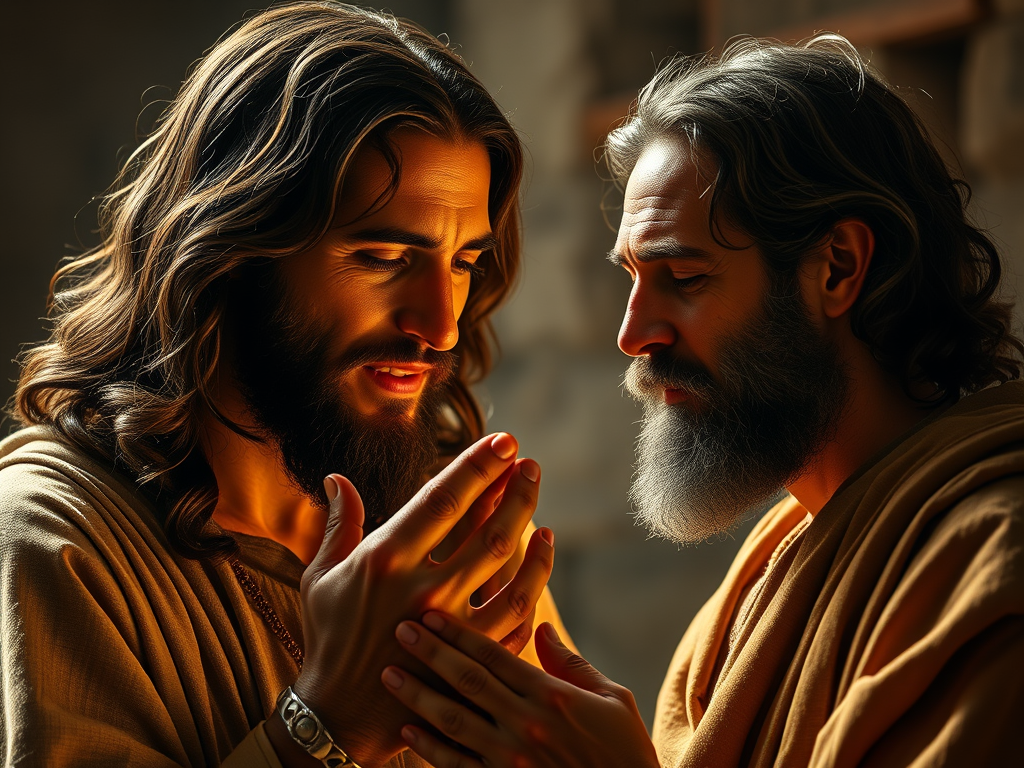
The Gospel passage, I see Jesus curing a disease that has separated a man from the wider community of people affected by that illness. I also see him honoring the feelings and the gifts of that person, as well as the practices of the culture both men were born into. I read that Jesus was “moved with pity” and that “he stretched out his hand [and] touched [the man] (Mark 1:41). Jesus feels empathy for the challenges the man faces.
I also notice that when the man approaches Jesus, he doesn’t actually make a request. Instead, he makes a proclamation of faith in what Jesus can do for him. In this scene, Jesus doesn’t say after the healing that faith has saved the man, but another healing scenes, he does tell the beneficiary this. I think showing the ill man making a statement rather than a request and then showing Jesus healing is another way of recognizing the man’s faith. (Skip ahead to Beyond This Week’s Readings for an important aside about this aspect of the story. Finished the PSA break? Okay. Let’s rejoin our regularly scheduled programming that’s already in progress.)
The passage could have just said that Jesus touched the man, and the man was healed. But it doesn’t say this. It stands out to me that the passage says Jesus “stretched out his hand” (Mark 1:41). Because of my muscle spasticity, I can’t fully extend my arm, so to me, the passage is making a point that Jesus’s work takes effort and that that work is closing an often wide divide between people with this condition and people without it. Now quarantining people with this condition had a practical benefit for the wider community. What’s today called Hansen’s disease is contagious, though not as contagious as it was once thought, according to Wikipedia’s Leprosy entry. The infection can affect the nerves and the lungs and can lead to amputations as well as affecting the skin.
Jesus demonstrates knowing that communities lose irreplaceable contributions when some members are cut off from them. He also demonstrates understanding that humans are made for community, and not just conversation either, but companionship that includes touch.
Jesus’ actions after the healing also reveal wisdom, as we might expect. They remind us, for one, of the importance of letting timing shape our actions. His actions suggest he has discerned that working within the expectations of authority figures who will be challenged by his message, not giving offense, in other words, is important to fulfilling his mission at the time of this healing. He tells the newly cured man not to discuss with anyone the change in his condition or how it came about. He tells the man that instead of talking about his healing, he should go to the priest, who will see that he no longer displays the visible symptoms of the illness. Once the priest declares him clean, Jesus instructs, he should make offerings to God in gratitude for his cleansing (Mark 1:44).
I think Jesus knows the man won’t follow his instructions. Aside from Him being both fully human and fully divine at and it not being clear to us in this life how those two natures interacted, I can’t imagine the healed man being able to resist telling everyone he meets what he’s just experienced. People will no longer distance themselves at the sight of him. They’ll no longer turn away if they spot him in the distance. His appearance won’t make children scream or cry. And these are just the unpleasant reactions I imagined him receiving on account of the outward signs of his former condition. Illnesses and disabilities shape lives in so many ways that aren’t visible. I suspect Jesus not only understands that healing the man will have these effects on his life, but also he understands how tempting it is to share even a secret that is far less significant than the one the healed man knows.
Regardless of how prepared He was for the man not to follow his instructions, the reading shows Him seeking to do what He’s called to do in a way that acknowledges and responds to how the choices of others affect that calling. He responds to the news of his miracles spreading by staying in more sparsely populated areas (Mark 1:45).
We saw in last week’s Gospel that He uses time away from crowds to rest and to speak and listen to his Father. Maybe it was during one of these times away that the man who gets healed in this reading was able to approach Jesus. This week, we read that despite His efforts to give Himself that time and space, people who need help and trust that He can provide it find him anyway. God works in all our circumstances, regardless of whether our senses can detect that this is true or whether we feel like it’s true. My senses often can’t, and I often wish I felt the Spirit’s unending accompaniment more strongly.
What someone else is sharing about this week’s readings:
Olivia Cathrine Hastie reflects on what it means for God to make us clean. It means far more than removing visible or invisible dirt from us, even “dirt” as in anything that might be perceived as unpleasant or uncomfortable, either by us or by someone forming an impression about us based on what he or she can perceive. She also points out that there are different words used in different translations of how Jesus is described as feeling in the Gospel passage. As I wrote earlier, the translation used for Masses in the U.S. says he feels pity for the sick man. Ms. Hastie says other translations use the word “compassion” in the place of “pity. “
Beyond this week’s readings:
I propose that compassion makes more sense than pity in the context of the Gospel passage. I make this proposal because I’d also like to offer that pity says the person who has it only feels sorry for the person who inspires that feeling, whereas a person acts with compassion. Compassion addresses a need, whereas pity merely recognizes one. Okay, maybe sometimes pity donates a few coins or offers another temporary fix in response to a situation, but I’d like to think that compassion allows for deeper connections that extend in more directions, and it offers both material and emotional or spiritual help.
In addition to prompting me to make a distinction between pity and compassion, the Gospel passage prompts me to feel it’s important to say a bit about the relationship between faith and healing. Some believe that if a person has enough faith, he or she will be healed of whatever ails him or her physically and/or mentally. As a person who is neurodiverse and has a physical disability, this perspective is unhelpful and even hurtful. It implies, however unintentionally so, that if I had enough faith, my mind and body would work the way medical textbooks say healthy minds and bodies should.
Elsewhere, Jesus tells his disciples that a man isn’t blind because of his or his parents’ sins (John 9:3). And Jesus provides the ultimate example of faith, yet he still suffered crucifixion and died from it before rising the following Sunday.
The miracles in the Gospels teach readers and hearers about who Jesus is. He is God. That is to say that he has authority over nature and the authority to forgive sins and liberate people from the grip of them. He is sensitive to the requests and the unacknowledged needs of people who approach him. But we were reminded last week that he didn’t stay in one town and continue to work miracles there. The inclusion of this detail suggests that not everyone who might have sought healing from Jesus in a given town was healed.
I have faith that there’s not a single form of suffering in the world that He doesn’t care about, yet despite this care that I have faith in, suffering still continues, and sometimes it’s not the result of anyone’s actions. I struggle with the idea that He wills suffering. Yet my senses compel me to accept that he allows it. Why? I won’t pretend to know all the reasons.
Lord, help me to recognize what suffering I can prevent and what suffering I can alleviate. Help me to be patient with the suffering You allow that I cannot prevent or alleviate — at least not right now. Help me to recognize if my ability to help changes. Help us to experience Your presence with us in our suffering. Amen.
Work cited
The Bible.The New American Bible Revised Edition, Kindle edition, Fairbrother, 2011.
Fortunately, I suppose, unlike Jeremiah, I don’t currently “hear the whisperings of many saying . . . “Let us denounce [her] (Jer. 20:10, The New American Bible, 2001 Edition). But at times, I’ve perceived myself as surrounded by such “whisperings.” (Jer. 20:10). Was I more hurt because I felt someone was rejecting me, or because I thought that person was rejecting God? I suspect that more often than not, the answer was the former. “[Z]eal for [God’s] house” doesn’t “consum[e] me” as I assume it did Jeremiah, though Jeremiah isn’t the name given for the narrator of this week’s psalm (Ps. 69:10).
Jeremiah’s emotional response, his anger, is understandable. But in contrast with what Jeremiah seems to request of God, I don’t want God to “take vengeance” on anyone, or to witness anyone taking vengeance on anyone else (Jer. 20:12). After all, the Webster’s New World College Dictionary defines vengeance as “the return of an injury for an injury, in punishment or retribution” I want to see wrongs made right. In the many situations where what’s lost cannot be recovered, I want to see efforts made to prevent the same harm from happening again. I don’t want to see “the return of an injury for an injury in punishment or retribution.”
And even if I had an experience that changed my mind and my heart about vengeance, it wouldn’t bring back what I’d lost. Also, I have a hard time believing that a God whose very nature is a self-emptying love that we humans struggle to imitate would want to take vengeance on people who hurt me. Why? Because God is the source of their lives as well as mine, God wants to remove anything that might distance them from himself. Now that removal might be painful and difficult for a person to go through, just like breaking oneself of a bad habit or putting distance between oneself and toxic people might be extremely hard to do. Still, I wouldn’t think of actions such as these as vengeance. I would consider them lifesaving in the long run. On the other hand, in the long run, the rejection of such life-saving actions would be its own punishment.
It helps me to put the Old Testament passage into perspective if I consider that the words are attributed to Jeremiah. They aren’t attributed to the voice of God. I believe that God speaks to us through the Scriptures, but so do the other people in them. Not everything in the Bible is God’s will because the people whose stories the Bible hands on to us are subject to rash judgment and limited understanding just like we are. I believe Jeremiah is not excluded from these human weaknesses, and that’s why he asks God to let him witness God taking vengeance on the people who persecute him. He’s likely in grave danger, and he wants to get out of it. I would want the same “rescu[e],” were I in his situation (Jer. 20:13). Perhaps the only way he can imagine God alleviating his suffering is for God to take vengeance on the people causing it.
Despite whatever ways Jeremiah’s spiritual vision may be limited, he’s ahead of me in the faith department because he can say, ” . . . Praise the Lord,/for he has rescued the life of the poor/ from the power of the wicked (Jer. 20: 13)!
This declaration is, more often than I would like, difficult to make my own. I hear too often of those with trusting natures being defrauded of their savings by strangers. The world over, the rich get richer while the poor face food insecurity or even famine, and some leaders sacrifice truth and countless lives on the altar of holding onto and increasing their power.
Does “the LORD [hear] the poor,” as the psalm says (Psalm 69:34)? Undoubtedly, but Jesus died not only so that his brothers and sisters could have eternal life through Him but also so that they could have a clearer understanding of their own dignity and live for more than themselves, becoming conduits of His justice and mercy (qualities that are intertwined with each other) generation after generation. It is receiving and sharing these gifts of Christ’s sacrifice that give eternal life to a soul even though a body can be killed. This receiving and sharing also allows Paul to declare, “For if by the transgression of the one, many died, how much more did the grace of God in the gracious gift of the one man Jesus Christ overflow for the many” (Rom. 5:15).
Lord, I often struggle to share Paul’s faith in the gifts you have given me and anyone open to them. And yet, “I do believe; help my unbelief” (Mark 9:24, The New American Bible Revised Edition). Help me to remember that “[e]ven all the hairs on [my] head are counted (Matt 10:30, The New American Bible, 2001, Edition). Everyone’s are. Nothing happens without [our] Father’s knowledge. Even though so much that happens is unpleasant or unjust, the final victory is not doesn’t belong to these events. Guide me as to how to make this truth tangible for myself and for others. Help me and others to be conduits for more of what you are offering us. Amen.
Works cited
Confraternity of Christian Doctrine, Inc. “Sunday 25 June 2023: Readings at Mass.” The New American Bible, 2001. Universalis for Windows, Version 2.179, Universalis Publishing Ltd., 26 Feb. 2023, https://universalis.com/n-app-windows.htm.
The New American Bible Revised Edition, Kindle edition, Fairbrother, 2011.
He guides me in right paths for his name’s sake. Even though I walk in the dark valley I fear no evil; for you are at my side, with your rod and your staff that give me courage.
— New American Bible, 2001 Edition
He guides me along right paths* for the sake of his name. Even though I walk through the valley of the shadow of death, I will fear no evil, for you are with me; your rod and your staff comfort me.
— New American Bible Revised Edition, 2011
Psalm 23: 3b-4
He guides me in right paths for his name’s sake. Even though I walk in the dark valley I fear no evil; for you are at my side, with your rod and your staff that give me courage.
— New American Bible, 2001 Edition
He guides me along right paths* for the sake of his name. Even though I walk through the valley of the shadow of death, I will fear no evil, for you are with me; your rod and your staff comfort me.
— New American Bible Revised Edition, 2011
As I announced at the end of last week’s post, I’m continuing to sit with Psalm 23 this week. The first line of this week’s excerpt paints a different picture in my mind than the “green pastures” or “still waters” of last week (Psalm 23: 2). I picture Jesus walking with me in a canyon. He’s behind me, actually. He has one hand on each shoulder, and I know that, using power I trust though I don’t understand it, he will guide me along the often steep, rocky path between the river at the bottom of this canyon and its rim. There will be times when I roll backwards (I use a wheelchair, remember?), many times, but he won’t let me fall the several stories into the raging river that carved the canyon. I won’t get lost in this place and be trapped forever. This is what being guided “in” or “along right paths” looks like to me (New American Bible, 2001 Edition; New American Bible Revised Edition). Maybe the canyon is this life.
So what’s with this line about “for his name’s sake”? (New American Bible, 2001 Edition).
To me, this phrase is a reminder of who God is. God is all that’s good: God is presence rather than absence, truth rather than lies, self-giving love rather than apathy. God cannot be what and who God isn’t, so the Shepherd of Psalm 23 can only lead sheep along the path that not only protects them but also allows them to thrive.
The path that allows them to thrive is often not well lit. The sheep’s view of the Light Source is blocked by the high canyon walls that surround the valleys through which the Shepherd leads them. Yet being surrounded by darkness is no reason to fear it because the Shepherd is with them in it. He isn’t guiding the herd through the darkness from a distance. He became a sheep himself and allowed himself to be slaughtered so he could walk alongside others facing slaughter and show them how to avoid this fate.
The rod was used to fight off wild animals and to count the sheep and direct them. The rod prodded them during the day in the fields and at night into the sheepfold. A willing sheep would respond to the prodding, but a stubborn, strong-willed sheep would not.
While sheep might not be as dumb as often suggested, they do have characteristics that give some merit to that claim. They’ll indiscriminately eat just about anything, regardless whether it is something that could harm or kill them. They endlessly wander, seemingly without direction. And many sheep stubbornly resist the shepherd’s prodding. That’s why the staff, with a crook at the end, is needed. The shepherd uses the staff to more strongly exert his authority and to gently, but firmly, pull the sheep back to the fold and keep the sheep moving in the right direction. He can also use the crook of the staff to pull the sheep from harm.
You can view a picture of these tools here. I think of a staff as a support for something else, but it’s apparently not just a supportive device, such as a cane is. It can be used to grasp and pull wandering sheep back to the shepherd if they won’t come back on their own, Abbot writes.
Being prodded back to the right path or pulled to it may not feel very comforting or courage-infusing when it happens. But sometimes it’s necessary to endure temporary pain to prevent longer-term pain. The cross is the ultimate example of this truth. The Shepherd submitted to it to deliver us from eternal pain, and because he didn’t want the pain of being eternally separated from us. In accepting the cross, he promised that any pain we face won’t last forever if we also accept his cross. In surrendering to the cross, he offers us courage and comfort through it, despite the pain it inflicts.
Other ways life follows the pattern of this truth come to my mind:
A medical treatment has difficult side effects but slows or halts the process of a life-threatening disease.
A Good Samaritan performs CPR, and this action causes bruising or popped ribs, (This can happen. Click here to see my source for this example.) but a person’s life is saved, and he or she eventually makes a full recovery.
Parents set boundaries for their children’s technology and media usage, or we set boundaries for our own indulgence in the things we enjoy, and the boundaries aren’t enjoyable in the short term, but living within them makes for healthier lives and means having time to learn important lessons and to build, repair, and strengthen relationships.
Someone misses an occasion he or she is look forward to, choosing instead to get started on a school project or to look after his or her health or someone else’s. Missing out is unpleasant but serves a greater good and pays off in the long term.
So the rods and the staffs of life keep us, the sheep, from wandering off, getting lost and likely getting attacked and killed in the process. We may not experience the rod or the staff as pleasant, but the Shepherd is aware of dangers that sheep aren’t. The shepherd knows the rod and the staff protect his sheep from the greater suffering — or worse — that they’d face if he didn’t use them.
And sometimes, even at the times they’re used, the rod and the staff don’t feel like punishments to the sheep, according to Jack Albright, retired clinical chaplain and freelance writer:
It is used in drawing sheep together into an intimate relationship. He will use his staff to gently lift a newborn lamb and bring it to its mother if they become separated. He does not use his bare hands for fear that the ewe will reject her offspring if it bears the odor of his hands upon it.
“[The staff] is also used for guiding sheep through a new gate or along a dangerous, difficult route. He will use the slender stick to press gently against the animal’s side, and this pressure guides the sheep in the way the owner wants it to go. Thus the sheep is reassured of its proper path . . .”The staff is also used for guiding sheep through a new gate or along a dangerous, difficult route. He will use the slender stick to press gently against the animal’s side, and this pressure guides the sheep in the way the owner wants it to go. Thus the sheep is reassured of its proper path . . . Keller says that he has seen a shepherd walk beside a pet or favorite sheep with his staff gently resting on its back. It appears that they are in touch or walking hand-in-hand. Sheep are not easily trained but this may be a method of training her as a leader.
The Shepherd’s staff – a source of comfort
This excerpt reminds me that, yes, a shepherd reassures his or her sheep. The Good Shepherd does this better than any other. It also reminds me that the Good Shepherd came not just to walk alongside us, amid his flock, but to teach us to be a leader like him. Thank You, Lord, for being the Foremost and Ultimate Shepherd.
And Lord, even when Your protection and your training aren’t experiences I’d like to repeat, help me to recognize You loving me through these difficult times. Help me to respond eagerly to Your efforts to shape me into a leader with Your eyes, Your heart, Your mind, and Your will. Amen.
The Bible. The New American Bible Revised Edition, Kindle edition, Fairbrother, 2011.
Confraternity of Christian Doctrine, Inc. “Sunday, 7 May 2023: Readings at Mass.” The New American Bible, 2001. Universalis for Windows, Version 2.179, Universalis Publishing Ltd., 26 Feb. 2023, https://universalis.com/n-app-windows.htm.
“Do not let your hearts be troubled or afraid (John 14:28). I heard this verse again last weekend. That was before latest mass shooting. At an elementary school. Again. I can’t believe there has been more than one mass shooting at an elementary school. I can’t believe there have been so many mass shootings, period. Well, I can believe all of it, unfortunately. But I don’t want to.
Often, I struggle with what I’m going to post here, what verse I’m going to focus on, but this time, I knew immediately that I was going to focus on John 14:28. I was going to write about how it’s one of those verses that leaves me feeling like I can never measure up, one of those verses that feels inapplicable to life as I know it on many days. The verse makes me feel this way because I live with anxiety and OCD.
If I still thought I had to be untroubled to be a faithful Christian or to grow spiritually in any way, I’d give up trying, I think.
Yet I haven’t given up, thanks to the Gospels telling me about times when Jesus was troubled. There was the time he wept when it seemed he arrived too late to save his friend Lazarus from death. He wept even though he knew Abba loved him and his friends and could still be found in the midst of the suffering and loss. Obviously, I can’t know exactly what he was feeling when he wept, but I’ve often wondered if his grief rose out of the suffering that had occurred before the massive sign that God was about to offer through him. He accepted that sometimes pain couldn’t be avoided, but his acceptance didn’t mean that he didn’t dread pain at the same time.
Peace I leave with you; my peace I give to you. Not as the world gives do I give it to you.
John 14: 27
The blood we’re told he sweated in the garden of Gethsemane is evidence of another troubled time, as is the moment on the cross when, feeling abandoned, even though on some level he must know he isn’t, (otherwise he’d have no one to implore) he cries out to God. I’d say “troubled” is a drastically inadequate word to describe how he’s feeling, yet I can also imagine him experiencing a kind of peace in this moment and the others because he knows what God is asking him to do, and that’s to respond as each situation calls him to respond. This peace doesn’t come from comfort but from discerning his purpose and acting upon it in unselfish love.
I wouldn’t go so far as to say my own acceptance of anxiety and my willingness to share it with God manage it well, but anxiety feels less inescapable than it used to. Because I accept that certain situations are going to make me anxious. And I don’t have to make the physical experience of anxiety — the muscle tension, or the churning stomach, or the faster heartbeat — go away. It’s okay just to do what I can, to go through the motions that each moment calls for. It’s okay to go about life this way because all my experiences of anxiety and discomfort are temporary.
But I get the grief doesn’t feel temporary. It feels crushing, insurmountable. I’ve heard it said that grief doesn’t go away. It just changes.
So weep. Focus on one mundane task and in the next. Turn over tables if you need to. (We’re told that Jesus did at least once.) Then help clean up the mess afterwards, and don’t resort to violence. Let’s channel our tears and our anger into positive change.
Yes, Jesus prayed. He also stood up to the suffering of others by doing what he could to relieve it. Think what good we can do if we participate in that work of Love.
Work cited
The Bible. The New American Bible Revised Edition, Kindle edition, Fairbrother, 2011.






 Sitting with the Sacred