The readings for September 8 give me more to work with in the exploration of what justice means that I began in last week’s post. The passages tell me that doing justice means making sure that everyone has what they need to thrive physically, mentally, and spiritually.
Justice serves what gives life by looking beneath the surface for signs of that life. It doesn’t serve that which is fleeting or artificial—except when what is fleeting or artificial serves what’s good and eternal.
Beyond this week’s readings:
In the previous section, I wrote that justice removes barriers rather than that justice heals, even though the readings for September 8 contain more than one reference to what are often called healings. I wrote to “removes barriers” because I’d like to propose that the references to physical healing in the readings don’t have to be as much about removing this physical impairment or that one – any physical impairment, for that matter — as we may be accustomed to thinking they are. (By the way, these perspectives on physical impairment and their relationship to well-known accounts in Scripture are far from unique to me. Ms. Iozzio, whose reflection is linked in the next section, offers a perspective that relates to my own.)
Healing is involved, but I propose that more is being healed than seems apparent. A man’s physical Deafness is removed, and his difficulties with speech are removed so that he can connect with and contribute to his community in different ways than he has before. The event inspires his faith in Jesus as God incarnate.
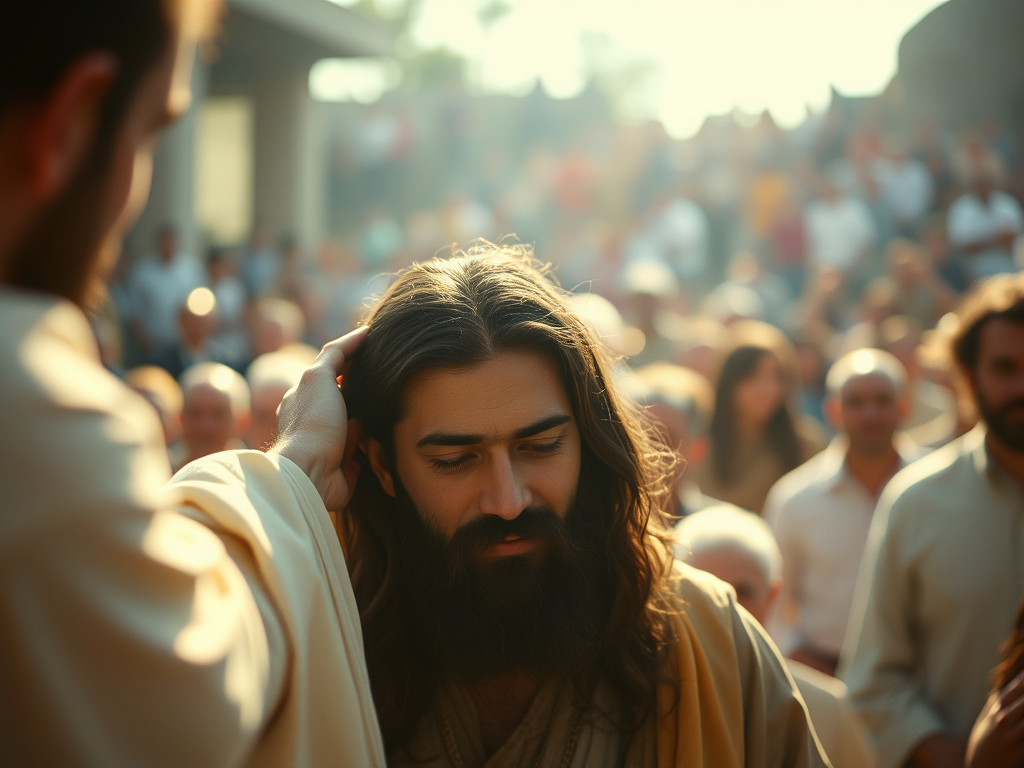
I find it revealing that Jesus doesn’t say to the man “hear” and “speak clearly” when he lays hands on the man. Instead, He says, “Be opened!” (Mark 7:34). Granted, I can imagine ancient peoples explaining Deafness as being caused by the ears being closed. But I can also see “Be opened!” meaning, “Be open to faith.” For this man, Jesus is also opening the door to relating to his community in a new way. I invite you to read more about that new way of relating by clicking the link in the next section.
Each of us, regardless of what our limitations are and what causes them, are our most God-like selves when we’re open to faith and community. There are multiple ways to facilitate this openness. Healing impairments is only one of them. We can remove barriers. We can also be open to alternate ways of communicating and seeing. Impairments do no mean that a person reflects God’s image any less clearly than someone who seems to be without impairments. Being a member of the Deaf community or having a disability or illness doesn’t make anyone any less complete than anyone else. This perspective affects everyone because no one on this side of heaven has an invincible body.
New Testament support passages support the perspective that, though we are called to do our best to take care of what we have, and God is present to us to us so that we can share our desire to be well, having certain abilities isn’t the ultimate goal of the spiritual life. Consider that:
Jesus tells his apostles that a man’s blindness is not reflection of his own sinfulness or the sinfulness of his parents (John 9:1-3).
Saul, who will become Paul, goes blind when Jesus speaks to him on the road to Damascus (Acts 9:7).
Jesus heals a paralyzed man, telling him to get up and walk so that [onlookers] “may know [He has] the authority to forgive sins (Mark 2:9-12).
After healing a woman who’s had a hemorrhage for years, Jesus says to her, “your faith has saved you (Luke 7:50).
The human conditions in the examples above aren’t punishments. Even in Paul’s case, I think it’s the brightness of the light that blinds him, and the blindness helps him rely on God and the people around him (Acts 9:8). Blindness means the loss of physical vision for Paul, but it also means the acquisition of clearer spiritual vision for him.
However, it’s important to note that, in the same way that having an impairment doesn’t make a person less complete, than a person without that impairment, the condition also doesn’t necessarily make a person more spiritually insightful than a person without the same impairment. It’s also important to note that God is at work in different ways in different situations and to be cautious about presuming to understand why circumstances are what they are. Every situation presents its own challenges and its own opportunities for grace.
In each of the examples above, the physical healing isn’t the only or even the primary gift Jesus offers. The miracles treat sick souls, and not just the soul of the person who experiences a physical impact, but also the souls of the people who witness the impact or learn of it more than 2,000 years later.
What someone else is sharing about this week’s readings:
Lord, help us to be open to You and to one another. Help us to respond to Your invitation to healthy relationships, which are two-way streets that can be built in many ways. Amen.
I almost never serve God entirely willingly. Starting to draft this post is a drag. The thought of going back to watching a baking competition is much more pleasant than the thought of having to come up with my own content. Yet I always enjoy having written here, and the thought that someone else might be encouraged by something I’ve written keeps me coming back.
Too often when I’m at church, my mind isn’t there with my body. My mind is either on a hamster wheel of anxiety or wandering in a daydream. I’m most inclined to pray alone, outside, and in my own words—the fewer the better.
Yet I recognize that while some moments of practicing faith can and should be solitary, faith isn’t living if it’s not a group activity as well as an individual one. Liturgies and formal prayers are part of that group activity. The more fully I engage in such group activities, with their ancient, traditional prayers, the more they have the power to put the movements of my heart, mind, and will into perspective and to unite them to the mind, heart, and will of Christ. To the extent that we all experience this transformation into communion, we’re united to each other. This communion spanning time and space and joining God and creation is what liturgy offers, Showing up for it each week is part of my commitment each week to wrestle with getting out of my own head.
Do I think God doesn’t hear my prayers because I struggle with being present in the moment and with choosing to participate in life? No. God doesn’t need me to pray. Prayer is for my benefit and for the benefit of all creation. The more space I have in my mind, my heart, and my will for this benefit, the better I’ll able to receive it and the more good it can do me and the world around me. This is what the verse from Sirach means to me.
But I’m far from being able to fully receive this benefit — and not just because my faith often isn’t as alive as it might appear. I don’t feel as courageous as friends seem to think I am. My default approach to life is not to rock the proverbial boat, not to bring disapproval on myself, and not to disrupt my routines — because disruption triggers anxiety. My default approach is to follow my inclinations. I don’t write this blog because my faith, hope, and love are mature. I write this blog because I want these virtues and others to mature in me.
I constantly fall into the trap of comparing myself to others. I either focus on how my life doesn’t measure up to theirs or how their lives fall short of the ideals I wish we both lived up to. This tendency toward comparison makes me sinful and unwise, and it steals my joy, the very joy God brought me into being to share. And for that reason, the prayer of the tax collector in Luke 18:13 is also my own: “O God, be merciful to me, a sinner.”
Confraternity of Christian Doctrine, Inc. “Sunday July, 2 2023: Readings at Mass.” The New American Bible, 2001. Universalis for Windows, Version 2.179, Universalis Publishing Ltd., 26 Feb. 2023, https://universalis.com/n-app-windows.htm
Faith is the realization of what is hoped for and evidence of things not seen.
Hebrews 11:1
This weekend, my pastor said that another way to put this verse would be to say that faith makes what we believe in come to pass. I find this interpretation a lot easier to understand than a more literal English translation of the original Greek. That doesn’t mean I find either version any easier to live.
When I’d like to imagine a certain outcome, and conditions don’t seem to lend themselves to that outcome, I have such a hard time believing it will happen. Yet when I’m dreading a certain outcome, I experience it not just as if it’s going to happen, but as if it’s already happening.
The understanding of faith I began this post with is a good reminder to keep my eyes on the spiritual prize while I make choices that do my part to make a good outcome possible. My mind, heart, and body can get in the way or out of the way of the unfolding Ultimate Good. My mind, heart, and body can also cooperate in bringing about that Ultimate Good.
The parable in Luke 12: 35-40 is about expecting that Ultimate Good — expecting to be united with God — in mind, in will, in heart, in body, and in deed. I believe the Ultimate Good can be experienced in the clearest and fullest way after death. For me, this total, unobscured union is what Heaven means.
I usually hear and read that the parable in Luke 12:35-40 presents two scenarios:
what it’s like to be in Heaven with God, to have had God’s heart and mind and have done God’s work even at times when a person hasn’t been able to experience the fullness of God’s presence.
what it’s like, at the end of life, not to have recognized that Heaven is a possibility, not have sought union with God, and without reconsidering, to have done the opposite of what God would do.
But I think there’s also room in this parable for the story to be about expecting the good that God brings each day, acting and thinking as if I know today’s the day, that, like a package I received notification of, Divine goodness will arrive.
More often than a package does, a gift from God waits on the threshold of my awareness. However, unlike a package, I don’t always see a Divine gift with my physical eyes or recognize it with my wounded soul. When I don’t expect to receive God’s love each day, I may not ,experience it when it arrives. And not experiencing or recognizing it can feel — emotionally and spiritually more than physically — like receiving the beating the unfaithful servant receives in the parable.
Lord, give me the grace to expect, to receive, and to share Your love each day. Amen.
Work cited
The Bible. The New American Bible Revised Edition, Kindle edition, Fairbrother, 2011.
I’ve often read and heard that Jesus’ parables include twists, that an element of surprise is often included, and this element increases the impact of the story all the more. The parable of The Good Samaritan (Luke 10: 25-37) is no exception to this observation. If we were hearing the story in Jesus’s’ time on earth, we might have been surprised that the Samaritan is the one who stops to help the victim. It’s my understanding that Samaritans and Jews were far from close allies around the 1st century A.D.
I wonder how Jewish hearers of this story would have felt about the fact that the priest and the Levite don’t seem to notice the man lying bloody by the side of the road. Angry at the priest and the Levite? Angry at Jesus for presenting these two characters in that way. Cynically unsurprised as in “That’s just like a priest to act that way”? Or would they be unsurprised in another way because they had heard Jesus before and were used to the ways he turned their expectations upside down? As with any story, how an audience member responds to it depends not only on the culture from which he or she comes or the status he or she has in that culture, but in the unique combination of experiences that an individual brings to the hearing.
I listened to this parable on an app that invited me to put myself into the story. Before I did that, I saw a reflection on the parable whose title asked me whether I was a victim or perpetrator in the story. I was a little surprised that when I closed my eyes and played the events in my mind, I was neither one.
I was a beggar lying on the opposite side of the road from where the victim would fall. I saw myself in this position because I can’t walk or stand. My arms don’t allow for much extension or have much strength either. If I had lived in the first century and had miraculously survived to be born and then survived to my current thirty-eight years, I’d probably stay home and be cared for by my extended family, so long as I had living relatives, as I do now. But if I were the only one of my people left, I wouldn’t have much choice but to have someone place me by the side of the road to beg for food and coins, so that’s the position I felt prompted to imagine myself in as I prayed with this parable. The position allowed me to witness the scene.
I witnessed the man being beaten and then robbed, but I didn’t make a sound because I didn’t want the perpetrators to attack me. Then, as they hurried away, and the victim and I lay turned away from each other, I thought to myself, “God’s law requires that I help this man, but he can probably still move more than I can. So what can I do?”
Beg passersby to help the injured man. That’s all. To imagine myself doing it, I’ll have to imagine I’m braver, more hopeful, and more altruistic than I am. Because if the priest and the Levite ignored the injured man, why would they give any indication they heard me calling? Perhaps because I’m persistently making noise, while the injured man isn’t. Perhaps because they’ve seen me there before, and giving me a few coins time would make them feel good without costing as much as helping the injured man would. Maybe they would answer me but would say they could do nothing because they had somewhere to be and they were already late. Besides, they didn’t have any more money on them. Maybe next they would command me to hush, and I’d clutch at their robes until they shook me off until I lost my grip. I would be silent then until they were out and of earshot.
I would feel that all was lost. What was the point in nagging people? It wouldn’t change anyone’s mind or help the injured man, and it would make things worse for me.
But so what if it gave me new rips in my scraps of clothing and some new scrapes and bruises? A man’s life was at stake, and more of that life pulsed out of him with every second that went by.
But so what if it gave me new rips in my scraps of clothing and some new scrapes and bruises? A man’s life was at stake, and more of that life pulsed out of him with every second that went by. Maybe the events of this day were one of the reasons I was here. Maybe my persistence would do some good, even if it wasn’t for me or the man, and and even if I didn’t see it.
So when I saw another man approaching at a distance, I spoke for the victim again, first in a whisper and then in a shout as the stranger passed me.
He didn’t acknowledge me but stopped to wash the other man’s wounds, lifting the victim onto his own stooped shoulders and making his way back to his horse to drape the man over the animal.
Only then, caked in dust, flushed and sweating out of every pore did he trudge over to me and hold out a coin.
“No, save it for him.” I nodded toward the man lying across the horse.
He dropped the coin into the dirt and strode toward his animal.
As he rode out of sight, that was the last I saw of either man.
Would the helper have done what he did without my pleas?
Probably.
But the price of silence had been too high to find out.
What might have been didn’t matter. What mattered was the good that had been and would continue to be.
“Carry no money bag, no sack, no sandals; and greet no one along the way ” (Luke 10: 4). With these words, Jesus gives seventy-two disciples counterintuitive instructions for how to prepare for their mission to help spread the Gospel. After all, we normally want to prepare for a trip by packing anything we’ll need, especially if we’re getting ready for a trip important enough to be called a mission. So what was the thinking behind Jesus’s words? I won’t pretend to know for sure, but I have no doubt that following the instructions would be very helpful to the disciples’ mission in at least these ways:
The disciples would be reminded or would learn for the first time about the experiences of people who are totally dependent on others for their survival. Hopefully, such an experience would make any of us want to do more to help the less fortunate in the future.
The dependency and simplicity with which the disciples presented themselves would convey humility. This presentation might also contrast with the grandeur with which many leaders of the day may have presented themselves. This contrast may have encountered may have aided the disciples’ trustworthiness and relatability in the eyes of some of those they wanted to reach.
The dependency of the disciples would present an opportunity to the people whose houses they entered, the opportunity to be the means of God’s providence. It would open the disciples to trusting God, thanks to the kindness of their fellow human beings. I’d say God’s will is to work through us is to provide for each other because, as I’ve written before, God’s very nature is relationship.
The disciples would receive opportunities to practice brushing off rejection, not letting it distract or dishearten them. Instead of letting rejection “cling” to them, they were to practice continuing with forward progress toward building new relationships (Luke 10: 10-11). This take on Luke 10:10-11, verses that follow the ones I began with, is not original to me. Among other places, I’ve encountered this perspective in a series of reflections I subscribe to. Writing for America Media, Sarah Vincent shared a similar perspective. perspective
Into whatever house you enter, first say, “Peace to this household.” If a peaceful person lives there, your peace will rest on him; but if not, it will return to you.
Luke 10: 5-6
Many of us aren’t called to “Carry no money bag, no sack, no sandals, and greet no one along the way” (Luke 10:4-5). In fact, especially in the literal sense, many of us may be called to the opposite: to raise money or to support financially those who depend on us, to pack an extra pair shoes, and to give a stranger a simple kindness such as a smile, a “Hello” or a “How are you?” (And actually want to know the answer, whether it’s what we want to hear or not.)
Nonetheless, it’s worth considering what we can do and whatever work we’re called to to make ourselves more open to the gifts others have to offer. It’s worth considering what we can do to demonstrate trustworthiness and humility. I wrote about these considerations in How to Share the Good News: Open a Two-Way Street. It’s also worth considering the ways we’ve been dependent since before we were born and since we were small. It’s worth considering how each of us still needs each other and God whether or not we realize our need for relationship. It’s worth considering how our needs can change due to age, an accident, an illness or another life-changing event. Nothing is guaranteed but Divine Love. Jesus’ instructions to the seventy-two disciples remind us of that.
Works cited
The Bible. The New American Bible Revised Edition, Kindle edition, Fairbrother, 2011.
“I will follow you, Lord, but first let me say farewell to my family at home.”
To him Jesus said, “No one who sets a hand to the plow and looks to what was left behind is fit for the kingdom of God.”
Luke 9: 61-62
I don’t like Jesus’ response. Doesn’t he care whether the family knows where the man disappeared to? Doesn’t he care that the family might be left without support? If God’s nature is to share Godself completely, and if Jesus gives a human nature to that God without diminishing the Divine nature in any way, (and I believe both statements are true) I believe he cares deeply about these concerns. So how do I reconcile this belief with that response?
I took that question to prayer. I told God I’d heard about abusive people and groups that cut individuals off from their families. How long could it really take the man to say farewell to his family and then catch up to the other followers? Was the man’s really so unreasonable?
An answer came to me: maybe there’s more to this scene than the literal meaning of the dialogue indicates. This possibility let me to more questions: How many times have I needed to do something important, especially something that will mean changes are ahead, and I’ve come up with some more ordinary task — like deleting emails—that I need to do before doing the more important thing? Maybe Jesus knows the man’s request isn’t really about saying farewell to the family and then setting out to do the work the man is being called to. Maybe Jesus knows the man is hesitant about following through on the commitment he just made. Maybe Jesus doesn’t want concerns and doubts of family members to cause the man to turn back, though I wouldn’t blame these family members if they were to question this man’s decision to follow an unknown preacher from an unimportant town who criticizes civil and religious authorities. I can’t call questions and doubts bad things when a person is about to make a life-changing choice. But I’m prone to analysis paralysis. Maybe Jesus didn’t want the man to fall prey to the very same paralysis and have time to lose the confidence and conviction that in the moment made him say, “I will follow you, Lord.”
“And if he finds [a lost sheep], amen, I say to you, he rejoices more over it than over the ninety-nine that did not stray.”
Matthew 18: 13
On one hand, I don’t want to think of God as someone who gives only one opportunity. After all, I’ve read and heard that the Good Shepherd leaves the gathered flock of ninety-nine to find one lost sheep (See Matt. 18: 10-14). On the other hand, I can see that, while life offers many opportunities, no single opportunity arrives in exactly the same circumstances as the previous one. The same test taken or the same job applied for at different times can mean different results, depending on how a person has prepared, how focused the person is when the big day comes, and who else is involved, to name just a few variables. The would-be follower in Luke might be able to return to his family and catch up to the other followers later, but what lessons will he miss while he’s delayed that he’ll have to learn in a different way in the future? What contributions will he be delayed in making? Will the good resulting from the lessons he might learn or the contributions he might make outweigh any good he might do by returning home or any harm that might result from him not returning home?
What if there’s harm to himself or others he needs to avoid by leaving his past in the past? All this is possible. I also know there may be people reading this post and saying the passage I began with is about not hesitating to answer God’s call, about making nothing else more important than following God. For anyone saying this, I hear you, but I’m not good at not hesitating, so I wasn’t about to put that message out there without qualifying it. I don’t want to be like, “Do as I say, and not as I do.”
Besides, I believe a lot of following God is about looking at the relationships and things in our lives in different ways, not always about leaving those relationships or things behind — unless those relationships or things are taking over our lives and/or harming the ability of each of us to become the unique and undistorted reflections of God we’re meant to become.
Work cited
The Bible. The New American Bible Revised Edition, Kindle edition, Fairbrother, 2011.
This is a post about “The Coming of the Spirit.” That’s the title the Bible I use gives to the first story presented in Acts Chapter 2. It’s a story I’ve heard many times, and most reflections I’ve heard or read about it focus on the effect of this event on the apostles. The affect the Spirit had on the apostles didn’t grab my attention this time, though. What I zeroed in on were the sensory details used to describe the Spirit. Acts says “And suddenly there came from the sky a noise like a strong driving wind, and it filled the entire house in which they were. Then there appeared to them tongues as of fire, which parted and came to rest on each one of them” (2:2-3). The “driving wind” and the “tongues of fire” got me thinking about the many effects wind and fire have on us here on Earth and how some of those effects can remind us of what God does.
“And suddenly there came from the sky a noise like a strong driving wind, and it filled the entire house in which they were. Then there appeared to them tongues as of fire, which parted and came to rest on each one of them.”
Acts Chapter 2:2
I’ll start with wind. It can generate energy and can send some of our balloons, kites, and ships whichever way it blows. Along with water, it can reshape the natural landscapes in which we live. It can rip apart and topple structures we build, especially if we don’t or can’t use the sturdiest materials and designs. Wind outlasts all temporary construction. But it’s gentlest form is breath.
We start fires to generate warmth and coziness. They melt what we can’t bend without them. They weld things together. We will also use fire (or more commonly the heat it generates) to purify water and instruments, to protect ourselves from disease-causing microbes. It changes how even compounds and elements react. Its heat can change the nature of matter. It turns ice to water, and water to gas. It can both solidify and consume the work of human hands. Sometimes we want it to consume the work of those hands so we can get rid of what we don’t want. This article from Science says that, sometimes, fires clear away “dead litter on the forest floor.” The article continues:
[Wildfires allow] important nutrients to return to the soil, enabling a new healthy beginning for plants and animals. . . .
But fires are only good if they serve their specific purpose. If they burn too long or the ground stays dry too long, ecosystems can’t recover.
The above quotation illustrates that the analogy between the Holy Spirit and wind and fire is far from perfect. I don’t believe in a Holy Fire that burns “too long,” drying out creation so that it can’t recover. I don’t believe the Holy Spirit destroys us. On the contrary, the Spirit I believe in is all about giving life, and helping us “have it more abundantly” — (John 10:10). In its ability to refresh, I would characterize the Holy Spirit as being like water as much as fire. And God created wind, fire, and water with certain characteristics and ways of interacting with each other.
I came so that they might have life and have it more abundantly.
John 10:10
It is we who put ourselves in the path of the elements because they offers many gifts that help us establish and continue our communities. But proximity to these powerful gifts is also also one of the ways we’re vulnerable. And we contribute to the danger of their power because we who sometimes overuse, misuse and abuse what is good, including natural gifts.
In doing so, we can contribute to the destruction of ourselves and each other. Or we can use the gifts of that Spirit to allow ourselves to be reshaped for the better when nature’s power and/or human choices remind us of the frailty earthly life.
Works cited
The Bible. The New American Bible Revised Edition, Kindle edition, Fairbrother, 2011.
Much of the Gospels concern themselves with the ways God became one with us through Jesus. But the stories about the ascension set the stage for something very much related but different: our ability to become one with God because Jesus returned to the Father and promised his followers they would receive the Holy Spirit. In Acts, He tells them the Spirit will allow them to be his “witnesses . . . to the ends of the earth (1:8).
Think about what being a witness in court means. A witness sees and shares what she sees. In this way, she receives and gives. The Spirit allows her to do this, to experience Christ and to allow others to experience Him through her. This witness is necessary because with only one person, there is no kingdom. I would define a kingdom as a gathering of people under one, anointed leader. God’s kingdom shares this nature with kingdoms bound by time and space. And yet, God’s kingdom is different. It doesn’t belong exclusively to one generation or one place. It doesn’t belong only to the pre-resurrection Jesus or to that first generation of followers, or to Israel. This difference isn’t something the disciples understand yet in Acts 1:6.
They ask Jesus, “Lord, are you at this time going to restore the kingdom to Israel?” He replies that “It is not for [them] to know the times or seasons that the Father has established by his own authority (Acts 1:7). All the violence and suffering in the world can make this response as frustrating for us as it must have been for the apostles.
Fortunately, Jesus teaches us through the Lord’s Prayer that we should ask for the kingdom to come and for help in bringing it about by being effective witnesses and imitators of his life.
I read an article a while back that suggested putting The Lord’s Prayer in your own words can enrich your prayer life. Since I read that article, some ideas of how I might do this with the Lord’s Prayer have come to me now and then. When the Acts reading made me think of the prayer, I thought I’d share some of those ideas here. Please know that as I do so, it isn’t my intention to change the meaning of the prayer. But it is my intention to share what those traditional words mean to me.
Our nurturing Creator, Protector, Provider, and Sanctuary of total and endless sharing, help us make your presence felt and acknowledged in the world by making our actions match our just and loving words. Let us see through Your eyes, and transform our desires to make them align consistent with Yours so that Your creation will reflect you more and more. Give us what we need physically and spiritually today to do your work, and help us trust that tomorrow you’ll do the same. Forgive us for the ways our choices distort how each of us is uniquely gifted to reflect You so the we can forgive others when their limitations and choices hurt us. Help us to share with others what You give to us, and help us to trust you and to love like You when we don’t feel like it. Help us see through any lies about You, ourselves, and others, and when we don’t see through them, help us not to lose hope. Help us heal from the experiences these lies create. Help us to believe and live as if everything is possible with You.
We open ourselves to Your bringing these words to fruition in our lives.
Work cited
The Bible. The New American Bible Revised Edition, Kindle edition, Fairbrother, 2011.
What follows is a new continuation of the story I posted last week. Like last week’s story, it uses fiction writing techniques to engage with Scripture.It is based mostly on John 20:17-28 with a few verses from elsewhere in the Gospels mixed in as indicated.
In a way I couldn’t explain, Jesus wasn’t just alive again. He looked and felt more alive than ever before. More alive than I was. And yet I felt as if seeing him like this, touching him like this had transferred some of that life, that energy, to me. It filled me and overflowed, compelling me to run back to where the eleven disciples still living hid behind locked doors.
I came up against the locked doors sooner than I expected to. I could neither recall all the turns I’d taken, nor did I remember climbing the stairs that led to them. It was as if the doors had come to me.
I glanced around, peering into every shadow and raised my hand to knock the signal that only the followers knew. I hesitated, surprising myself. Though I was thrilled to have received a new purpose directly from the Teacher and eager to fulfill it, it was precisely because of this mission that I didn’t want the doors to swallow me again. The encounter had dissolved my fear. The Lord’s power was stronger even than death. What else could I fear? Why should only the followers huddling behind the locked doors get the message? Nevertheless, I trusted there was a reason the Teacher had instructed me to him tell only the brothers.
So I told them “I have seen the Lord. I’ve embraced his feet, and he told me to tell you this: ‘I am going to my Father and your Father, to my God and your God’ (John 20:17-18).
I received looks of confusion and suspicion in reply with, perhaps, astonishment mixed in.
“Why would he appear and speak to you?” John asked.
“He spoke to the Samaritan woman at the well, to the woman with a hemorrhage, and to the woman about to be stoned for adultery. And don’t forget Mary and Martha in Bethany.”
“Yes, but that was before he was crucified,” Peter said.
How could he speak as if I didn’t know this?
I was soothed a little when he continued. “No doubt things we don’t understand are happening. Grave robbers would never take the time to separate the burial cloths and fold them neatly, but even if what you say is true, what does it mean for us? What are we to do?”
I opened my mouth, No words came out for far too long before I was able to admit, “He didn’t tell me that.” Had I run away too quickly? Surely he would have called after me if I had. “But he’s told us this, so he’ll tell us more when the time is right.”
“You’re suggesting we should wait here,” Thomas said. We’ve already been doing that for two days. Your news changes nothing. We’ll be discovered eventually and suffer the same fate as the teacher. Surely we cannot return the way he has. Why delay the end that’s God’s will? In the meantime, I can pray out there just as well, and I will.” He strode toward the doors before turning to face us. “May the Lord be with you, brothers and sisters. He didn’t slam the doors behind him, but part of me wished he would and hoped, somehow, the sound would result in a visit from the Teacher and instructions about what to do next. If he did, perhaps he would tell us that Thomas acted rightly despite his unbelief. Jesus hadn’t told me to tell the brothers to stay behind the locked doors.
The Teacher did visit us, but not until hours later, when I was helping to prepare the evening meal. I didn’t hear the secret knock and, apparently, neither did anyone else because what I did hear was a collective gasp.
When I looked up to see what happened, I saw the Lord. The ten remaining brothers saw him too. They lay facedown on the floor.
“Peace be with you,” Jesus said.
Gazes lifted one by one.
Touching his wounds told them he was as substantial as he had been before Passover, that he wasn’t a spirit or only a vision.
The men began to talk over each other as they praised God and asked what to do next and what was to become of them.
Jesus replied by repeating, “Peace be with you,” and he added, “As the father sent me, so I send you . . “. (21). Then he breathed like he was blowing out a dozen candles at once and said that in doing this, he was giving them the power to share the Abba’s forgiveness with whomever confessed their sins and seemed sincere in their desire to let go of what was not of God.
For a moment after Jesus spoke these words and gave the disciples this gift, we were all silent. In the midst of our silence Jesus vanished, even though the doors were still locked.
The men began to murmur amongst themselves. Who would believe that after everything that happened the previous week, they had the authority to speak for God, to call people to repentance and to tell those who repented that God had forgiven them?
“Supper is ready.” I called to them over the cacophony of their spoken unanswered questions.
Peter said that hearing me made him aware, once again, of the weakness of his faith.
“Please forgive me for doubting what you told us. I confess it’s so easy to forget so much of what the rabbi has taught us, but now I remember that he said that in the kingdom of God, the last would be first and the first would be last” (Matt. 20:16).
For a moment, my pride resented the implication that I was one of “the last.” I never felt that way when Jesus’ eyes met mine or when he spoke to me. But I Jesus had chosen me as a disciple by name the way the original twelve had. I had begun following Jesus after he freed me from invisible torments that had plagued me since I began to turn from a girl to a woman.
Furthermore, women were not disciples. And now Jesus had asked his disciples to take on a new kind of priesthood, to assure repentant people that God forgave them. Priests were not women.
Yet Peter was asking me for forgiveness. The Holy Spirit was indeed mighty. I dared not presume too much, but I didn’t think it would be doing so to remind the others of something else Jesus had said. “I remember too his words about what the kingdom would be like. And I remember that when he taught us how to pray, he said the Father would forgive us if we forgave those who wronged us (Luke 11:4). I don’t blame you now for your suspicion, given that I saw him die myself and given my troubled past. However, I confess that at first my pride enjoyed that Jesus said come to me at the tomb, and my pride was hurt by your questions. I was wrong. I see that now, and I will do my best to serve my brothers and sisters as Jesus did.”
“In the name of Jesus, my sister, I forgive you of all your sins, and I ask my brothers to forgive me of mine.”
John spoke for the brothers and for the Father in offering Peter forgiveness, and then he confessed his own sins, among which was doubting the truth of my proclamation, and Peter and I forgave him. All of us followed John’s example in seeking forgiveness and offering it.
Then we all sat down to discuss what else we remembered from Jesus’s teachings. We also wondered if Thomas and Judas needed to be replaced. It seemed there needed to be twelve leaders, one representing each tribe. We knew Judas had taken his own life, but what would become of Thomas? And how would the remaining disciples know who should be appointed to replace the ones who were no longer with the group?
It was in the midst of these questions that the familiar knock sounded on the other side of the doors. It might be Thomas, it might be someone else who had discovered our location and method of entering it, or it might be Thomas having betrayed us for his own gain. After all, Judas had done no different just a few days before.
“I’m going to open them,” Peter announced without hesitation. “We’ve seen that no betrayal, no darkness has the last word unless we believe it does and give ourselves totally to that belief. God is distant only if we push Him away.”
The moan of the doors seemed unusually loud as Peter unlocked them and pulled them apart.
“May I come in? Thomas asked. He didn’t look up, and his shoulders slumped.
“What can I do except sit here among friends and wait? I can’t teach the people after everything that’s happened. What he taught us seems like empty promises now. And I can’t go back to the life I had before he called my name. I’m a different man now. I’m not sure I’m a better one, but I know I’m a different one.”
Peter put a hand on Thomas’s shoulder. “Straighten your back, and look up, Brother.” And Peter told Thomas about everything that had happened while he was away.
“Unless I see the mark of the nails in his hands and put my finger into the nailmarks and put my hand into his side, I will not believe” (25).
A chorus of protests went up in response to Thomas’s declaration. When these left Thomas unmoved, the protests turned to prayers. Prayers continued over the breaking of the bread for several days. Whenever we broke bread we also sang Psalms, and each of us did our best to recall a different lesson learned from Jesus.
Seven days passed. Then suddenly, though, as before, no one had unlocked the doors, Jesus stood before us, saying, “Peace be with you. Then he said to Thomas, ‘Put your finger here and see my hands, and bring your hand and put it into my side, and do not be unbelieving, but believe'” (26-28).
Thomas did what Jesus had invited him to do, and he said, “my Lord and my God.”
I was grateful for these words. They reminded us who Jesus was and that he would still show us the way to Abba. Our challenge was to follow him there by living as he had shown us by example. And what a challenge it was.
When Thomas had expressed his refusal to believe without proof that he could touch, I’d had two reactions. First was anger. That was before I realized that we all might have said the same. We’d had the same disbelief. We had simply expressed it in different ways. Second, I’d feared the wrath of God for him and for all of us — more, I realized, than I had feared any Roman soldier or high priest.
But destruction had not rained down upon us. Instead, Jesus had given Thomas what he had needed.
Still, since the teacher had begun returning to us, he had never seemed to be able to stay for very long. I wondered if our sphere couldn’t contain him now the death couldn’t defeat him. I wondered if there would come a time soon when we couldn’t touch him or see him the way we’d been doing for the past week. If so, would we have to rely on what he’d already given us to keep the doors of our hearts open to the faith that he was still alive and still with us?
Suffering and the fear of it had made it so easy to forget all that Jesus had given us. But Jesus understood this. After all, he had called out to God from the cross asking why he had been abandoned (Matt. 27:46). Yet he had still had the faith to ask why.
Maybe that kind of faith — one that keeps asking while the senses and the mind don’t believe or understand — the faith that keeps asking even when it seems pointless — maybe that’s the one that keeps the doors of the heart from locking Abba and His children out.
Work cited
The Bible. The New American Bible Revised Edition, Kindle edition, Fairbrother, 2011.
Two days from today, once again, the Gospel reading will be an account of Christ’s Passion. I decided that reflections on the Stations of the Cross would be fitting accompaniments to this narrative. This year, I’m sharing with readers of Sitting with the Sacred the Reflections on the Way of the Cross for Life with a Disability that I first wrote for The Mighty, an online forum, network, and information source for people affected by disabilities and chronic illnesses. The reflections I’m linking to here were originally published on The Mighty March 28, 2021.












 Sitting with the Sacred