The path to true peace, joy, and freedom — which is to say the path to union with God — isn’t often the same as the path to comfort. The first path I mentioned will require setting off without knowing what the journey will involve or what the destination will be like. In other words, following the path to union with God will ask us to trust what lies beyond our wounds, fears, and desires.
The journey will remind us that listening only to our instinct for self-preservation has led us astray in the past. It has isolated us, keeping us from finding true peace, joy, and freedom together, which is the only way we can find these gifts. We can’t find them alone.
We’re relational creatures who find our deepest sense of meaning beyond ourselves and our experiences, even beyond the communities we build with each other. We find lasting peace, joy, and true freedom when we recognize that while it’s essential to acknowledge our experiences and communities, as well as our practical needs, there is Someone who promises to provide for all of our needs and more, and we’re able to live in this reality.
What someone else is sharing about this week’s readings:
“That feeling of holy discontent doesn’t mean that yesterday’s prayer didn’t work; it means that God is building a relationship of trust with you. Just like the Israelites’ physical hunger kept them looking to the heavens for manna, our spiritual hunger turns us toward God.”
Lord, help me not to confuse comfort with true peace, joy, and freedom. Give me the faith and courage to trust you and to follow You when doing so feels most difficult so that I can find true peace, joy, and freedom. Amen.
I’m used to hearing that this week’s readings are about the following:
God’s providence
God’s power over nature, demonstrated differently than in the calming of the storm
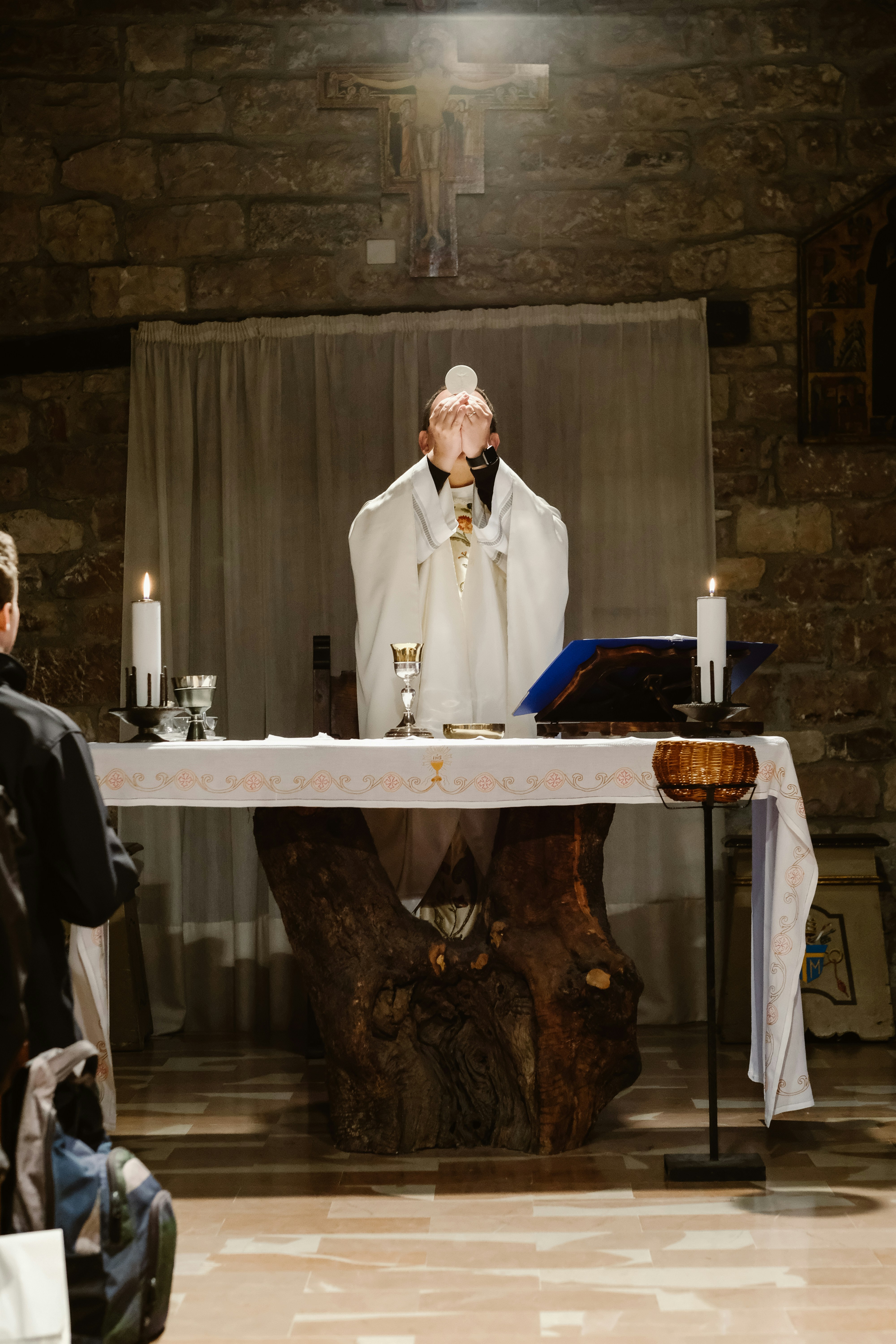
Christ feeding His spiritual family members his own Body and Blood, an ongoing act of love that comes to us from His apostles because He extended it to them on the night of his Last Supper.
And it is all of the above, but I feel prompted to highlight what else stood out to me as I read the passages this time around:
A man came from Baal-shalishah bringing to Elisha, the man of God, twenty barley loaves made from the firstfruits, . . . . Elisha said, “Give it to the people to eat.” But his servant objected, “How can I set this before a hundred people?” . . . . And when they had eaten, there was some left over, as the LORD had said.
2 Kings 4:42-44
This passage and the New Testament one tell me that questions and doubts are only obstacles to God to the extent that they keep a person from acting with faith. In both passages, people act as God inspires them to do, and God works with what they give. God keeps his promises and gives more than the people hope for.
The eyes of all look hopefully to you, and you give them their food in due season . . .
Psalm 145:15
This verse reminds me that God’s timing may be different from mine. It doesn’t say God will give me what I want right now. Instead, it says God will give me what I need indue season — when the timing is best for me and for the overall plan.
Brothers and sisters: I, a prisoner for the Lord, urge you to live in a manner worthy of the call you have received, with all humility and gentleness, with patience . . .
Ephesians 4:1-2
This excerpt relates to how God provides for us by giving Himself because we need God’s humility, gentleness, and patience to allow God to provide for us in other ways. God doesn’t force-feed us. Instead, God waits for us to be open to receiving Him.
Trusting in God, who isn’t limited by our sense of time and timing also takes patience.
Feeding others from the gifts we have received, in other words, making Christ visible in what we do, requires the virtues mentioned in this excerpt as well.
“’Gather the fragments left over, so that nothing will be wasted.'”
John 6:12
In addition to reinforcing the lessons of the Old Testament passage, the New Testament passage includes the above instruction. Not only does God give us more than we hope for in due season, but also we must be careful not to waste the abundance we receive. What we don’t waste can meet future needs.
What someone else is sharing about this week’s readings:
Dr. Alice Prince points out that the virtues highlighted in this week’s epistle don’t just make room to receive God’s abundance. God’s abundance is one of those proverbial two-way streets. Receiving God’s abundance helps us experience and practice those virtues.
Beyond this week’s readings:
It’s easy enough to quote Scripture passages as evidence that God provides. I even posted last week about the ways I’ve noticed God providing for me lately. Even so, I know there are plenty of situations in which it doesn’t seem like God provides. I listed some of those situations at the end of last week’s post. I find myself asking, “Lord, if you can use five loaves and two fish to feed more than 5,000 people, why aren’t you making sure everyone in Gaza, the U.S. or everywhere else in the world has enough to eat right now? Don’t you care about food insecure and starving people anymore?
Faith tells me the answer is “yes.” But I wonder how often humans get in the way of God’s providence. I know that too often what’s left over gets wasted and doesn’t make it to the people who need it.
This week’s prayer:
May we never interfere with God’s providence. May we participate in it instead. And may we never waste what we have to share, in the name of the Father, the Son, and the Holy Spirit. Amen.
I’m back — a week later than I thought I’d be. The events of the last week or so are reminders that intentions and plans aren’t guarantees. Plans and intentions can come from God. Without them, no one would start anything. So we all make blueprints of one kind or another, but none of us is working on a complete project. Rather, we’re all working on segments of that project, and only God can see what it will look like when it’s complete.
It was a storm that kept me away week longer than I thought I’d be. But because I’d planned to be away, I wasn’t long without comforts my neighbors missed for almost a week — electricity and everything it allows us to have. I’ve also been visited by a respiratory virus, that while it hasn’t required hospitalization or unusual treatment, it also hasn’t been fun. These things usually aren’t, and I’m on day thirteen of the symptoms.
Even so, I have renewed gratitude for the following:
the ability to power up the computer and dictate this post.
the ability to use my phone and to recharge it when its battery dies without having to prioritize returning my portable battery charger first
the ability to watch TV
the ability to heat, refrigerate, and freeze food
the ability to come out of the heat and into an air-conditioned room
the ability to lie down into sleep for an entire night without waking up coughing
the ability to breathe through one’s nose, to taste, and to smell. When I fully enjoy the privileges included in this last list item, may I never take them for granted again
I wonder how many people in the world either don’t get to enjoy the comforts I just listed or have much more limited access to them than I do.
I also know that too many people are deprived of even more basic needs, and the following are only a few:
the need for food
the need for for access to clean water
the need for freedom from violence and other threats to safety
This week’s prayer:
And yet, this week’s readings promise a Shepherd who meets the needs of His flock, not the least of which, as Yolanda Chavez says, is to accept the rest the Shepherd offers as we participate in the Shepherd’s work.
Good Shepherd, thank You for the safety, food, and rest You offer. Thank you for your accompanying us as we endeavor to trust in Your providence. May we be sources of that providence. Amen.
The theme I’m getting from this week’s readings is that authentic, nurturing strength comes from God. Like last week’s passage from 2 Corinthians, this week’s Old Testament reading reminds me that nothing visible will remain as it is forever. The passage says branches of a cedar tree can break off and become shoots that will grow into a new tree able to shelter everything. A towering tree can also be struck down, a green tree can wither, and a withered tree can bear fruit. All of the above can happen because God allows it. The passage closes by reminding me that God keeps God’s word. God is trustworthy.
This week’s psalm excerpt begins with the following words:
It is good to give thanks to the LORD, to sing praise to your name, Most High, to proclaim your kindness at dawn and your faithfulness throughout the night.
Psalm 92:2-3
It says that those who are just will “flourish” (Psalm 92:13-14). It says those who have deep roots of faith in God will remain with God eternally. They’ll never cease to bear fruit. They can sway in high winds without breaking. They proclaim the perfect love of the Lord without hesitation.
The epistle, like the psalm, presents the ideal attitude and behavior of someone who places his or her trust in God. This person is “courageous,” always seeking to live the life God has called him or her to live with the help of the Holy Spirit (2 Cor. 5:8). He or she lives this way despite the struggles and obstacles involved in living this life and despite desiring to be free of these troubles and obstacles. Why? Because the person has faith that on the other side of death, he or she will reap what he or she has sown, “whether good or evil” (2 Cor. 5:10).
The Gospel reading uses a parable to remind me that I’ll reap what I sow. I find the way the Gospel passage shares this message to be more relatable and encouraging than the way the epistle teaches the same. The Gospel passage says to me that I don’t have to know every step of the path forward for the journey to be worth taking and to bear fruit. The smallest seed can grow into a tree that will serve so many good purposes. And God gave that seed the innate ability to grow when it’s cared for and to become so much more than it appears to be able to become.
What someone else is sharing about this week’s readings:
Kathleen O’Brien acknowledges that it’s natural for all of us to imagine the end results of processes we begin and journeys we set out on. At the same time, her reflection on this week’s readings uses the lifecycle of the mustard seed to invite us to recognize God’s presence in each stage of the process or journey. She encourages us not just to focus on imagining the end result we want but also to recognize that each stage is important for growth and contributes to the end result. Furthermore, she invites us to recognize that the end result may be different from what we had imagined, but differences don’t reduce the value of the result.
Beyond this week’s readings:
“. . . I want to . . . invite you to recall and reflect on something you have or are tending to. . . .Now, when you reflect here, what do those different stages in consistently tending to something look like for you? How did you feel when you first started your big project . . .? Maybe your feelings would swing from feeling confident and in control to then feeling inadequate and not enough. What were your imagined expectations of the end result?
When it comes to tending the current iteration of my novel manuscript, the first stage feels like knowing something no one else does yet. It’s an exciting experience because it’s the experience of starting something new. It’s a journey no one can get in the way of yet because no one else knows about it yet. What grows out of my seat of an idea can’t yet fall short of resonating with someone else the way it does with me. It’s good enough for me, and that’s all that matters. The seed feels safe cocooned in darkness.
In the second stage, the drafting stage, the seed of an idea struggles to break the surface of the soil, which in this case, means it struggles to transform from the dialogue-and-image snippets in my mind to sentences, paragraphs, and pages in my word processor, And I want so much for those pages to describe a coherent and satisfying series of events experienced by empathetic characters. This stage means relying on determination — faith by another name — in the face of frustration.
In the third stage, my seed will be exposed to the elements. The elements, in this, case will be the feedback of others and of editing software. The plant may be pruned. It will likely have more done to it than pruning. It will have branches removed from it. It may even be cut back to the point of being no more than a seedling again. It may need to be planted elsewhere and to grow into a different shape than the one my constantly shifting vision had of it as a mature plant.
Only a couple of my fictional plants have ever grown beyond their first exposure to the elements. None of my ideas for novels have ever grown beyond the third stage. I’ve felt overwhelmed by the feedback, the revision process it necessitated, and the time the process required of me. I couldn’t figure out how to make my seedlings for novels hardy enough to survive, let alone thrive. I couldn’t see how to manage their networks of roots that grew, seemingly, in every direction. Their sprawling root systems tripped readers and blocked their paths so that no one, not even I, could get close enough to benefit from what they might have had to offer.
This week’s prayer:
Lord, help me to trust that You are at work in both the consolations and desolations I experience on this journey of life. With the power and guidance of Your spirit, I can allow both joy and pain to bring me into union with You. I can become and do more than I imagine. Help me trust in Your vision and that You have a plan for achieving it, even though I can’t see the plan or the realization of it yet. I pray this prayer in the name of the Father, the Son, and the Holy Spirit. Amen.
The first reading says to me that even though God wants us to trust in who He is and what He says so that we can live without shame and without hurting ourselves and others, He understands how easily we can be tricked into not trusting in who He says he is and what He says about how to avoid hurting ourselves and others. He wants to defend us against and protect us from what distorts our vision of Him, of ourselves, and of others.
The psalm is a plea for that defense, that protection from the Lord. It reminds me not to let my weaknesses and the ways I fall short lead me to give up hope but instead, with patience, to ask the Lord to pick me up when I fall and to expect that God will do just that and is waiting to help me avoid falling into the same pits in the future, provided that I trust in the support God offers.
From my perspective, this week’s readings are about what God does in response to what I do and how I can respond so that God works in and through me; the passage from Corinthians is no exception. The passage reminds me to respond with trust in God and to let that trust be reflected in my words and actions. If I do, the letter promises, I’ll help grow a family that recognizes the presence of God and radiates it now and eternally. If I do, my actions will spread gratitude for the gifts and the graces God gives. My own physical and spiritual frailties won’t be able to tempt me to despair. Neither will anyone else’s choices or any other obstacle. Rather than being temptations, weaknesses and obstacles can be reminders that I’m dependent on God’s grace and that nothing the senses detect lasts forever. But God within and God and around me “is eternal” (2 Cor. 4:18).
The Gospel passage says to me that only my attempts and the attempts of others to place limits on what God can do have the ability to limit what God can do. I have the ability to put these limits on God because God isn’t in the habit of overriding free will. God can, and I suppose sometimes does, for the sake of the overall Plan, but God doesn’t seem to prefer to work this way. God is one God in three Persons — relationship by nature. Because God isn’t subject to the limits God has placed on the material realm, God calls me to nurture relationships not only with those connected to me by DNA or with those who can offer me something material, but with everyone who wants to be open to God’s grace and to live by it, and to share it.
What someone else is sharing about this week’s readings:
This week’s readings prompt me to ask myself some questions:
What does it mean to trust in God? Does it mean just letting life happen to me and assuming that whatever happens is God’s will?
I don’t think so. Maybe part of trusting in God means trusting that God has given me the ability to look at the effects of my choices, to evaluate the extent to which these effects are positive and negative and to reflect on how I might avoid certain circumstances in the future and/or modify my choices in the hope that their effects will be more positive in the future.
Can I always know whether the results of my choices will be positive or negative? No.
Is my perception of what’s positive and negative always crystal clear?
No.
Will I always see the results of what I do?
No.
My limited perspective is another reason trust, which is another word for faith, comes is important.
Do I have perfect faith?
No. Far from it.
The renewal of my inner self has a long way to go. I take comfort in the reminder this week’s readings provide: God knows I can’t renew myself, so with my help and permission, God is “renew[ing]” my inner self “day by day” (2 Cor. 4:16). What God asks of me is that I invite Him again and again to renew me.
I can’t see that day-by-day renewal right now, but I choose to act with trust that it’s happening by inviting God to work in me again and again.
This week’s prayer:
Come, Holy Spirit. Amen.
Work cited
The New American Bible Revised Edition, Kindle edition, Fairbrother, 2011.
The transition from spring to summer and the changes in schedules that it brings has invited me to be open to new routines. But I’ve never been naturally inclined toward this kind of openness, and this week has been no exception. It’s Saturday afternoon, and I haven’t worked on this post since I typed this week’s readings above a week ago. I’m short on time, so I’m going to write what’s been on my mind to write in honor of this week’s Solemnity of the Most Holy Body and Blood of Christ.
I’ve been thinking about this solemnity in light of last week’s solemnity, thinking that this weekend we celebrate the sacrificial love of the Trinity’s incarnation. It’s a love is willing to live for others to the point of suffering and dying for them. This death allows the sacrificial love of the Trinitarian God to take a different form, one I can see, touch, taste, and consume, even though I’m not living during Jesus’ earthly ministry.
Of course, I’m not the only one who can receive this gift. It’s been available to Jesus’ spiritual family members since the Last Supper—before Christ made His final sacrifice on the cross, and it continues to be offered and will continue to be offered until the end of time. The offerings of the Trinitarian God aren’t limited by time and space.
Yet these gifts are not merely abstract, spiritual, and mystical, though they can have all of these qualities. They’re tangible and consumable. These physical qualities allow the incarnate Trinity to become part of the physical body of anyone who takes and eats them. The physical forms of bread and wine allow us to receive the Body, Blood, Soul, and Divinity of the Trinity, and when we live lives that make our souls homes for these gifts, more and more, we become what we eat and carry it into the world around us.
What someone else is sharing about this week’s readings:
Sr. Julia Walsh. FSPA reflects on how this week’s solemnity reminds us that what’s ordinary is also sacred. She tells of times when this reality has been particularly palpable for her, times when she’s experienced it in communion with others.
This week’s prayer:
Lord, thank You for feeding me spiritually and physically. Restore in my body and soul a dwelling place for You so that You can be recognized in me, and I can do my part to heal the wounds in Your Body. I ask this in the name of the Father, and of the Son, and of the Holy Spirit. Amen.
This week’s readings tell me that the Trinitarian nature of God means that God is more intimate with everything that is than human understanding can conceive of. And even though this is the case, God’s intimacy doesn’t mean that God is too small or too close to us to have a view with more dimensions than we can imagine. God so intimate as to dwell within us and to be discoverable in everything around us while being the source of all that is. God is the ultimate mother, father, sibling, partner, and inspiration.
What concerns us can neither be too big nor too small for God, and with God’s help, what concerns God is neither too unmanageable nor too insignificant for us to be concerned with. God invites us to open ourselves fully to the Trinity and the gifts — relationships, talents, and resources — that come from a God who is both so like and unlike us, a God who is without limits, except to the extent that God limits God’s self.
The following quotations from the readings for May 26 encapsulate for me what The Most Holy Trinity means:
. . . fix in your heart, that the LORD is God in the heavens above and on earth below. . . [Italics mine]
Deuteronomy 4:39
The Spirit himself bears witness with our spirit that we are children of God, and if children, then heirs, heirs of God and joint heirs with Christ, if only we suffer with him so that we may also be glorified with him.
Romans 8:16-17
Does the second quotation mean that we should seek out suffering? No, but it acknowledges that to live as Jesus did during his time on earth, will have to allow ourselves to be inconvenienced at the very least. And we may be asked to endure more than inconvenience. If we never find ourselves inconvenienced by our efforts to follow and imitate Christ, how closely are we following and imitating him? Where are we on the path to becoming the people God can see is becoming if we follow and imitate Christ? Where are we on the journey to becoming undistorted versions of ourselves?
Then Jesus approached and said to them, “All power in heaven and on earth has been given to me. Go, therefore, and make disciples of all nations, baptizing them in the name of the Father, and of the Son, and of the Holy Spirit, teaching them to observe all that I have commanded you. And behold, I am with you always, until the end of the age.”
Matthew 28:16-20
What someone else is sharing about this week’s readings:
Julia Erdlen reflects on the mystery of the Trinity as both comforting and confounding.
Beyond this week’s readings:
When I grappled with what words of my own to use to summarize Julia Erdlen’s reflection, I used “confounding” because it started with the same letter as comforting, which would make the summary memorable and because I thought “confounding” meant “mysterious.”
However, the Oxford Languages dictionary that the Bing search engine defines confounding this way: “cause[ing] surprise or confusion in (someone), especially by acting against their expectations” Considering this definition, “confounding” and is an unintentionally fitting adjectives to use when describing a God who is three persons in one, a God who had us and all that’s good in mind before everything began, who has been with all that’s good in every way since it came into existence, and wants to bring us to be with Him if we’re willing to come and to let go of the work of our hands and let God free us from the clutches of what stands between us and Him. It takes a God who is both indwelling and who was before everything and will be after everything to accomplish all that. It takes a God that we can’t fully understand or describe an entirely accurate way. It takes a God who surprises us by “acting against our expectations” and working beyond our limitations. This Trinitarian God helps us recognize which limitations are real but only temporary and which are illusions God is waiting to help us see through once we ask for and we cooperate with the grace of the Holy Spirit.
This week’s prayer:
Lord, thank You for giving us today is a reminder of how surprising, how incomprehensible, and yet how familiar You are. Help us always to grow in familiarity with You until, when we pass from this life, we can fully embrace and understand You and all You have brought into being. We offer this prayer in the name of God who is one in three Persons — Father, Son, and Holy Spirit. Amen.
What stands out to me about the first reading Pentecost is that the Spirit first draws Jesus’ earliest followers together for prayer. Then it pours gifts on each member of the group. These gifts prepare each person receiving them to share the gifts of the Spirit with other individuals. The Spirit gathers people together to set them apart, to prepare each of them to work with others and to do work that only each one of them can do.
The psalm recognizes that every resource and everything that lives is the work of the Spirit. Nothing exists without the Holy Spirit, though the work of this Spirit can be corrupted by other spirits that tempt us to actions that the Holy Spirit must work around instead of with.
The third reading, the epistle, reminds us that what we do says a lot about which spirit has the upper hand within us. The Holy Spirit is unselfishness in all its forms. It isn’t divisive, but the spirits, attitudes, and actions that oppose it are. The passage also tells us that the Holy Spirit can’t be contained. When we become vessels for it, it fills us up and spills out of us, sharing its fruits with the next person and then the next one and with the tasks we’ve been given. Come to think of it, the first reading also teaches the same lesson.
The Gospel passage reminds us that the Holy Spirit comes from God to dwell within us and among us because Jesus Christ is one of us and lives in union with the Holy Spirit and the Father, which are the active life force and its Source. Christ shares the Spirit with us so that we can live as children of God now and forever and continue to grow in our knowledge and experience of what it means to be children of God.
What someone else is sharing about this week’s readings:
This week’s readings help Maureen O’Connell reflect on what it means to be “a people” and by being “a people,” to evangelize. She also applies the Pentecost Sequence to our present moment in a powerful way.
Beyond this week’s readings:
Almost a year ago, in celebration of Pentecost, I linked to a musical adaptation of the Pentecost Sequence. It’s called “Come Holy Spirit.” Its music is composed and performed by John Michael Talbot. I find this music in these lyrics helpful for letting the words of the sequence sink in. Taking a look at one or the other of the sources linked in this section adds its context to the adaptation of the sequence included in Maureen O’Connell’s reflection.
This week’s prayer:
May my life reflect the fruits of the Holy Spirit: “love, joy, peace, patience, kindness, generosity, faithfulness, gentleness, self-control” (Gal 5:22-23). through the Father, the Son, and the Holy Spirit. Amen.
This week’s readings are the readings that commemorate the Ascension of the Lord. The themes of this week’s passages call to mind themes we’ll revisit near the end of the year, on the last Sunday before Advent, the feast of Christ the King. On this day and on that one, we honor Christ’s kingship.
Today, the first reading gives us a summary of what happened during Christ’s reign on earth. It reflects on the past. In the same passage, the apostles ask the risen Lord what His resurrection means in terms of the prophecies about the Messiah that have been handed down to them. They wonder what the prophecies and the resurrection mean for their futures. He tells them this is no time to sit back and wonder what God is going to do. He tells them instead to focus on what He has asked them to do, which is to do as He has done and to share what He has taught them.
This week’s psalm is one that praises God’s kingship.
In the epistle, the third passage listed above, Paul tells the church in Ephesus how to live as Christ lived and how to teach what He taught. He says the key to communion with others and Christ is practicing “humility and gentleness” so that we might “preserve the unity of the spirit through the bond of peace” (Eph. 4:2-3). Embracing these qualities allows God, who is Love, to reign “over all and through all and in all” (Eph. 4:6).
To me, the passage seems to go on to say that Christ didn’t ascend to reign “over all” without descending into death and into a tomb first so He could loosen the grip of death on creation (Eph. 4:6-10). By ascending He cannot only reign but rain gifts on all of creation. These gifts prepare each of us to grow in union with God, to help others grow in that union and to care for what we have in different ways (Eph. 4:10-12).
The Gospel passage reminds us that if we don’t grow in union with God, we die. Furthermore, if we don’t care for the people and resources we’ve been given, we lose them. We run out of resources. The Gospel passage also reminds us to share what we’ve been given and that the gifts we have possessed great power.
What someone else is sharing about this week’s readings:
This week, Martha Ligas proposes that the natural world can teach us how to live out the mission that Jesus gave the apostles.
Beyond this week’s readings:
These signs will accompany those who believe: in my name they will drive out demons, they will speak new languages. They will pick up serpents with their hands, and if they drink any deadly thing, it will not harm them. They will lay hands on the sick, and they will recover.
(Mark 15:17-18)
The above excerpt reminds me that for we flawed human beings, every gift brings with it temptations. Humans sometimes use this verse and the fact that they can receive, live in, and share God’s spirit as justification to put God to the test. We read that when the spirit drives Jesus into the desert, Satan tempts him to put God to the test by commanding a stone to turn into bread and by throwing Himself off the parapet of the temple and expecting God to rescue Him (Luke 4:3 and 9-11). Jesus responds by telling us and Satan that neither we nor He should put God to the test (Luke 3:12). Possessing God’s spirit doesn’t mean we should act without employing reason and exercising prudence. The rules in place in the natural world are just as much reflections of who God is as are events humans are more inclined to call miracles. Let’s celebrate the beauty of nature and laws of the universe and respect that God works within and beyond these gifts. God’s vision is deeper, wider, and clearer than ours is. To respect and to celebrate this reality is to live with gratitude and humility.
This week’s prayer:
The following prayer has a lot of work to do to come to fruition in me: Lord, may we not invite trouble and danger, fear what trouble may come, or be afraid when You allow difficult times to invite us to turn to you and be transformed into the people we can become in You. Amen.
This week’s readings are about who God is and what it means to live with God by living like Jesus did when he walked the Earth. This week’s readings tell us that God doesn’t have favorites. God doesn’t care what country, or culture, or group someone who wants to be in a relationship with God comes from. And God isn’t stingy, selfish, or secretive.
God has invited us into us into a covenant, a bond like a marriage, so God wants to share the present moment and what we think of as the future with us. God asks us to be life partners who can share in God’s dreams and take part in making them a reality. God wants to form and grow an eternal family with us.
God wants all of the above, so God through Christ came and comes to meet us as we are. He holds back no part of himself from anyone who’s ready to commit or to re-commit to Him. Because He wants to share a loving, committed relationship with us, He wants us to choose that relationship and respects our freedom to decline it or to walk away from it. He’s not controlling and knows better than anyone else how important open communication is to the health of that relationship.
What someone else is sharing about this week’s readings:
I only really love God as much as the person I love the least.
Dorothy Day, quoted by Meghan Larsen-Reidy
David Brooks writes about the difference between résumé virtues and eulogy virtues. We often worry about appearing the best that we forget we should simply love the best.
Meghan Larsen-Reidy
This week’s prayer:
Lord, I ask You for the grace not to limit through my actions, words, or finite imagination how, where, and through whom You can work. Amen.








 Sitting with the Sacred