Feeds:
Posts
Comments

Posts Tagged ‘Relationship with God’

Photo by Bruno van der Kraan on Unsplash

This week’s readings:

  1. Acts 10:34a, 37–43
  2. Psalm 118:1–2, 16–17, 22–23
  3. Colossians 3:1–4 
  4. John 20:1–9

What this week’s readings say to me:

Happy Easter! This week’s readings present me with contrasts. The contrast I find in the first reading is that Jesus came to minister, to suffer, to die and to rise so that “everyone who believes in him will receive forgiveness through his name ” (Acts 10:43). Yet relatively few people had the privilege of being witnesses to His ministry, His suffering, His death and His resurrection. Yet the small group chosen for this purpose was “commissioned to preach to the people and testify that [Jesus is] the one appointed by God as judge of the living and the dead (Acts 10:42).

The third reading says:

Brothers and sisters: If then you were raised with Christ, seek what is above, where Christ is seated at the right hand of God. Think of what is above, not of what is on earth. For you have died, and your life is hidden with Christ in God.

Colossians 3:1-3

It sets up a contrast between what’s above and what’s below.

The Easter Gospel reading and that the contrast between what Jesus’ first followers thought the disappearance of his body from the tomb meant — having Jesus taken from them — and what they later came to understand the disappearance of his body from the tomb— having Jesus restored to them in His glory. The third reading testifies to the greater understanding of the events of Easter morning that Jesus’ followers came to over time.

At the same time, I think the contrasts presented in the third reading point to how understandings of Jesus’ mission for us have developed since the third reading was committed to paper. It’s my understanding that the first recipients of the third passage assumed Christ’s return was imminent. I think I’d be a lot less inclined to worry about what’s going on around me if I thought I was about to be taken out of those circumstances.

This is not the only scripture passage that tells Christians what not to worry about. For example, Jesus tells us not to worry about what to wear and what to eat (Matt. 6:31-32). But when looked at alongside other teachings of Jesus and of Paul, I don’t think either person was advising us to be passive and wait for what we need and what others need to materialize from Heaven. 2 Thessalonians 3:10 says “… we instructed you that if anyone was unwilling to work, neither should that one eat.” (As an aside, this verse is often used as a political weapon, so I’d like first to make a distinction between someone who cannot work enough to support him or herself and someone who could but doesn’t. A person on the outside of an individual’s situation is unlikely to have enough information to assess with perfect clarity whether a person is doing all he or she can to support him or herself. Secondly, I’d like to offer that a person who supports others doesn’t necessarily get income from that work with which to feed him or herself. This reality doesn’t mean the person is lazy.) Jesus says, “If anyone wants to go to law with you over your tunic, hand him your cloak as well” (Matt 5: 40). In these examples, Paul and Jesus are concerned with the challenges of life here on earth. They aren’t focused on a future reality where these challenges don’t exist.

So I propose that the lesson of the third reading is not “Think only about God, angels and saints rather than what’s going on around you. Instead, the lesson is to look at what’s around us and what we have and don’t have through eyes of faith. Perhaps the third reading offers a different way of bringing us back to the message we received at the start of Lent. Perhaps we are being reminded that only God is eternal. We are eternal when we unite ourselves to God by trusting Jesus and doing as He does. What we celebrate today reminds us of that promise and that reality.

Some aspects of life are gifts from God — and we can recognize them as such – but aren’t eternal. Other aspects of life aren’t welcome, and the promise that they aren’t eternal is good news. For both cases, perhaps this week’s passage from Colossians is a reminder to discern what’s eternal — the qualities of God — and not to treat what’s not eternal as if it were.

What someone else is sharing about this week’s readings:

Dr. C. Vanessa White invites us on this Easter Sunday to be to the world around us what Mary Magdalene was for the apostles on the first Easter Sunday.

Beyond this week’s readings:

Here it is, Easter Sunday. Do I feel or think I’ve moved any closer to God than I was at the beginning of Lent? I wish I could say I do, but I don’t. But what I decided to offer to God this Lent did teach me. It taught me how important my favorite free-time activities are in my life and how much they feel like additional ways to express myself. They make me grateful for the many forms beauty takes in this world.

I’m also grateful that taking time away from these activities made me appreciate them more and helped me be more present to what’s happening around me and not to rush to these activities rather than expressing myself through writing first. Still, letting myself be bored and/or uncomfortable, and struggle with practicing the discipline of focus has been a strain.

I think that during these weeks of Lent, I’ve gotten used to making time for ways of expressing myself that have greater potential to serve others than my favorite hobbies do so that now I can continue benefiting from these flexible practices every day while reintroducing other hobbies.

Learning from and living with Jesus changed the lives of those who walked with him on Earth. But experiencing life with Jesus didn’t erase the pasts of His spiritual brothers and sisters, their personalities, or all their concerns. Instead, sharing life with Jesus changed how his disciples saw the other components of their lives. Experiences with Jesus planted the seeds of being open again and again to changes in circumstance and perspective.

The understanding Jesus’ followers had of the significance of the empty tomb and how it related to their mission evolved over time. Similarly, I hope that as time goes by, I’ll recognize that greater spiritual growth and significance came out of this Lent then I can recognize today.

Open my heart to the significance of the empty tomb, Lord. You have left the tomb. Come and fill my heart to overflowing so that I can’t help but share Your love. Amen.

Work cited

The New American Bible Revised Edition, Kindle edition, Fairbrother, 2011.

Read Full Post »

Photo by Erik Mclean on Unsplash

This week’s readings:

  1. 1 Samuel 3:3b–10, 19
  2. Psalm 40:2, 4, 7–8, 8–9, 10
  3. 1 Corinthians 6:13c–15a, 17–20
  4. John 1:35–42

What this week’s readings say to me:

Becoming the person I’m meant to be means continually re-examining who and what I need to let go of and who and what I need to take hold of. It’s a continuous journey of discerning what to do when and when to let go of doing so I don’t get in the way of the Holy Spirit’s movement. The psalm says that God calls me to these cycles of surrender and action.

The third reading reminds me that I’m made for relationship — with nature, with others, and with God. It reminds me that to be in relationship means to give and to receive with commitment. A relationship isn’t fleeting, and it takes effort and maintenance. It takes openness.

God demonstrated that I’m made for relationship by living a human life. The relationship between the created and the creator is perfect in Jesus, and the Spirit that joins me to Jesus when I’m open to him can patch the imperfections in my relationship with God.

Because Jesus has a human body and consciousness, the body is just as much a part of God as the spirit. So treating my body and the bodies of others as if I believe this is true is vital. Doing so nurtures relationships between people and God. Treating bodies as and spirits if they are meant for eternal relationship — relationship between body and spirit, between one body and spirit and another, and between those sacred persons made of body and spirit and God — makes them open to eternal relationship.

“Do you not know that your body is a temple of the Holy Spirit within you, whom you have from God, and that you are not your own? For you have been purchased at a price. Therefore glorify God in your body,” the third reading says (1 Cor. 6:19-20). I don’t know about you, but thinking of myself as a possession bought by God makes my stomach churn. I’m not comfortable with the idea of a parent buying his or her children. But I guess if a child sold him or herself on the promise of receiving a reward that didn’t pan out, and the only way to get the child back was for the parent to buy him or her, I feel a little better about the analogy.

Nonetheless, I find the analogy of being part of God’s body more helpful. A head and an arm have different functions, but, of course, both are part of the whole that is the body. It makes sense to try to reattach an arm that has become separated from that body. To use another analogy that doesn’t come from Scripture (and, granted, doesn’t quite square with what I understand of Christian theology, but I’m going to use it anyway) the cards in a deck or the pieces in another type of game don’t own each other, they don’t control each other, but they belong to each other. If one piece of the set or one card from the deck is missing, the set or deck is incomplete and the game can’t be played as intended. Unlike a deck of cards or a chess set of which I might be a part, God doesn’t need me to be complete, yet God has a vision in mind, and that vision includes a place and a purpose for each of us.

The Gospel passage reinforces that God calls us to relationship, a place, and a purpose in the Divine plan. In this passage, Jesus doesn’t call his disciples in an obvious way. Rather, he walks by, and John announces who he is (John 1:36). Two disciples respond to the announcement by following Jesus and by asking where he’s staying (John 1:37-38). They aren’t seeking knowledge alone from Jesus. They want relationship with him, to know him, and to be known by him, to go where he goes, do what he does, and stay where he stays. They want to be a part of his group, his set, you might say.

What someone else is sharing about this week’s readings:

Laura Boysen-Aragon reflects on the (anxiety inducing for me) challenges and the opportunities of recognizing and responding to God’s voice reminding us with whom we belong.

Beyond this week’s readings:

Lord, help me to practice listening, to persevere in the practice, and help me also to know what work is — and isn’t – mind to do. Amen.

Works cited

The New American Bible Revised Edition, Kindle edition, Fairbrother, 2011.

Read Full Post »

Photo by KaLisa Veer on Unsplash

This week’s readings:

  1. Isaiah 61:1–2a, 10–11
  2. Luke 1:46–48, 49–50, 53–54
  3. 1 Thessalonians 5:16–24 
  4. John 1:6–8, 19–28

What this week’s readings say to me:

This week’s readings remind me that we’re all called to be a mirror for the Holy Spirit, and like Jesus, to share the mind, the heart, and the eyes of God. We are called to use this mind, this heart, these eyes, and the rest of our bodies to do God’s work rather than to be a boulder the Holy Spirit has to go around. While each of our callings has what I just mentioned in common, none of us can know all that God knows, I see all that God sees, or can have compassion on all that God has compassion on. Unlike God, we’re limited — not omnipotent. We can’t be everywhere, do everything, and know everything all at once.

But this isn’t bad news. Rather, it points to the Good News. One way aspect of this Good News is that the limitations mean we need each other and God. Another aspect of this Good News is that, as Richard Rohr said, God’s nature is relationship, and as we are made in God’s image, we are made for relationships — with God and one another. We were made to depend on God and one another and, by being open to the movement of the Holy Spirit within us, to be dependable for God and each other. We are dependable for each other and God when we reflect the unique combination of God’s qualities that each of us is able to.

This week’s readings show how four different people will read with God so they can reflect Divine qualities in different ways. Perhaps the first reading demonstrates how two people do this. Through a prophet, this passage foretells what life will be like when God takes on a human existence and when God reigns over the “. . . new heavens and a new earth in which righteousness dwells” that we were promised in the third reading last week (2 Peter 3:13). In the second reading, Mary proclaims that despite her apparent insignificance in her culture, God has blessed her. God’s ways are not like human ways, and so she rejoices in who God is and what God and will do. In the fourth reading, John the Baptist reflects who God is by demonstrating humility, honesty, and an unflinching dedication to the mission God has given him. The readings themselves illustrate better than I can by just pointing to specific verses how Isaiah, Mary, John the Baptist and Jesus each invited the Holy Spirit to work through them in ways that are unique to who they are in the situations in which they find themselves.

Yes, I’ve skipped the third passage so forth because it doesn’t show us how a famous biblical figure invited God to work through him or her (except that the passage comes from a letter a letter attributed to Paul who is letting God work through him and reflecting God in a way that only he can by composing the letter). Instead, it instructs us in how to invite the Holy Spirit to work through us. It urges us to become a link in the chain of love, some other links of which we’ve met in the rest of this week’s readings.

No link in this chain is a copy of the others around it. It’s not a dull, rough restraint that rubs skin raw. I propose it’s more like a bracelet on which each charm or jewel is unique, each reflecting the light in a different way and reflecting a different, significant moment.

What someone else is sharing about this week’s readings:

Bridget McDermott Flood reflects on a theme given to the third Sunday of Advent every year — joy — and how to experience it.

Beyond this week’s readings:

This reflection from Jeff Cavins was released in response to last week’s readings. However, I heard it right before I looked into this week’s readings as I prepared to draft this post, and I heard influenced how I read this week’s passages. You’ll need to login to listen to the reflection, and even after you login, this particular session may not be available on the free version of the Hallow app. In case you are unable to listen to it without subscribing to the paid version of the app, the gist of Mr. Cavins’ message is that each of us is called to “Prepare the way of the Lord,” even though each of us may not be called to do so in the same way as the person next to us (Isa. 40:3).

When I hear “prepare,” I think of doing something, but I’m realizing how often changing my habits would involve not doing something. Yes, I say hurtful things, and a version of me in perfect union with God wouldn’t. But as I reflect on this blaming, these barbs, I realize that even they come from my wanting to make the pieces around me fit where I want them to, instead of accepting that I can’t make them fit.

Maybe I and the people around me aren’t connected like precious charms on a bracelet, but more like pieces of broken, yet beautiful differently colored pieces of glass that God brings together to form a beautiful picture. A few days ago, I saw a Christmas movie whose title I’ll only link to here so that anyone who wants to can avoid having me spoil its plot. For these readers, I just want to acknowledge that the plot of that movie inspired my colored-glass metaphor. In my life and in any life, the pieces are the shapes and colors they are. All I can do is accept the pieces as they are, let God polish the piece that is me, and seek where I fit best.

It’s difficult enough to seek where I belong in the mosaic and to let God polish me. I didn’t come up with the concept for the overall picture the picture or any of its elements, nor do I know what the whole picture looks like, so its components usually don’t connect the way I’d like them to, I feel frustrated and embarrassed that I can’t complete the picture as I would like because I can’t see the whole picture. I respond to these feelings by lashing out and making edges on the multicolored, reflective shards sharper and the gaps between them wider. I scatter the pieces, accomplish the opposite of what I want by trying to force what I want to happen, to make it take place when and how I want it to. What would do the most good is surrendering instead. In addition to the prayers I linked to last week, this prayer is one I find myself turning to for help with surrendering:

Take, Lord, and receive all my liberty,
My memory, my understanding
And my entire will,
All I have and call my own.
You have given all to me.
To you, Lord, I return it.
Everything is yours; do with it what you will.
Give me only your love and your grace.
That is enough for me.
Amen.

Prayer of St. Ignatius of Loyola

Lord, help me experience Your love and grace as enough for me. Help me to mean the words of the above prayer, trusting that when I offer the gifts You’ve given me back to You, You’ll remove any distortion caused by sin from them and they’ll do the good you intend them to do. Amen.

Work cited (but not linked to)

Confraternity of Christian Doctrine, Inc. “3rd Sunday of Advent, Sunday 17 December 2023: Readings at Mass.” The New American Bible, 2001. Universalis for Windows, Version 2.183, Universalis Publishing Ltd., 31 Oct. 2023, https://universalis.com/n-app-windows.htm.

Read Full Post »

Photo by Ashin K Suresh on Unsplash

This week’s readings:

  1. 1 Kings 3:5, 7–12
  2. Psalm 119:57, 72, 76–77, 127–128, 129–130
  3. Romans 8:28–30
  4. Matthew 13:44–52

This week’s readings are about the value of wisdom, what wisdom looks like — and what it doesn’t look like. They tell me that wisdom means wanting to know right from wrong. It also means knowing that without God’s grace, I can’t know right from wrong. It means having hope because the ultimate form of the many forms this grace takes is that God was carried and delivered by a woman, entering personally into the human experience. God entered into the darkest parts of that experience, giving everything possible to those darkest experiences so the Light could overpower them. Nowhere the Light breaks through can remain as dark as it was before Light’s entry, and the more Light is allowed in, the more darkness is pushed out. The way I’m thinking about this in terms of Jesus is that once the Spirit had left his human body, suffering and death no longer had metaphorical fingers on God.

They still have fingers on God’s creation, but those fingers no longer have a chokehold on it because the darkness cannot be stronger than unfettered Light. Because Light’s now unfettered, it shines on all of creation — or it would if it could shine through everyone.

But we all block the Light in some ways; I know I do. My desire to have only what I want when I want it and nothing I don’t gets in the way of the light shining through me. This desire lets ingratitude and covetousness spread in my heart. From my heart, it spreads to my mouth and comes out as criticism and self-righteousness fueled by unchecked anger and resentment. Fears about not getting only what I want when I want also get in the way of me being a conduit for the Light.

Such desire and fear is selfishness. It’s the result of looking at myself, others, and God only through the lens of my own pain and my desire to avoid it. I can’t honestly say I’m willing to sell everything that seems to allow me to avoid it so that I can make room for the Kingdom of God that Jesus has purchased for me. I don’t honestly trust myself to protect the treasure of the kingdom that is within and around me. I’m not even sure I can honestly say I want to. But I know that I want to want to. So my prayer for this week is for the Spirit to give me true wisdom so that I can recognize in a personal, heart-based way what a treasure the Kingdom of God is. Amen.

I sense that I received one answer to this prayer before putting it into words here. I sense that I may find what I’m seeking by approaching this blog differently in the future. One part of my idea – we’ll see if it’s God’s idea too — is to post links to others’ reflections on the readings each Sunday after this one. I don’t mean to say that I envision this blog becoming merely a place where I post links to other people’s writing and videos. On the contrary, the other part of my idea is to make this blog a place where I journal and pray through what ever form of expression seems most meaningful at a given time.

I feel called to shift what I write here from being focused on interpretation and application to being focused on conversation with God and with you. I suspect I’ll find it helpful to use prayer journaling prompts as inspiration for some future posts here. I hope they’ll inspire me to ask questions and to listen to and look for God. I also hope my exploration will encourage you to explore with God too. I’m discerning that I need more time for this exploration.

Taking this time may mean posting links to weekly reflections from others here and sharing journaling prompts and responses of my own more or less often than I have posted so far. I don’t know which. How often I post will probably vary what I’m wrestling with or sitting with. I’m looking forward to this new approach, this approach of noticing how the Spirit moves within and around me and not being in a rush to interpret what I notice or to tie it up in a very defined bow. Join me on this new adventure of following where the Wind blows and seeking the Light within and at each end of every tunnel. Lead me, Lord. Help me to dive deeper into love of You and everything and everyone that You love. Amen.

Read Full Post »

Photo by K. Mitch Hodge on Unsplash
This picture was one of the results when I searched Unsplash.com for “God’s-Eye View.”

This week’s readings:

  1. 2 Kings 4:8–11, 14–16a
  2. Psalm 89:2–3, 16–17, 18–19
  3. Romans 6:3–4, 8–11
  4. Matthew 10:37–42

I’d say this week’s readings are about how seeing the world through God’s eyes affects a person’s outlook and behavior. They’re also about how seeing this way reaps rewards, though often not one’s that come quickly or easily.

It seems a reward for virtue hasn’t come quickly or easily for the woman in the Old Testament reading. She’s promised a gift that she must worry she won’t receive —a son. The passage tells me “her husband is getting on in years,” and the couple doesn’t have a son yet, so there’s reason to doubt that would change as the husband ages (2 Kings 4:14). And not having a son could mean loss of financial security and social standing for the wife as she gets older, since, it seems, her husband is considerably older than she is. If he dies before she does, and she doesn’t have a son, she won’t have a home or support unless another male relative takes her in or she remarries.

The woman in the story isn’t going to be facing this situation though. Because of the hospitality she shows Elisha, he promises her that “by the same time next year, [she’ll] have a son” (2 Kings 4:16). The next verse reveals the woman’s life changes as Elisha has promised it will , but I think the fact that the reading ends before the prophecy comes true provides a lesson, which is that we can take Elisha at his word because word comes from God. The further message of the passage is that the woman receives her gift from God because she has supported God’s work in recognizing Elisha’s holiness and in offering him hospitality on account of it. In other words, good things happen to people who see the world through the eyes of God and respond to the needs that this way of seeing reveals to them.

This week’s psalm sends a similar message with the following words:

Blessed the people who know the joyful shout;
in the light of your countenance, old LORD, they walk.
At your name they rejoice all the day,
and through your justice they are exalted.

Psalm 89: 16-17

The thing is, if a person doesn’t see through God’s eyes, someone “exalted” through God’s justice may not look “raise[d] on high; elevate[d], as the New World College Dictionary defines “exalted.” After all, Jesus was exalted by God’s justice and yet he grew up in circumstances that were humble, to say the least, and he worked hard, traveling long distances on foot. Then he was subjected to an agonizing death. Furthermore, relatively few people were physical witnesses to the signifiers of his exaltation, the resurrection and the ascension. Not even Paul witnessed these events in the way that people who walked with Jesus while he was alive did. And yet Jesus allowed him to see with God’s eyes and to write:

Brothers and sisters: Are you unaware that we who were baptized into Christ Jesus were baptized into his death? We were indeed buried with him through baptism into death, so that, just as Christ was raised from the dead by the glory of the Father, we too might live in newness of life.

Romans 6: 3-4

I don’t know about you, but I usually don’t feel like I’m living in “newness of life” or that I’m going to, so I don’t feel like the people described in the psalm as “rejoicing all the day at [the] name” of God (Romans 6:4). I’ve heard some believers say that the times I least feel like doing this are the times I most need to do it anyway. Come to think of it, a lot of activities and mindsets feel like less of a struggle to me — writing I’m thinking of you here—when I make myself do them even when I don’t feel like it. I suppose this approach to life builds perseverance and resilience. Maybe being intentional about offering gratitude and praise would remind me that God has a broader view of life than I do. God sees which path is best. I can’t on my own, but sometimes, with God’s help, I can. Yet even in situations where the best path seems clear, I need to allow that God sees and knows things I don’t and can’t.

The reality that I’m limited in ways God is why I need God’s help to have healthy relationships. What’s best for relationships and the people in them isn’t always what’s preferred by the people involved. However, when I don’t love God first so that I can see my relationships through God’s eyes, and love the people as God loves them, I distort who the people are. I turned them Into idols. To do so is to give all of us less than we deserve, which is to be seen and treated like the unique reflection of God that each of us is.

Lord, help me to see the world around me as You see it so that I can recognize what reflects You in myself and others and nurture it. Plans whatever is in me and others that doesn’t reflect You, and help me to trust that surrendering to Your vision and Your cleansing will result in an exultation that surpasses anything this world can offer or imagine. Amen.

Work cited

Confraternity of Christian Doctrine, Inc. “Sunday July, 2 2023: Readings at Mass.” The New American Bible, 2001. Universalis for Windows, Version 2.179, Universalis Publishing Ltd., 26 Feb. 2023, https://universalis.com/n-app-windows.htm

Read Full Post »

Photo by Thomas Bormans on Unsplash

This week’s readings:

  • Exodus 19:2–6a
  • Psalm 100:1–2, 3, 5
  • Romans 5:6–11
  • Mark 1:15

When I read the first reading, the Old Testament reading, I thought, It’s easy to zero in on the last sentence of the passage: “You shall be to me a kingdom of priests, a holy nation (The New American Bible, 2001 Edition, Exod. 19:6). It seems we humans are naturally tempted to put ourselves in God’s “in crowd” and to assume that others who aren’t part of our group are not a part of that “in crowd.”

But Isaiah, sacred scripture to both Christian and Jewish people, says that “The Servant of the Lord” is “a light to the nations,” not to just one group or one nation” (The New American Bible, 2001 Edition, 42:6a). And the second-to-last sentence of this week’s Old Testament reading gives me a different way of thinking about who belongs to God than Exodus 19:6a does. “If you hearken to my voice,” it says, “and keep my covenant, you shall be my possession, dearer to me than all other people, though all the earth is mine (The New American Bible, 2001 Edition, Exod. 19:5). What matters to God is that we “hearken to [the Lord’s] voice,” that we resolve again and again to do what that voice asks of us, to share it, and so offer back to God what God has given to us.

When our response to God falls short of what’s best, God is there to renew the covenant by reminding us of what He has done and inviting us to reenter into the covenant with Him. He has never abandoned it; it is we who have done that, not allowing God to possess us. He doesn’t prevent us from wriggling out of His embrace when we find it uncomfortable, even though “all the earth is [His],” and “[h]is kindness endures forever,/ and his faithfulness to all generations” (The New American Bible, 2001 Edition, Psalm 100:5). God wants everyone to enter the Divine flock, so much so that “Christ, while we were still helpless, yet died at the appointed time for the ungodly” (The New American Bible, 2001 Edition, Romans 5:6).

Considering that He went so far as to die, in the words of Romans “for the ungodly,” His instruction to His disciples “not to go into pagan territory” seems incongruous (Matt.10:5). It seems even more confusing when we recall that Jesus praised that faith of a Roman centurion and “stated that, in heaven, many Gentiles will dine together with Abraham, Isaac, and Jacob” (Matt. 8: 10; qtd. in Newman). (Check out the source I just linked to. It gives great background on Jewish-Gentile relations in biblical times and what the New Testament says about Jesus’ perspective on Jewish-Gentile interactions. Furthermore, after the resurrection, a disciple and apostle—Paul—discerned that he was called to do the opposite of Jesus’ instructions in Matthew 10.5. (See Galatians 2:7.)

The contrast between Jesus’ instruction in Matthew 10:5 and the inclusion of Gentiles in His teaching on other occasions, as well as Paul’s ministry to non-Jewish people, reminds me that who, what, when, why, and how are key questions to ask when seeking to do God’s will and to follow in Jesus’ footsteps. The mission of each follower of Christ and each person of goodwill has certain things in common. And yet, each person’s vocation is different in some ways than the calling anyone else receives. In addition, what we shouldn’t do in one moment may be something that we should do at a different time. These lessons bring to mind Ecclesiastes 3:1-8, the verses that, in the King James Version, start with, “to every thing, there is a season . . . “The translation I usually turn to begins these verses with “There is an appointed time for everything (Ecc. 3:1-8, The New American Bible Revised Edition).

So as I conclude my time sitting with this week’s readings for now, I’m reminded that God’s timing isn’t my timing, and my timing may not coincide with God’s.

Lord, help me to get out of my own way. Help me not to get in the way of Your work, the work of giving all of Yourself, the work of true love. Help me to remember that when I don’t get in Your way, when I instead imitate You in word and deed, I’ll be on the path of growth and of helping others grow, as this week’s readings remind me that God wants me to do by allowing Him to guide and to care for me. Amen.

Works cited

The Bible. King James Version, Bible Gateway, n.d. Accessed 13 June 2023, https://www.biblegateway.com/passage/?search=Ecclesiastes%203&version=KJV.

The Bible. The New American Bible Revised Edition, Kindle edition, Fairbrother, 2011.

Confraternity of Christian Doctrine, Inc. “Sunday July, 2 2023: Readings at Mass.” The New American Bible, 2001. Universalis for Windows, Version 2.179, Universalis Publishing Ltd., 26 Feb. 2023, https://universalis.com/n-app-windows.htm

Newman, John. “Jesus and the Gentiles.” New Hope Community Development of Acadiana, 21 Sept. 2020, http://newhopelafayette.org/jesusandthegentiles/.

Read Full Post »

Photo by Heike Mintel on Unsplash

“Carry no money bag, no sack, no sandals; and greet no one along the way ” (Luke 10: 4). With these words, Jesus gives seventy-two disciples counterintuitive instructions for how to prepare for their mission to help spread the Gospel. After all, we normally want to prepare for a trip by packing anything we’ll need, especially if we’re getting ready for a trip important enough to be called a mission. So what was the thinking behind Jesus’s words? I won’t pretend to know for sure, but I have no doubt that following the instructions would be very helpful to the disciples’ mission in at least these ways:

  • The disciples would be reminded or would learn for the first time about the experiences of people who are totally dependent on others for their survival. Hopefully, such an experience would make any of us want to do more to help the less fortunate in the future.
  • The dependency and simplicity with which the disciples presented themselves would convey humility. This presentation might also contrast with the grandeur with which many leaders of the day may have presented themselves. This contrast may have encountered may have aided the disciples’ trustworthiness and relatability in the eyes of some of those they wanted to reach.
  • The dependency of the disciples would present an opportunity to the people whose houses they entered, the opportunity to be the means of God’s providence. It would open the disciples to trusting God, thanks to the kindness of their fellow human beings. I’d say God’s will is to work through us is to provide for each other because, as I’ve written before, God’s very nature is relationship.
  • The disciples would receive opportunities to practice brushing off rejection, not letting it distract or dishearten them. Instead of letting rejection “cling” to them, they were to practice continuing with forward progress toward building new relationships (Luke 10: 10-11). This take on Luke 10:10-11, verses that follow the ones I began with, is not original to me. Among other places, I’ve encountered this perspective in a series of reflections I subscribe to. Writing for America Media, Sarah Vincent shared a similar perspective. perspective

Into whatever house you enter, first say, “Peace to this household.” If a peaceful person lives there, your peace will rest on him; but if not, it will return to you.

Luke 10: 5-6

Many of us aren’t called to “Carry no money bag, no sack, no sandals, and greet no one along the way” (Luke 10:4-5). In fact, especially in the literal sense, many of us may be called to the opposite: to raise money or to support financially those who depend on us, to pack an extra pair shoes, and to give a stranger a simple kindness such as a smile, a “Hello” or a “How are you?” (And actually want to know the answer, whether it’s what we want to hear or not.)

Nonetheless, it’s worth considering what we can do and whatever work we’re called to to make ourselves more open to the gifts others have to offer. It’s worth considering what we can do to demonstrate trustworthiness and humility. I wrote about these considerations in How to Share the Good News: Open a Two-Way Street. It’s also worth considering the ways we’ve been dependent since before we were born and since we were small. It’s worth considering how each of us still needs each other and God whether or not we realize our need for relationship. It’s worth considering how our needs can change due to age, an accident, an illness or another life-changing event. Nothing is guaranteed but Divine Love. Jesus’ instructions to the seventy-two disciples remind us of that.

Works cited

The Bible. The New American Bible Revised Edition, Kindle edition, Fairbrother, 2011.

Vincent Sarah. “The Disciples Show Us How to Take a Leap of Faith.” America: The Jesuit Review, their July 2022, https://www.americamagazine.org/faith/2022/07/03/disciples-scripture-reflection-faith-243293/. Accessed their July 2022.

Read Full Post »

Photo by James Coleman on Unsplash

For me, last week’s theme was the wonder of a world that reflects a God who is relationship, the wonder of a world in which the grandest features reflect God, and yet God” delight[s] [in] human beings]” (Prov. 8:31).

For me, there is an element of distance involved in wonder. Wonder is amazing, like a view of a mountain range or a canyon When I picture a God of wonder, I picture a God who “delight[s] in human beings” but doesn’t feel accessible. I picture a God who watches from above and smiles but is, nonetheless, watching from above.

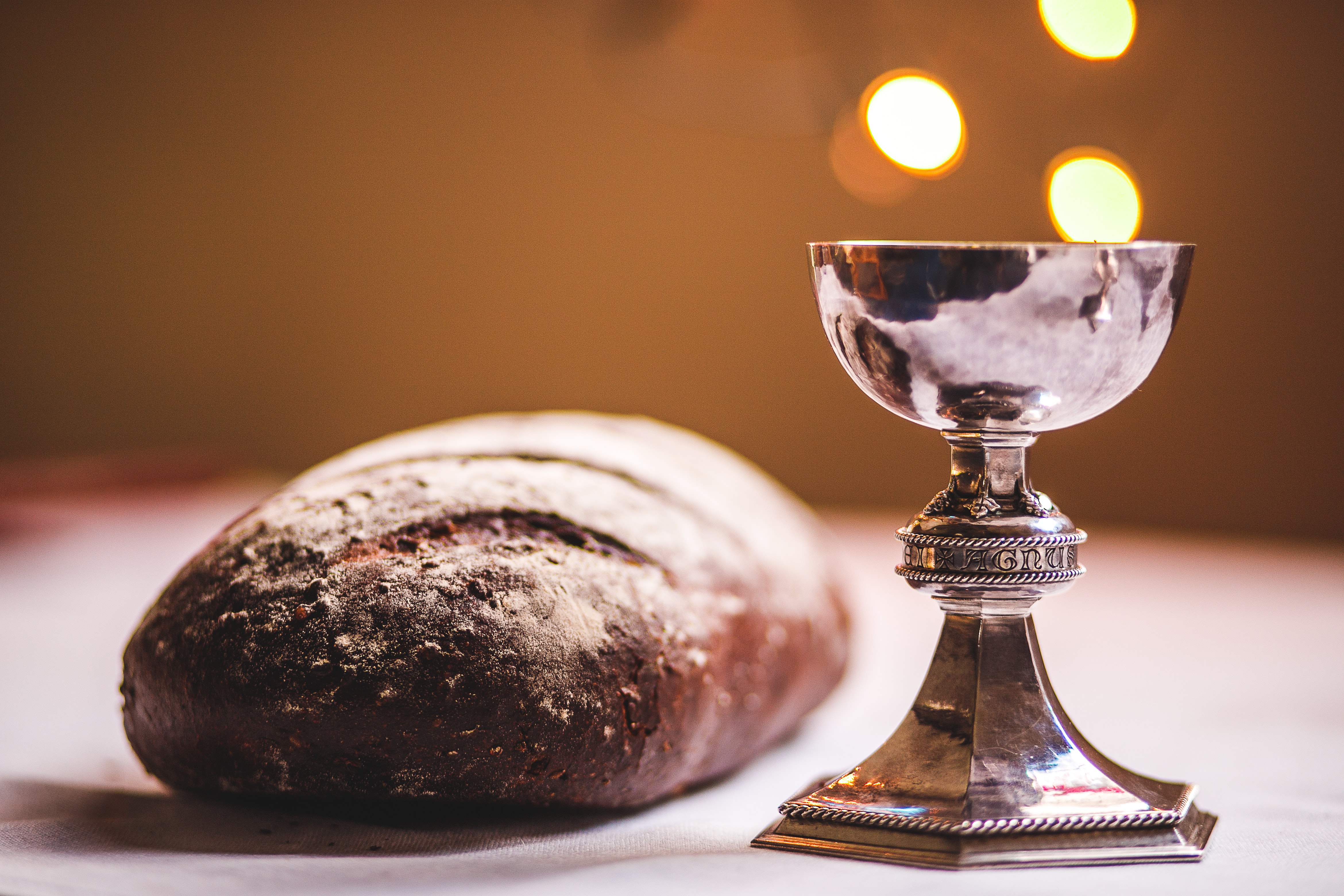
But this week’s readings don’t speak to me about a God who is content to watch me from above. He doesn’t even stop at sharing my human nature and walking beside me. He feeds me, and not just by inviting me over to dinner like another friend might. He becomes one with me by feeding me with himself — and not just with his spirit — but with everything that made him a living, touchable human being — his body and blood, in addition to his Divine Life. Everything. He holds nothing back from me. In fact, he wants me not only to share in his Holy Spirit and his humanity, but in other gifts of nature — offered in what the senses perceive as bread and wine. He provides for me in so many ways in the hope that the blessings of these gifts will spread from me outward.

Paul reminds the Christian community of Corinth:

“[O]n the night [Jesus] was handed over [he] took bread, and, after he had given thanks, broke it and said. ‘This is my body that is for you… In the same way also [he took] the cup… saying, ‘This cup is the new covenant in my blood [Italics mine]

1 Corinthians 11:23-26.

The New Oxford American Dictionary on my Kindle defines a covenant, in the theological sense, as, “an agreement that brings about a relationship of commitment between God and his people.” (Loc. 188613-188614).

“A relationship of commitment” — like a marriage — one in which the groom offers all of himself — even to the point of offering his body and shedding his blood.

This groom is the Trinitarian God, one of our pastors reminded us this weekend. This is the God of relationship that I wrote about last week. And yes, this God is the God of wonder. But this same God is also the God of the utmost intimacy.

Works cited

The Bible. The New American Bible Revised Edition, Kindle edition, Fairbrother, 2011.

The New Oxford American Dictionary, Kindle edition, Oxford UP, 2008.

Read Full Post »

« Newer Posts