Feeds:
Posts
Comments

Posts Tagged ‘Reflections on Scripture’

Photo by Pedro Ramos on Unsplash

This week’s readings:

  1. Isaiah 55:6–9
  2. Psalm 145:2–3, 8–9, 17–18
  3. Philippians 1:20c–24, 27a
  4. Matthew 20:1–16a

What this week’s readings say to me:

This week’s readings prompt me to imagine a high wall with a door in it. I’m on one side of that door, and God is on the other. God is knocking, asking me to open that door, to come in and work in the parts of God’s vineyard that occupy the space outside my body and soul. Opening this door will also allow God to work in the parts of the vineyard that God placed within my body and soul. God planted the vineyard, and the human tendency to sin created the weeds in the vineyard and the wall around it. This tendency also created walls within it. These are the walls of pride, anger, and envy.

I couldn’t enter the vineyard, and God couldn’t enter the vineyard of my body and soul if God hadn’t created doors into both. Why? Because “[God’s] thoughts are not [my] thoughts, nor are [my] ways [God’s] ways” (Isa. 55:8). The psalm goes so far as to describe God’s “grandeur” as “unsearchable” (Psalm 145:3). Yet God has created doors so that if I let God move freely in in the vineyards within and around me, whether I live or die, I won’t do so alone, but with God. And if I live or die with God, I do so for God and in God, as the end of Philippians 1:20 says.

The same door stands that stands between me and God stands between God and everyone else. It’s up to each of us how wide we open that door. What can be found through that opening is the same for everyone, regardless of when each person opens the door while he or she lives on this earth. Once we no longer live on this earth, we live on, we are eternal, in God to the extent that we have allowed God, the Eternal, to live in us.

What someone else is sharing about this week’s readings:

In Darlene Jasso’s reflection on this week’s readings, she asks how our world would be different if we treated each other the way God treats us. As last week’s readings told us, God doesn’t treat us the way we sometimes treat God and each other. God doesn’t draw close to us only when He asks something of us or only in difficult times. God doesn’t give us back only what we give to God. God withholds no part of Himself that we are open to receiving.

Beyond this week’s readings:

Ms. Jasso makes important and thought-provoking points about God and us. She says God shows everyone the same generosity. This truth can be difficult to keep in mind. I don’t know about you, but when I don’t make a conscious effort to alter my mindset, I tend to think that God loves and answers the prayers of the people who do the things that God wants when He wants and doesn’t do the same for the people who don’t do what He wants.

And it’s a worthy ideal for me to show everyone the same generosity. I suppose the true ideal would be to withhold nothing good from anyone. It’s easiest to want to do this with nonmaterial goods, such as justice and mercy. But my mind can’t quite ignore that what the landowner in the parable offers is monetary payment.

I realize that parables are highly metaphorical, that what the landowner, who represents God, gives represents more than money. Yet parables also don’t shy away from teaching us about what we should do with our material goods — material goods that none of us have an unlimited supply. Most of us have far less than an unlimited supply of material goods, and some of our brothers and sisters don’t have even what they need to survive, let alone be healthy.

Imagine if all of us found ourselves in this situation of need. Imagine if we all received the same level of generosity that too many societies show those who like the most basic necessities — which is not enough. On the other hand, what if we showed everyone unlimited material generosity? My human mind says resources would run out, that God has unlimited resources, but the physical world doesn’t. Another preachy voice in my head says that this reality is the reason we need to trust God to supply what we lack. And yet God doesn’t always supply what people lack, materially. Otherwise, food insecurity and famine wouldn’t exist. Yet they do, so God wants us to provide for each other and to share what we have.

God also knows having everything we want wouldn’t be good for us because excess lets us believe that we don’t need God and each other, that what we have is a substitute for interdependency on each other and dependence on God. God also knows that once humans have more than we need, we tend to want even more than that, and the more we have, the more we want, and we tend to confuse what we want what we need and to fear losing what we have wanted and received.

I suppose the realization I’ve come to as I write this post is that generosity means discerning what we truly need versus what we want and sharing what we have but don’t need. That which gives some of us what we want can supply what others need.

God doesn’t need us or any other part of creation, but God wants us, and so He distributes what He doesn’t need — all of creation — among various members of His family.

Lord, help me to discern the difference between what I want and what I need and to share my surpluses. This is the generosity you ask of me. Help me to practice it. Amen.

Work cited

The New American Bible Revised Edition, Kindle edition, Fairbrother, 2011.

Read Full Post »

This week’s readings:

  1. Sirach 27:30—28:7
  2. Psalm 103:1–2, 3–4, 9–10, 11–12
  3. Romans 14:7–9
  4. John 13:34

What this week’s readings say to me:

The theme of this week’s readings is forgiveness — how it’s God’s nature and why extending it to others is important. The first reading asks me a question: how can I expect forgiveness if I can’t forgive others, especially considering that they are subject to the same weaknesses I struggle with? The second reading offers reassurance, conveying that God isn’t like me. God is “slow to anger” (Ps. 103: 9). God doesn’t “requite us according to our crimes” (103:10). “As far as the east is from the west/so far has he put our transgressions from us” (103: 11). “[S]o surpassing is his kindness toward those who fear him” (103: 13).

Now I don’t believe in being asked to be afraid of God. What I am being asked is to recognize that I’m not God. God shares some knowledge with me, but not all knowledge. God’s ways are not my ways (Isa. 55:8).

The third reading offers a lesson in how to respond to this reality: remember whom you and everyone else around you was created in the image of — God. So I ask God to help that image be reflected in me. The result of allowing God’s image to be reflected in me would be living for God and for others in God rather than for myself. It would mean forgiving others because I want God to forgive me. And He does if I acknowledge my sins to Him. Doing so hands might sin-wounded soul over to Him for healing. Confessing my sins to someone who has been given the ministry of this healing helps me hand my sins over. I’m more likely to struggle with the weight of something when I carry it without the help of someone who is being God’s ears and voice. In the Gospel reading, Jesus tells a parable with a tough message for anyone who doesn’t approach the wrongdoings and shortcomings of others with God’s forgiving ears and voice.

Let’s see what someone else has to say about that message.

What someone else is sharing about this week’s readings:

Caitlin Morneau’s reflection reminds me that forgiveness isn’t something a person can snap his or her fingers and make happen. It takes a conscious decision to forgive, and then even once the decision to forgive is made, it takes time and effort to put into practice. Her perspective also reminds me that not being able to take that time and make that effort is a punishment in and of itself.

Beyond this week’s readings:

As I typed that last reminder, I wondered if there would be a way to reconcile it with the message of the Gospel reading. I had my doubts. I remembered the message of the Gospel reading being that I needed to forgive others as God has forgiven me, and if I don’t, God won’t forgive me.

I struggled with this understanding because I couldn’t make it mesh with the message I was getting from the psalm. I didn’t expect the tension I was experiencing from the struggle to resolve because, let’s face it, sometimes passages in the Bible just don’t agree with each other. Different scriptures were written at different times. Even within a single culture, understandings of God and God’s will evolve over time, and the differences between passages may reflect that evolution. Different books that are included within the biblical canon were also written with different audiences and purposes in mind. Some of them are poems; some of them are more like folktales. They have morals just like an Aesop’s fable or a Grimm’s fairy tale does. Others have more in common with legal documents than with a poem or a story.

So sometimes the differences between Scripture passages just are what they are, and I have to sit with the tension, the unanswered question, or the challenging lesson, and ask myself what words from a reading session stand out for me on a given day. I use the answer to that question to help me discern what God has to say to me at that moment.

Surprisingly though, when I went back to the Gospel after reading Caitlin Morneau’s reflection, the king in the parable no longer seemed as punitive. It isn’t the king who punishes the servant who doesn’t forgive the debts of others. Rather, the translation I’m using says that the king “handed [the servant] over to torturers (Mat. 18:34) What are the torturers? What is the debt but the effects of unforgiveness on the person who shoulders them?

Unforgiveness might be the sin I struggle with the most. In God I Have Issues: 50 Ways to Pray No Matter How You Feel, Fr. Mark Thibodeaux describes an approach he learned to use to free himself from the torture of unforgiveness:

Adapting the insights from a particular style of psychological therapy called Gestalt, I prayed in my chair with two other chairs in front of me. I sat Jesus in one of those chairs and my offender in the other. With Jesus present, I would say anything that I wanted to my offender. I might yell at him or curse him or tell him all sorts of despicable things. But at the end of my prayer time, I allowed both of my two guests to speak to me as well. At the end of our conversation, regardless of whether my heart felt it or not, I told my offender, “You hurt me, but I forgive you and I love you.” And one beautiful sunny morning, I said it and realized that there was no part of me that didn’t genuinely mean it, not even my heart!

loc. 1149-1157

A book I just finished, Things You Save in a Fire, by Katherine Center, offers other tips for practicing forgiveness:

“Just saying the words ‘I forgive you,’ even to yourself, can be a powerful start…” “Forgiveness is about a mind-set of letting go… “It’s about acknowledging to yourself that someone hurt you, and accepting that… Then it’s about accepting that the person who hurt you is flawed, like all people are, and letting that guide you to a better, more nuanced understanding of what happened. … And then there’s a third part… that involves trying to look at the aftermath of what happened and find ways that you benefited, not just ways you were harmed.”

112

I can imagine some people saying the above approaches and tips aren’t applicable to all situations, and I understand that reaction. All feelings are valid. It’s what we do with them, and what we let them do to us that matters. No one’s journey is exactly the same, and everyone’s journey unfolds at a different pace. However, these excerpts resonate with me. They’re applicable to my situation.

Lord, I invite you into the process of making these steps to forgiveness part of my life. Amen

Works cited

Confraternity of Christian Doctrine, Inc. “Sunday 17 September 2023: Readings at Mass.” The New American Bible, 2001. Universalis for Windows, Version 2.181, Universalis Publishing Ltd., 8 Aug. 2023, https://universalis.com/n-app-windows.htm.

Center, Katherine. Things You Save in a Fire. Kindle edition, St. Martin’s Press, 13 Aug. 2019.

Thibodeaux, Mark E. God, I Have Issues: 50 Ways to Pray No Matter How You Feel, Kindle edition, St. Anthony Messenger Press, 2005.

Read Full Post »

Photo by Jed Owen on Unsplash

This week’s readings:

  1. Ezekiel 33:7–9
  2. Psalm 95:1–2, 6–7, 8–9
  3. Romans 13:8–10
  4. Matthew 18:15–20

What this week’s readings say to me:

This week’s readings unpack concepts that the English language zips into a suitcase its speakers call love. The first reading tells me that one concept that love suitcase holds is looking out for each other. The first reading goes on to remind that the drive within us to protect each other is often painful because we don’t always appreciate protective efforts or recognize them for what they are. We especially bristle against warnings, advice, and other kinds of help when we didn’t ask for it.

If is looking out for each other is one half of a pair of glasses that go into the love suitcase, not harming each other is the other half. Maybe a better metaphor for these concepts is a set of hearing aids rather than a pair of glasses. Or maybe the love suitcase contains both a set of hearing aids and a pair of glasses. To look out for each other, we have to be able to see our surroundings through God’s eyes and to hear through God’s ears. Wearing God’s glasses and God’s hearing aids also allows us to recognize and appreciate the protective efforts of God and our neighbors in our lives. This is one message I get from the second reading.

The third reading points me to several ways we harm each other when we don’t wear God’s glasses and hearing aids, when all we can see is our own desires rather than what’s best for us and the people and resources God has given to us. Not wearing the assistive devices God wants to give us doesn’t just result in blurry vision or distorted hearing. It results in a variety of wounds or diseases. The preventative medicine and treatment for these is love. Like an antibiotic, acting with love provides an answer to numerous problems. The fourth reading first recommends that when someone wounds us, we try to treat the injury ourselves. But sometimes we run out of bandages or ice packs and have to get some from a neighbor — or a store. Then there are the times when these over-the-counter treatments don’t do the trick, and we have to seek professional help and sometimes prescription remedies. This is the extended analogy that came to my mind when I read the Gospel reading’s guidance about what to do when someone “sins against” me (Matt 18:15). So maybe this container that represents self-giving love holds not only a special pair of glasses and hearing aids but also special bandages, ice packs, and the ultimate prescription drug — one that doesn’t cease to be effective if we turn to it too much. Instead, I’m told, the more we rely on it, the more powerful it becomes.

What someone else is sharing about this week’s readings:

The reflection on this week’s readings offered by Carolyn Jacobson, MSW, PhD doesn’t use my analogy of the suitcase of love and its contents. Frankly, I’m glad because making that analogy work involves quite a stretch. However, if Dr. Jacobson’s reflection had used my analogy, it would say that we aren’t meant to use the items in the suitcase in a vacuum. Their power lies in their ability to facilitate connection.

Beyond this week’s readings:

My first reaction when I thought about what to write for this section was that the first reading is really uncomfortable to read. Reading it doesn’t give me the cushion of forgetting the passage’s commission and warning as I move on to the next part of the Mass.

And it’s warning is unpleasant to hear. Why? Because it’s easiest to warn someone when there is physical evidence that something he or she is doing clearly hurts himself or herself and/or others. But spiritual harm can be harder to detect than physical harm. I hate even the thought of telling people what I think they won’t like hearing if I can’t prove that what I’m warning against is harmful.

Sharing and being open to correction is especially difficult today when so many voices have access to audiences, and not all opinions can coexist in healthy, productive ways. I wonder if the amount of access many people these have these days to a variety of opinions and information means there are fewer incidences of innocently not knowing something. I wonder if there’s choosing not to find out or choosing to ignore is more common now than these responses have been at other times. Or has humanity simply ignored different individual and societal ills in different ways at different times in different places?

On one hand, I recognize not making assumptions is important, but if I’m reasonably sure that someone has access to the same information about what’s right and wrong and I do, it doesn’t seem helpful to, or warn him or her, even if I haven’t done so before and I don’t know whether someone else has.

I’m wrestling with part of the Gospel reading too. It says that if someone wrongs me and doesn’t want to make amends, even when other people, including those in authority tell him or her to, I should treat the person like a Gentile. To many characters in the Bible, treating someone else like a Gentile means avoiding them as much as possible. And yet, while Jesus might challenge Romans and Sumerians, He doesn’t reject them. Maybe the message is that He doesn’t reject people who are open to Him but that I don’t need to feel responsible for the choices of people who reject my concern. I don’t need to keep opening my concern to dismissal. Rather, the time to consider reopening that door is when the person opens it a crack him or herself.

I want to close this post with a prayer for parents, guardians, teachers, and mentors. God bless advisers and caregivers and grant them Your wisdom, courage, and consolation. Amen.

Work cited

 The New American Bible Revised Edition, Kindle edition, Fairbrother, 2011.

Read Full Post »

Photo by Sammie Chaffin on Unsplash

This week’s readings:

  1. Jeremiah 20:7–9
  2. Psalm 63:2, 3–4, 5–6, 8–9
  3. Romans 12:1–2
  4. Matthew 16:21–27

What this week’s readings say to me:

This week’s readings say to me that the room within me created for faith by humility and perseverance is not a comfortable space. It’s a space the Holy Spirit fills with its fire, and fire burns, and this fire cannot be contained. So it doesn’t let people who carry it be still in the place where they were before the fire sparked. People within whom it burns cannot help but move as it moves. They can’t help but spread it because their movement feeds it, and they give it room to spread. Spreading it means the next person who makes room for and fuels the fire can’t stay where he or she is either. As we witness this these effects of the spread, our inclinations toward convenience and self-preservation tell us to stop it. We don’t want to move. We don’t want to change. We don’t want to be different from earlier versions of ourselves or from the people around us. And we can’t stop these processes. We can increase our discomfort with the Spirit’s transformative power by resisting it, or we can find a peace that comes from freedom by accepting and participating in its transformative power.

The Good News is this transformative power. Its burning isn’t one that destroys but one that gives life. That life just won’t look the way our desires for convenience and self-preservation want it to because it changes us from the inside out and changes our relationship with our surroundings, including how we think about them, see them, and interact them. This change won’t let a person blend in, and the reading from Romans encourages us to ask for the grace not to want to blend in — at least not just for the sake of blending in. Any blending a person might do must be done for the Spirit. And any work done for the Spirit can only be done in cooperation with the movement of the Spirit.

The Gospel tells us not even to let fear for our lives get in the way of the movement of the Spirit. It says caving to such fear won’t save us, even though we may feel as if listening to fear will save us.

I used to think of this reading as being only about the importance of living faith and sharing it regardless of any risks that living it and sharing it might pose to my life. Of course, this is the literal message of the reading. However, I’ve come to want to apply it more broadly to life’s difficult situations. I wonder if my broader understanding will relate to someone else’s reflection on these readings. Let’s find out in the next two sections.

What someone else is sharing about this week’s readings:

These days, I interpret the Gospel reading as telling me “to be and to do what God calls [me] to be and to do,” as Dr. Phyllis Zagano says. Follow this link to read or watch her reflection on how Sts. Phoebe and Gregory did just that and how their stories relate to this week’s readings.

Beyond this week’s readings:

God called Phoebe and Gregory to bring the Gospel to others in word and action. We are called to do the same, though not always by using the texts and trappings of our faith.

There are people all over the world for whom living their faith costs them their freedom and even their earthly lives. I hope none of us seeing these words ever have to pay those prices.

But even if we never have to, each of us dies and finds life regularly, but if we don’t surrender to these smaller deaths, we miss opportunities to find life.

For me, as a person with anxiety and cerebral palsy, one of these smaller deaths can mean doing things my mind says are not safe to do, such as:

  • Joining a group with whom I might share an interest or a goal when I don’t know any of the members or when I don’t know how accessible the place where then be is going to be
  • Having the courage to be who I am and share my perspective when I don’t fit totally into one camp or another in a world that’s divided and subdivided into camps.
  • Having the courage to get to know someone whose experience is different from my own and may make me uncomfortable and encourage me to ask myself questions about my own views.
  • Not avoiding situations that remind me of difficult ones I have faced in the past. Please understand that with this example, I’m not advocating that anyone stay in abusive situations. I’m saying that there’s a difference between an unpleasant or uncomfortable situation and an unhealthy or unsafe one. I’m also saying that anxiety likes to lie to me and tell me that these two types of situations are the same. They aren’t.

I’ve also come to believe that losing my life to save it encompasses surrendering control and ideas of what I want various situations and people to be like. I think this is such a difficult thing for all of us to do. I don’t know whether the difficulty of doing this increases depending on how great a sense of independence a person is used to having or if the desire and frustration are equally strong regardless of a person’s circumstances.

Either way, I can think of a few different ways to express the ironic truth in this week’s Gospel passage:

  • However tightly I cling to life on earth I cannot make it last forever.
  • Surrounding myself with different types of walls or with metaphorical bubblewrap might save my body, for a time, but these actions won’t save my soul. In fact, they might kill it. Furthermore, a withering soul withers the body, eventually – in one way or another. (I’m pretty sure too much isolation and too few contacts are unhealthy for the body and the soul. And eating one’s emotions, an attempt at treating the pain of the soul, I’d say, can kill the body if it isn’t moderated.)
  • Staying alive is not the same as living; surviving is not the same as thriving.

Lord, help me neither to fear my death to earthly life, nor the precursors to this death that I face each day so that I can live in the freedom of the life you have planned for me. Amen.

Read Full Post »

This week’s readings:

  1. Isaiah 22:19–23
  2. Psalm 138:1–2, 2–3, 6, 8
  3. Romans 11:33–36
  4. Matthew 16:18

What this week’s readings say to me:

This week’s readings say to me that the power of faith comes not only from perseverance, as I was reminded last week, but also from humility. A person in with a humble mindset is able to trust even when he or she doesn’t understand a situation. Trust isn’t rooted in knowing all the details. It’s rooted in hope, and not speaking and acting on behalf of oneself but on behalf of God. Not speaking and acting on behalf of God as if we have God’s perspective — more like making room in and around us for God to speak and act through us, for it is God who “builds up strength within” us — if we allow the construction (Psalm 138:3). “For from him and through him and for him are all things” (Rom. 11:36). The “servant” in the reading from Isaiah understands this (Isa. 22:20). His understanding of this must be why God gives the trappings and responsibilities of authority to him, after apparently having removed it from someone people recognized as a leader (22:21-22)

From what I understand about Jewish culture when Jesus walked the earth, the family, friends, and community of the man eventually called Peter wouldn’t have seen spiritual leader material in him. Before Jesus called him, he wasn’t studying with a rabbi. He must not have been considered a skilled enough student to do that. He was working in his earthly father’s business. And yet, the Holy Spirit gives Peter the heart knowledge that Jesus is the Christ and gives him the grace, the humility, to acknowledge who Jesus is.

Outside of the grace of humility, he can’t acknowledge needing a Messiah — the Messiah — knowing him, or trusting in him. When Peter doesn’t have room for the gift of humility because his fear and/or pride crowds it out, Jesus doesn’t refer to him as “the rock on which [He] builds [His] church” (Matt. 16:18). Instead, Jesus tells Satan to “get behind” Him (16:23). At these times, he knows Peter is relying on his own mind to make sense of the world around him — not God’s — as the Holy Spirit allows him to do when his fear and pride don’t get in the Spirit’s way.

When he doesn’t start to think that his fear is more powerful is than God is, he not only can recognize Jesus as the Christ, but also he can walk on water, and he can share the message of Jesus’s ministry and his resurrection despite the risk to his earthly life, a life that he will eventually hand over as a result of the mission that Jesus gives him. It’s a mission that, thanks to the work of the Holy Spirit in him and his spiritual siblings and descendants, we can be bound together by what gives life and freed from what doesn’t.

What someone else is sharing about this week’s readings:

While this week’s readings spoke to me about humility as another fuel for faith, for the ability to recognize Christ, along with perseverance, Mary Margaret Schroeder invites us to explore how each of us recognizes Christ personally. She invites us to recognize Christ in our everyday experiences rather than by relying only on knowledge and ways of talking about that knowledge that have been handed down to us.

Beyond this week’s readings:

So who do I say Christ is:

  • the ultimate storyteller, the hero of that story, and the author of my story within that master story.
  • the One who walks ahead of me, beside me, stands behind me, and lives within me.
  • the One who carries me
  • The experience I have when I read a book and
    • relate to what we find there — pain, joy, fear, and every mixture of emotion
    • don’t relate to what I read, but what I read makes me appreciate what I have
    • long for the friendship, love, transformation, and growth I find there
  • the experience of driving alone in my neighborhood — not in a car, but in my wheelchair — and I feel the sun warming my neck, back, and shoulders. I feel the breeze, too, and I see roses blooming in front of my neighbors’ houses. Flowers spill over the brick retaining walls between the sidewalks and the streets.
  • the experience of my family and my neighbors throwing a surprise party for my birthday
  • the experience of wanting to say something that, at best, won’t help a situation, and might make it worse and actually succeeding in not saying it.
  • the experience of seeing a task through rather than putting it off for another day and instead playing games on my phone
  • the experience of not pretending to be somebody someone other than God wants me to be
  • The relief of being able to acknowledge to myself and God that I’m not the person God plans to love me into becoming, and yet experiencing that God loves me anyway

Now I have this list. Maybe I’ll revisit these memories when God feels distant. Maybe I’ll think of things to add to this list over time. Help me, Lord, Amen.

Who is Christ to you, personally? Maybe you’d like to journal or to pray about this yourself. Share your thoughts here, if you’d like.

Work cited

Confraternity of Christian Doctrine, Inc. “Sunday 27 August 2023: Readings at Mass.” The New American Bible, 2001. Universalis for Windows, Version 2.181, Universalis Publishing Ltd., 8 Aug. 2023, https://universalis.com/n-app-windows.htm.

Read Full Post »

Photo by Flash Dantz on Unsplash

This Week’s Readings:

  1. Isaiah 55:10–11
  2. Psalm 65:10, 11, 12–13, 14
  3. Romans 8:18–23
  4. Matthew 13:1–23

I found myself conversing with what stood out to me in each of this week’s readings, and the conversation felt familiar. The familiarity wasn’t comfortable. It was boring, and the boredom I experienced in response to each reading was a bit anxiety-inducing.

Now that I’ve been writing this blog for a year and a half, I worry I’m the responding to these passages the same way I did the last time I wrote about each one here. And I want to receive and share new insights — for my own sake and for yours.

Nonetheless, I trust that the Spirit is working on me, in me, and through me even when I feel like I’m following the same old tracks and in doing so, may be getting stuck in the same ruts over and over.

The first reading reassures me:

my word shall not return to me void,
but shall do my will,
achieving the end for which I sent it.

Isaiah 55:11

This reading suggests that at least I can’t totally stop the ability of Love’s winds from re-forming creation, I said to myself as I read this verse. I can only force these Winds to choose a different tunnel. Yet when I interrupt their course, I miss out on being enlivened by them — maybe more often than I don’t miss out on this gift.

Fortunately, for me, God, I want to be the dirt in the second stanza of this week’s psalm, and I suppose I am. This isn’t as bad as it sounds. The stanza speaks to God as follows:

Thus have you prepared the land: drenching its furrows,
breaking up its clods,
softening it with showers,
blessing its yield.

Psalm 65:11

The question for me is, will I appreciate what it takes to break up or to avoid the unhelpful knots in my life, what the psalm characterizes as clods of dirt? Will I appreciate what it takes to soften what has hardened within me so that it can yield growth? Often not, because spiritual clods and hardness, like muscular hardness, develop over time and in uncomfortable, sometimes extreme conditions. Going through the softening process is no different. This process might mean taking a pounding, like meat that needs tenderizing. It definitely means experiencing rebirth and changing my world.

The concept of rebirth sounds nice. It sounds like a sudden shift, something that happens in between blinks, but the third reading’s characterization of the process provides a reality check. It says:

We know that all creation is groaning in labor pains even until now; and not only that, but we ourselves, who have the firstfruits of the Spirit, we also groan within ourselves as we wait for adoption, the redemption of our bodies.

Romans 18:22-23

This excerpt tells me that spiritual restoration is a process, a laborious and often painful one. It also tells me that I’m undergoing the process here and now, but I will also be undergoing it, in what, to me, is the future. To God, everything is happening now and all at once in a way I can’t comprehend.

Because I can’t comprehend not being bound by time, in the reading from Matthew, Jesus uses a parable to compare the process of spiritual growth to the process by which a crop grows — or doesn’t.

In the reading, Jesus gives an interpretation of the parable, and I’m grappling with how to apply this parable and its interpretation my life. I know that, to grow, a seed needs a certain depth of soil that isn’t too rocky for the plant to put down roots. It also needs room to grow. To me, this means the seed that is me needs a deep trust in God to grow. Having such trust would keep the often difficult conditions of life from stunting my growth. Reaching out to God in the midst of difficulties just might transform them from obstacles to opportunities. Spiritual fertilizers, I might call these experiences.

For me, the weeds in the parable are the distractions that take up time I could be using to love God, myself, and others as God loves me. Sometimes these distractions are unpleasant. They feel like the anxieties Jesus says the weeds represent. Other times, they’re harder recognize as weeds because they’re activities I enjoy and use to forget about feelings I don’t want to feel and to put off doing what I don’t want to do.

It’s useful for me to distract myself sometimes, to break myself out of a pattern of unhelpful thinking, a pattern of replaying unpleasant past experiences or of dreading a future experience that I anticipate will be difficult. But there are questions I know I’d benefit from asking myself about my favorite distractions:

  • How often am I turning to these distractions?
  • How long do the benefits I get from these activities last, and how satisfying are they? Can I do them in moderation, or do they leave me only wanting more?
  • How much time are these enjoyable activities taking away from activities that have longer-lasting benefits for me and others?
  • What activities with longer-lasting and broader benefits could I use instead to break myself out of unhelpful thinking? (For the record, no, memorizing comforting or inspiring Bible verses hasn’t served this purpose for me, though I’ve tried this approach and won’t rule out trying it again. Getting outside and/or getting exercise have helped.)
  • What do I want to avoid dealing with, and how much better have I felt in the past when I dealt with whatever I didn’t want to rather than distracting myself from it?

Lord, open the ears of my heart and mind to hear and listen to Your answers to these questions. Thank You for hearing me. Amen.

Work cited

Confraternity of Christian Doctrine, Inc. “Sunday 16 July 2023: Readings at Mass.” The New American Bible, 2001. Universalis for Windows, Version 2.180, Universalis Publishing Ltd., 29 June 2023, https://universalis.com/n-app-windows.htm.

Read Full Post »

Photo by K. Mitch Hodge on Unsplash
This picture was one of the results when I searched Unsplash.com for “God’s-Eye View.”

This week’s readings:

  1. 2 Kings 4:8–11, 14–16a
  2. Psalm 89:2–3, 16–17, 18–19
  3. Romans 6:3–4, 8–11
  4. Matthew 10:37–42

I’d say this week’s readings are about how seeing the world through God’s eyes affects a person’s outlook and behavior. They’re also about how seeing this way reaps rewards, though often not one’s that come quickly or easily.

It seems a reward for virtue hasn’t come quickly or easily for the woman in the Old Testament reading. She’s promised a gift that she must worry she won’t receive —a son. The passage tells me “her husband is getting on in years,” and the couple doesn’t have a son yet, so there’s reason to doubt that would change as the husband ages (2 Kings 4:14). And not having a son could mean loss of financial security and social standing for the wife as she gets older, since, it seems, her husband is considerably older than she is. If he dies before she does, and she doesn’t have a son, she won’t have a home or support unless another male relative takes her in or she remarries.

The woman in the story isn’t going to be facing this situation though. Because of the hospitality she shows Elisha, he promises her that “by the same time next year, [she’ll] have a son” (2 Kings 4:16). The next verse reveals the woman’s life changes as Elisha has promised it will , but I think the fact that the reading ends before the prophecy comes true provides a lesson, which is that we can take Elisha at his word because word comes from God. The further message of the passage is that the woman receives her gift from God because she has supported God’s work in recognizing Elisha’s holiness and in offering him hospitality on account of it. In other words, good things happen to people who see the world through the eyes of God and respond to the needs that this way of seeing reveals to them.

This week’s psalm sends a similar message with the following words:

Blessed the people who know the joyful shout;
in the light of your countenance, old LORD, they walk.
At your name they rejoice all the day,
and through your justice they are exalted.

Psalm 89: 16-17

The thing is, if a person doesn’t see through God’s eyes, someone “exalted” through God’s justice may not look “raise[d] on high; elevate[d], as the New World College Dictionary defines “exalted.” After all, Jesus was exalted by God’s justice and yet he grew up in circumstances that were humble, to say the least, and he worked hard, traveling long distances on foot. Then he was subjected to an agonizing death. Furthermore, relatively few people were physical witnesses to the signifiers of his exaltation, the resurrection and the ascension. Not even Paul witnessed these events in the way that people who walked with Jesus while he was alive did. And yet Jesus allowed him to see with God’s eyes and to write:

Brothers and sisters: Are you unaware that we who were baptized into Christ Jesus were baptized into his death? We were indeed buried with him through baptism into death, so that, just as Christ was raised from the dead by the glory of the Father, we too might live in newness of life.

Romans 6: 3-4

I don’t know about you, but I usually don’t feel like I’m living in “newness of life” or that I’m going to, so I don’t feel like the people described in the psalm as “rejoicing all the day at [the] name” of God (Romans 6:4). I’ve heard some believers say that the times I least feel like doing this are the times I most need to do it anyway. Come to think of it, a lot of activities and mindsets feel like less of a struggle to me — writing I’m thinking of you here—when I make myself do them even when I don’t feel like it. I suppose this approach to life builds perseverance and resilience. Maybe being intentional about offering gratitude and praise would remind me that God has a broader view of life than I do. God sees which path is best. I can’t on my own, but sometimes, with God’s help, I can. Yet even in situations where the best path seems clear, I need to allow that God sees and knows things I don’t and can’t.

The reality that I’m limited in ways God is why I need God’s help to have healthy relationships. What’s best for relationships and the people in them isn’t always what’s preferred by the people involved. However, when I don’t love God first so that I can see my relationships through God’s eyes, and love the people as God loves them, I distort who the people are. I turned them Into idols. To do so is to give all of us less than we deserve, which is to be seen and treated like the unique reflection of God that each of us is.

Lord, help me to see the world around me as You see it so that I can recognize what reflects You in myself and others and nurture it. Plans whatever is in me and others that doesn’t reflect You, and help me to trust that surrendering to Your vision and Your cleansing will result in an exultation that surpasses anything this world can offer or imagine. Amen.

Work cited

Confraternity of Christian Doctrine, Inc. “Sunday July, 2 2023: Readings at Mass.” The New American Bible, 2001. Universalis for Windows, Version 2.179, Universalis Publishing Ltd., 26 Feb. 2023, https://universalis.com/n-app-windows.htm

Read Full Post »

Photo by Chris Chow on Unsplash

This week’s readings:

  1. Jeremiah 20:10–13
  2. Psalm 69:8–10, 14, 17, 33–35
  3. Romans 5:12–15
  4. Matthew 10:26–33

Fortunately, I suppose, unlike Jeremiah, I don’t currently “hear the whisperings of many saying . . . “Let us denounce [her] (Jer. 20:10, The New American Bible, 2001 Edition). But at times, I’ve perceived myself as surrounded by such “whisperings.” (Jer. 20:10). Was I more hurt because I felt someone was rejecting me, or because I thought that person was rejecting God? I suspect that more often than not, the answer was the former. “[Z]eal for [God’s] house” doesn’t “consum[e] me” as I assume it did Jeremiah, though Jeremiah isn’t the name given for the narrator of this week’s psalm (Ps. 69:10).

Jeremiah’s emotional response, his anger, is understandable. But in contrast with what Jeremiah seems to request of God, I don’t want God to “take vengeance” on anyone, or to witness anyone taking vengeance on anyone else (Jer. 20:12). After all, the Webster’s New World College Dictionary defines vengeance as “the return of an injury for an injury, in punishment or retribution” I want to see wrongs made right. In the many situations where what’s lost cannot be recovered, I want to see efforts made to prevent the same harm from happening again. I don’t want to see “the return of an injury for an injury in punishment or retribution.”

And even if I had an experience that changed my mind and my heart about vengeance, it wouldn’t bring back what I’d lost. Also, I have a hard time believing that a God whose very nature is a self-emptying love that we humans struggle to imitate would want to take vengeance on people who hurt me. Why? Because God is the source of their lives as well as mine, God wants to remove anything that might distance them from himself. Now that removal might be painful and difficult for a person to go through, just like breaking oneself of a bad habit or putting distance between oneself and toxic people might be extremely hard to do. Still, I wouldn’t think of actions such as these as vengeance. I would consider them lifesaving in the long run. On the other hand, in the long run, the rejection of such life-saving actions would be its own punishment.

It helps me to put the Old Testament passage into perspective if I consider that the words are attributed to Jeremiah. They aren’t attributed to the voice of God. I believe that God speaks to us through the Scriptures, but so do the other people in them. Not everything in the Bible is God’s will because the people whose stories the Bible hands on to us are subject to rash judgment and limited understanding just like we are. I believe Jeremiah is not excluded from these human weaknesses, and that’s why he asks God to let him witness God taking vengeance on the people who persecute him. He’s likely in grave danger, and he wants to get out of it. I would want the same “rescu[e],” were I in his situation (Jer. 20:13). Perhaps the only way he can imagine God alleviating his suffering is for God to take vengeance on the people causing it.

Despite whatever ways Jeremiah’s spiritual vision may be limited, he’s ahead of me in the faith department because he can say, ” . . . Praise the Lord,/for he has rescued the life of the poor/ from the power of the wicked (Jer. 20: 13)!

This declaration is, more often than I would like, difficult to make my own. I hear too often of those with trusting natures being defrauded of their savings by strangers. The world over, the rich get richer while the poor face food insecurity or even famine, and some leaders sacrifice truth and countless lives on the altar of holding onto and increasing their power.

Does “the LORD [hear] the poor,” as the psalm says (Psalm 69:34)? Undoubtedly, but Jesus died not only so that his brothers and sisters could have eternal life through Him but also so that they could have a clearer understanding of their own dignity and live for more than themselves, becoming conduits of His justice and mercy (qualities that are intertwined with each other) generation after generation. It is receiving and sharing these gifts of Christ’s sacrifice that give eternal life to a soul even though a body can be killed. This receiving and sharing also allows Paul to declare, “For if by the transgression of the one, many died, how much more did the grace of God in the gracious gift of the one man Jesus Christ overflow for the many” (Rom. 5:15).

Lord, I often struggle to share Paul’s faith in the gifts you have given me and anyone open to them. And yet, “I do believe; help my unbelief” (Mark 9:24, The New American Bible Revised Edition). Help me to remember that “[e]ven all the hairs on [my] head are counted (Matt 10:30, The New American Bible, 2001, Edition). Everyone’s are. Nothing happens without [our] Father’s knowledge. Even though so much that happens is unpleasant or unjust, the final victory is not doesn’t belong to these events. Guide me as to how to make this truth tangible for myself and for others. Help me and others to be conduits for more of what you are offering us. Amen.

Works cited

Confraternity of Christian Doctrine, Inc. “Sunday 25 June 2023: Readings at Mass.” The New American Bible, 2001. Universalis for Windows, Version 2.179, Universalis Publishing Ltd., 26 Feb. 2023, https://universalis.com/n-app-windows.htm.

The New American Bible Revised Edition, Kindle edition, Fairbrother, 2011.

Read Full Post »

Photo by Janine Meuche on Unsplash

The grace of the Lord Jesus Christ and the love of God and the fellowship of the Holy Spirit be with all of you.

2 Corinthians 13:13

Today, we arrive again at Trinity Sunday. Here’s what I posted in honor of Trinity Sunday last year. I wanted to link to it because Richard Rohr’s reflection on the Trinity, which I included in the post, is insightful and helpful. But my plan from here on out is not simply to repost or to link to other posts.

This year, I feel prompted to sit with the Trinity by reflecting on 2 Corinthians 13:13. As I revisit this verse, it’s tempting to put dividers that are too solid between the Persons of the Trinity, to get the impression that the Lord Jesus Christ offers grace, God offers love, and the Holy Spirit offers fellowship, as if each of the Persons has a separate role. Yet I trust that my Creator, my Redeemer, and my sanctifier, a.k.a. my Father, my Brother, and the “love between them” extend grace, sacrificial love, and fellowship (Rohr). This one God in three Persons always has. The redemption began as soon as sin did. I trust that no part of God’s nature has ever not existed, and that the very nature of the Divine Being is grace, love, and fellowship. The theology of the Trinity reminds me that God is so intimate with me as to abide in my soul and body. At the same time, it reminds me that God’s nature and ways are above mine because God is the source and sustainer of all that lives and/or provides, all that is good. God is the ultimate intimacy and the ultimate transcendence. I’d say the way these qualities are entwined with each other like the strands of a braid is expressed as the Trinity.

What can this entwinning of seemingly opposite qualities, this Trinity, mean for my life and yours? As I’ve been mulling over this post the last couple of weeks, John 17 has been among the Gospel readings for each day. In this chapter, Jesus prays and teaches us what the Trinity can do and mean in our lives because of what it does and means in His. It means there’s no distance between Him and His father. is in His father and His father is in him. ( John 14:11). This abiding allows him to draw as near to other people as they will allow. If they don’t put up walls between themselves and him, and thus between themselves and the Father, they will be one with each other and will do God’s work. Their reflection of God and doing of God’s work will glorify the Father, and through the reflection and work the Father will glorify them.

Such glorification will result in those who allow the oneness standing out from whatever isn’t compatible with the life-giving, growth-supporting nature of the oneness. Whatever and whoever embraces and is embraced by this oneness opposes what is not embraced by it and is opposed by whatever or whoever doesn’t welcome the Divine Embrace that is the Trinity. Because Jesus knows the world needs the ones the Father has given to him and that they will face opposition both inside and outside themselves, He asks the Father not “to take [the ones He has given to the Son] out of the world but to keep them “from the evil one” because “[t]hey do not belong to the world anymore than [the Son] belong[s] to the world (John 17:9, 15).

The Son opened the Way to eternal life, and He leads us to it by his life, death, and resurrection. Thanks to his life, death, and resurrection, we are invited into the same embrace of the Trinity in which He lives. I invite this Love of the Trinity into my heart as I join my prayer to the one Jesus offers in John 17.

As another closing prayer, I’m looking to what is sometimes called “St. Patrick’s Breastplate Prayer” because, according to the version of this prayer that’s included with the Hallow app, it is prayed in Ireland not only on St. Patrick’s Day but on Trinity Sunday.

Deliver us deliver us from evil, Lord and protect us in times of temptation. Amen.

The Bible. The New American Bible Revised Edition, Kindle edition, Fairbrother, 2011.

Confraternity of Christian Doctrine, Inc. “Sunday July, 2 2023: Readings at Mass.” The New American Bible, 2001. Universalis for Windows, Version 2.179, Universalis Publishing Ltd., 26 Feb. 2023, https://universalis.com/n-app-windows.htm

Slanz, Julianne, “Lorica of St. Patrick.” Hallow, 17 March 2023, https://hallow.com/prayers/1016394.

Read Full Post »

This post is a continuation of my Lenten reflections on the Scriptural Stations of the Cross. The station titles and scripture and verse citations, except where otherwise noted, are published on USCCB.org.

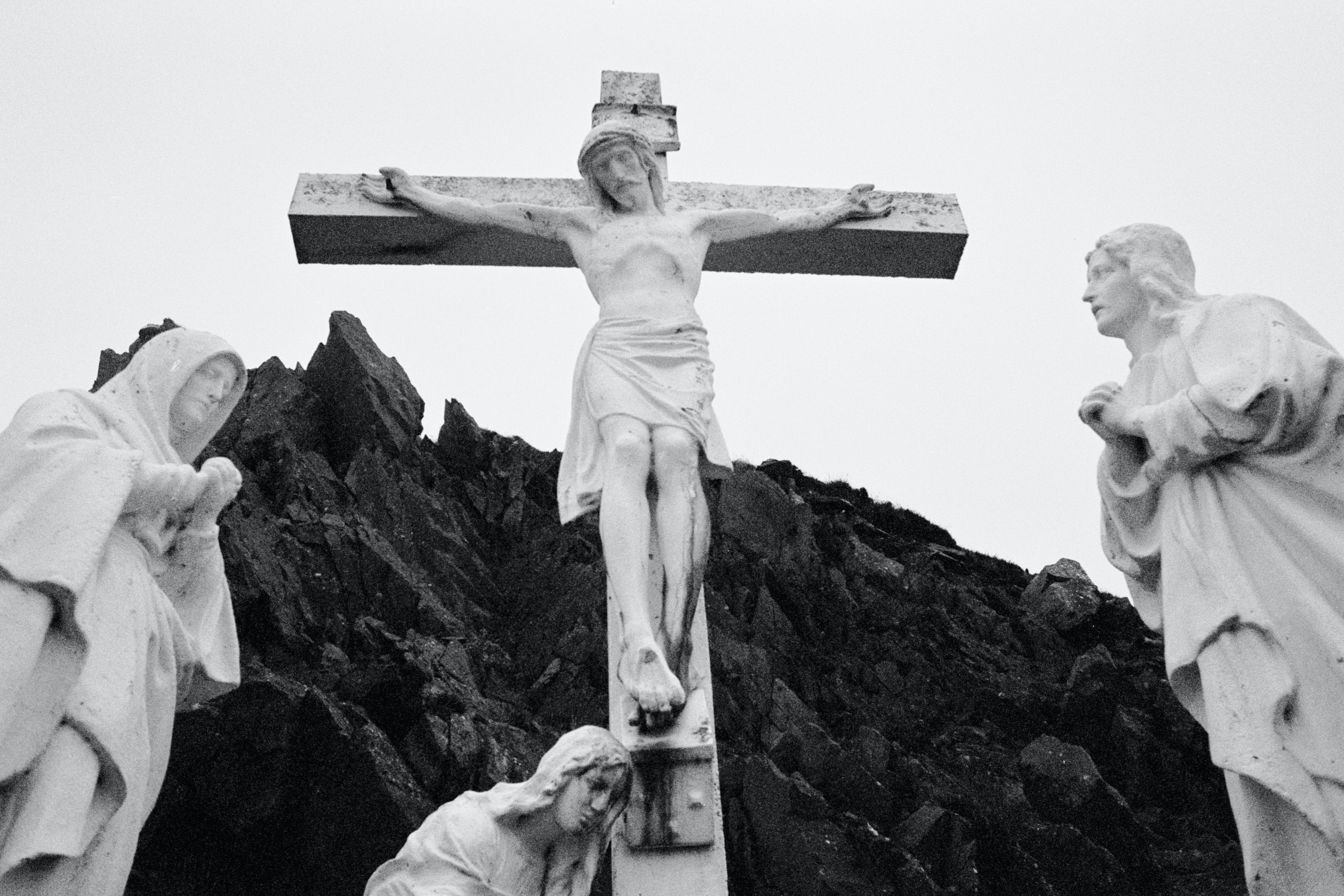
Eleventh Station: Jesus Promises His Kingdom to the Good Thief

(Luke 23: 33-34 [and Philippians 2:6-7 – my insertion)

Photo by Dylan McLeod on Unsplash

Jesus, thank You for not regarding “equality with God something to be grasped, but instead “empty[ing] [Yourself], taking the form of a slave,” of a working man’s son, who experienced unpleasant emotions, temptations, poverty, and sickness (Phil. 2: 6-7). Thank you for surrendering to one of the worst punishments a criminal could receive — crucifixion — a punishment involving multiple forms of torture — even though You were innocent. In accepting Your sentence, You showed Your brothers and sisters accused of crimes and those convicted of them — whether justly or wrongly — that no choice they make forfeits God’s love for them or the ability of their lives to have purpose and meaning in Your eyes.

Nothing I or anyone else can do forfeits God’s love. Help me remember this truth and to put it into action by living in solidarity with those who are rejected and/or who struggle to forgive themselves and to have hope.

Help me also to remember the following lessons offered by the exchange between You and the people crucified beside You:

  • Suffering brings You sorrow, and yet, avoiding sorrow is not more important than surrendering to God’s plan for me so that I can become my best self and participate in God’s healing work.
  • Part of being truthful is taking responsibility for my actions and their consequences.
  • When I do take responsibility for my actions and come to you in my woundedness and with sincerity, You will remind me that I’m so much more than any destructive choices. Those choices will not be the end of me if I surrender them to You. You work not only around weaknesses and harmful choices but through them, even if I don’t ask You to. You want me to ask so that I can hear You reassure me that You are near. I am in Your heart, and You are in mine if I invite You in.

Thank You for Your nearness, especially when I feel furthest away from You and when I forget You or don’t understand the Divine plan. Amen

Twelfth Station: Jesus Speaks to His Mother and the Disciple

(John 19: 25-27)

Photo by Hennie Stander on Unsplash

Jesus, Your friends John and Mary, as well as Your aunt and Your mother were embodiments of God’s faithfulness at the foot of Your cross. These beloved ones did not him hide or abandon You when being seen as one of Your group might have been very dangerous for their earthly lives.

Meanwhile, You let these bravest members of Your circle know that you were thinking of them and their future needs.

You make those you draw to Yourself not just friends for each other but family. Thank you for inviting me into the embrace of that family. Help me to experience the Love of that embrace and to share that Love, to participate in the growth of Your family.

Jesus, grant me the grace to support my family and friends in ways that help them experience Your love. Help me to support them, especially at their most difficult times and mine.

The Bible. The New American Bible Revised Edition, Kindle edition, Fairbrother, 2011.

Confraternity of Christian Doctrine, Inc. “Sunday July, 2 2023: Readings at Mass.” The New American Bible, 2001. Universalis for Windows, Version 2.179, Universalis Publishing Ltd., 26 Feb. 2023, https://universalis.com/n-app-windows.htm

Read Full Post »

« Newer Posts - Older Posts »