Help me to know when to build onto the what I’ve started, when to start fresh, and when my part of the construction process is finished. Amen.

Posted in Ordinary Time, Reflections on Scripture, tagged bible, christianity, Lectio Divina, Ordinary Time, Prayer on September 5, 2025| Leave a Comment »
Help me to know when to build onto the what I’ve started, when to start fresh, and when my part of the construction process is finished. Amen.
Posted in Ordinary Time, Reflections on Scripture, tagged Abundance, bible, christianity, Genorisity, Gratitude, jesus, Joy, Lectio Divina, Ordinary Time, Prayer, Reflection on the Gospel on August 30, 2025| Leave a Comment »

Do the best you can with what you have. It painted contrasting pictures of two different perspectives. One sees limitations scarcity and responds with fear and resentment. The other sees opportunity and abundance and responds with gratitude and generosity.
May I see opportunity and abundance and respond with gratitude, and generosity so that I can experience joy.
Posted in Easter, Reflections from Other Writers and Speakers, Reflections on Scripture, tagged bible, christianity, Doubts, Easter, Encouragement, Faith, jesus, Prayer, Questions, Reflections on Scripture, resurrection, Scripture Reflections from Others, suffering on April 24, 2025| Leave a Comment »
https://bible.usccb.org/bible/readings/042725.cfm
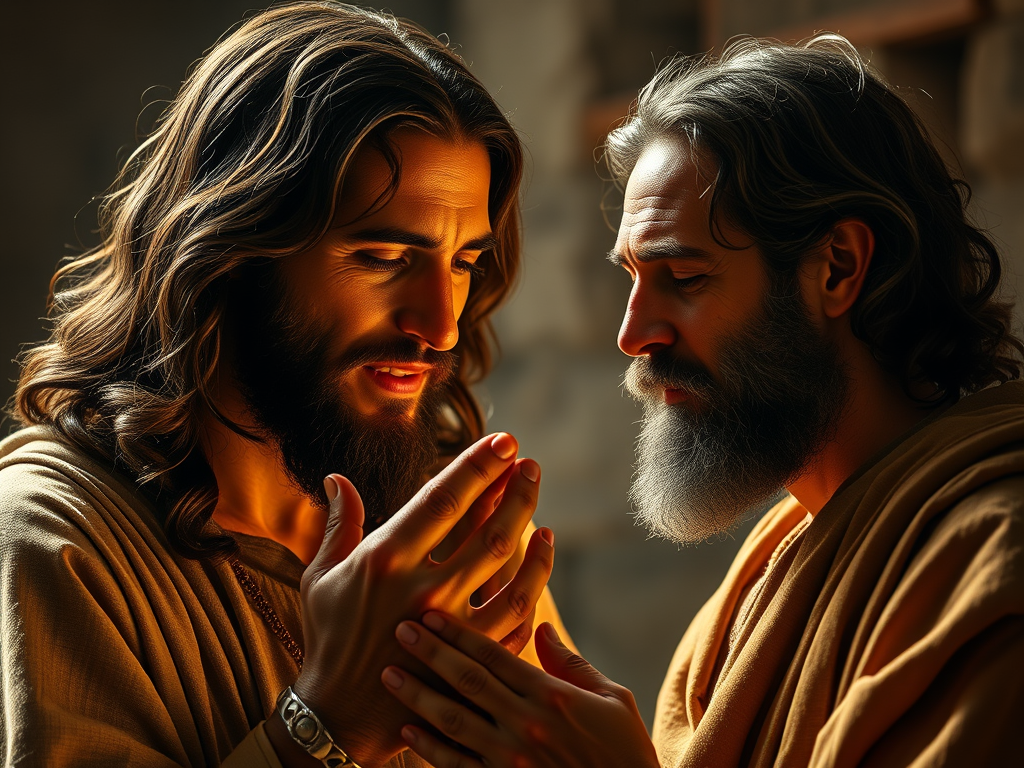
We read more than once in this week’s Gospel that the disciples find Jesus in their midst, even though they’re behind locked doors. It also stands out that Jesus greets the disciples by saying “Peace be with you” and by showing them his wounds.
It’s as if Jesus is saying,” Don’t be afraid. It’s me. I’m here with you, and nothing can stop me from being with you now. I’ve gone to battle with everything that pushes you away from me. I won. See these wounds? They’re an everlasting reminder of my victory over suffering and death. This victory gives new meaning to your suffering and death. United to mine, your suffering will transform you. Like me, you’ll be someone new. And you’ll be that someone because of what you went through — what we went through — before.”
We’ve lost, in Pope Francis, someone I would call the world’s pastor. From what I’ve seen, this is true, to some extent among people of various beliefs.
And here we are in the Easter season. Face tells me that the Easter he is experiencing now is different from the one that I’m experiencing. And my Easter share similarities and differences with the Easter you’re experiencing. You may not be experiencing the emotions you think of when you think of Easter. I’m not. I’m sad and uncomfortable with the unknowns the Church and the world faces. I grieve because of the many forms of violence (greed and selfishness, for example) and loss in the world.
Last Sunday’s readings and this Sunday’s readings tell me the experiences of Jesus’ followers on the first Easter were no different. They tell me the cross and the resurrection are two sides of the same coin. And neither experience is something only Christ goes through. Rather, we all share in both experiences again and we can’t have one without the other. When we have both, nothing can separate us from each other and from God — no suffering — not even death.
Still, sometimes a living sense of communion is hard to perceive on the earthly side of life. Jesus and his first spiritual family members understand that as well as anyone.
In Marissa Papula’s reflection for Divine Mercy Sunday, she explores how trauma and healing can coexist. She unpacks how the gospel passage for this week illustrates this coexistence.
Jesus, help us to see You and to touch You in our midst despite any obstacles to being enlivened by Your presence. Renew us to do Your work in the world, and bring us to rest together with You and all Your beloved departed in eternity. Amen.
“Second Sunday of Easter, Sunday of Divine Mercy — Lectionary: 45.” Daily Readings, Lectionary for Mass for Use in the Dioceses of the United States, Confraternity of Christian Doctrine, 2nd typical ed, United States Conference of Catholic Bishops, 2025, https://bible.usccb.org/bible/readings/042725.cfm.
Posted in Easter, Reflections from Other Writers and Speakers, Reflections on Scripture, tagged bible, christianity, Doubts, Easter, Encouragement, Faith, jesus, Prayer, Reflections on Scripture, Scripture Reflections from Others on April 20, 2025| Leave a Comment »

https://bible.usccb.org/bible/readings/042025.cfm
Peter refers to himself as one of the few people chosen in advance to be witnesses to all Jesus did in his earthly life and after His resurrection. These few witnesses have been given the responsibility and the grace to “bear witness that everyone who believes in [Christ] will receive forgiveness through his name” (Acts 10:43).
“‘[The Lord’s] mercy endures forever'” (Psalm 118:2-4).
There are two choices of epistle readings. The second option tells us to “clear out the old yeast… of malice and wickedness” and “celebrate the feast” … with the unleavened bread sincerity and truth (1 Cor. 5:7-8).
In the gospel passage we’re given for Easter Sunday, Mary of Magdala doesn’t yet understand that Jesus is risen. She tells the disciples, “They have taken the Lord from the tomb, and we (the women who went to pay their respects at the tomb) or they put him” (John 20:2).
In response, Peter and another disciple run to the tomb, and the disciple who is not Peter gets there first, yet Peter goes into the tomb first. He sees the burial cloths but not the body of Jesus. We aren’t told much about what he makes of this discovery. We are told that the other disciple sees the burial cloths, which are apparently neatly set aside separately from each other, and believes. What the disciple believes we aren’t told. I find the question of what he believes even more perplexing because of the last sentence: “For they did not yet understand the Scripture that he had to rise from the dead” (John 20:9).
So if you’re wrestling with doubt and/or confusion this Easter, you’re in the company of more than one disciple.
If you’ve arrived at this Easter and are still clear[ing] out the old yeast of sins, habits and wounds, the second option for the epistle is a reminder that the journey to union with Christ and the members of his body is a lifelong one. It doesn’t end this Easter. Otherwise, we wouldn’t need the exhortation to “[c]lear out the old yeast” (1 Cor. 5:7).
If you’re bothered because the first reading refers to “witnesses chosen by God,” but the disciples in the Gospel passage for Easter Mass during the day don’t see the risen Lord, you’re not alone. I’m with you (Acts 10:41).
Now right after the Gospel excerpt for that Mass ends, Mary of Magdala does see and speak with Jesus, who is risen. The passage that describes this encounter is my favorite in the Bible. It’s more detailed than many passages. It’s easier with this passage than with many others to use my imagination to engage all five senses in the scene it describes. For me, it conveys confusion, grief, tenderness, and intimacy in a way that few other Gospel passages do. In the Gospel of John, it’s because of, or at least after, this encounter between Jesus and Mary Magdalene that other disciples become chosen witnesses of Christ’s resurrection. That’s why, although this encounter isn’t included in the lectionary until the Tuesday after Easter, I’ve linked to it at the top of this post. Several years ago, I also wrote this short story based on the passage.
Dr. Cynthia Bailey Manns offers her own celebration of Mary Magdalene’s love for Jesus. She powerfully conveys the importance of this love in salvation history. I was particularly inspired by her reflections on the ways Mary expresses this love in the days leading up to the resurrection.
Lord, help us to live in ways that reflect that You live and are with us in every circumstance of our lives. May our lives bring this truth to all of creation. Amen.
“Tuesday in the Octave of Easter” — Lectionary: 42.” Daily Readings, Lectionary for Mass for Use in the Dioceses of the United States, Confraternity of Christian Doctrine, 2nd typical ed, United States Conference of Catholic Bishops, 2025, https://bible.usccb.org/bible/readings/042025.cfm.
“The Resurrection of the Lord: The Mass of Easter Day”— Lectionary: 262.” Daily Readings, Lectionary for Mass for Use in the Dioceses of the United States, Confraternity of Christian Doctrine, 2nd typical ed, United States Conference of Catholic Bishops, 2025, https://bible.usccb.org/bible/readings/042225.cfm.
Posted in Lent, Reflections from Other Writers and Speakers, Reflections on Scripture, tagged bible, christianity, Faith, Forgiveness, found, god, jesus, journaling, lost, Prayer, Prodigal, Reflections on Scripture, Scripture Reflections from Others on March 29, 2025| Leave a Comment »

https://bible.usccb.org/bible/readings/033025-YearC.cfm
At the end of the Old Testament reading, when manna is lost, “the yield of the land of Canaan” is gained (Josh. 5-12).
In the epistle, I read that:
“[W]hoever is in Christ is a new creation:
2 Corinthians 5:17
the old things have passed away;
behold, new things have come.In the gospel passage, the younger son begins by finding what he thinks he wants and losing the satisfaction he gets from it. He responds by recognizing what he has lost — the experience of belonging to a family and being provided for by his father — and seeking to find these experiences again.
The father begins the passage by losing the portion of his possessions that he gives to his younger son as well as losing the presence of the younger son himself. But he never stops longing for that presence or loving his son. He rejoices in the son’s presence again when the son heads back to the father’s house.
Ironically, once the younger son comes back to the father, the return reveals distance between the father and the older son. By reasoning with the older son, the father does his part to find what has been lost between him and his first son.
I was away from the blog and from my journaling practice last week. My first impulse was to try to catch up this week so that I would finish all the journaling books by Easter. But I quickly realized I was getting further and further behind and that catching up catching this week was not a realistic goal. I also realized that if I managed to catch up this week, I might not reap the benefits of the prompts. I’d be focused on checking them off my list rather than on reflecting on what they invite me to reflect on.
So now my goal is to journal in the morning before anyone else gets up, for however long that amount of time is each day. Using this approach, I’m setting the intention of writing through my journaling books to their end, no matter how long it takes me to get there. I hate even to write “get there” because I don’t want to think of journaling as something I need to get done. I want it to help me grow in my relationship with myself, with God, and in my relationships with others. This isn’t a desire for one season. It’s the quest of a lifetime. I’ve let go of one idea and taken hold of another — lost one idea and found another.
This week, Wilderness Within invited readers to consider what sins they find themselves confessing over and over. What are the roots of these sins? Sister Josephine Garrett encourages readers not to respond with what they think is the correct theological answer. Describe the roots in your own words (91).
Here’s how I’d describe the primary root of choices I regret making: fear of discomfort, fear of rejection, fear of being alone. Fear.
Garrett also asks readers to consider how they feel before and after they sin. My answers are helpless and trapped and hypocritical. These are the opposite of liberated, open, and honest.
As I write these words, I’ve been tempted to end this section with my paraphrase of the prompt, but that feels like letting the roots grow deeper so that you don’t worry about me, attack me, or reject me. And letting the roots grow deeper isn’t what I sense is best for any of my relationships.
Also as I write these words, I feel nudged to allow a more relaxed publication scheduled for posts on this blog. Taking into consideration other writing-related activities I feel called to, I will publish this post and future posts whenever I finish them. This will probably make the posts less timely. Maybe I can figure out ways to make them less time-sensitive. Now I’ve written similar things in these posts before, so we’ll see what approach I ease into as I let go of another one.
Lord, help me to discern what’s life-giving and lasting and to let go of what isn’t. Help me to seek and to find strength in you. Give me patience and perseverance amid the challenges of the moment. Help me to trust and to experience that You are the ultimate source of fulfillment. Help me to lay down fear and pick up faith. Amen.
Garrett, Sr. Josephine. Wilderness Within. Kindle version, e-book ed., Ave Maria Press, 2024, A Guided Lent Journal for Prayer and Meditation, Accessed 23 Feb. 2025.
“Fourth Sunday of Lent Year C— Lectionary: 33.” Daily Readings, Lectionary for Mass for Use in the Dioceses of the United States, Confraternity of Christian Doctrine, 2nd typical ed, United States Conference of Catholic Bishops, 2025, https://bible.usccb.org/bible/readings/033025-YearC.cfm.
Posted in Lent, Reflections from Other Writers and Speakers, Reflections on Scripture, tagged bible, christianity, Faith, god, jesus, journaling, Lent, Prayer, Reflections on Scripture, Scripture Reflections from Others on March 7, 2025| Leave a Comment »

https://bible.usccb.org/bible/readings/030925.cfm
It surprised me that God as provider and liberator stood out to me this week. As I got ready to draft this section, thinking about what had surprised me, I went back to the Gospel passage looking for the reference to angels ministering to Jesus. I thought that reference would be another lesson in God’s providence, and it is. But it’s not in this week’s gospel passage. It’s in Matthew 4:11, and it comes after the temptations. That chapter in Matthew begins telling us that “Jesus was led by the Spirit into the desert to be tempted by the devil” (1). But the Luke passage begins with “Filled with the Holy Spirit, Jesus returned from the Jordan and was led by the Spirit into the desert for forty days, to be tempted by the devil” (Luke 4:1). This is Luke’s way of telling readers and hearers that the Son of God is not entering alone into an unfamiliar, harsh environment. He won’t face temptation without providence from God.
Outside of this week’s readings, I’ve begun the journaling I wrote about in this section last week. A couple of the books, rightly, I think, invite their readers to start the process of using the book before Lent begins. Doing this has given me a deeper appreciation of what the upcoming season is really about. Prompts have gotten me thinking about what actually stands in the way of my relationship with God and with others. Hint: it isn’t chocolate, and it is in the game or a TV show. Prompts have made me want to get begin practices that I’ll (hopefully) continue through Easter and beyond.
While the journaling prompts in each book is different, each one has tended to draw a similar answer out of me. That’s helpful. It clarifies what I see the need to surrender. It also highlights the areas of my life where I’m seeking renewal. Answering similar questions that are asked in different ways is also beneficial. It lets me see my answers in a different light each time I record them. Maybe recording the same ideas multiple times in different ways will help habits that are spiritually healthier stick.
I’m setting an intention this Lent to see the season or as a continual process of turning toward God rather than away from what is not God. Yes, turning toward one thing often requires turning away from another. However, my desire is to make the acts of turning toward awareness my emphasis.
Try to keep an open mind and heart. Leave room for adjusting your plans. Be careful about not letting your plans take over your life so that they work against their intended purpose. Be careful that your plans don’t take away from the good you are already doing before you began them.
Mindfulness is a lot harder to maintain than the avoidance of chocolate. Distractions are everywhere, all the time, and they aren’t just external. Recommitting to mindfulness is something that happens over and over again throughout the day. It’s not something a person “gets right.” Returning to mindfulness again and again makes sense for Lent. Practicing mindfulness is just that — practicing. Practicing it is like falling and getting up again and again.
Silence isn’t always empty or quiet. It can be filled with presence and sounds I rarely notice — like a variety of bird songs.
Ana Gonzalez, OP relates this week’s readings to the suffering that goes on in the world around us. Her reflection reminds us of the spiritual purpose behind Lenten practices. They are meant to deepen our relationships with God. By doing so, they deepen our relationships with others.
Lord, you did not make us to die in spiritual deserts. Help us not to wither this Lent but to grow instead. Help us to grow in relationship with you and in solidarity with others. Instill in us gratitude for the ways the natural world and spiritual realms provide for us.
“First Sunday of Lent — Lectionary: 24.” Daily Readings, Lectionary for Mass for Use in the Dioceses of the United States, Confraternity of Christian Doctrine, 2nd typical ed, United States Conference of Catholic Bishops, 2025, https://bible.usccb.org/bible/readings/030925.cfm.
Posted in Ordinary Time, Reflections from Other Writers and Speakers, Reflections on Scripture, tagged bible, christianity, Faith, god, Holy Spirit, jesus, Jesus Christ, Mass Readings, Ordinary Time, Prayer, Reflections on Scripture, Scripture Reflections from Others on February 28, 2025| Leave a Comment »

https://bible.usccb.org/bible/readings/030225.cfm
The Old Testament passage says to me that what a person says and does reveals what’s important to him or her. What a person does is even more revelatory than what she says. So is how a person responds to temptations and hardships.
The psalm passage says to me that to be just is to do more than praise God or say kind words to another person. It means rooting one’s perspective and actions in God. The first reading points to the potential for distance between appearance or words and what’s in a person’s heart. The psalm points to what results if there is no distance between what’s in the heart and the good a person speaks or shows to the world.
The epistle points to Christ and the Spirit that comes from Him as the relationship that closes the distance. God transforms hearts prone to frailty and wounded by sin through Christ. Christ transforms through the Spirit through day-to-day experiences, through sacraments, and by again and again, offering forgiveness for sins. His offering and act of solidarity on the cross makes it possible for us to receive all these other gifts. To paraphrase the last sentence of this week’s epistle, His giving of Himself in suffering, to the point of death, and beyond has the potential to make everything we do part of His healing mission. What we do becomes part of this mission when what we do is grounded in the Spirit He has given us to share with Him and with others.
But, the Gospel passage reminds us, we can share that Spirit only if we invite it to work in and through us again and again. We can help others see only if we allow the Spirit to help us see. The passage reinforces the message of the selection from the Old Testament. The effects of a person’s words and actions reveal a person’s true nature.
Sr. Quincy Howard shares with us a reflection on this week’s readings. Her words offer an eye-opening look at the ways we grow our food. I never realized how the taste of fruit has changed over time until I read her reflection. After describing farming methods, she uses them to examine how we tend our souls and the souls of others.
Well-known Scripture passages can become overly familiar. Passages Christians turn to during Lent and Easter are no exception to this tendency. So this Lent, I thought exploring different reading materials might be helpful. These could provide journaling prompts, meditations, and reflections. This approach might help me see familiar words in new ways.
I’ve looked at some options and haven’t settled on just one or even two. Besides, I’m hesitant to follow one collection of reflections too closely on this blog because I want to encourage you to look into the books yourself. I invite you to see which one, if any, deepens your perspective and your relationships with God and others. I’m thinking of pulling a bit of inspiration for my Lenten posts from this book, and a bit from that one. Here are the titles I’m considering journaling or meditating with, in case you’d like to follow along with me:
I’ve listed the books in no particular order, but so far, the last one on the list intrigues me the most because the author, Sr. Josephine Garrett, in addition to having a religious vocation, is a trained mental health professional. A sample I read indicates that she brings all facets of her vocation into the book’s meditations, reflections, and prompts. I plan to start Lent by looking into each book in the list above, but I have a feeling I’ll end up following along with just one or two.
Lord, enlighten my heart so that what comes from it participates in building Your kingdom of love. Amen.
“Eighth Sunday in Ordinary Time — Lectionary: 84.” Daily Readings, Lectionary for Mass for Use in the Dioceses of the United States, Confraternity of Christian Doctrine, 2nd typical ed, United States Conference of Catholic Bishops, 2025, https://bible.usccb.org/bible/readings/030225.cfm.
Posted in Ordinary Time, Reflections from Other Writers and Speakers, Reflections on Scripture, tagged bible, christianity, Faith, Forgiveness, god, jesus, Jesus Christ, Ordinary Time, Prayer, Reflections on Scripture, Scripture Reflections from Others on February 21, 2025| Leave a Comment »

https://bible.usccb.org/bible/readings/022325.cfm
. . . love your enemies and do good to them,
Luke 6:35
and lend expecting nothing back;
then your reward will be great
and you will be children of the Most High,
for he himself is kind to the ungrateful and the wicked.
Be merciful, just as your Father is merciful.
To the person who strikes you on one cheek,
Luke 6:29
offer the other one as well, and from the person who takes your cloak,
do not withhold even your tunic.
This verse stands out to me because, as I read it, I can’t help but think how it can be misused. It can be interpreted as telling someone got to protect him or herself from abuse. But I don’t think this is the intended message. The verse I chose to highlight in the first section is the intended message.
In the New Testament, Jesus sometimes uses figurative language and even hyperbole to make a point. Remember the instruction in Matthew 18:9. It tells us to pluck an eye out if it causes us to sin. Do we really think Jesus wants us to do this? I don’t think so. The point of those verses is to tell us to avoid what we know isn’t good for ourselves, others, and for our relationship with God.
Other ways to express this week’s message might be: Don’t retaliate. Don’t take revenge. Don’t take advantage of others. Don’t be selfish. Taking any of this advice is different from accepting abuse. David had the opportunity to retaliate in this week’s first reading. He didn’t because he wasn’t being attacked. If he been under attack, he’d have been within his rights to protect himself. He could defend himself and/or remove himself from the situation. People have a right to defend themselves and other vulnerable people in their care who are in danger. They also have the right to remove themselves and others from such situations.
This week’s readings remind us again of the difference between wants and needs. They advise us not to withhold from someone something he or she needs because we want it.
Diana Macalintal’s reflection on the readings for February 23 is just what I need right now. I don’t think I’m alone in this assessment. She begins and ends her reflection with a personal story that involves her and her godson. I could picture the events unfolding as I read about them, and I found the little boy’s as well as Ms. Macalintal’s response so relatable. Click here to experience for yourself what I mean.
In Ms. Macalintal’s reflection, she also mentions details from the gospel accounts of Christ’s passion. These references remind me that I meant to wrestle with the events of the passion in the last section. I’ll just do that here instead of pretending I haven’t yet read her words.
So what do the events of Christ’s passion have to say about an individual who is having violence inflicted upon him? It’s an uncomfortable question because in the accounts of Jesus’ suffering and death, He doesn’t flee, and He doesn’t defend himself — not physically and not even verbally — at least not directly. I’m tempted to respond to these depictions with, “That’s because it was his mission and ministry to bear the consequences of our sins and weaknesses to the point of death so that these consequences might not have the final say in our lives and deaths. There’s only one Savior. To suffer and to die isn’t the mission of the rest of us.”
But isn’t it? At some point, in some way, just not in the same way Jesus did? No matter how much we try to avoid and resist it, life brings pain to us (along with pleasure) in many ways. Does this reality mean that to seek holiness is to seek pain? No, I think one understanding of what it means to be holy is to define it as being aware. To be holy means not pretending that what brings pain and what brings pleasure, what brings sorrow and what brings joy doesn’t exist. To be holy is to be awake, and to be awake is to be honest.
While I don’t have direct personal experience with the topic, it seems to me that forms of abuse are built on distorting who the people involved are. It seems to me that abusers operate under the illusion that they are entitled to more power than they actually are. It’s this sense of power that they crave. What gives them this sense power is making their victims believe their abusers have this power and making victims believe they deserve to be abused or that the abuse is somehow related to love.
In the passion accounts, Jesus never loses sight of who He is. He never agrees with what His abusers and attackers accuse Him of and say about Him. Rather, He asks His Father, to forgive them for what they do and for their blindness and ignorance as to what they are doing (Luke 23:34). He knows who really has the power during His crucifixion, even when he doesn’t feel that power accompanying him. Ultimately, He and the Father have that power.
When I think about the passion this way, I see it not as Him allowing himself to be robbed of his dignity and his life, but as Him giving us these two gifts freely. In His offering to us he shows the ultimate solidarity with every human frailty. He offers communion with Him to every human and to all of creation. I suppose having the freedom to do this is what gives Him the power to offer all the forms of surrender that Ms. Macalintal points to in her reflection.
Lord, help us discern what we need and what we want we can better provide for others what they need. Also help us to pray for as we find it most difficult to pray for. Amen.
“Seventh Sunday in Ordinary Time — Lectionary: 81.” Daily Readings, Lectionary for Mass for Use in the Dioceses of the United States, Confraternity of Christian Doctrine, 2nd typical ed, United States Conference of Catholic Bishops, 2025, https://bible.usccb.org/bible/readings/022325.cfm.
Posted in Feast of the Presentation, Reflections from Other Writers and Speakers, Reflections on Scripture, tagged bible, candlemas, christianity, Faith, god, hope, jesus, Mental health, Prayer, Reflections on Scripture, Scripture Reflections from Others, Social Justice, Women on January 30, 2025| Leave a Comment »

For he is like the refiner’s fire,
Malachi 3:2-3
or like the fuller’s lye. . . .
Refining them like gold or like silver
that they may offer due sacrifice to the LORDSince the children share in blood and flesh, Jesus likewise shared in them, that through death he might destroy the one who has the power of death, that is, the Devil, and free those who through fear of death had been subject to slavery all their life.
Hebrews 2:14-15. . . Simeon blessed them and said to Mary his mother, “Behold, this child is destined for the fall and rise of many in Israel, and to be a sign that will be contradicted . . . .
Luke 2:33-34She never left the temple, but worshiped night and day with fasting and prayer. And coming forward at that very time, she gave thanks to God and spoke about the child to all who were awaiting the redemption of Jerusalem.
Luke 2:37-38
When I first revisited the Scripture passages for February 2, the first quotation brought to mind the Kelly Clarkson song “Stronger” (What Doesn’t Kill You).” I actually felt that since Jesus took away the fear of death, as the epistle says, what else did I really have to be afraid of? The things people say can’t kill me. Neither the mistakes I make nor their consequences can kill me either, if I trust in the Lord and learn from those mistakes.
I tend to respond in one of two ways when someone disagrees with me:
I think I tend to respond the first way more than the second. But option one might be more accurate in one situation, while option two might be more accurate in another. I find consolation in the message that it’s the [R]efiner’s fire that allows me to “make due sacrifice to the Lord,” to choose what’s right regardless of what others think of my choices (Mal. 3:3). My refinement isn’t finished yet, and that’s okay, as long as I stay open to being refined.
Then last night, anxiety caught up with me, as if to counteract the freedom I’d felt listening to “Stronger (What Doesn’t Kill You).” Plenty of experiences don’t make me feel stronger or freer, even though they aren’t death.
I read in the Gospel passage for February 2 that the prophet Anna had lived a long time, especially for a first-century woman. She spent years not remarrying, as many women might have been expected to do or would have had to do to survive. She spent years fasting, and praying, and waiting. Then baby Jesus came into the temple, she told everyone she could about Him. Anna’s life couldn’t have been easy. But once she’d lived through her experiences, seen Jesus, and heard what Simeon said about Mary and her baby, she refused to be silenced.
We are all social creatures, but not all relationships we have the opportunity to take part in are healthy. The Kelly Clarkson song is about breaking free of a harmful relationship. Other relationships might be healthy but aren’t the right fit for us or aren’t right for right now. I wonder if the prophet Anna had experience with these realities. Were such experiences part of what made her open to those years of fasting, praying, waiting, and trusting in the temple?
Anna Robertson explores insights we can gain from the prophet Anna’s appearance in the Gospel passage. She also points out that we may not hear about this prophet at Mass. Including her story in the Gospel passage for the Feast of the Presentation is optional.
Lord, help us to persevere in even the most difficult times. Help us to maintain hope. Help us to discern what thoughts, words, and actions will do the most good in various situations. May we follow where discernment and wise advice leads. Help us to be a source of hope and truth for others. Thank you, Lord for giving us opportunities to be sources of hope, May we show love in concrete ways. Amen.
“Feast of the Presentation of the Lord — Lectionary: 524.” Daily Readings, Lectionary for Mass for Use in the Dioceses of the United States, Confraternity of Christian Doctrine, 2nd typical ed, United States Conference of Catholic Bishops, 2025, https://bible.usccb.org/bible/readings/020225.cfm.
Posted in Baptism of the Lord, Christmas, Reflections on Scripture, tagged Baptism, Baptism of the Lord, bible, christianity, Christmas, Faith, god, jesus, Jesus Christ, Mass Readings, Prayer, Reflections on Scripture on January 9, 2025| Leave a Comment »

The feast we celebrate today commemorates a turning point. Today is the last day of the liturgical Christmas season. It’s the end of the beginning.
In today’s gospel passage, we see that Jesus has grown into a man. And yet the message of today’s readings is still the message of Christmas. That message is that God is with us. One of the ways God is with us is by being one of us.
In all the gospel passages associated with Christmas, including today’s, most people don’t understand who Jesus is until God reveals the identity of the only begotten Son in unusual ways. These unusual ways include an announcement from an angel, the radiance of a star, and, in the case of today’s story, a disembodied voice.
But the heavens don’t open, and that voice doesn’t speak until Jesus places himself among sinners — this time in a more conscious and open way than ever before. He’s no longer the infant visited by shepherds and astrologers. His ministry is no longer that of a carpenter in a single village. He’s a man now, free to go where He will without making his mother worry that she’s let God down.
Where He goes is to John. He goes to John to model repentance. He models of the death of the old self and the birth of a new one. His coming to John for baptism foreshadows His death and Resurrection that made ours possible. As part of His baptism, He allows Himself to be submerged in the Jordan River. He then lets the Holy Spirit, in the form of a dove, come to rest on Him. He offers himself to unite the natural world with God. He teaches that all of this world points to God. It points to God for those who are willing and able to follow where it leads.
All the options for this week’s readings do the same. They point to God being in our midst everywhere, at all times if we know how to look.
Lord, help us. You call all people your beloved children. Guide us to treat ourselves and others the way You call us to. Amen.
 Sitting with the Sacred