Feeds:
Posts
Comments

Posts Tagged ‘Mass Readings’

Photo Generated by WordPress AI

Readings for March 2, 2025:

All in one place:

https://bible.usccb.org/bible/readings/030225.cfm

In the context of each Bible book:

  1. Sirach 27:4-7
  2. Psalm 92:2-3, 13-14, 15-16
  3. 1 Corinthians 15:54-58
  4. Luke 6:39-45

What stands out to me from this week’s readings:

The Old Testament passage says to me that what a person says and does reveals what’s important to him or her. What a person does is even more revelatory than what she says. So is how a person responds to temptations and hardships.

The psalm passage says to me that to be just is to do more than praise God or say kind words to another person. It means rooting one’s perspective and actions in God. The first reading points to the potential for distance between appearance or words and what’s in a person’s heart. The psalm points to what results if there is no distance between what’s in the heart and the good a person speaks or shows to the world.

The epistle points to Christ and the Spirit that comes from Him as the relationship that closes the distance. God transforms hearts prone to frailty and wounded by sin through Christ. Christ transforms through the Spirit through day-to-day experiences, through sacraments, and by again and again, offering forgiveness for sins. His offering and act of solidarity on the cross makes it possible for us to receive all these other gifts. To paraphrase the last sentence of this week’s epistle, His giving of Himself in suffering, to the point of death, and beyond has the potential to make everything we do part of His healing mission. What we do becomes part of this mission when what we do is grounded in the Spirit He has given us to share with Him and with others.

But, the Gospel passage reminds us, we can share that Spirit only if we invite it to work in and through us again and again. We can help others see only if we allow the Spirit to help us see. The passage reinforces the message of the selection from the Old Testament. The effects of a person’s words and actions reveal a person’s true nature.

What someone else is sharing about this week’s readings:

Sr. Quincy Howard shares with us a reflection on this week’s readings. Her words offer an eye-opening look at the ways we grow our food. I never realized how the taste of fruit has changed over time until I read her reflection. After describing farming methods, she uses them to examine how we tend our souls and the souls of others.

What I’m saying (about the readings and beyond) this week:

Well-known Scripture passages can become overly familiar. Passages Christians turn to during Lent and Easter are no exception to this tendency. So this Lent, I thought exploring different reading materials might be helpful. These could provide journaling prompts, meditations, and reflections. This approach might help me see familiar words in new ways.

I’ve looked at some options and haven’t settled on just one or even two. Besides, I’m hesitant to follow one collection of reflections too closely on this blog because I want to encourage you to look into the books yourself. I invite you to see which one, if any, deepens your perspective and your relationships with God and others. I’m thinking of pulling a bit of inspiration for my Lenten posts from this book, and a bit from that one. Here are the titles I’m considering journaling or meditating with, in case you’d like to follow along with me:

I’ve listed the books in no particular order, but so far, the last one on the list intrigues me the most because the author, Sr. Josephine Garrett, in addition to having a religious vocation, is a trained mental health professional. A sample I read indicates that she brings all facets of her vocation into the book’s meditations, reflections, and prompts. I plan to start Lent by looking into each book in the list above, but I have a feeling I’ll end up following along with just one or two.

This week’s prayer:

Lord, enlighten my heart so that what comes from it participates in building Your kingdom of love. Amen.

Scripture Passage Source:

“Eighth Sunday in Ordinary Time — Lectionary: 84.” Daily Readings, Lectionary for Mass for Use in the Dioceses of the United States, Confraternity of Christian Doctrine, 2nd typical ed, United States Conference of Catholic Bishops, 2025, https://bible.usccb.org/bible/readings/030225.cfm.


Read Full Post »

Auto generated by WordPress AI

Readings for February 9, 2025:

  1. Isaiah 6:1-2a, 3-8
  2. Psalm 138:1-2, 2-3, 4-5, 7-8
  3. 1 Corinthians 15:1-11 or 1 Corinthians 15:3-8, 11
  4. Luke 5:1-11

What stands out to me from this week’s readings:

The following messages:

  • An encounter with God is more than reading about God or learning about God. An encounter with God is tangible. It’s personal and intimate.
  • An encounter with God changes how the person who has the encounter sees him or herself.
  • This new view of himself/herself and the tangible, personal encounter with God is uncomfortable, humbling and overwhelming. These feelings because the person to retreat and to cower.
  • God says, in different ways, “I don’t seek personal encounters with you just to make you uncomfortable. Take heart in My presence. Stand with me in this new perception of who you are. Let Me work through and in the midst of your anxieties and weaknesses. Let me heal your wounds and work through what you’ve learned from them. When you let Me, you can do for others what I do for you.”
  • God says, “If you’re having trouble encountering Me right now, look for those who have encountered Me. You’ll recognize the effects of those encounters. Companions changed by them will remind you of what you’re worth to me. I’ve died with you so you can live with Me.”

What I’m saying (to the readings and beyond) this week:

I had the most visceral reaction to the epistle for this week. It’s embarrassing to admit. Initially, I felt resistant to the passage. I didn’t know how to fit it into the theme I was discerning for this week’s post. The Old Testament passage and the Gospel passage describe profound, face-to-face encounters with God. We aren’t allowed as directly into such an encounter when we read the psalm excerpt. However, it seems to be the words of someone who has had a personal encounter with God. The narrator has experienced God’s providence.

Now St. Paul, the author of the letters to the Corinthians, has had this kind of encounter. But that blinding light through which Christ speaks is not what I read about in this week’s epistle. This passage isn’t where I can read about the details of that encounter. Instead, Paul mentions large number of people who encountered the risen Christ before he did. Then he points out that the risen Christ appeared to him last, “as to one born abnormally” (1 Cor. 15:8).

His assessment of himself bothered me. It’s one thing to feel humbled in the presence of God by becoming aware of the ways your choices fall short of self-giving love. But no one chooses when he or she is born. Why should characteristics a person doesn’t choose mean he or she is chosen last? I reminded myself that when the letter was written, perspectives on birth were very different. Views on disability and many other human experiences were also very different. Still, the phrase was jarring to read. What happened to “the last shall be first, and the first shall be last” (Matt. 20:16)? An answer to this question is that the verse from the Gospel of Matthew reflects a perspective gained later, from a memory recorded later. Matthew was written down after 1 Corinthians. But back to the passage from 1 Corinthians that we’re looking at this week.

The day after I first revisited the passage, I saw the note that accompanies 1 Corinthians 15:9. If I understand this note correctly, it says verses 8 and 9 reflect the attacks his opponents leveled at him. The note reminds me of an important question to ask when reading Scripture: how might the experiences of the human writer affect how the message is expressed? How might God work through the wounds revealed in the expression of the message?

Paul says he was chosen to be an apostle not thanks to his own merit but thanks to God’s grace. This message at the end of the passage means it actually does fit in with the theme I had discerned for the February 9 readings.

Nevertheless, in other ways it still doesn’t seem to fit as well as the other passages do. As I wrote above, the passage doesn’t include much of a recap of what Paul experienced on the road to Damascus. Instead, Paul says indirectly that happened. He says that because it happened, he came to believe and to preach what the other apostles had experienced with regard to Jesus’s resurrection. He seems to want the letter’s readers to persevere in faith based on his words and the words of the apostles. He seems to suggest that a personal encounter with God isn’t essential to a faith that perseveres in difficult times.

Or does he? He writes, “I am reminding you… of the gospel I preached to you, which you indeed received and in which you also stand” [emphasis mine] (1 Cor. 15:1). I usually associate receiving with something concrete coming into my possession. I don’t usually associate it with merely hearing. “Receiving” suggests something sinking in, settling. To me, receiving implies more than intellectual acceptance. Furthermore, it’s hard to imagine “stand[ing] in” something merely heard from someone else, even if that something heard comes from people who say they actually saw it. Maybe he’s suggesting that the experiences he’s had and the ones that have been shared with him open the door for the Corinthians to have their own personal encounters with God’s grace.

What someone else is sharing about this week’s readings:

Leah Sealey reflects on the readings for February 9, 2025. As she does so, she suggests ways to make encounters with Scripture personal encounters with God. Some of the approaches I’d heard of. Others I hadn’t, such as asking what a passage doesn’t say and imagining myself saying it to Jesus. Usually, I read the reflections from Catholic Women Preach after I’ve written the first section of that week’s post. But I wish I’d read Ms. Sealey’s reflection before I wrote my own this week.

This week’s prayer:

Lord, open the doors of my heart and soul to encounters with You. May I recognize encounters with others as encounters with You, and may others do the same when they meet me. Grant us the grace to experience encounters with You and with others as occasions to experience clarity and compassion. Amen.

Scripture Translation Used:

“Fifth Sunday in Ordinary Time — Lectionary: 75.” Daily Readings, Lectionary for Mass for Use in the Dioceses of the United States, Confraternity of Christian Doctrine, 2nd typical ed, United States Conference of Catholic Bishops, 2025, https://bible.usccb.org/bible/readings/020925.cfm

Read Full Post »

Readings for January 19th:

  1. Isaiah 62:1–5
  2. Psalm 96:1–2, 2–3, 7–8, 9–10
  3. 1 Corinthians 12:4–11
  4. John 2:1–11

What stands out to me from this week’s readings:

Today’s readings remind me that God’s nature is relationship – not just relationship between the Persons of the Trinity but with creation. God creates because God’s nature is relationship, and a relationship isn’t something that happens to one person. It’s a bond between at least two.

Today’s readings are about an intimate bond, the most intimate bond, the bond between God and God’s people. The readings characterize this bond as a bond between a bride and a groom. They paint an idealized picture of the bond between newlyweds. In the Old Testament reading, God is the groom who “delight[s]” and “rejoice[s]” in his bride (Isa. 62:4-5). Yes, the bride and groom exchange vows him, but the first reading makes it clear that more than vows, expectations, and a legal bond joins the bride and groom. It’s not a bond that’s imposed. It’s a bond that forms and grows. So is the relationship between God and a person who loves God.

The psalm says the royal groom gives the bride cause to sing His praises and get dressed up. Why? Because the groom is a just and heroic leader who escorts His previously captive, deceived, and abused bride to freedom. When I look at this week’s epistle through the lens of a marriage between an individual and God, the passage says to me that the relationship between God and each person is unique. It comes with pleasant experiences, less pleasant ones, challenges, and surprises. Each person’s relationship with God is unique. Each one of these relationships offers distinct gifts to the world.

Fittingly, given the marriage metaphor developed in the first reading, this week’s gospel passage takes place at a wedding. What stood out to me as I revisited the passage this time was the role of surprise in it. Based on what we find in the New Testament, Jesus knows how his earthly ministry will end, but He’s surprised by encounters He has during it. Maybe he doesn’t know everything all at once. The stories about his infancy and childhood suggest this.

And then His mother comes to Him at a wedding and says the host is out of wine. He seems to wonder what this problem has to do with his ministry and mission. Yet I imagine he knows that any good he does can serve that mission. He also knows relationship is the source and goal of the mission. Interaction between two living beings creates that relationship. So his mother’s request plays a key part in his work on this occasion.

He’s not the only person surprised in the passage. The head waiter is surprised, too, by how much better the second batch of wine, the one Jesus changed from water, is than the first.

And why wouldn’t surprise have an important role in the passage? Continuing to be pleasantly surprised keeps a relationship interesting. Furthermore, being able to accept unexpected developments is crucial in a healthy relationship. Responding to these developments in authentically helpful ways is also essential.

I would think having a basis in more than routine and ritual is also important. When I think about this, it seems significant that Jesus uses jars meant for ceremonial washings. He fills them with the water that will become wine. He takes vessels used for ritual and for external purposes and uses them to provide for the needs of the guests.

A lot of water wasn’t safe for drinking for centuries. Water was for spiritual and practical cleansing, in many cases. According to this source, wine mixed with water was for drinking. So not providing guests with enough wine wouldn’t just have been a serious social faux pas. It was likely also health concern.

Therefore, by making sure the host has more wine, Jesus is providing for those present physically and emotionally. He hasn’t made sure they have more wine so they merely survive. As a good spouse cares, He cares about how the guests feel and wants them to thrive. This passage reminds me of when Jesus says, “I came so that they might have life and have it more abundantly” (John 10:10) Like the jars for ceremonial washing, he wants the guests “filled to the brim” with what they need. It’s not enough just to keep the jars – us — from being empty.

What someone else is sharing about this week’s readings:

Claire Erlenborn turns to this week’s readings for help with reflecting on what makes “change for the good” happen.

This week’s prayer:

Jesus, I want to fall in love with You. Help me grow in my relationship with you so our relationship can take part in bringing good change to the world. Amen.

Work cited (but Not Linked to):

The New American Bible Revised Edition, Kindle edition, Fairbrother, 2011.

Read Full Post »

Image Generated by WordPress AI

Readings for January 12th:

  1. Isaiah 40:1–5, 9–11 or Isaiah 42:1–4, 6–7
  2. Psalm 28(29):1-4,9-10 or Psalm 104:1b–2, 3–4, 24–25, 27–28, 29–30
  3. Acts 10:34–38 or Titus 2:11–14; 3:4–7
  4. Luke 3:15–16, 21–22

What stands out to me from this week’s readings:

The feast we celebrate today commemorates a turning point. Today is the last day of the liturgical Christmas season. It’s the end of the beginning.

In today’s gospel passage, we see that Jesus has grown into a man. And yet the message of today’s readings is still the message of Christmas. That message is that God is with us. One of the ways God is with us is by being one of us.

In all the gospel passages associated with Christmas, including today’s, most people don’t understand who Jesus is until God reveals the identity of the only begotten Son in unusual ways. These unusual ways include an announcement from an angel, the radiance of a star, and, in the case of today’s story, a disembodied voice.

But the heavens don’t open, and that voice doesn’t speak until Jesus places himself among sinners — this time in a more conscious and open way than ever before. He’s no longer the infant visited by shepherds and astrologers. His ministry is no longer that of a carpenter in a single village. He’s a man now, free to go where He will without making his mother worry that she’s let God down.

Where He goes is to John. He goes to John to model repentance. He models of the death of the old self and the birth of a new one. His coming to John for baptism foreshadows His death and Resurrection that made ours possible. As part of His baptism, He allows Himself to be submerged in the Jordan River. He then lets the Holy Spirit, in the form of a dove, come to rest on Him. He offers himself to unite the natural world with God. He teaches that all of this world points to God. It points to God for those who are willing and able to follow where it leads.

All the options for this week’s readings do the same. They point to God being in our midst everywhere, at all times if we know how to look.

This week’s prayer:

Lord, help us. You call all people your beloved children. Guide us to treat ourselves and others the way You call us to. Amen.

Read Full Post »

Image Generated by WordPress AI

Readings for January 5th:

  1. Isaiah 60:1–6
  2. Psalm 72:1–2, 7–8, 10–11, 12–13
  3. Ephesians 3:2–3a, 5–6
  4. Matthew 2:1–12

What stands out to me from this week’s readings:

Then you shall be radiant at what you see,
your heart shall throb and overflow . . .

Isaiah 60:5

The Old Testament passage for January 5 describes God’s light drawing the members of the tribes of Israel together and to itself. The verse above, particularly its second line, is what stands out to me from the passage and from this week’s readings.

It doesn’t surprise me that this verse is the one that jumps out at me from all the ones chosen for this week. Romantic themes and imagery are what resonate with me. I watch, read, and write stories about what it means to love.

When I think about the feast we celebrate today, I think of a brilliant light leading wise men who are not Hebrews to baby Jesus. I think of how the magi bring him gifts that don’t seem appropriate for a baby.

Nonetheless, these gifts teach Jesus’ spiritual family members about who He is and what His mission is. I think of how, while what the New Testament passage calls a star leads the wise men from afar to Jesus, the magi don’t tell Herod where to find Jesus. In other words, I engage my mind and its ears and eyes in the story.

But when I read the second line of Isaiah 60:5 this time around, the story of the Magi seeking the infant Jesus took on a new dimension for me. Or at least I received the story’s message in a new way. I imagined the Incarnation of Christ as a physical sensation within me. It

Isaiah 60:5 says the experience of Christ in the flesh cannot be contained in any way, not even within a single time period, space, or culture. And yet it is tangible everywhere.

It reminds me I’m called not just to follow the Light but to let the pain and pleasure of it in. I’m to be a vessel as much as the next person, and the next. The Light has the weight and power of water as much light. It is as much like a swollen river as it is an astronomical occurrence that makes night like day.

What someone else is sharing about this week’s readings:

The “Hark!” podcast from America Media explores the history and messages of various Christmas carols. (If you can’t access the link in this section without subscribing to America, I encourage you to search for the podcast and the “We Three Kings” episode in particular in the podcast player of your choice.) Each episode is named for the title of the carol featured in it. This episode about “We Three Kings” discusses the familiar components and interpretations of this week’s gospel passage. It also offers some insights I’d never heard before. Here’s a teaser: maybe the gifts of the magi were for Mary too.

This week’s prayer:

Lord, open the eyes of my soul so I can follow Your light. Make me “be radiant at what [I] see” (Isa. 60:5). Make my heart “throb and overflow” (Isa. 60:5). Amen.

Work cited (but Not Linked to):

Confraternity of Christian Doctrine, Inc. “The Epiphany of the Lord – Mass of the Day Sunday 5 January 2025: Readings at Mass.” The New American Bible, 2001. Universalis for Windows, Version 2.198, Universalis Publishing Ltd., 13 Dec. 2024, https://universalis.com/n-app-windows.htm.

Read Full Post »

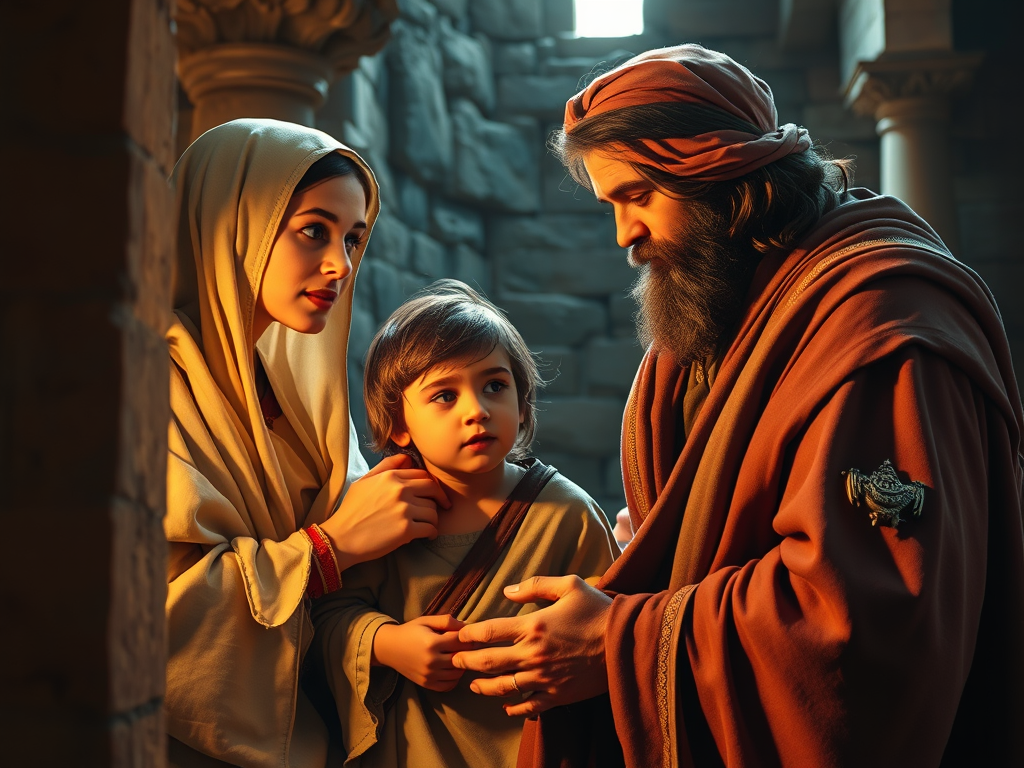
Photo Generated by WordPress AI

Readings for December 29th:

  1. 1 Samuel 1:20–22, 24–28
  2. Psalm 84:2–3, 5–6, 9–10
  3. Colossians 3:12–17
  4. Luke 2:41–52

Reflection on the Gospel Passage for December 29th: Luke 2:41–52

Like many of us, the family in this week’s gospel passage has been traveling as a part of its observance and celebration of a religious festival. Like many of us, this nuclear family has been sharing in traditions and customs with family and friends. The passage describes this nuclear family as having “completed [the] days” of the festival (Luke 2:46).

Perhaps this wording is simply a reflection of the culture in which the passage was written. Perhaps such observances represented obligations that needed to be fulfilled, tasks that needed to be completed. And yet, it was undoubtedly not just God that these rituals served. They also served the family members, providing welcome variance in their day-to-day routines and helping them to think not only in terms of days but in terms of centuries, maybe even millennia. They strengthened the connections between generations. And not just because people of different ages might share in these customs, not just because of what might be enjoyable about the customs either.

Holiday travel can be a pain these days, but I feel like any conception that I might come up with for how difficult it must’ve been in Jesus’ childhood would be woefully inadequate. Yet, this week’s gospel passage tells me, Jesus’ family and friends have traveled to Jerusalem and continued Passover traditions in what must have been a crowded city.

Then the time comes to head home, and, lo and behold, Joseph and Mary can’t find their boy. For a while, they assume he’s with their friends and extended family. It’s no wonder. They’ve been traveling with a large group.

And part of me imagines they just weren’t ready to grapple with the reality that their boy wasn’t with that group. This possibility would be beyond difficult for any parents to face. Add to that what the possibility would mean for Mary and Joseph — that they have lost God’s son, the Messiah Israel that has been promised and has been waiting for for so long.

I imagine them wondering why God would let this happen. Would God let their failures get in the way of God’s promises to his people being kept. How could it be God’s will that any son disobey his parents, let alone this Son?

We’re told that it takes Mary and Joseph three days to find Jesus. Yes, groups of three have symbolic importance in Scripture. I’m not sure what the official interpretation of the symbolism of three in the Bible is, and to be quite frank, I’m probably not going to look it up before I publish this post. I’m writing these particular words for days before Christmas and probably won’t get them published much before the twenty-ninth. I want to spend most of the time in between being present with my family and friends.

At some point in school, I learned that the triangle is the strongest shape, so the number three makes me think of strength. Its association with the Trinity makes me think of strong bonds. Its association with the time between Jesus’ Last Supper and his resurrection makes me think of perseverance in the face of suffering. It makes me think of how waiting itself can be a form of suffering. Time passing more quickly than I would like can bring suffering with it too.

I imagine Mary and Joseph experiencing many forms of suffering when they have to accept, after having traveled a day’s distance, that Jesus isn’t with them or any of their traveling companions. Maybe they didn’t even feel like they ought to take time to eat or sleep while they searched for Jesus. Maybe they didn’t have appetites anyway and couldn’t relax enough to rest even if they thought God wanted them to. These possibilities mean more suffering.

In the midst of their suffering, Mary and Joseph find Jesus in the temple. He’s listening to the teachers there, “and asking them questions” (Luke 2:46). The phrase in quotation marks stands out to me. It reminds me of how important listening and asking questions is to forming and growing relationships, even my relationship with myself. It reminds me that these are no less important components of my relationship with God.

After I read that Jesus is “sitting in the midst of the teachers, listening to them and asking them questions,” I read that “all who heard him were astonished at his understanding and his answers” (Luke 2:46-47). It seems like the listening and understanding are going in multiple directions. There’s a message about what it means to grow and to grow in all kinds of relationships in that detail as well. The same detail also says that God listens to and understands me. And by me, I mean you, too.

Maybe, at the age Jesus was when he found his way to the temple, didn’t understand human nature quite as well as he would come to as he “advanced in wisdom and age and favor before God and man” (Luke 2:52). After all, in the passage, he doesn’t seem to understand his parents’ anxiety and confusion. He seems to think they should have known why he left the group and where he went. Nevertheless, despite his young age, he seems to have a clearer grasp of who He is and what that means then they do.

Maybe Mary and Joseph have become comfortable in their day-to-day and annual duties and with their own ideas of what the future will hold for them and for Jesus. Maybe they’ve consoled each other by saying that the suffering they were warned about when he was eight days old hasn’t come yet. And then he disappears, and when they find him, he reminds them who he is. He invites them, once again, to trust God in the face of uncertainty — just when they’ve begun to believe they understood the parts they’d been given in that plan.

How many times have we acted and felt like Mary and Joseph, even though we haven’t been tasked with bringing up God’s son, and some of us haven’t been given children to bring up all? On the other hand, what about times we’ve wandered from the path of others thought we would follow on our quest to become the person God calls us to be and to do what God calls us to do? Do we have the courage to listen to the questions of others, as well as to their answers. Do we have the courage to learn from each other? Do we have the courage to ask the questions and listen to the answers? Do we have the courage to trust that God listens to us even when it’s hard for us to see the evidence of that listening. Lord, give us the courage. Holy family, pray for us. Amen.

Work cited:

The New American Bible Revised Edition, Kindle edition, Fairbrother, 2011.

Read Full Post »