I’m used to hearing that this week’s readings are about the following:
God’s providence
God’s power over nature, demonstrated differently than in the calming of the storm
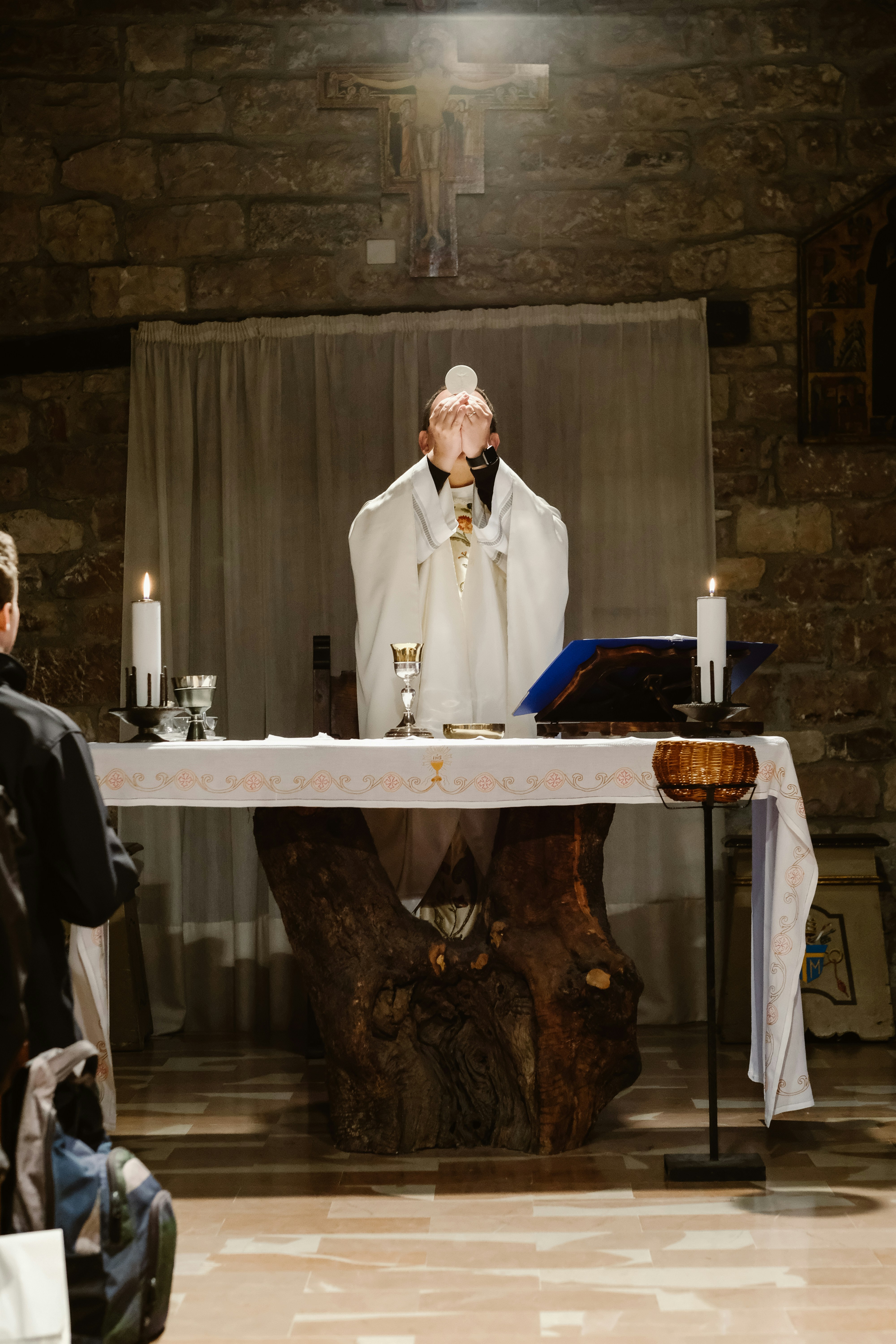
Christ feeding His spiritual family members his own Body and Blood, an ongoing act of love that comes to us from His apostles because He extended it to them on the night of his Last Supper.
And it is all of the above, but I feel prompted to highlight what else stood out to me as I read the passages this time around:
A man came from Baal-shalishah bringing to Elisha, the man of God, twenty barley loaves made from the firstfruits, . . . . Elisha said, “Give it to the people to eat.” But his servant objected, “How can I set this before a hundred people?” . . . . And when they had eaten, there was some left over, as the LORD had said.
2 Kings 4:42-44
This passage and the New Testament one tell me that questions and doubts are only obstacles to God to the extent that they keep a person from acting with faith. In both passages, people act as God inspires them to do, and God works with what they give. God keeps his promises and gives more than the people hope for.
The eyes of all look hopefully to you, and you give them their food in due season . . .
Psalm 145:15
This verse reminds me that God’s timing may be different from mine. It doesn’t say God will give me what I want right now. Instead, it says God will give me what I need indue season — when the timing is best for me and for the overall plan.
Brothers and sisters: I, a prisoner for the Lord, urge you to live in a manner worthy of the call you have received, with all humility and gentleness, with patience . . .
Ephesians 4:1-2
This excerpt relates to how God provides for us by giving Himself because we need God’s humility, gentleness, and patience to allow God to provide for us in other ways. God doesn’t force-feed us. Instead, God waits for us to be open to receiving Him.
Trusting in God, who isn’t limited by our sense of time and timing also takes patience.
Feeding others from the gifts we have received, in other words, making Christ visible in what we do, requires the virtues mentioned in this excerpt as well.
“’Gather the fragments left over, so that nothing will be wasted.'”
John 6:12
In addition to reinforcing the lessons of the Old Testament passage, the New Testament passage includes the above instruction. Not only does God give us more than we hope for in due season, but also we must be careful not to waste the abundance we receive. What we don’t waste can meet future needs.
What someone else is sharing about this week’s readings:
Dr. Alice Prince points out that the virtues highlighted in this week’s epistle don’t just make room to receive God’s abundance. God’s abundance is one of those proverbial two-way streets. Receiving God’s abundance helps us experience and practice those virtues.
Beyond this week’s readings:
It’s easy enough to quote Scripture passages as evidence that God provides. I even posted last week about the ways I’ve noticed God providing for me lately. Even so, I know there are plenty of situations in which it doesn’t seem like God provides. I listed some of those situations at the end of last week’s post. I find myself asking, “Lord, if you can use five loaves and two fish to feed more than 5,000 people, why aren’t you making sure everyone in Gaza, the U.S. or everywhere else in the world has enough to eat right now? Don’t you care about food insecure and starving people anymore?
Faith tells me the answer is “yes.” But I wonder how often humans get in the way of God’s providence. I know that too often what’s left over gets wasted and doesn’t make it to the people who need it.
This week’s prayer:
May we never interfere with God’s providence. May we participate in it instead. And may we never waste what we have to share, in the name of the Father, the Son, and the Holy Spirit. Amen.
Note: I won’t have much time for the blog for the next two or three weeks. Until I have more time to devote to Sitting with the Sacred, I’m planning on keeping this section brief, perhaps by pointing out an overall theme or lesson that stands out to me. So, what’s going to come to me this week?
On my first read-through of the readings for June 23, I noticed lots of imagery relating to stormy seas, the Lord having power over them, and as a result, people being kept safe amid destructive forces.
But the passage from 2 Corinthians doesn’t immediately seem to fit in with this theme. I’ve struggled to unpack it’s meaning, but I think the gist of its meaning is familiar: because Christ withheld nothing from us — not even His life so that he could conquer death and stop it from having the final say, we should withhold nothing from Him. We must instead ask for the grace not to see others only in terms of what is transitory, such as looks and abilities, or in terms of what they can do for us. All of these can and do change.
We are also being encouraged to ask for the grace not to view others in terms of the harm they’ve caused. Looks, abilities, what we can do for each other, and the ways we can hurt each other — none of these things remain as they are. They’re transformed by Christ’s resurrection. So are understandings of what it means to be saved and to die. I suppose that’s why, in the Gospel passage, Jesus is able to sleep while the apostles are terrified of drowning in the storm. He knows that neither the storm nor death have ultimate power over anyone in the boat. He and our free will have the ultimate power — because He and God are one, and it is God’s love that gives life and the freedom to receive God’s love or reject it.
It’s not trusting that love that brings about spiritual death. At one time or another, each of us will undergo physical death. But whenever we trust in God’s love and share it, we receive new life in our spirits.
This week’s prayer:
Lord, protect us as we face the literal and figurative storms of life on Earth. Thank You for being with us in the midst of the storms of all kinds that life sends our way. Help us to experience that storms don’t have the final say — no matter how much they hurt us. Help us to experience that it’s okay to have questions and be angry and afraid when they hurt us.
This week especially, we bring to prayer residents of coastal communities, seafarers, police, firefighters, healthcare workers, lifeguards, pastors, ministers, counselors, aid workers and many others who offer rescue in all its forms. Amen. We offer this prayer in the name of the Father, the Son, and the Holy Spirit.
The theme I’m getting from this week’s readings is that authentic, nurturing strength comes from God. Like last week’s passage from 2 Corinthians, this week’s Old Testament reading reminds me that nothing visible will remain as it is forever. The passage says branches of a cedar tree can break off and become shoots that will grow into a new tree able to shelter everything. A towering tree can also be struck down, a green tree can wither, and a withered tree can bear fruit. All of the above can happen because God allows it. The passage closes by reminding me that God keeps God’s word. God is trustworthy.
This week’s psalm excerpt begins with the following words:
It is good to give thanks to the LORD, to sing praise to your name, Most High, to proclaim your kindness at dawn and your faithfulness throughout the night.
Psalm 92:2-3
It says that those who are just will “flourish” (Psalm 92:13-14). It says those who have deep roots of faith in God will remain with God eternally. They’ll never cease to bear fruit. They can sway in high winds without breaking. They proclaim the perfect love of the Lord without hesitation.
The epistle, like the psalm, presents the ideal attitude and behavior of someone who places his or her trust in God. This person is “courageous,” always seeking to live the life God has called him or her to live with the help of the Holy Spirit (2 Cor. 5:8). He or she lives this way despite the struggles and obstacles involved in living this life and despite desiring to be free of these troubles and obstacles. Why? Because the person has faith that on the other side of death, he or she will reap what he or she has sown, “whether good or evil” (2 Cor. 5:10).
The Gospel reading uses a parable to remind me that I’ll reap what I sow. I find the way the Gospel passage shares this message to be more relatable and encouraging than the way the epistle teaches the same. The Gospel passage says to me that I don’t have to know every step of the path forward for the journey to be worth taking and to bear fruit. The smallest seed can grow into a tree that will serve so many good purposes. And God gave that seed the innate ability to grow when it’s cared for and to become so much more than it appears to be able to become.
What someone else is sharing about this week’s readings:
Kathleen O’Brien acknowledges that it’s natural for all of us to imagine the end results of processes we begin and journeys we set out on. At the same time, her reflection on this week’s readings uses the lifecycle of the mustard seed to invite us to recognize God’s presence in each stage of the process or journey. She encourages us not just to focus on imagining the end result we want but also to recognize that each stage is important for growth and contributes to the end result. Furthermore, she invites us to recognize that the end result may be different from what we had imagined, but differences don’t reduce the value of the result.
Beyond this week’s readings:
“. . . I want to . . . invite you to recall and reflect on something you have or are tending to. . . .Now, when you reflect here, what do those different stages in consistently tending to something look like for you? How did you feel when you first started your big project . . .? Maybe your feelings would swing from feeling confident and in control to then feeling inadequate and not enough. What were your imagined expectations of the end result?
When it comes to tending the current iteration of my novel manuscript, the first stage feels like knowing something no one else does yet. It’s an exciting experience because it’s the experience of starting something new. It’s a journey no one can get in the way of yet because no one else knows about it yet. What grows out of my seat of an idea can’t yet fall short of resonating with someone else the way it does with me. It’s good enough for me, and that’s all that matters. The seed feels safe cocooned in darkness.
In the second stage, the drafting stage, the seed of an idea struggles to break the surface of the soil, which in this case, means it struggles to transform from the dialogue-and-image snippets in my mind to sentences, paragraphs, and pages in my word processor, And I want so much for those pages to describe a coherent and satisfying series of events experienced by empathetic characters. This stage means relying on determination — faith by another name — in the face of frustration.
In the third stage, my seed will be exposed to the elements. The elements, in this, case will be the feedback of others and of editing software. The plant may be pruned. It will likely have more done to it than pruning. It will have branches removed from it. It may even be cut back to the point of being no more than a seedling again. It may need to be planted elsewhere and to grow into a different shape than the one my constantly shifting vision had of it as a mature plant.
Only a couple of my fictional plants have ever grown beyond their first exposure to the elements. None of my ideas for novels have ever grown beyond the third stage. I’ve felt overwhelmed by the feedback, the revision process it necessitated, and the time the process required of me. I couldn’t figure out how to make my seedlings for novels hardy enough to survive, let alone thrive. I couldn’t see how to manage their networks of roots that grew, seemingly, in every direction. Their sprawling root systems tripped readers and blocked their paths so that no one, not even I, could get close enough to benefit from what they might have had to offer.
This week’s prayer:
Lord, help me to trust that You are at work in both the consolations and desolations I experience on this journey of life. With the power and guidance of Your spirit, I can allow both joy and pain to bring me into union with You. I can become and do more than I imagine. Help me trust in Your vision and that You have a plan for achieving it, even though I can’t see the plan or the realization of it yet. I pray this prayer in the name of the Father, the Son, and the Holy Spirit. Amen.
The transition from spring to summer and the changes in schedules that it brings has invited me to be open to new routines. But I’ve never been naturally inclined toward this kind of openness, and this week has been no exception. It’s Saturday afternoon, and I haven’t worked on this post since I typed this week’s readings above a week ago. I’m short on time, so I’m going to write what’s been on my mind to write in honor of this week’s Solemnity of the Most Holy Body and Blood of Christ.
I’ve been thinking about this solemnity in light of last week’s solemnity, thinking that this weekend we celebrate the sacrificial love of the Trinity’s incarnation. It’s a love is willing to live for others to the point of suffering and dying for them. This death allows the sacrificial love of the Trinitarian God to take a different form, one I can see, touch, taste, and consume, even though I’m not living during Jesus’ earthly ministry.
Of course, I’m not the only one who can receive this gift. It’s been available to Jesus’ spiritual family members since the Last Supper—before Christ made His final sacrifice on the cross, and it continues to be offered and will continue to be offered until the end of time. The offerings of the Trinitarian God aren’t limited by time and space.
Yet these gifts are not merely abstract, spiritual, and mystical, though they can have all of these qualities. They’re tangible and consumable. These physical qualities allow the incarnate Trinity to become part of the physical body of anyone who takes and eats them. The physical forms of bread and wine allow us to receive the Body, Blood, Soul, and Divinity of the Trinity, and when we live lives that make our souls homes for these gifts, more and more, we become what we eat and carry it into the world around us.
What someone else is sharing about this week’s readings:
Sr. Julia Walsh. FSPA reflects on how this week’s solemnity reminds us that what’s ordinary is also sacred. She tells of times when this reality has been particularly palpable for her, times when she’s experienced it in communion with others.
This week’s prayer:
Lord, thank You for feeding me spiritually and physically. Restore in my body and soul a dwelling place for You so that You can be recognized in me, and I can do my part to heal the wounds in Your Body. I ask this in the name of the Father, and of the Son, and of the Holy Spirit. Amen.
This week’s readings tell me that the Trinitarian nature of God means that God is more intimate with everything that is than human understanding can conceive of. And even though this is the case, God’s intimacy doesn’t mean that God is too small or too close to us to have a view with more dimensions than we can imagine. God so intimate as to dwell within us and to be discoverable in everything around us while being the source of all that is. God is the ultimate mother, father, sibling, partner, and inspiration.
What concerns us can neither be too big nor too small for God, and with God’s help, what concerns God is neither too unmanageable nor too insignificant for us to be concerned with. God invites us to open ourselves fully to the Trinity and the gifts — relationships, talents, and resources — that come from a God who is both so like and unlike us, a God who is without limits, except to the extent that God limits God’s self.
The following quotations from the readings for May 26 encapsulate for me what The Most Holy Trinity means:
. . . fix in your heart, that the LORD is God in the heavens above and on earth below. . . [Italics mine]
Deuteronomy 4:39
The Spirit himself bears witness with our spirit that we are children of God, and if children, then heirs, heirs of God and joint heirs with Christ, if only we suffer with him so that we may also be glorified with him.
Romans 8:16-17
Does the second quotation mean that we should seek out suffering? No, but it acknowledges that to live as Jesus did during his time on earth, will have to allow ourselves to be inconvenienced at the very least. And we may be asked to endure more than inconvenience. If we never find ourselves inconvenienced by our efforts to follow and imitate Christ, how closely are we following and imitating him? Where are we on the path to becoming the people God can see is becoming if we follow and imitate Christ? Where are we on the journey to becoming undistorted versions of ourselves?
Then Jesus approached and said to them, “All power in heaven and on earth has been given to me. Go, therefore, and make disciples of all nations, baptizing them in the name of the Father, and of the Son, and of the Holy Spirit, teaching them to observe all that I have commanded you. And behold, I am with you always, until the end of the age.”
Matthew 28:16-20
What someone else is sharing about this week’s readings:
Julia Erdlen reflects on the mystery of the Trinity as both comforting and confounding.
Beyond this week’s readings:
When I grappled with what words of my own to use to summarize Julia Erdlen’s reflection, I used “confounding” because it started with the same letter as comforting, which would make the summary memorable and because I thought “confounding” meant “mysterious.”
However, the Oxford Languages dictionary that the Bing search engine defines confounding this way: “cause[ing] surprise or confusion in (someone), especially by acting against their expectations” Considering this definition, “confounding” and is an unintentionally fitting adjectives to use when describing a God who is three persons in one, a God who had us and all that’s good in mind before everything began, who has been with all that’s good in every way since it came into existence, and wants to bring us to be with Him if we’re willing to come and to let go of the work of our hands and let God free us from the clutches of what stands between us and Him. It takes a God who is both indwelling and who was before everything and will be after everything to accomplish all that. It takes a God that we can’t fully understand or describe an entirely accurate way. It takes a God who surprises us by “acting against our expectations” and working beyond our limitations. This Trinitarian God helps us recognize which limitations are real but only temporary and which are illusions God is waiting to help us see through once we ask for and we cooperate with the grace of the Holy Spirit.
This week’s prayer:
Lord, thank You for giving us today is a reminder of how surprising, how incomprehensible, and yet how familiar You are. Help us always to grow in familiarity with You until, when we pass from this life, we can fully embrace and understand You and all You have brought into being. We offer this prayer in the name of God who is one in three Persons — Father, Son, and Holy Spirit. Amen.
This week’s readings are about being in exile — far from home, the place where one belongs. The first reading and the psalm teach that God can work, even through those in exile — perhaps especially through the exiled, provided that those in exile don’t lose sight of who they are and where they come from. God works through those in exile precisely because while they hopefully can live in harmony with the people native to the place they now find themselves, they stand out. They can use their visibility to be examples of authenticity and charity. Humility is necessary for authenticity, and authenticity makes room for charity, which is service toward and cooperation with others.
The third reading teaches that we can be neither authentic nor humble if we’re under the illusion that anything we are or anything we do comes from us alone. Setting aside any environmental factors that contribute to who each of us is, none of us would exist without the combined DNA of other people, and none of the people who make up who we are would exist without God’s life giving, sustaining, and restoring love. All that is exists to magnify and to be a channel for that love.
Unfortunately, the magnifying glass or prism that each of us is meant to be gets clouded by things we get tricked into thinking are God. These idols block our ability to see God’s light, to feel its warmth, through and beyond them. Blockers of God’s light that come to my mind are fear, shame, anger, and envy.
This week’s Gospel reading reassures us that Jesus didn’t come into the world to condemn us for the very human experiences that I just listed. He came into the world to bear the weight of all our sins, our weaknesses and our pain, to surrender himself entirely to these, going so far as to engage with death itself so that He could neutralize its power and along with it, the power of every other human frailty. The key to experiencing that, as evidenced by His victory over death, He’s stronger than every idol is to hand over the imposters to His custody so they don’t take custody of us. This handing over is so much harder to do than the writing about it was. The imposters still feel powerful, no matter how many times we hear that God has rescued us from them. We let ourselves get trapped by them into believing we should hide from the light because we belong to the seemingly stronger darkness, and that we’ll be set adrift and alone if we come into the light’s embrace and expose the distortions darkness creates as the illusions they are.
What someone else is sharing about this week’s readings:
It’s one thing to write about not hiding from the light and instead moving forward into its healing rays. It’s another matter to take the risk of coming out of hiding and to trust. One step toward allowing God to embrace me in my weakness and with all the I’m ashamed of is to bring what I’m tempted to hide to God in prayer. Doing this feels like coming to God and asking God to put a spotlight on me. In this situation, I may confront what I’d rather hide, even from myself. But I’ve also been known in times like this to be confused about what God wants me to bring to light. These tendencies are the reason why I need at least one other person to help me lift to God what I’d rather not acknowledge. The first three readings support my need for healing to have a relational component I can perceive with my physical senses.
And yet it’s so hard to seek this help, to put into words what fear warns me keep silent. After all, everyone else is imperfect too, and no one has the unlimited perspective of God. Will my frailty, my failings be understood if I share them? Will they be judged? Can I even put them into words? Will doing so ever bring me closer to spiritual wellness? After years of struggling in the same ways, believing I can be spiritually free and comfortable in the light is so difficult.
Nonetheless, “I do believe,” Lord, [H]elp my unbelief. (Mark 9-24). Help me not to carry burdens you are waiting to take from me. Grant me the grace to seek and to find refuge in Your light along with and in the sight of all your children. Amen.
Work cited
The New American Bible Revised Edition, Kindle edition, Fairbrother, 2011.
This week’s readings give specific examples of what wisdom looks like. In general, the readings tell me that wisdom appreciates healthy boundaries and relationships. The Ten Commandments, which are listed in the first reading, help us maintain healthy boundaries and relationships. The psalm celebrates the wisdom God offers us. The third reading acknowledges that humans often don’t recognize God’s wisdom, even though the psalm praises it. The third reading points out that God’s wisdom asks us to do more than accept a set of ideas, aspire to a set of ideals, or simply beg for God to act and then wait for the action.
The Gospel shows Jesus exemplifying that having faith is more than an intellectual activity, and it isn’t a passive activity. either. This week’s fourth reading also exemplifies that living a life of faith means seeking a healthy relationship with God. And a healthy relationship with God is more than a transactional relationship. It means more than going to a specific place and/or performing. Living a life of faith requires the cooperation of the whole person — body and spirit — and the offering of everything he or she has to God.
What someone else is sharing about this week’s readings:
Vickey McBride reminds me of the importance of being sensitive to the difficulties in the lives of people I come into contact with. She reminds me to be attentive when others share their difficulties. She also acknowledges how challenging attentiveness can be in these circumstances and relates Jesus’ actions in the Gospel passage to the challenge of this part of the human experience. Click here to find out how.
Beyond this week’s readings:
It’s important that I begin this section by revisiting my response to last week’s readings. I learned from my pastor’s homily about last week’s Old Testament reading that the story of the almost-sacrifice occurs at a place in the timeline when Isaac isn’t a child. My pastor said that in the passage, Isaac is a grown man who knows what’s expected of a man in his culture. As a man in his prime, he also could overpower his much, much older father, but he doesn’t. He trusts in the promises God made to his father, so he does what the situation seems to require of him and waits to see how God will work within the situation. He chooses to trust that God is good, even if the circumstances in which he finds himself make it tempting to think otherwise. Another homily about the same reading, this homily from Fr. Mike Schmidt, goes so far as to specify that Isaac would be around the same age Jesus was when he died. (Free podcast episodes of Fr. Mike’s Sunday homilies are also available from your favorite podcast player and Ascension Media.) So there are stronger parallels between Isaac’s almost-sacrifice and Jesus’ sacrifice than I had previously realized.
Feeling called to pursue other projects has led me to focus less of my preparation for these posts on research and more of time on what the readings are saying to me and on how I feel when I read them. It turns out this approach removes some richness from reflecting on the readings because the amount of knowledge I have about the context in which a passage appears affects my response to it.
At the same time, I don’t want to make this blog another place to find commentaries from Scripture scholars. As I’ve written before, I’m not a Scripture scholar. And commentaries are insightful but accessible in many ways. You don’t need my blog to find them. In many cases, you can find them in the introductions to Bible books and in the footnotes within those books, to name just a couple study aids. Rather than seeing this blog a place to find those introductions and footnotes, I’ve always envisioned it primarily as a spiritual journal. Nevertheless, I’d like to do a better job from here on out of putting the readings into their cultural and chronological context as I pray about them by writing here.
With this intention in mind, I’ll start with my gut reactions and my experience with the Gospel passage, and once I’ve laid these out, I’ll bring in some context from someone with a lot more expertise on the topic than I have. I guess my main experience with and response to this passage is to have questions:
How often would Jesus have cause to act similarly as He does in the passage if He walked into churches today?
If someone were to walk into a place of worship today and behave similarly to how Jesus does in the passage, would we be willing to consider that the person whom many would call a vandal has a point? It’s easy when we recognize the instigator as Jesus to look for righteousness behind the actions. Could we do the same if we weren’t told the instigator was Jesus?
How comfortable are we, really, with the reality that Christianity is about worshiping by imitating a person? Believing that God has a body also means that our bodies and spirits are places of worship. We are the church. If the Spirit of God — love — isn’t obviously at work in our actions, the places we worship might be little more than marketplaces — or perhaps worse — they might be just buildings, idols to human achievement or aspirations, vessels that might hold a healing balm but don’t.
How well do we think we know God and God’s will? How will we respond if what we think we know or what we’re used to gets challenged?
Like the writer of this post, I’ve heard this week’s Gospel passage explained in terms of the money changers taking advantage of poor worshipers for profit. But according to the perspective on the passage offered by the blog, the money changers may not have been behaving unethically. Jesus’ actions may be less about who the money changers are and more about who He is and who we can become through relationship with Him.
Lord, help me recognize Your presence in my life, even when You’re present in ways I don’t expect You to be and don’t seem present in ways I do expect. Help me magnify Your presence. Help me also to recognize Your presence in those around me, especially when others don’t do what I expect or what I think is best. Amen.
The message I first get from the first reading is that the one who withholds nothing from God receives blessings now and into eternity.
The message of the psalm is a challenge to trust God, especially when doing so is most difficult. Actually, the first and third readings issue this challenge as well. The third reading also asserts that God blesses and saves whomever trusts God. And the Transfiguration in the Gospel promises the same. It also reminds us who Jesus is, and who we are. When we listen to Jesus and show that we’ve been paying attention by following Him, we regain a clear perspective of who we are, the perspective that Jesus shared about himself and about us. When we live this perspective, acting as beloved sons and daughters of God, we’re family members connected by more than DNA or choice, and someday, neither time nor any other force will be able to limit the reach of our light or our love. This is a promise that runs through each of this week’s readings.
What someone else is sharing about this week’s readings:
I’m grateful to have access to Ms. Ibrahim’s perspective on the first reading, because I find the Old Testament passage disturbing. If someone today said God commanded the literal sacrifice of his or her child, even if the person later said God had stopped the sacrifice, people inside and outside religious communities would express certainty that God had not commanded the sacrifice. They’d say the parent was mentally ill and/or hearing the voice of Satan or a demon.
As with the actions attributed to God in last week’s Old Testament reading, it can be very tempting to smooth over the disturbing content and implications of the passage by saying that the Old Testament reading prefigures God the Father not withholding the sacrifice of his Son on the cross to save the rest of humanity.
But I can think of some differences between the two sacrifices. First, thankfully, in the first reading, God prevents the sacrifice, Second, Jesus is an adult who accepted the cross, not a child, as Isaac is in this week’s Old Testament passage. I see other differences as well, but I think I’ll save these observations for a future Palm Sunday reflection.
Both the crucifixion and the story of Abraham’s almost-sacrifice of Isaac inspire me to pray about violence. Especially on my mind is how these parts of Scripture present violence done in the name of God. I offer the following prayer:
Lord, grant us the grace to trust You to keep Your promises and the freedom to live in friendship with You. Help us to recognize the vulnerable among us. Guide us and to care for them and protect them. Guide us in discernment as we seek to do Your will. Deliver us from temptation and evil masquerading as Your will. Protect us from violence, especially violence that claims to be done in Your name, but only harms the people and other living things and resources that are most vulnerable in this world rather than protecting them. Amen.
This week’s readings remind me that neither suffering nor pleasure is eternal in the universe. Only God is eternal and all-powerful. Sin is rejecting that which gives life and treating something else as if it were eternal and all-powerful. The readings invite me to re-examine what the things I think, do, and say reveal about what I treat like God. The passages encourage me to step back from my routines, to start fresh, and to rearrange my priorities so that I treat only God as eternal, all-wise, and all-powerful. They propose that committing to a period of abstaining from something that, while not harmful, is also not necessary, can help me reorder my life and clarify and broaden my perspective. In other words, the readings propose spiritual decluttering for the sake of gaining that broader perspective and increased clarity.
This week’s readings also remind me that actions have consequences, but I don’t believe this reality means that God sends the consequences. Certain choices yield unpleasant results, but God can take those results and use them for good. I can also use my choices to practice self-control and to help avoid experiences that are more unpleasant than the temporary inconveniences that practicing self-control can entail.
What someone else is sharing about this week’s readings:
Diana Marin offers her perspective on what a spiritual desert feels like, means, and can provide.
Beyond this week’s readings:
The first reading communicates that a rainbow is a reminder of God’s promise never again to destroy the earth and almost everyone who lives on it with a flood. The psalm says that God is good, “shows sinners the way,” and “guides the humble to justice” (Psalm 25: 8-9). I have a hard time reconciling what the psalm says about God with the story about a massive flood that kills all but two of each species and one human family. My experience of the world around me and with what I’ve been taught tells me that people are made up of varying combinations of positive and negative traits. No one I’ve known has possessed either all positive traits or all negative ones. I’ve also been taught that everyone around me is created by God and loved by God, while also being vulnerable to temptation and sin. So wouldn’t Noah and his family have these characteristics too? I can imagine some arguing in response to this question that maybe Noah’s family asked for God’s forgiveness and others didn’t. Nobody outside of Noah’s family? Really?
I’m not actually bothered by these questions because I don’t view the first reading as a historical account. I think there was a massive flood because several cultures have passed down stories about it, but I also think it’s important not to be too literal about what the flood says about human nature and Divine nature.
The third reading offers a lens through which Christians can look at the flood and the rainbow that Genesis says followed it. I read the epistle as proposing that between His death and resurrection, Christ redeemed the victims of the flood, a comforting understanding to have after the resurrection and ages after that flood. Because of Christ’s total surrender to death and His victory over it, physical death is not final. Yet it’s important not to minimize that death is often painful for anyone touched by it in any way. Therefore, it’s important not to minimize the tragic nature of a massive flood, even as we look at such an event through the lens of Scripture passages written later, when understandings of God and how God interacts with the material world had evolved.
The third reading proposes that the flood prefigures baptism. It’s jarring to think of baptism as a flood that kills unjust people and establishes a new relationship, renewing promises to the people who come after the flood. The Good News is that the death of baptism isn’t a physical one. Neither is the other death, the death of selfish-centeredness I’m called to surrender to each day to keep my priorities from getting out of whack, to keep me from letting someone or something not God masquerade as God in my life.
Lord, every time I see a rainbow, remind me that my baptism was a death that inaugurated a new life, one stronger than weakness and physical death. Grant me the grace to keep returning to You, the Source of that life, to reignite the fire of Your eternal life within me. Amen.
Work cited
Confraternity of Christian Doctrine, Inc. “1st Sunday of Lent, Sunday 18 February 2024: Readings at Mass.” The New American Bible, 2001. Universalis for Windows, Version 2.185, Universalis Publishing Ltd., 29 Jan. 2024, https://universalis.com/n-app-windows.htm.
In the first passage, I read that the Lord gives specific instructions to Moses and Aaron about what to do if someone has leprosy and what to tell the affected person to do.
The subject of the psalm is a different disease — the disease of sinfulness. The Good News that this psalm shares is that God offers treatment for the latter condition to everyone. The first step in the treatment is acknowledging I have this illness. The second is sharing with God and with a wise adviser or two the symptoms of it that I’m experiencing. The third step is acknowledging that I can get rid of neither the symptoms nor their cause of this illness on my own. The process of spiritual healing begins with my trust in the power of God to cure what’s sick in my soul and my awareness of and gratitude for what in me reflects God.
The third passage, the epistle, begins by reminding me that my purpose is to reflect God. The ideal is for people to be drawn to God by being able to appreciate how others and whatever is beautiful around them reflect God. I’m called to discern what guardrails come from love of God and others and what might seem like a guardrail but isn’t. It’s a wall, a human construct that divides family members and distorts their relationships with the world around them. In this passage, Paul is able to envision a world in which members of the human family, with God’s accompaniment, can come from different places and with different experiences without being divided. He urges us to honor each other’s feelings and to respect the diversity of our human family.
The Gospel passage, I see Jesus curing a disease that has separated a man from the wider community of people affected by that illness. I also see him honoring the feelings and the gifts of that person, as well as the practices of the culture both men were born into. I read that Jesus was “moved with pity” and that “he stretched out his hand [and] touched [the man] (Mark 1:41). Jesus feels empathy for the challenges the man faces.
I also notice that when the man approaches Jesus, he doesn’t actually make a request. Instead, he makes a proclamation of faith in what Jesus can do for him. In this scene, Jesus doesn’t say after the healing that faith has saved the man, but another healing scenes, he does tell the beneficiary this. I think showing the ill man making a statement rather than a request and then showing Jesus healing is another way of recognizing the man’s faith. (Skip ahead to Beyond This Week’s Readings for an important aside about this aspect of the story. Finished the PSA break? Okay. Let’s rejoin our regularly scheduled programming that’s already in progress.)
The passage could have just said that Jesus touched the man, and the man was healed. But it doesn’t say this. It stands out to me that the passage says Jesus “stretched out his hand” (Mark 1:41). Because of my muscle spasticity, I can’t fully extend my arm, so to me, the passage is making a point that Jesus’s work takes effort and that that work is closing an often wide divide between people with this condition and people without it. Now quarantining people with this condition had a practical benefit for the wider community. What’s today called Hansen’s disease is contagious, though not as contagious as it was once thought, according to Wikipedia’s Leprosy entry. The infection can affect the nerves and the lungs and can lead to amputations as well as affecting the skin.
Jesus demonstrates knowing that communities lose irreplaceable contributions when some members are cut off from them. He also demonstrates understanding that humans are made for community, and not just conversation either, but companionship that includes touch.
Jesus’ actions after the healing also reveal wisdom, as we might expect. They remind us, for one, of the importance of letting timing shape our actions. His actions suggest he has discerned that working within the expectations of authority figures who will be challenged by his message, not giving offense, in other words, is important to fulfilling his mission at the time of this healing. He tells the newly cured man not to discuss with anyone the change in his condition or how it came about. He tells the man that instead of talking about his healing, he should go to the priest, who will see that he no longer displays the visible symptoms of the illness. Once the priest declares him clean, Jesus instructs, he should make offerings to God in gratitude for his cleansing (Mark 1:44).
I think Jesus knows the man won’t follow his instructions. Aside from Him being both fully human and fully divine at and it not being clear to us in this life how those two natures interacted, I can’t imagine the healed man being able to resist telling everyone he meets what he’s just experienced. People will no longer distance themselves at the sight of him. They’ll no longer turn away if they spot him in the distance. His appearance won’t make children scream or cry. And these are just the unpleasant reactions I imagined him receiving on account of the outward signs of his former condition. Illnesses and disabilities shape lives in so many ways that aren’t visible. I suspect Jesus not only understands that healing the man will have these effects on his life, but also he understands how tempting it is to share even a secret that is far less significant than the one the healed man knows.
Regardless of how prepared He was for the man not to follow his instructions, the reading shows Him seeking to do what He’s called to do in a way that acknowledges and responds to how the choices of others affect that calling. He responds to the news of his miracles spreading by staying in more sparsely populated areas (Mark 1:45).
We saw in last week’s Gospel that He uses time away from crowds to rest and to speak and listen to his Father. Maybe it was during one of these times away that the man who gets healed in this reading was able to approach Jesus. This week, we read that despite His efforts to give Himself that time and space, people who need help and trust that He can provide it find him anyway. God works in all our circumstances, regardless of whether our senses can detect that this is true or whether we feel like it’s true. My senses often can’t, and I often wish I felt the Spirit’s unending accompaniment more strongly.
What someone else is sharing about this week’s readings:
Olivia Cathrine Hastie reflects on what it means for God to make us clean. It means far more than removing visible or invisible dirt from us, even “dirt” as in anything that might be perceived as unpleasant or uncomfortable, either by us or by someone forming an impression about us based on what he or she can perceive. She also points out that there are different words used in different translations of how Jesus is described as feeling in the Gospel passage. As I wrote earlier, the translation used for Masses in the U.S. says he feels pity for the sick man. Ms. Hastie says other translations use the word “compassion” in the place of “pity. “
Beyond this week’s readings:
I propose that compassion makes more sense than pity in the context of the Gospel passage. I make this proposal because I’d also like to offer that pity says the person who has it only feels sorry for the person who inspires that feeling, whereas a person acts with compassion. Compassion addresses a need, whereas pity merely recognizes one. Okay, maybe sometimes pity donates a few coins or offers another temporary fix in response to a situation, but I’d like to think that compassion allows for deeper connections that extend in more directions, and it offers both material and emotional or spiritual help.
In addition to prompting me to make a distinction between pity and compassion, the Gospel passage prompts me to feel it’s important to say a bit about the relationship between faith and healing. Some believe that if a person has enough faith, he or she will be healed of whatever ails him or her physically and/or mentally. As a person who is neurodiverse and has a physical disability, this perspective is unhelpful and even hurtful. It implies, however unintentionally so, that if I had enough faith, my mind and body would work the way medical textbooks say healthy minds and bodies should.
Elsewhere, Jesus tells his disciples that a man isn’t blind because of his or his parents’ sins (John 9:3). And Jesus provides the ultimate example of faith, yet he still suffered crucifixion and died from it before rising the following Sunday.
The miracles in the Gospels teach readers and hearers about who Jesus is. He is God. That is to say that he has authority over nature and the authority to forgive sins and liberate people from the grip of them. He is sensitive to the requests and the unacknowledged needs of people who approach him. But we were reminded last week that he didn’t stay in one town and continue to work miracles there. The inclusion of this detail suggests that not everyone who might have sought healing from Jesus in a given town was healed.
I have faith that there’s not a single form of suffering in the world that He doesn’t care about, yet despite this care that I have faith in, suffering still continues, and sometimes it’s not the result of anyone’s actions. I struggle with the idea that He wills suffering. Yet my senses compel me to accept that he allows it. Why? I won’t pretend to know all the reasons.
Lord, help me to recognize what suffering I can prevent and what suffering I can alleviate. Help me to be patient with the suffering You allow that I cannot prevent or alleviate — at least not right now. Help me to recognize if my ability to help changes. Help us to experience Your presence with us in our suffering. Amen.
Work cited
The Bible.The New American Bible Revised Edition, Kindle edition, Fairbrother, 2011.









 Sitting with the Sacred