Feeds:
Posts
Comments

Posts Tagged ‘hope’

Photo Generated by WordPress AI

Readings for February 2, 2024:

  1. Malachi 3:1–4
  2. Psalm 24:7, 8, 9, 10
  3. Hebrews 2:14–18 
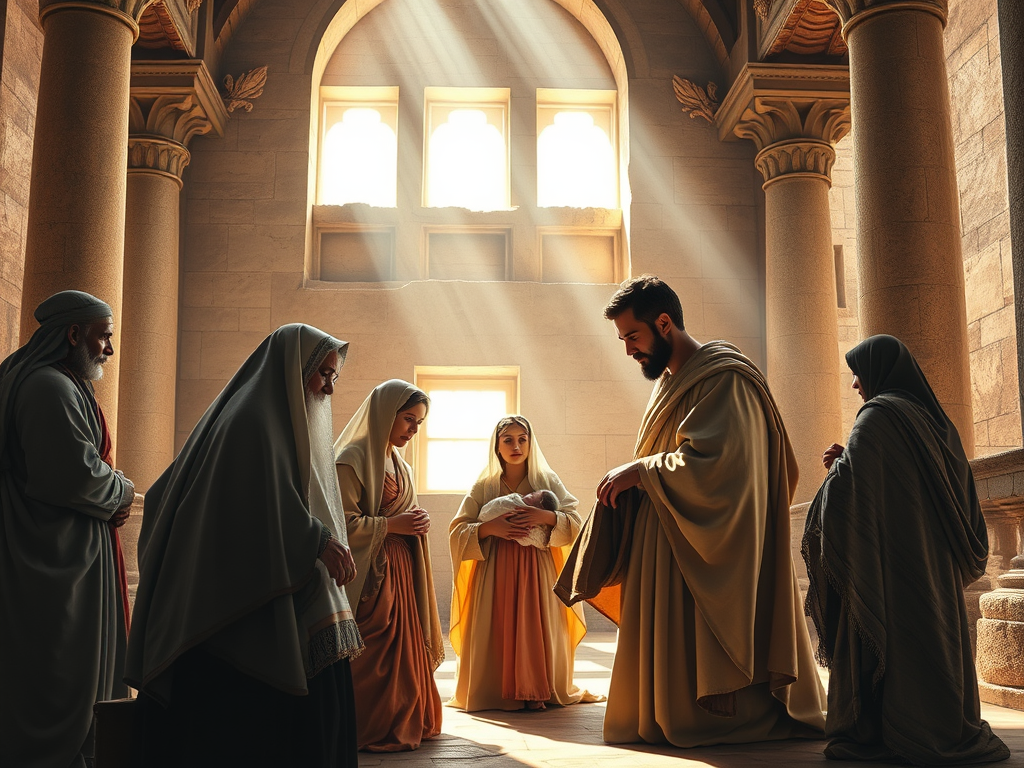
  4. Luke 2:22–40

What stands out to me from this week’s readings:

For he is like the refiner’s fire,
or like the fuller’s lye. . . .
Refining them like gold or like silver
that they may offer due sacrifice to the LORD

Malachi 3:2-3

Since the children share in blood and flesh, Jesus likewise shared in them, that through death he might destroy the one who has the power of death, that is, the Devil, and free those who through fear of death had been subject to slavery all their life.

Hebrews 2:14-15

. . . Simeon blessed them and said to Mary his mother, “Behold, this child is destined for the fall and rise of many in Israel, and to be a sign that will be contradicted  . . . .

Luke 2:33-34

She never left the temple, but worshiped night and day with fasting and prayer. And coming forward at that very time, she gave thanks to God and spoke about the child to all who were awaiting the redemption of Jerusalem.

Luke 2:37-38

What I’m saying (to the readings and beyond) this week:

When I first revisited the Scripture passages for February 2, the first quotation brought to mind the Kelly Clarkson song “Stronger” (What Doesn’t Kill You).” I actually felt that since Jesus took away the fear of death, as the epistle says, what else did I really have to be afraid of? The things people say can’t kill me. Neither the mistakes I make nor their consequences can kill me either, if I trust in the Lord and learn from those mistakes.

I tend to respond in one of two ways when someone disagrees with me:

  • Someone’s criticizing me. I must be in the wrong. I need to do what the critic expects.
  • I’m doing what Simeon said the “sign that [would] be contradicted” wants me to do. That’s why I’m being criticized. The backlash is a good sign.

I think I tend to respond the first way more than the second. But option one might be more accurate in one situation, while option two might be more accurate in another. I find consolation in the message that it’s the [R]efiner’s fire that allows me to “make due sacrifice to the Lord,” to choose what’s right regardless of what others think of my choices (Mal. 3:3). My refinement isn’t finished yet, and that’s okay, as long as I stay open to being refined.

Then last night, anxiety caught up with me, as if to counteract the freedom I’d felt listening to “Stronger (What Doesn’t Kill You).” Plenty of experiences don’t make me feel stronger or freer, even though they aren’t death.

I read in the Gospel passage for February 2 that the prophet Anna had lived a long time, especially for a first-century woman. She spent years not remarrying, as many women might have been expected to do or would have had to do to survive. She spent years fasting, and praying, and waiting. Then baby Jesus came into the temple, she told everyone she could about Him. Anna’s life couldn’t have been easy. But once she’d lived through her experiences, seen Jesus, and heard what Simeon said about Mary and her baby, she refused to be silenced.

We are all social creatures, but not all relationships we have the opportunity to take part in are healthy. The Kelly Clarkson song is about breaking free of a harmful relationship. Other relationships might be healthy but aren’t the right fit for us or aren’t right for right now. I wonder if the prophet Anna had experience with these realities. Were such experiences part of what made her open to those years of fasting, praying, waiting, and trusting in the temple?

What someone else is sharing about this week’s readings:

Anna Robertson explores insights we can gain from the prophet Anna’s appearance in the Gospel passage. She also points out that we may not hear about this prophet at Mass. Including her story in the Gospel passage for the Feast of the Presentation is optional.

This week’s prayer:

Lord, help us to persevere in even the most difficult times. Help us to maintain hope. Help us to discern what thoughts, words, and actions will do the most good in various situations. May we follow where discernment and wise advice leads. Help us to be a source of hope and truth for others. Thank you, Lord for giving us opportunities to be sources of hope, May we show love in concrete ways. Amen.

Scripture Translation Used:

“Feast of the Presentation of the Lord — Lectionary: 524.” Daily Readings, Lectionary for Mass for Use in the Dioceses of the United States, Confraternity of Christian Doctrine, 2nd typical ed, United States Conference of Catholic Bishops, 2025, https://bible.usccb.org/bible/readings/020225.cfm.


Read Full Post »

Photo by KaLisa Veer on Unsplash

Readings for December 8th:

  1. Zephaniah 3:14–18a
  2. Isaiah 12:2–3, 4, 5–6
  3. Philippians 4:4–7
  4. Luke 3:10–18

What stands out to me from this week’s readings:

I generally think of the readings for this season being about God’s people rejoicing because God is with them, drawing them close. I especially think this about the readings for the third week of Advent. Or I did until I actually read the passages.

This week’s first reading says that God rejoices in God’s people. The psalm reflects what I expect to read in this week’s readings. Together, the readings describe the relationship between God and God’s people.

The epistle describes how prayer strengthens that relationship. It’s a relationship that needs trust, openness, and gratitude to thrive. It’s a relationship that when nurtured, calms anxieties and prompts rejoicing. It’s a relationship that spreads its qualities to other relationships. The gospel passage supports this message about the effects of a relationship with God on relationships with others. It also reminds me that my relationships with others, and indeed, with all of creation, affect the strength of my connection with God.

The strength of God’s love never changes. In other words, God never stops rejoicing over us because we are not our sins and shortcomings. We’re God’s children, expressions of God’s love. Imagine the connection between a person and God like the connection between two phones. God is represented by one of the phones, and God never cuts off communication. Rather, it’s the phones of our minds, hearts and souls that often don’t receive the strongest signals.

What I’m saying (to the readings and beyond) this week:

The truth of everything I typed above is just sitting on the surface of my consciousness. Lord, let Your love permeate my being.

What someone else is sharing about this week’s readings:

What great wisdom in the Church’s tradition, to put a day for joy in this season of stillness, to remind us that joy comes when we slow down, when we accept silence and waiting and inactivity, and when we remember that everything good is a gift from God. Yes, indeed, Advent is a time for joy.

Kate Ward

Check out the full reflection on the readings for December 15th that includes this quote.

This week’s prayer:

Lord, help me experience and share Your joy. Amen.

Read Full Post »

Readings for December 1st:

  1. Jeremiah 33:14–16
  2. Psalm 25:4–5, 8–9, 10, 14
  3. 1 Thessalonians 3:12—4:2
  4. Luke 21:25–28, 34–36

Readings for December 8th

  1. Baruch 5:1–9
  2. Psalm 126:1–2, 2–3, 4–5, 6
  3. Philippians 1:4–6, 8–11
  4. Luke 3:1–6

What this week’s readings say to me:

The first reading for December 1st foretells the arrival of the long-promised Messiah. The passage from Jeremiah promises that the Messiah will “do what is right and just” (Jer. 33:15). People who trust Him and follow Him will be able to live in safety and security.

The psalm for December 1st recognizes that God has the qualities described in the first reading. It also describes how those who trust God and follow God reflect those same qualities.

The epistle urges readers and listeners to treat each other with charity, as they have been taught to do. It calls us to be more and more vigilant in looking for opportunities to act with charity.

In the gospel passage, Jesus foretells that there will come a time when the world as we know it will be “shaken” (Luke 21:26). He says the events of this time will cause people to “die of fright” (Luke 21:26). But, he says, this doesn’t need to be the fate of His disciples. He teaches them that when they find themselves in the midst of disturbing events, He is near. “[R]edemption is at hand” (Luke 21:28). He says His spiritual family members will be prepared to receive this redemption if they keep returning to His teachings. They must also return to His example whenever life’s distractions, whether pleasant or worrisome, tempt them to lose sight of His Way. He reminds them that prayer is the source of focus and strength in the face of temptations and trials.


For me, the Old Testament reading for December 8th paints a beautiful word picture of the effect God’s salvation and the arrival of the Messiah will have on God’s people. Like the previous week’s Old Testament passage, the one chosen for December 8th is written in future tense.

The psalm selection for December 8th, in contrast, is written in past tense. The first two stanzas would fittingly describe the people’s reaction to the events foretold in the Old Testament reading. There is “laughter” and “rejoicing” (Psalm 126:2). People who trust in God will be lifted up, and everything will be made right. The visibility of the people’s joy gives glory to God, even among those who do not know the God of Israel, as well as the peoples who have been comforted, cared for, and freed by God. The third and fourth stanzas ask for God’s continued care. The narrator trusts that even in difficult circumstances, when he can’t see the fruits of his faith, it will, nonetheless, bear fruit.

In the epistle for December 8th, St. Paul writes to the Philippians about the content of his prayer. He writes about expressing joy in his prayer. His joy comes from the work the Philippians do with him for the sake of the gospel. He describes the affection he has for the recipients of this letter. He conveys that he experiences them not only as coworkers, but as as friends and family members brought together by Christ’s love. He assures them that God, who began the work of salvation in them will continue it and complete it. He prays that they continue to grow in “knowledge… perception” and “discern[ment]… the fruit of righteousness that comes through Jesus Christ for the glory and praise of God” (Phil. 1:9-11).

The Gospel passage for December 8 echoes the message of the Old Testament passage for the day and prepares to point to Jesus Christ as the fulfillment of the promises of both passages.

Combined, the message of the readings for these two weeks is that justice and security are coming. Don’t give up on this promise. Insist on believing that it’s possible with God. Keep looking for it — no matter how long it takes for you to see its fulfillment. While you cling to this promise, make room for each other. Make room for joy.

What I’m saying (to the readings and beyond) this week:

I feel called to more stillness and fewer words this Advent. I desire more focus, more intimacy with God — maybe more spontaneity with God.

So starting next week, I plan to focus on one passage. I may even concentrate on one word or phrase within the passage. The passage may even be one that’s not part of the Sunday readings. Maybe adjustments such as these will give me more time to sit with the divinely inspired words and to reflect on what they mean for me at the moment. Maybe this approach will allow me to do more listening to what God has to say to me. When I share what I hear, maybe you’ll be able to relate.

What someone else is sharing about this week’s readings:

December 1st

Valerie D. Lewis-Mosley, RN, OPA reflects on the theological theme for the first Sunday of Advent: hope.

December 8th

Colleen McCahill reflects on how, in the epistle for December 8th, St. Paul finds light in darkness. She also reflects on how Advent encourages us to seek light in times of darkness. It is a season that helps us do so.

This week’s prayer:

Lord, help me to seek and to find light amid the darkness that I experience around me and within me. Help me not to fear the brightness of the light but instead to let its fire shape me. Help me to follow the path it illuminates — the path of hope. Amen.

Works cited:

Confraternity of Christian Doctrine, Inc. “1st Sunday of Advent — Sunday 1 December 2024: Readings at Mass.” The New American Bible, 2001. Universalis for Windows, Version 2.196, Universalis Publishing Ltd., 6 Nov. 2024, https://universalis.com/n-app-windows.htm.

—. “2nd Sunday of Advent — Sunday 8 December 2024: Readings at Mass.” The New American Bible, 2001. Universalis for Windows, Version 2.196, Universalis Publishing Ltd., 6 Nov. 2024, https://universalis.com/n-app-windows.htm.

Read Full Post »

Image Generated by WordPress AI

Readings for November 17th:

  1. Daniel 12:1–3
  2. Psalm 16:5, 8, 9–10, 11
  3. Hebrews 10:11–14, 18
  4. Mark 13:24–32

What The Readings for November 17th Say to Me:

This week’s readings are about the Last judgment and the end times, the time when the material world ends.

The first reading tells us that this future time will be one “unsurpassed in distress” (Daniel 12:1). The passage continues:

“Many of those who sleep in the dust of the earth shall awake;
some shall live forever,
others shall be an everlasting horror and disgrace.

“But the wise shall shine brightly
like the splendor of the firmament,
and those who lead the many to justice
shall be like the stars forever.”

Daniel 12:2-3

The psalm promises that God guides and protects all who turn to God in times of great distress.

The epistle reminds us that Jesus’s sacrifice on the cross is God’s ultimate act of salvation. It’s the ultimate act to defend the human race and the human spirit against whatever opposes divine love. Christ’s sacrifice was offered once, and yet we can receive the graces of that sacrifice again and again. The key is that we seek those graces.

In the Gospel passage, Jesus describes what the end times will be like. They will be characterized by the destruction of the material world and by His return. He suggests there will be signs that these events are upon us, but signs are not definite indicators. No one can say for sure when these times will come. Therefore, we aren’t called to make looking for signs of the world’s end the purpose of our lives. We’re called to live according to Christ’s words and example.

What I’m Saying (to the Readings and Beyond) This Week:

In addition to prophesying about the end times, do this week’s readings invite me to see times of “distress” as times of purification? (Daniel 12:1) These are times to get a clearer vision of what’s fleeting and what lasts. These are times to reconnect with God, with each other and our purpose and through these connections, to grow stronger.

What Someone Else Is Sharing About This Week’s Readings:

When we feel the most despair, the most fear, the most anxiety, that is when God is the closest to us. That is when we are the least alone. That is when the Promised One is right at our door.

Martha Ligas in her reflection on the readings for November 17th

This Week’s Prayer:

Lord, help me to respond with greater charity. Grant me faith and hope whenever and wherever shadows get longer, and lights get harder to see. Amen.

Work Cited:

The New American Bible Revised Edition, Kindle edition, Fairbrother, 2011. T

Read Full Post »

Image Generated by WordPress AI

Readings for June 30:

  1. Wisdom 1:13–15; 2:23–24
  2. Psalm 30:2, 4, 5–6, 11, 12, 13
  3. 2 Corinthians 8:7, 9, 13–15
  4. Mark 5:21–43

What this week’s readings say to me:

In this interval in which time is in shorter supply than usual, the following quotations stand out to me from the readings for June 30:

God did not make death,
nor does he rejoice in the destruction of the living.
For he fashioned all things that they might have being;
and the creatures of the world are wholesome. . . .

Wisdom 1:13-14

For you know the gracious act of our Lord Jesus Christ, that though he was rich, for your sake he became poor, so that by his poverty you might become rich . . . . Not that others should have relief while you are burdened, but that as a matter of equality your abundance at the present time should supply their needs, so that their abundance may also supply your needs, that there may be equality.

2 Corinthians 9 and 13

On this readthrough of the Gospel passage, I’m reminded of how important each of us is to God and to the world around us, even when we feel invisible and insignificant. I’m also reminded of how important journeys are. So many opportunities come up when we’re on the way to do something else. This passage teaches that even what looked like death can be a passageway to a new experience of life.

Beyond this week’s readings:

It looks like I’m not going to get a chance to write a post for next week, so I’ll see you back here in two weeks.

This week’s prayer:

Lord, thank you for the goodness of the natural world and for caring about the concerns of everyone in it. Thank you for meeting us where we are and for helping us to do good and to appreciate the beauty around us — sometimes when we least expect to receive opportunities or to be reminded of Your presence. Amen.

Work cited

Confraternity of Christian Doctrine, Inc. ” 13th Sunday in Ordinary Time — 30 June 2024: Readings at Mass.” The New American Bible, 2001. Universalis for Windows, Version 2.189, Universalis Publishing Ltd., 14 June 2024, https://universalis.com/n-app-windows.htm.

Read Full Post »

Image Generated with WordPress AI

Readings for June 23:

  1. Job 38:1, 8–11
  2. Psalm 107:23–24, 25–26, 28–29, 30–31
  3. 2 Corinthians 5:14–17
  4. Mark 4:35–41

What this week’s readings say to me:

Note: I won’t have much time for the blog for the next two or three weeks. Until I have more time to devote to Sitting with the Sacred, I’m planning on keeping this section brief, perhaps by pointing out an overall theme or lesson that stands out to me. So, what’s going to come to me this week?

On my first read-through of the readings for June 23, I noticed lots of imagery relating to stormy seas, the Lord having power over them, and as a result, people being kept safe amid destructive forces.

But the passage from 2 Corinthians doesn’t immediately seem to fit in with this theme. I’ve struggled to unpack it’s meaning, but I think the gist of its meaning is familiar: because Christ withheld nothing from us — not even His life so that he could conquer death and stop it from having the final say, we should withhold nothing from Him. We must instead ask for the grace not to see others only in terms of what is transitory, such as looks and abilities, or in terms of what they can do for us. All of these can and do change.

We are also being encouraged to ask for the grace not to view others in terms of the harm they’ve caused. Looks, abilities, what we can do for each other, and the ways we can hurt each other — none of these things remain as they are. They’re transformed by Christ’s resurrection. So are understandings of what it means to be saved and to die. I suppose that’s why, in the Gospel passage, Jesus is able to sleep while the apostles are terrified of drowning in the storm. He knows that neither the storm nor death have ultimate power over anyone in the boat. He and our free will have the ultimate power — because He and God are one, and it is God’s love that gives life and the freedom to receive God’s love or reject it.

It’s not trusting that love that brings about spiritual death. At one time or another, each of us will undergo physical death. But whenever we trust in God’s love and share it, we receive new life in our spirits.

This week’s prayer:

Lord, protect us as we face the literal and figurative storms of life on Earth. Thank You for being with us in the midst of the storms of all kinds that life sends our way. Help us to experience that storms don’t have the final say — no matter how much they hurt us. Help us to experience that it’s okay to have questions and be angry and afraid when they hurt us.

This week especially, we bring to prayer residents of coastal communities, seafarers, police, firefighters, healthcare workers, lifeguards, pastors, ministers, counselors, aid workers and many others who offer rescue in all its forms. Amen. We offer this prayer in the name of the Father, the Son, and the Holy Spirit.

Read Full Post »

Photo by David Brooke Martin on Unsplash

This week’s readings:

  1. Genesis 9:8–15
  2. Psalm 25:4–5, 6–7, 8–9
  3. 1 Peter 3:18–22
  4. Matthew 4:4b

What this week’s readings say to me:

This week’s readings remind me that neither suffering nor pleasure is eternal in the universe. Only God is eternal and all-powerful. Sin is rejecting that which gives life and treating something else as if it were eternal and all-powerful. The readings invite me to re-examine what the things I think, do, and say reveal about what I treat like God. The passages encourage me to step back from my routines, to start fresh, and to rearrange my priorities so that I treat only God as eternal, all-wise, and all-powerful. They propose that committing to a period of abstaining from something that, while not harmful, is also not necessary, can help me reorder my life and clarify and broaden my perspective. In other words, the readings propose spiritual decluttering for the sake of gaining that broader perspective and increased clarity.

This week’s readings also remind me that actions have consequences, but I don’t believe this reality means that God sends the consequences. Certain choices yield unpleasant results, but God can take those results and use them for good. I can also use my choices to practice self-control and to help avoid experiences that are more unpleasant than the temporary inconveniences that practicing self-control can entail.

What someone else is sharing about this week’s readings:

Diana Marin offers her perspective on what a spiritual desert feels like, means, and can provide.

Beyond this week’s readings:

The first reading communicates that a rainbow is a reminder of God’s promise never again to destroy the earth and almost everyone who lives on it with a flood. The psalm says that God is good, “shows sinners the way,” and “guides the humble to justice” (Psalm 25: 8-9). I have a hard time reconciling what the psalm says about God with the story about a massive flood that kills all but two of each species and one human family. My experience of the world around me and with what I’ve been taught tells me that people are made up of varying combinations of positive and negative traits. No one I’ve known has possessed either all positive traits or all negative ones. I’ve also been taught that everyone around me is created by God and loved by God, while also being vulnerable to temptation and sin. So wouldn’t Noah and his family have these characteristics too? I can imagine some arguing in response to this question that maybe Noah’s family asked for God’s forgiveness and others didn’t. Nobody outside of Noah’s family? Really?

I’m not actually bothered by these questions because I don’t view the first reading as a historical account. I think there was a massive flood because several cultures have passed down stories about it, but I also think it’s important not to be too literal about what the flood says about human nature and Divine nature.

The third reading offers a lens through which Christians can look at the flood and the rainbow that Genesis says followed it. I read the epistle as proposing that between His death and resurrection, Christ redeemed the victims of the flood, a comforting understanding to have after the resurrection and ages after that flood. Because of Christ’s total surrender to death and His victory over it, physical death is not final. Yet it’s important not to minimize that death is often painful for anyone touched by it in any way. Therefore, it’s important not to minimize the tragic nature of a massive flood, even as we look at such an event through the lens of Scripture passages written later, when understandings of God and how God interacts with the material world had evolved.

The third reading proposes that the flood prefigures baptism. It’s jarring to think of baptism as a flood that kills unjust people and establishes a new relationship, renewing promises to the people who come after the flood. The Good News is that the death of baptism isn’t a physical one. Neither is the other death, the death of selfish-centeredness I’m called to surrender to each day to keep my priorities from getting out of whack, to keep me from letting someone or something not God masquerade as God in my life.

Lord, every time I see a rainbow, remind me that my baptism was a death that inaugurated a new life, one stronger than weakness and physical death. Grant me the grace to keep returning to You, the Source of that life, to reignite the fire of Your eternal life within me. Amen.

Work cited

Confraternity of Christian Doctrine, Inc. “1st Sunday of Lent, Sunday 18 February 2024: Readings at Mass.” The New American Bible, 2001. Universalis for Windows, Version 2.185, Universalis Publishing Ltd., 29 Jan. 2024, https://universalis.com/n-app-windows.htm.

Read Full Post »

Photo by Lensabl on Unsplash

This week’s readings:

  1. Isaiah 25:6–10a 
  2. Psalm 23:1–3a, 3b–4, 5, 6
  3. Philippians 4:12–14, 19–20
  4. Matthew 22:1–14

What this week’s readings say to me:

This week’s readings and Casey Stanton’s reflection on them offer me five different lenses through which to find hope. I’ve heard the spiritual understanding of hope defined as “joyful expectation.” I’m not sure who I received this understanding from — maybe my spiritual director. So if you’re reading this, and you shared this understanding with me — thanks — because that understanding of hope comes to mind as I read this week’s readings.

The Old Testament reading gives me a glimpse of the future — when everything reflects nothing but God’s nature, which is love, and which I sometimes grasp partially — as justice and mercy — with the line between the two virtues being indistinct because one can’t be separated from the other. This reading contains one of those verses familiar both to people with a lot of background in Scripture and without that background. The verse says:

The Lord GOD will wipe away
the tears from every face;
the reproach of his people he will remove
from the whole earth; for the LORD has spoken.

Isaiah 25:8

The psalm this week is also familiar favorite, Psalm 23. As I’ve written in a series on this blog, I see this psalm as a proclamation of faith and a promise, and faith and promises are founded on the joyful expectation that is hope. If you’d like to visit or revisit that series, it starts here.

The third reading tells me that holding onto hope allows a person to maintain trust in God’s love regardless of what his or her circumstances are. The third reading also includes a verse that can be helpful for inspiring hope:

I can do all things in him who strengthens me.

Philippians 12:13

Now no one is called to do everything. Rather, we’re called to have hope and faith that we can do what each of us is called to do. Each of our vocations involves some activities and experiences that others also share in and other activities and experiences that are unique to each of us. So the third reading urges me to have confidence that when I trust in God, I’ll be able to do and be what I’m called to do and be, whether I find myself in pleasant or unpleasant circumstances. This message gives me hope.

As I read this week’s Gospel passage with the theme of hope in mind, its words remind me that authentic hope comes from accepting God’s invitation to a healthy relationship with God and one another. Hope comes from viewing whatever I do in terms of how it contributes to the health of those relationships. Nothing I do or want can replace a healthy relationship with God, and I can’t have healthy relationships with others, or with my goals if I don’t have healthy relationship with God.

The passage also tells me that an authentic — a.k.a. healthy — relationship with God can’t be faked. Hope can’t be faked either — at least not in the eyes of God. This is important to keep in mind because it’s authentic hope that solves problems and allows for harmony with one another and with God.

Lord, please strengthen my hope; help me cling to it regardless of my circumstances. Amen.

What someone else is sharing about this week’s readings:

While I looked at the Gospel passage as I considered the theme of hope, I’ll be honest — I’m bothered by the amount of violence the featured parable includes. So was Casey Stanton. Then some current events inspired her to relate to the parable differently than she had before. Click here to find out how.

Beyond this week’s readings:

Ms. Staton reflects on events unfolding in the Catholic Church. Her reflection prompts me to ask how a listening and sharing approach to relating to others, how an attitude of stillness and openness with regard to my circumstances, can be lived outside those events. Lord, open my senses, my heart, and my soul. Amen.

Work cited

Confraternity of Christian Doctrine, Inc. “Sunday 15 October 2023 28th Sunday in Ordinary time: Readings at Mass.” The New American Bible, 2001. Universalis for Windows, Version 2.181, Universalis Publishing Ltd., 8 Aug. 2023, https://universalis.com/n-app-windows.htm.

Read Full Post »

Photo by Pisit Heng on Unsplash

As I wrapped up this year’s reflections on the Way of the Cross, I started to think about Easter and the sights and sounds the word “Easter” brings to mind.

I imagined a stone rolled aside and and a cave-like tomb lit from an unknown source. The light is so bright it’s painful to the eyes — or maybe it ought to be painful but isn’t somehow. I can’t describe the light or explain it. I can’t describe how I can make out the outlines of a figure within its brightness. The figure is discernible, but I can’t see most of its features amid all the radiance.

The voice that comes from it is clear, however. It asks, “Why do you search for the living among the dead?” He is not here, for he has been raised.” It turns out that by including this quotation, my imagination is quoting Luke 24:5 almost verbatim but not quite. Matthew and Mark start their final chapters with similar scenes and related quotations. These accounts are dramatic, so it’s no wonder that movie scenes depicting that Sunday morning look and sound like the one I just imagined.

But what the Gospel reading for this Easter morning, John 20: 1-9, prompts me to see, hear, and think about is different from the other accounts of the ways Jesus’s first followers initially experienced the resurrection.

John 20:1-9 doesn’t present me with a story that is as obviously miraculous.

Mary sees the stone that had guarded the entrance to the tomb moved aside, and she runs to get Peter and “the other disciple whom Jesus loved,” announcing that Jesus’ body has been stolen (John 20:2-3). I learned somewhere that “the disciple whom Jesus loved” was John, so I’m going to refer to that person by this name to make this post easier to read, even though I don’t remember where I learned to identify the disciple this way.

In response to this news, Peter and John run back to the tomb. John gets there first but doesn’t go inside (20:5). Apparently, he just bends down and sees the burial cloths. I wonder why he acts this way. I wonder if some part of him was telling himself that if he doesn’t look any closer, he doesn’t have to see anything he doesn’t want to see. He could tell himself Jesus’ body hadn’t been stolen, that it was still hidden by the darkness. If he can’t yet face the memories and the reality of Jesus’ death (a reality that would’ve been difficult enough to grapple with had he not stood at the foot of the cross), he can go through the motions of looking without really seeing. Maybe he wants to show deference to Peter, or to let Peter be the one to confirm the worst. Peter seems ready to do that. He goes in and sees the cloth that had covered Jesus’ head rolled up in “a separate place” from the other burial wrappings (20:7). I always thought the details about the separate and apparently careful placement of the wrappings were meant to point to the resurrection. And maybe these details were included in hindsight to do just that, but on this reading of the text, I realized that in this scene, Jesus’ followers don’t yet believe he is risen. John 20:9 says “they [don’t] yet understand the scripture that he had to rise from the dead.”

This realization reminded me in a new way that the resurrection doesn’t erase all confusion or pain from the present or the past. The burial cloths haven’t disappeared. They’re still bloody, too, because in verse 19, Jesus shows his disciples the wounds in his hands and his side.

But that moment is for revisiting in future weeks. In this week’s reading, I’m not shown the words themselves, but I’m given reminders of them in the wrappings that no longer bind Jesus. If I take John 20:1-9 without the stories that follow it, I’m not reminded that pain doesn’t have the final word. Yet the Good News is that pain doesn’t have the final say, even if some of life’s experiences tempt me to think it will. Because Jesus is risen, I’m offered future resurrection. I’m neither promised resurrection now (though there are signs of it everywhere in nature’s spring awakening), nor am I to let the past behind me as the burial wrappings bound Jesus.

Photo by Chetan Kolte on Unsplash

The experience of reading John 20:1-9 without the stories that follow these verses remind me of what it’s like to celebrate Easter present. It will take time to understand a lot of things in this life. I won’t fully understand or experience what resurrection means while I’m here. My time-bound experience of Easter won’t feel as extraordinary as the one I imagined at the beginning of this post. It won’t mean forgetting things I don’t want to remember. It won’t banish disappointment or grief. And now I remember I’m not alone in this reality. The experience Jesus’ earliest followers had before sunrise that first Easter morning was not one of perfect clarity and joy.

You were risen, but neither You nor Your loved ones were in Heaven yet that first Easter. Neither am I on this Easter. Thank You, Lord, for the reminder from John 20:1-9 about what it means to practice patience and to hope. Amen

The Bible. The New American Bible Revised Edition, Kindle edition, Fairbrother, 2011.

Confraternity of Christian Doctrine, Inc. “Sunday July, 2 2023: Readings at Mass.” The New American Bible, 2001. Universalis for Windows, Version 2.179, Universalis Publishing Ltd., 26 Feb. 2023, https://universalis.com/n-app-windows.htm

Read Full Post »