Feeds:
Posts
Comments

Posts Tagged ‘Holy Trinity’

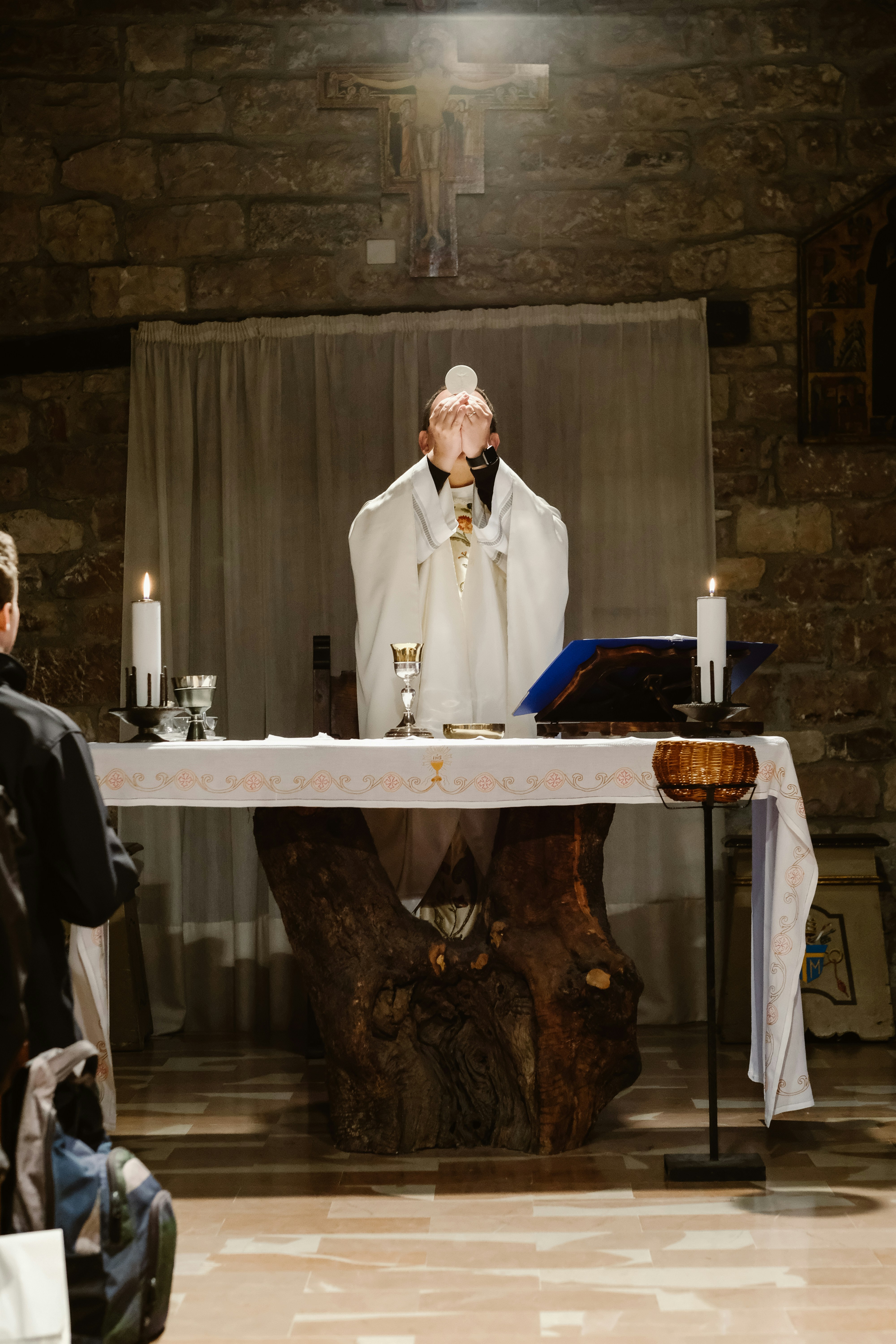
Photo by Josh Applegate on Unsplash

Readings for June 2:

  1. Exodus 24:3–8
  2. Psalm 116:12–13, 15–16, 17–18
  3. Hebrews 9:11–15 
  4. Mark 14:12–16, 22–26

What this week’s readings say to me:

The transition from spring to summer and the changes in schedules that it brings has invited me to be open to new routines. But I’ve never been naturally inclined toward this kind of openness, and this week has been no exception. It’s Saturday afternoon, and I haven’t worked on this post since I typed this week’s readings above a week ago. I’m short on time, so I’m going to write what’s been on my mind to write in honor of this week’s Solemnity of the Most Holy Body and Blood of Christ.

I’ve been thinking about this solemnity in light of last week’s solemnity, thinking that this weekend we celebrate the sacrificial love of the Trinity’s incarnation. It’s a love is willing to live for others to the point of suffering and dying for them. This death allows the sacrificial love of the Trinitarian God to take a different form, one I can see, touch, taste, and consume, even though I’m not living during Jesus’ earthly ministry.

Of course, I’m not the only one who can receive this gift. It’s been available to Jesus’ spiritual family members since the Last Supper—before Christ made His final sacrifice on the cross, and it continues to be offered and will continue to be offered until the end of time. The offerings of the Trinitarian God aren’t limited by time and space.

Yet these gifts are not merely abstract, spiritual, and mystical, though they can have all of these qualities. They’re tangible and consumable. These physical qualities allow the incarnate Trinity to become part of the physical body of anyone who takes and eats them. The physical forms of bread and wine allow us to receive the Body, Blood, Soul, and Divinity of the Trinity, and when we live lives that make our souls homes for these gifts, more and more, we become what we eat and carry it into the world around us.

What someone else is sharing about this week’s readings:

Sr. Julia Walsh. FSPA reflects on how this week’s solemnity reminds us that what’s ordinary is also sacred. She tells of times when this reality has been particularly palpable for her, times when she’s experienced it in communion with others.

This week’s prayer:

Lord, thank You for feeding me spiritually and physically. Restore in my body and soul a dwelling place for You so that You can be recognized in me, and I can do my part to heal the wounds in Your Body. I ask this in the name of the Father, and of the Son, and of the Holy Spirit. Amen.

Read Full Post »

Image generated by WordPress AI

Readings for May 26, 2024:

  1. Deuteronomy 4:32–34, 39–40
  2. Psalm 33:4–5, 6, 9, 18–19, 20, 22
  3. Romans 8:14–17
  4. Matthew 28:16–20

What this week’s readings say to me:

This week’s readings tell me that the Trinitarian nature of God means that God is more intimate with everything that is than human understanding can conceive of. And even though this is the case, God’s intimacy doesn’t mean that God is too small or too close to us to have a view with more dimensions than we can imagine. God so intimate as to dwell within us and to be discoverable in everything around us while being the source of all that is. God is the ultimate mother, father, sibling, partner, and inspiration.

What concerns us can neither be too big nor too small for God, and with God’s help, what concerns God is neither too unmanageable nor too insignificant for us to be concerned with. God invites us to open ourselves fully to the Trinity and the gifts — relationships, talents, and resources — that come from a God who is both so like and unlike us, a God who is without limits, except to the extent that God limits God’s self.

The following quotations from the readings for May 26 encapsulate for me what The Most Holy Trinity means:

. . . fix in your heart, that the LORD is God in the heavens above and on earth below. . . [Italics mine]

Deuteronomy 4:39

The Spirit himself bears witness with our spirit that we are children of God, and if children, then heirs, heirs of God and joint heirs with Christ, if only we suffer with him so that we may also be glorified with him.

Romans 8:16-17

Does the second quotation mean that we should seek out suffering? No, but it acknowledges that to live as Jesus did during his time on earth, will have to allow ourselves to be inconvenienced at the very least. And we may be asked to endure more than inconvenience. If we never find ourselves inconvenienced by our efforts to follow and imitate Christ, how closely are we following and imitating him? Where are we on the path to becoming the people God can see is becoming if we follow and imitate Christ? Where are we on the journey to becoming undistorted versions of ourselves?

Then Jesus approached and said to them, “All power in heaven and on earth has been given to me. Go, therefore, and make disciples of all nations, baptizing them in the name of the Father, and of the Son, and of the Holy Spirit, teaching them to observe all that I have commanded you. And behold, I am with you always, until the end of the age.”

Matthew 28:16-20

What someone else is sharing about this week’s readings:

Julia Erdlen reflects on the mystery of the Trinity as both comforting and confounding.

Beyond this week’s readings:

When I grappled with what words of my own to use to summarize Julia Erdlen’s reflection, I used “confounding” because it started with the same letter as comforting, which would make the summary memorable and because I thought “confounding” meant “mysterious.”

However, the Oxford Languages dictionary that the Bing search engine defines confounding this way: “cause[ing] surprise or confusion in (someone), especially by acting against their expectations” Considering this definition, “confounding” and is an unintentionally fitting adjectives to use when describing a God who is three persons in one, a God who had us and all that’s good in mind before everything began, who has been with all that’s good in every way since it came into existence, and wants to bring us to be with Him if we’re willing to come and to let go of the work of our hands and let God free us from the clutches of what stands between us and Him. It takes a God who is both indwelling and who was before everything and will be after everything to accomplish all that. It takes a God that we can’t fully understand or describe an entirely accurate way. It takes a God who surprises us by “acting against our expectations” and working beyond our limitations. This Trinitarian God helps us recognize which limitations are real but only temporary and which are illusions God is waiting to help us see through once we ask for and we cooperate with the grace of the Holy Spirit.

This week’s prayer:

Lord, thank You for giving us today is a reminder of how surprising, how incomprehensible, and yet how familiar You are. Help us always to grow in familiarity with You until, when we pass from this life, we can fully embrace and understand You and all You have brought into being. We offer this prayer in the name of God who is one in three Persons — Father, Son, and Holy Spirit. Amen.

Read Full Post »