
Feeds:
Posts
Comments

Posts Tagged ‘Eucharist’

Image Generated by WordPress AI

Readings for August 25:

  1. Joshua 24:1–2a, 15–17, 18b
  2. Psalm 34:2–3, 16–17, 18–19, 20–21
  3. Ephesians 5:2a, 25–32 or Ephesians 5:21–32
  4. John 6:60–69

What this week’s readings say to me:

This week’s readings speak to me about commitment. What makes commitment difficult? What’s worth committing to, and what does committing to something worth committing to look like?

The first reading asks me whether I want to commit to God or to something else that’s taking the place of God. It reminds me that when I commit to God, I’m committing to the Source of liberation, the Source of protection, and the Source of perseverance and growth. This Source is Someone worth committing to and imitating so I can be a channel for the qualities of God.

What does the psalm, the same one that’s been used for the past two weeks, have to say about commitment to God? It says that commitment to God means honoring God in word, spirit, and action. Living this way helps others have the faith to honor God in word, spirit, and action as well. This way of living also serves justice, even though serving the causes of justice is seldom easy. Yet a person who serves justice is never alone in his or her work. God always supports those who work for justice.

The choices for this week’s epistle characterize justice in terms of relationship. They compare the relationship between people and Christ to a relationship between a husband and wife.

Now I’m not married, so I’m not going to sit here and write about how Paul says husbands and wives should relate to each other. If I did, the sentences would sound too much like I’m telling married people what to do without knowing the circumstances in which they find themselves. I find that an unhelpful and ineffective way to help myself reflect on how to apply the Gospel message to my life or — God and readers willing — to help others do the same. If you want to read the advice that both of this week’s epistle choices have for husbands and wives, you can look them up here. As an unmarried person, I want to consider what the passage from Ephesians listed at the beginning of this post has to say about what committing to Christ and Christ’s commitment to us means for us.

The passage says to me that committing to Christ means caring for my body and treating it with dignity. My body has dignity and is deserving of care because it’s part of Christ’s mystical body, and it bears God’s image.

The same is true of everyone else’s body. Accordingly, the reading calls me to treat others in ways that reflect this reality. It invites me to do for others what will bring them to God, as Christ has done for me. It invites me to imitate Christ, even though doing so is hard, so hard we that we can sacrifice for others only with help of the Holy Spirit.

As if sacrifice weren’t challenging enough, so is believing in what’s difficult to see and what challenges our instincts. The prospect of it being necessary for eternal life to consume someone’s flesh and blood is instinctively revolting in many human cultures. Apparently, the culture of first century Judaism was no exception. I learned in church recently that consuming blood, a creature’s life force, was considered a pagan practice. This understanding puts the people’s reaction to Jesus’s teaching about the power of consuming His body and blood into perspective. Jesus would have understood as well as anyone the responses of those who were hearing Him.

So what does the fact that he doesn’t back down from the teaching when people object to it say? On this reading and with the bit of context I now have, the doubling down reminds me that committing to live with faith isn’t just about adhering to tradition and avoiding activities that don’t adhere to that tradition. Instead, it’s about being aware of who and what my actions serve, whether those actions are traditional or less so. Jesus’ teaching reminds me that God feeds us and never stops offering to do so.

The same cannot be said of anything else we might confuse with God. By reminding me of this spiritual truth, the Gospel passage circles back to the message of the Old Testament passage.

Beyond this week’s readings:

Do I have an unwavering commitment to serving God in how I relate to the people and use the resources around me? I wish I could say I did. I’m glad making a commitment isn’t a one-time event, an opportunity that appears once and then dissolves. I’m glad that I have opportunities moment by moment to recommit to serving God in the world around me as well as to believe in and receive the nourishment God offers me to power my recommitment.

This week’s prayer:

Thank You, Lord because, as Anna Robertson says, no matter how often each of us wavers in our commitments to what is good, You never waver in Your commitment to each of us.
Read Full Post »

Photo by Thays Orrico on Unsplash

Readings for August 11:

  1. Proverbs 9:1–6
  2. Psalm 34:2–3, 4–5, 6–7 (and 9)
  3. Ephesians 5:15–20
  4. John 6:51–58

What this week’s readings say to me:

The first reading presents wisdom as a nurturing homemaker, someone who provides shelter and food. Perhaps the extended metaphor of the passage says something about how practical wisdom is necessary for meeting basic needs and how having basic needs met is necessary for a person to grow in “understanding” (Prov. 9:6).

This week’s psalm, the same as last week’s, continues to call us to recognize that God provides for our physical, emotional, and spiritual needs. God doesn’t run out all the means to provide for all of these needs. Ever.

Maybe because I focused on some of the psalm verses last week, the psalm refrain stands out to me more than the verses this week: “Taste and see the goodness of the Lord (Psalm 34:9). It invites us to use our physical senses — particularly taste and vision — to receive “the goodness of the Lord . . .” (Psalm 34:9).

Now there’s the old cliché “seeing is believing.” While it is cliché, it’s also often true for people. So it’s powerful to be able to see concrete signs of God’s goodness around us. How can the way each of us lives offer those concrete signs, not just by showing compassion, helping people see it, but by helping people experience it with their other senses.

Think what a powerful sense taste is. It’s inextricably linked to smell. Think of what emotions can be invoked by the taste and smell of a meal that reminds a person of a past special occasion. Without smell, it’s very difficult, if not impossible to taste. Think of how powerful it is to smell or taste something that you smelled or taste in the past not long before becoming sick. Given the power of these associations, the psalm refrain says to me that truly engaging with God and what God gives involves all the senses. This reality is why the celebration of the Eucharist and other sacraments engages all the senses.

This week’s epistle urges readers and listeners to engage all the senses as well and to be careful to engage all of them in the movement of the spirit, and the pursuit of wisdom, rather than dulling the senses with activities that make it more difficult for the spirit to move within and among us.

The Gospel passage reminds readers that Christ’s message engages all the senses, and in doing so, challenges them. To the crowds, he says that he’s bread, and that whoever eats this bread “will live forever” (John 6:51). The crowds see a man speaking to them. They were already wondering how this could be, and he was going to challenge them even further (John 6:52). He goes on to say that “the bread that [He] will give is [His] flesh for the life of the world and that “[w]hoever eats [His] flesh and drinks [His] blood remains in me and I in him” (John 6:51 and 56).

Christ had to give all of himself — body, blood, soul, and divinity, “for the life of the world” and for every individual in the world who will receive that life (Jon 6:56). Receiving that life in its fullness will involve all the physical senses — taste, touch, sight, and hearing — of individuals open to receiving it. It will also engage the mind and the spirit. It will challenge all of these by inviting them to enter into what self-preservation instincts tell us to run away from.

What someone else is sharing about this week’s readings:

Sarah Hart’s reflection on this week’s readings looks at different ways to “remain in” Christ, as the Gospel passage asks us to do, with none of the ways of doing so being separate from each other or less essential than another (John 6:56).

Beyond this week’s readings:

Thinking about how important smell is for taste and how important engaging all the senses is to relationship with God and others reminds me of a phrase from last week’s excerpt from Ephesians about being “imitators of God,” liv[ing] in love” (Eph. 5:1-2). This way of living that Christ modeled is described as making oneself a “sacrificial offering to God for a fragrant aroma” (Eph. 5:2).

This week’s prayer:

Lord, grant me the grace of courage to remain in You as You remain in the Father. Help me not to turn away when You challenge me with what You offer and with Your vision for the Kingdom of God. Amen (John 6:56-58).

Work cited:

Confraternity of Christian Doctrine, Inc. ” 20th Sunday in Ordinary Time — 18 Aug. 2024: Readings at Mass.” The New American Bible, 2001. Universalis for Windows, Version 2.192, Universalis Publishing Ltd., 30 July 2024, https://universalis.com/n-app-windows.htm.

Read Full Post »

Photo by Josh Applegate on Unsplash

Give to the Most High as he has given to you,
generously, according to your means.

Sirach 35:12 — from the Old Testament reading for May 30.

How much has God given to us? How generous has God been?

Yes, in Jesus, God died for us, but to do that he also had to be born for us and to live for us. Included in the ministry that was His earthly life was praying for us. Sitting with John Chapter 17 for last week’s post reminded me of this. Even so, that chapter presents Jesus’ offering of prayers for the members of His spiritual family as a past event. Yet in the following New Testament, verses, we are assured that he still intercedes for us:

  • Romans 8:34
  • 1 John 2:1
  • Hebrews 7:25

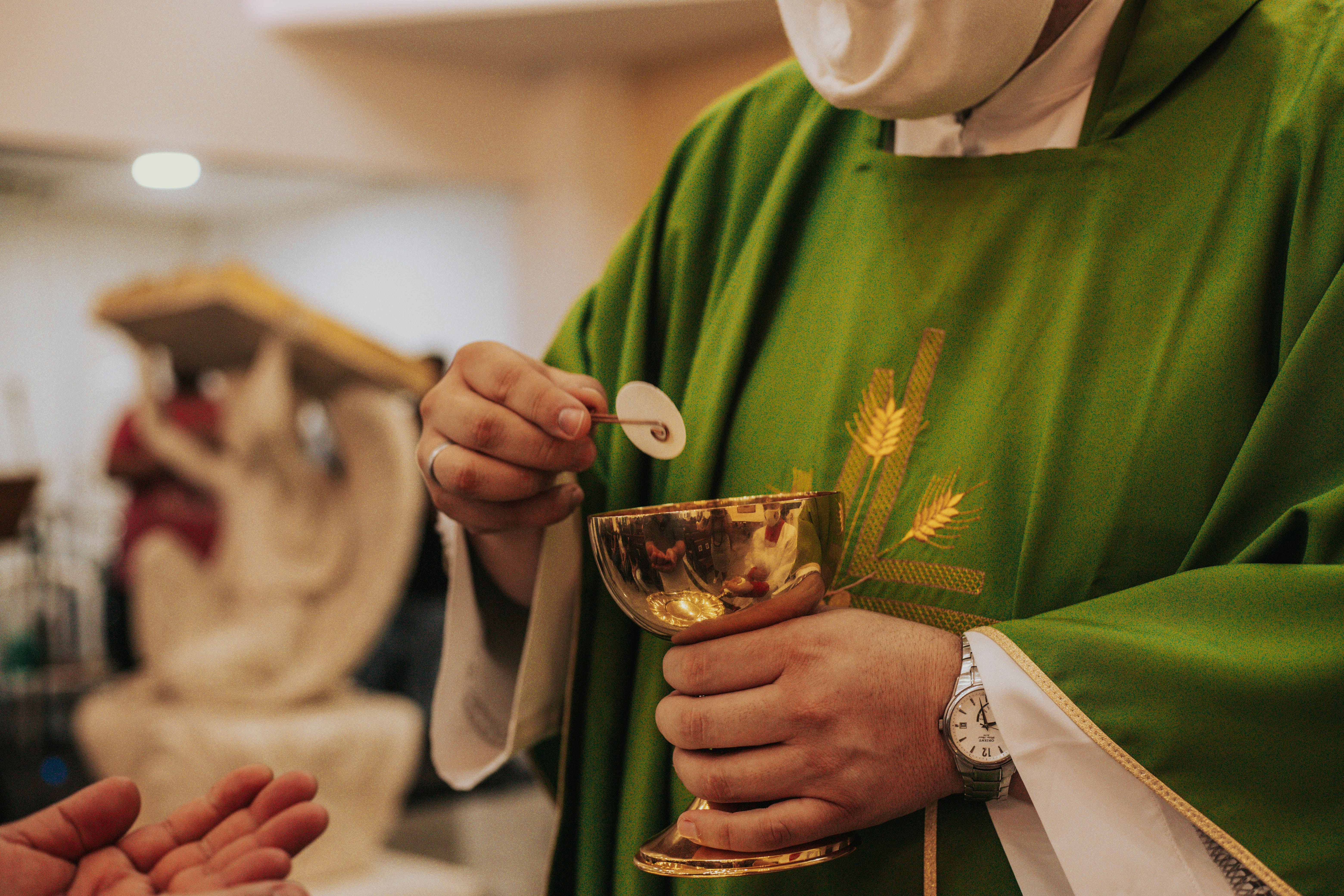
He not only continues to pray with and for us, but he continues to offer himself to us in a form our senses can perceive, though those very same senses don’t see, don’t touch, and don’t take Him in — even as they do. He offers Himself in what we perceive as bread and wine because offering Himself in this way is consistent with His nature that is simultaneously intimate and transcendent. He is more than we can see, yet He wants us to hold Him, to take Him in. He gave His life so we can do this again and again when we receive the Eucharist. Check out this post from April 23, 2023 for a deeper look at the meaning of the Eucharist.

I just skimmed that post again. What it says to me now is that Jesus offers Himself—Body, Blood, Soul and Divinity in bread and wine, and we receive the gifts of this offering by trusting in their presence and by being open to and grateful for them. We express this trust, openness, and gratitude in one way by preparing ourselves with humility to receive and in presenting ourselves to receive the Eucharist — offering ourselves in return, in other words.

But Sirach 35:12 tells me that my offering is not meant to stop with my reception of the Eucharist. Rather, Jesus offers me Himself in the Eucharist so I can give myself completely to Him in worship and in my neighbor. Do I give my life to Him completely as He gave—and gives—His life to and for me? Not yet. But I’m grateful that knowing I couldn’t do it on my own, He gave — and gives me—what I need to be able to give all to Him.

Lord, help me to trust in and find strength in the gift of all of Yourself that You give to me. Amen,

The Bible. The New American Bible Revised Edition, Kindle edition, Fairbrother, 2011.

Confraternity of Christian Doctrine, Inc. “Sunday July, 2 2023: Readings at Mass.” The New American Bible, 2001. Universalis for Windows, Version 2.179, Universalis Publishing Ltd., 26 Feb. 2023, https://universalis.com/n-app-windows.htm

Read Full Post »

Photo by Marek Piwnicki on Unsplash

The general answers that Luke 24: 13-35 is giving me are, “not where you expect” and “where you least expect.”

I relate to the pair of Jesus’ followers who come upon a stranger as they’re walking from Jerusalem to Emmaus, though when I first revisited the passage, I didn’t find their experience that relatable. Why wouldn’t I recognize Jesus if I’d spent every waking moment traveling with him for months or even years? Clearly, being unrecognizable and later returning to recognizability in an instant is something Jesus’ resurrected body can do that mine can’t do yet. So this story recounts a one-time event, a specific miraculous occasion that’s been handed down to me to teach me something. And in one sense, I suppose this initial interpretation is valid.

But I think another one is valid at the same time — because, in other ways, as I wrote before, I do relate to these deflated, despairing travelers. They’re lost, even though someone watching them would say they know exactly where they’re going—Emmaus, right? Yet they can’t really get what and where they want unless they are moving forward inside as well outside.

They’d come to believe that Jesus, as the Messiah, would lead them, their families, and the united tribes of Israel (what I might think of as their “country”) to external liberation.

But Jesus has been killed, and they feel no freer than they were before they heard him teach. In fact, their situation feels more precarious. Jesus has inflamed their hope only to fail them. Sometimes I think having hopes sparked and then having the sparks extinguished feels worse than never having had them ignited.

Before they end Jesus encountered each other, God had promised the Messiah to them, but God had not yet seemed to deliver on that promise. Hope founded on words is powerful but not as powerful as hope founded on experience. In the case of this pair, the experience on which their hope had been founded was the experience of journeying with Jesus. What experience would fuel more radiant hope than that one?

But now their bonfire of hope has been deluged. Only ashes are left of it. These are the ashes of grief, confusion, and despair. Heaped upon these ashes are boulders of fear because now, not only do they seem not to have a Messiah in their midst, but also, they’re in danger if they’re recognized as two of the people who followed Jesus, who has been executed as a traitor.

Now, I’ve never felt that I could be accused and executed for treason at any moment. However, I have plenty of experience with what heavy weights emotions can be. Too many times, my expectations and emotions prevent me from seeing the blessings that are right in front of me.

I think that’s part of what’s going on with the two people who walk with Jesus in this passage. Their expectations and emotions have led them only to be weighed down by the emptiness of the tomb rather than to recognize the confirmation and hope this particular emptiness offers them.

And their reaction is no wonder. When I think of an empty tomb, I think of having absolutely nothing left of someone I love. No one else’s report of an encounter with that person can fill the hole that the loss of that person leaves in my life. Talking or hearing about what and who you long for is not the same as what and whom you desire occupying physical space in your presence. It’s not the same as being able to touch who or what I long for, or more intimately, having it offered to me and receiving it into the empty space inside me.

Hearsay is not the same as an encounter. Neither is knowledge. I think that’s why, even after Jesus “interprets everything that refers to him in the Scriptures,” the traveling pair is still no nearer to understanding what recent events mean for them, and they still don’t recognize Jesus (Luke 24: 27).

Jesus knows what the pair needs to be able to recognize that he has been restored to life and can fill their emptiness. But he won’t impose what they long for upon them against their will. He “[gives] the impression that he [is] going farther” (Luke 24:28). He stays with them, breaks bread with them only after they invite an apparent stranger to join them. Then, it’s in the concrete action of breaking bread, blessing it, and giving it to them, even as they share what they have with him, that they recognize him and are in touch with how their hearts were set on fire “while he spoke to [them] and opened the Scriptures to [them]” (24:30-31).

God is working to fill their emptiness before they realize what’s going on. They realize how God is working in them through Jesus only after that work is shared among the group of three in a tangible way. They realize it only after they enter into a concrete offering of thanksgiving to God. They realize it only when they receive the Eucharist. In fact, “The term “Eucharist” originates from the Greek word eucharistia, meaning thanksgiving.”

This is a story to remind us that Jesus offers himself — God — tangibly to me and to you through creation, especially under the appearances of bread and wine as we gather with our needs and our gratitude. This story also reminds us that unless we have space within and around us for God, and we have gratitude for the ways God is already filling our emptiness, emptiness will only feel like lack and loss instead of the vessel for gifts that it can be.

Creator, Sanctifier, and Redeemer, help me to keep an open mind about Your plans. Help me to trust that I can see You at work everywhere so that I will see You at work everywhere. Help me to have and to express gratitude for Your work within and around me.. Amen

The Bible. The New American Bible Revised Edition, Kindle edition, Fairbrother, 2011.

Confraternity of Christian Doctrine, Inc. “Sunday July, 2 2023: Readings at Mass.” The New American Bible, 2001. Universalis for Windows, Version 2.179, Universalis Publishing Ltd., 26 Feb. 2023, https://universalis.com/n-app-windows.htm

Read Full Post »