Confession (or a peek behind the curtain): as I’m writing these words, it’s May 9. Since my Lenten Stations of the Cross series wrapped up, I’ve been writing the posts ahead. I hoped that by doing this, I’d have more time to reflect on the readings, and I’d be able to publish reflections that refer to the Mass readings for the day
Well, I got the first benefit with this post, but not the second. This post isn’t going to refer to this week’s readings because I just realized I looked at the wrong day’s readings when I started working on this post. The result is that this post makes a connection to last week’s readings — the readings for May 7 — not the readings for May 14.
Still, I enjoyed the connection I encountered between a verse in the May 7 Gospel reading and Psalm 23. So, with the exception of this introduction, I’m going to publish this post in what I previously thought would be its final form. The next post may relate to the readings for May 21, but then again, knowing me, it may not. Thanks for coming along with me on the adventure that is this blog.
“Believe me that I am in the Father and the Father is in me, or else, believe because of the works themselves”
John 14:11
You spread the table before me in the sight of my foes; you anoint my head with oil; my cup overflows. Indeed, goodness and mercy* will pursue me all the days of my life; I will dwell in the house of the LORD for endless days.
Psalm 23:5-6, The New American Bible Revised Edition
The readings for this Sunday don’t include Psalm 23, but I’ve found a point of intersection between the next two verses of the psalm and John 14:11, a verse from today’s Gospel reading. To me, verses 5 and 6 of Psalm 23 have something to say about how the Shepherd’s service shows even those who are not members of His fold just how powerful authority employed for care is. This care holds a power that everyone recognizes and wants to benefit from, even though not everyone recognizes the Foremost and Ultimate Shepherd and Host for who He is. Few people wouldn’t marvel at a host setting a banquet before a guest. According to the New American Bible Revised Edition, the banquet would signal to the psalmist’s enemies that he’s a “friend and guest” of God (Psalm 23: 5n).
But this host doesn’t just prepare a feast that would be enticing to anyone. He prepares his guests for this feast the likes of which they’ve never seen and can’t imagine or prepare themselves for. He helps them present the best version of ourselves to the world by anoint[ing] [their] head[s] with oil” (Psalm 23:5). The New American Bible Revised Edition says “a perfumed ointment made from olive [was] used especially at banquets” (23:5n). The third line of verse 5 and the note that accompanies it remind me of how someone is anointed with oil at baptism. According to information about the liturgy of baptism from the Diocese of Savannah, Georgia, “The celebrant anoints the person to be baptized with the Oil of Catechumens (an oil that has been blessed by the bishop for the candidates for Baptism) or imposes hands on the person. In this way, the person is being called to renounce sin and to leave behind the domination of the power of evil.” Artza adds that “Biblically, to be anointed was something of great significance, as it symbolized the Lord’s favor.” This Divine call and favor prepares the person for the heavenly feast, a gathering (communion) of the Host and His guests that satisfies their every desire and fills them with joy they can’t contain. I imagine it overflowing so that it can be shared among the guests and the host.
Many guests haven’t yet arrived at this feast, yet they aren’t totally cut off from its delights. They encounter “green pastures” and “still waters” that restore their souls after they’ve walked through “dark valley[s],” “the valley of the shadow of death” even (Psalm 23:2 and 4, The New American Bible Revised Edition; New American Bible, 2001 edition). These gifts help them endure the next valley they must pass through on the way to the feast as well. He doesn’t just lead them to these delights, either. These delights are both behind and ahead — for looking forward to and back upon for reassurance. They are ahead and behind because the Shepherd is always ahead, beside, and behind the members of His flock (Psalm 23: 4, The New American Bible Revised Edition). He is with them, and He “pursue[s]” them (Psalm 23:6, The New American Bible Revised Edition). [They are] “in the father, and the father is in [then]” (John 14:11).
Lord, remind me to look for You behind me, beside me, and ahead of me so that I may abide in You and so that You and Your works may be glorified because of my life. Amen.
Confraternity of Christian Doctrine, Inc. “Sunday 30 April 2023: Readings at Mass.” The New American Bible, 2001. Universalis for Windows, Version 2.179, Universalis Publishing Ltd., 26 Feb. 2023, https://universalis.com/n-app-windows.htm.
The LORD is my shepherd; I shall not want. In verdant pastures he gives me repose; beside restful waters he leads me; he refreshes my soul.
Psalm 23: 1-3b, New American Bible, 2001 Edition
Last year, in the fourth week of Easter, I reflected on a verse from the Gospel of John, 10: 27. This verse comes not long after this week’s Gospel reading, and the theme remains the same. The theme is, “Who is the Good Shepherd, and how do the sheep respond to Him?” Because I’ve already taken a look at John’s answers to these questions, I’m going to sit with Psalm 23 for this post.
For most of my life, my experience with the psalm has been like watching a movie that deserves to win Oscars for set and costume design. It projected beautiful scenes in my mind. But I’ve learned in the last two years that these verses offer beauty that’s even more appreciated when I engage my curiosity with them in addition to my mind’s eye.
Admittedly, the first verse doesn’t provide as much visual inspiration as the next two do. I think this is why it’s been the verse that I sometimes felt like I had to pretend I believed. “The Lord is my shepherd; I shall not want” says the translation used in Mass today. At times, I’ve gotten into my head that if I believed the Lord was my shepherd, I had to hide that I wished some things were different. Having to do this is problematic whenever living with one’s mind, body, or external circumstances is painful. Nonetheless, I thought I had to wear a contented mask because if I believed the Lord was my shepherd, I’d be satisfied. I wouldn’t feel like I lacked anything.
Maybe the New American Bible Revised Edition translation I usually use contributed to this thinking. It says, “The Lord is my shepherd; there is nothing I lack.” Not including the word “shall” in the translation suggests that I lack nothing now. The trouble with this sentiment is that it’s in conflict with my experience. I’m tempted to try to avoid the discomfort of this conflict by saying that I do lack nothing even if I feel like I lack something, that I lack nothing as long as I open myself more and more to God and move toward union with God. Any lack only seems like lack because my relationship with God is isn’t yet unobstructed.
Still, even this understanding puts lacking nothing in the context of having greater clarity in the future. The lack of clarity itself, the limitations themselves, are a lack To some extent that lack isn’t my fault, isn’t the fault of any individual alone. I’m wounded not only by my choices but by the wounds others carry, by the frailty of the human condition, and by the fact that I’m limited by time and space, and God isn’t.
So including or not including the word “shall” has a major impact on what the verse means to me. Now, it occurs to me that I might not have always understood the “shall” to promise the ideal future. It can signify a command, as in, “You shall not kill.” It’s difficult to think of God commanding me not to want anything. It doesn’t even seem possible not to want anything. And doesn’t wanting something sometimes lead me to seek God and all the justice, peace, and love that can be found in the seeking? Yes, in my experience, and I think I’m far from alone in this experience.
Therefore, I see this verse in the psalm as a whole as a prophecy and a promise that if I trust the Lord as my shepherd, the Lord will lead me to a life that lacks nothing. Sometimes this life without lack is easier to perceive than at others. It’s an experience that doesn’t always feel out of reach.
The verses that follow are reminders of these moments when God’s grace and providence fill the senses. “In verdant pastures he gives me repose” says the 2001 edition of the New American Bible that the Mass and the Universalis software use. “In green pastures he makes me lie down” says the New American Bible Revised Edition. For a long time I thought this verse was just a verse about the Ultimate Shepherd, God, leading me to find rest in beautiful surroundings.
Then a few years ago, my spiritual director gave me the perspective that it’s not normal sheep behavior to lie down in a field of green grass. Sheep would normally graze in such a field. They’d have to be so full they couldn’t eat anymore to lie down in that green pasture. So the shepherd satisfies the sheep so completely that they can’t do anything but rest.
He doesn’t just lead them “beside restful waters” either (New American Bible, 2001 Edition). The shepherd and the flock aren’t taking this path just to admire and be calmed by the view that a walk along a shore provides. Why does a shepherd lead a flock “”to still waters” (New American Bible Revised Edition)? I think so its members can drink, so they can take those “restful waters” into their bodies. No living thing can survive more than a few days without fluids, and water is the best kind for us. But the Good Shepherd doesn’t just satisfy the thirst of the body. This Ultimate Shepherd satisfies the thirst of the soul. This satisfaction gives peace a home within us. It gives us a peace that is less displaced by external circumstances. It’s so much more than the serenity we might get from the most mirror-like lake view we can imagine.
My experience is that the feeling of having a “restore[d]” soul is fleeting in this life (New American Bible Revised Edition). But less peaceful experiences aren’t permanent either. Recording for myself the moments when I’ve been a sheep made to lie down in green pastures and have been taken to drink water that restores my soul helps me hope for brighter days when I’m in the midst of darker ones.
I think Psalm 23 uses vivid imagery of nature to give himself something to lean on in difficult times. Later versus explore those difficult times more directly, but I’ve decided that is a discussion for next week’s post. Without planning on it, I’ve begun a two- or probably three-part series on Psalm 23.
For now Lord, thank you for being my Shepherd and the Shepherd of all Your creation. Help me to see unexpected developments as opportunities to see how beautifully you will provide for me if I listen to Your voice in my heart and follow where You lead. Amen.
Works cited
The Bible. The New American Bible Revised Edition, Kindle edition, Fairbrother, 2011.
Confraternity of Christian Doctrine, Inc. “Sunday July, 2 2023: Readings at Mass.” The New American Bible, 2001. Universalis for Windows, Version 2.179, Universalis Publishing Ltd., 26 Feb. 2023, https://universalis.com/n-app-windows.htm
The general answers that Luke 24: 13-35 is giving me are, “not where you expect” and “where you least expect.”
I relate to the pair of Jesus’ followers who come upon a stranger as they’re walking from Jerusalem to Emmaus, though when I first revisited the passage, I didn’t find their experience that relatable. Why wouldn’t I recognize Jesus if I’d spent every waking moment traveling with him for months or even years? Clearly, being unrecognizable and later returning to recognizability in an instant is something Jesus’ resurrected body can do that mine can’t do yet. So this story recounts a one-time event, a specific miraculous occasion that’s been handed down to me to teach me something. And in one sense, I suppose this initial interpretation is valid.
But I think another one is valid at the same time — because, in other ways, as I wrote before, I do relate to these deflated, despairing travelers. They’re lost, even though someone watching them would say they know exactly where they’re going—Emmaus, right? Yet they can’t really get what and where they want unless they are moving forward inside as well outside.
They’d come to believe that Jesus, as the Messiah, would lead them, their families, and the united tribes of Israel (what I might think of as their “country”) to external liberation.
But Jesus has been killed, and they feel no freer than they were before they heard him teach. In fact, their situation feels more precarious. Jesus has inflamed their hope only to fail them. Sometimes I think having hopes sparked and then having the sparks extinguished feels worse than never having had them ignited.
Before they end Jesus encountered each other, God had promised the Messiah to them, but God had not yet seemed to deliver on that promise. Hope founded on words is powerful but not as powerful as hope founded on experience. In the case of this pair, the experience on which their hope had been founded was the experience of journeying with Jesus. What experience would fuel more radiant hope than that one?
But now their bonfire of hope has been deluged. Only ashes are left of it. These are the ashes of grief, confusion, and despair. Heaped upon these ashes are boulders of fear because now, not only do they seem not to have a Messiah in their midst, but also, they’re in danger if they’re recognized as two of the people who followed Jesus, who has been executed as a traitor.
Now, I’ve never felt that I could be accused and executed for treason at any moment. However, I have plenty of experience with what heavy weights emotions can be. Too many times, my expectations and emotions prevent me from seeing the blessings that are right in front of me.
I think that’s part of what’s going on with the two people who walk with Jesus in this passage. Their expectations and emotions have led them only to be weighed down by the emptiness of the tomb rather than to recognize the confirmation and hope this particular emptiness offers them.
And their reaction is no wonder. When I think of an empty tomb, I think of having absolutely nothing left of someone I love. No one else’s report of an encounter with that person can fill the hole that the loss of that person leaves in my life. Talking or hearing about what and who you long for is not the same as what and whom you desire occupying physical space in your presence. It’s not the same as being able to touch who or what I long for, or more intimately, having it offered to me and receiving it into the empty space inside me.
Hearsay is not the same as an encounter. Neither is knowledge. I think that’s why, even after Jesus “interprets everything that refers to him in the Scriptures,” the traveling pair is still no nearer to understanding what recent events mean for them, and they still don’t recognize Jesus (Luke 24: 27).
Jesus knows what the pair needs to be able to recognize that he has been restored to life and can fill their emptiness. But he won’t impose what they long for upon them against their will. He “[gives] the impression that he [is] going farther” (Luke 24:28). He stays with them, breaks bread with them only after they invite an apparent stranger to join them. Then, it’s in the concrete action of breaking bread, blessing it, and giving it to them, even as they share what they have with him, that they recognize him and are in touch with how their hearts were set on fire “while he spoke to [them] and opened the Scriptures to [them]” (24:30-31).
God is working to fill their emptiness before they realize what’s going on. They realize how God is working in them through Jesus only after that work is shared among the group of three in a tangible way. They realize it only after they enter into a concrete offering of thanksgiving to God. They realize it only when they receive the Eucharist. In fact, “The term “Eucharist” originates from the Greek word eucharistia, meaning thanksgiving.”
This is a story to remind us that Jesus offers himself — God — tangibly to me and to you through creation, especially under the appearances of bread and wine as we gather with our needs and our gratitude. This story also reminds us that unless we have space within and around us for God, and we have gratitude for the ways God is already filling our emptiness, emptiness will only feel like lack and loss instead of the vessel for gifts that it can be.
Creator, Sanctifier, and Redeemer, help me to keep an open mind about Your plans. Help me to trust that I can see You at work everywhere so that I will see You at work everywhere. Help me to have and to express gratitude for Your work within and around me.. Amen
The Bible.The New American Bible Revised Edition, Kindle edition, Fairbrother, 2011.
Confraternity of Christian Doctrine, Inc. “Sunday July, 2 2023: Readings at Mass.” The New American Bible, 2001. Universalis for Windows, Version 2.179, Universalis Publishing Ltd., 26 Feb. 2023, https://universalis.com/n-app-windows.htm
Today, the Gospel reading is John 20:11-18. I’ve written here before that John 20:11-18 tells my favorite of all the Easter stories. The story of what happened when Mary of Magdala wept outside the tomb is my favorite not just among the Easter stories but in all of the Bible for several reasons:
It’s a story readers and listeners can see, hear, and feel with the eyes of their and hearts. It’s a story readers and listeners can see, hear, and feel with the eyes of their and hearts. Not all Bible stories provide such concrete sensory details, so this one that does has a special place in the storyteller’s heart that is mine.
It’s a story that paints a picture of profound love and loss, of grief and reunion. It’s emotionally intimate, from Mary’s weeping to her relatable experience of recognition when Jesus calls her by her first name (John 20:11:16 and 17). I like to imagine he’d addressed her in that same gentle yet that somehow still attention-grabbing way many times before. This time, when he calls her, she clings to him, and he has to tell her to let go (John 20:18). To me, it’s no wonder she responds this way. He healed of a lot of suffering. (SeeLuke 8:2 and Mark 16:9 for more about this.) And then she was among the women who offered him what care they could while he was being tortured and later, after his death, when he could no longer comfort them in return.
Now, I think if I lost someone after going through with him what Mary had with Jesus, and then I got that person back, I don’t think I’d want to let go either. I think someone would have to pry my arms away from him.
But Jesus doesn’t want Mary to live in the past, and he knows neither of them can stay in the present–not while they are both on this earth, where a new present constantly replaces old ones–so he gives her a mission that will carry her and the rest of the family he has gathered around himself into the future, and indeed, into eternity:
Go and announce that I’m “going to my Father and your Father, to my God and your God” (John 20:17). Another part of her message will be “‘I have seen the Lord'” (20:18).
Sharing my personal encounters with the sacred is one of the missions of this blog. That’s why Mary of Magdala is a fitting patron saint for this endeavor. That’s also why I’m linking here today to a Scripture Story I wrote inspired by John 20:11-18.
By the way, I decided the other patron saints of this blog are Mary the Mother of God (Jesus), and Mary and Martha of Bethany, the sisters of Lazarus. It’s the mission of this blog to be open to the will of God, to sit at the feet of Jesus and listen to him, and to serve others. I plan to show love to the other models for this blog when they are mentioned in the readings for the day.
Lord, help me be like these women. Help me help them in their ministries to You and to Your beloved ones – everyone. Amen.
The Bible.The New American Bible Revised Edition, Kindle edition, Fairbrother, 2011.
Confraternity of Christian Doctrine, Inc. “Sunday July, 2 2023: Readings at Mass.” The New American Bible, 2001. Universalis for Windows, Version 2.179, Universalis Publishing Ltd., 26 Feb. 2023, https://universalis.com/n-app-windows.htm
This post is a continuation of my Lenten reflections on the Scriptural Stations of the Cross. The station titles and scripture and verse citations, except where otherwise noted, are published on USCCB.org.
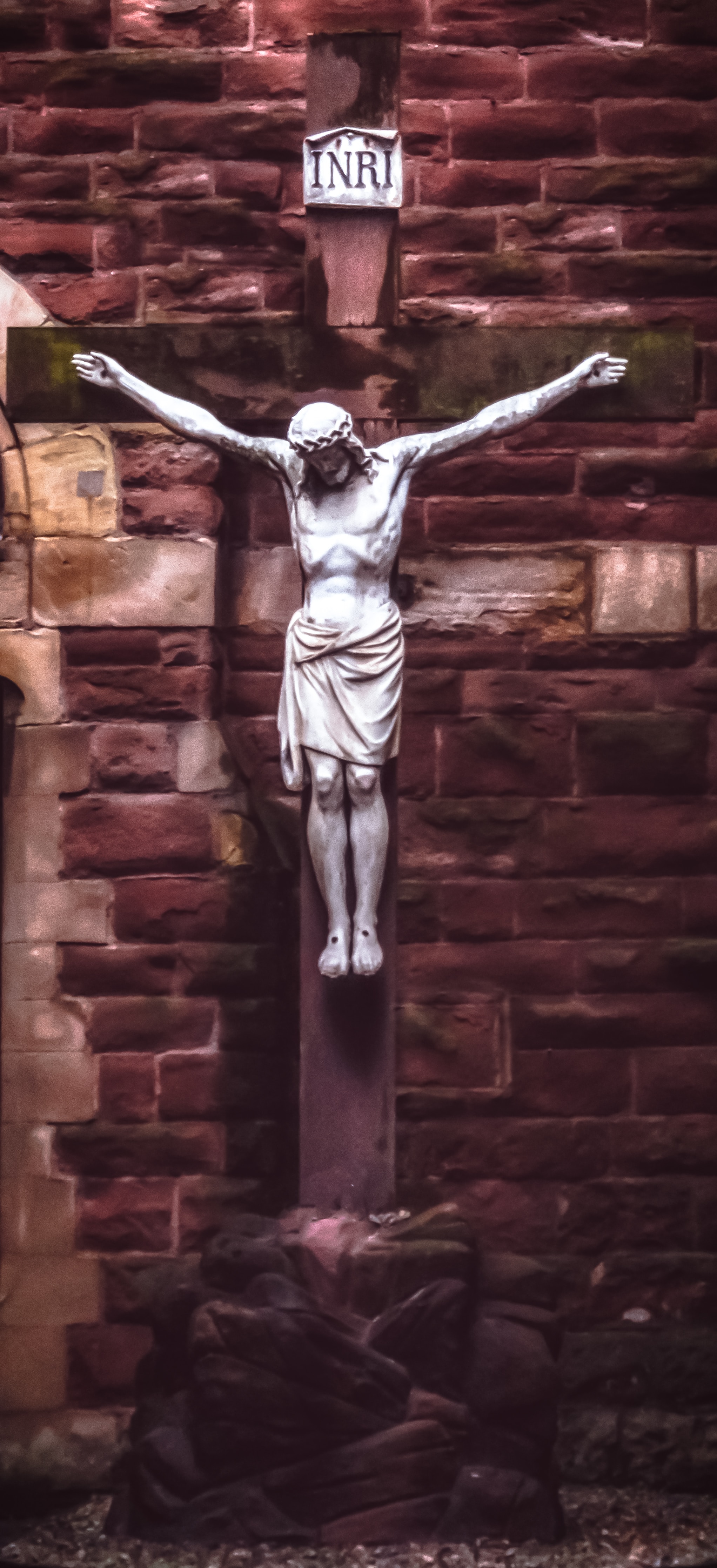
Thirteenth Station: Jesus Dies on the Cross
(Luke 23: 44-46)
Photo by K. Mitch Hodge on Unsplash —Crucifix in the alleyway next to St. Patrick’s Church in Belfast (Jan., 2020)
Jesus, You began Your journey to the cross, in one sense, in the desert at the start of Your public ministry, and in another sense, in the Garden of Gethsemane. In both places, You let the Spirit lead you away from other people and from material comforts so that You could nurture Your relationship with the One who created You and sent You on Your mission. Times of retreat such as these allowed You to seek and to find the strength You needed to offer Yourself to Your brothers and sisters in the human family despite their spiritual blindness, weakness, greed, lust, fear, and impatience. You were able to surrender Yourself to others because You trusted Your Father would use their sins and frailties to accomplish the work of redemption. You knew that, ultimately, You were surrendering not to evil but to the Good of Your Father. For that purpose, You gave back to Your Father everything You received — Your desires, Your will, Your body, Your blood — every drop of it — and, in the moment to which I now turn my attention, Your spirit. You knew that only by dying, only by commending everything You had received to the Father, would You be free from the grip death had on You.
I, too, must embark on a lifelong journey of surrendering everything I have to Divine Love in order to receive Divine Life. I couldn’t travel this path if You hadn’t done so before me and didn’t continue to do so beside me and within me. I forget the sight and the feel of Your Way again and again, and You are with me to guide me back to it. Thank You for doing for me, with me, and in me what I cannot do by myself. Thank you for creating me for relationship in all its forms. Amen.
Jesus, in honor of the care Joseph of Arimathea showed You when You could not express Your gratitude, I offer prayers of thanksgiving.
for those who share what they have
for those who give of themselves and their possessions without expecting compensation or a reward
for those who cannot express their gratitude for the care they receive
for those who look after the dignity of the dignity of members of the human family who have died.
I’m grateful that You call to Yourself people from all walks of life.
I pray for those who have died, for those who mourn, for those who wait, and for all of us who grapple with anxiety amid the uncertainty of life. I bring to You Your beloved ones who face situations that seem hopeless.
And I pray for the virtues of patience and charity. Help me to recognize and to accept opportunities to practice these virtues. Teach me to rest in You. Amen.
This post is a continuation of my Lenten reflections on the Scriptural Stations of the Cross. The station titles and scripture and verse citations, except where otherwise noted, are published on USCCB.org.
Eleventh Station: Jesus Promises His Kingdom to the Good Thief
(Luke 23: 33-34 [and Philippians 2:6-7 – my insertion)
Jesus, thank You for not regarding “equality with God something to be grasped, but instead “empty[ing] [Yourself], taking the form of a slave,” of a working man’s son, who experienced unpleasant emotions, temptations, poverty, and sickness (Phil. 2: 6-7). Thank you for surrendering to one of the worst punishments a criminal could receive — crucifixion — a punishment involving multiple forms of torture — even though You were innocent. In accepting Your sentence, You showed Your brothers and sisters accused of crimes and those convicted of them — whether justly or wrongly — that no choice they make forfeits God’s love for them or the ability of their lives to have purpose and meaning in Your eyes.
Nothing I or anyone else can do forfeits God’s love. Help me remember this truth and to put it into action by living in solidarity with those who are rejected and/or who struggle to forgive themselves and to have hope.
Help me also to remember the following lessons offered by the exchange between You and the people crucified beside You:
Suffering brings You sorrow, and yet, avoiding sorrow is not more important than surrendering to God’s plan for me so that I can become my best self and participate in God’s healing work.
Part of being truthful is taking responsibility for my actions and their consequences.
When I do take responsibility for my actions and come to you in my woundedness and with sincerity, You will remind me that I’m so much more than any destructive choices. Those choices will not be the end of me if I surrender them to You. You work not only around weaknesses and harmful choices but through them, even if I don’t ask You to. You want me to ask so that I can hear You reassure me that You are near. I am in Your heart, and You are in mine if I invite You in.
Thank You for Your nearness, especially when I feel furthest away from You and when I forget You or don’t understand the Divine plan. Amen
Twelfth Station: Jesus Speaks to His Mother and the Disciple
Jesus, Your friends John and Mary, as well as Your aunt and Your mother were embodiments of God’s faithfulness at the foot of Your cross. These beloved ones did not him hide or abandon You when being seen as one of Your group might have been very dangerous for their earthly lives.
Meanwhile, You let these bravest members of Your circle know that you were thinking of them and their future needs.
You make those you draw to Yourself not just friends for each other but family. Thank you for inviting me into the embrace of that family. Help me to experience the Love of that embrace and to share that Love, to participate in the growth of Your family.
Jesus, grant me the grace to support my family and friends in ways that help them experience Your love. Help me to support them, especially at their most difficult times and mine.
The Bible.The New American Bible Revised Edition, Kindle edition, Fairbrother, 2011.
Confraternity of Christian Doctrine, Inc. “Sunday July, 2 2023: Readings at Mass.” The New American Bible, 2001. Universalis for Windows, Version 2.179, Universalis Publishing Ltd., 26 Feb. 2023, https://universalis.com/n-app-windows.htm
This post is a continuation of my Lenten reflections on the Scriptural Stations of the Cross. The station titles and scripture and verse citations, except where otherwise noted, are published on USCCB.org.
Words are powerful. Help me, Lord, to remember this, and help me to use their power to do good. Help me to use them to build faith, hope, charity, justice, and mercy. May my words never stand in the way of anyone receiving and sharing Your gifts.
Help me to make the best of every situation by seeking and recognizing Your presence in each one, especially when I’m confronted with and affected by words and actions that don’t seem to foster faith, hope, charity, justice, and mercy.
Help me to do Your will and to feel Your presence, especially when I feel afraid, confused, weak, and alone. Strengthen me when I feel powerless. Increase my faith that you have given and will give me what I need to do what you ask. Amen.
Eighth Station: Jesus is Helped by Simon the Cyrenian to Carry the Cross
Lord, help me to remember that when I join my crosses — the annoyances, the struggles, and the pain in my life — to yours, when I don’t allow my crosses to hold me down but instead trust that You will help me move forward while carrying them, I take part in my own redemption and the redemption of Your creation. Thank You for showing me through Simon and others how to do this, and thank You for giving my carrying of my crosses and the crosses of others redemptive power through Your passion and resurrection. Thank You also for teaching me through the role of Simon on the way of Your cross that I take part in Your redemptive work even when I don’t receive crosses willingly. Grant me the grace to accept and to share crosses willingly, nonetheless. Grant me the patience and discernment I need to share the crosses of the brothers and sisters closest to me and the closest those who are suffering throughout the world. Amen.
This post is a continuation of my Lenten reflections on the Scriptural Stations of the Cross. The station titles and scripture and verse citations, except where otherwise noted, are published on USCCB.org.
(Mark 15: 1-5, 15 [John 18:38 and Romans 8:31 — my insertions])
Jesus, as I read this passage, I imagine Pilate being focused on whether You seek power in the way that Pilate understands it. The power that Pilate is concerned about is a power that would come from an ambition to rule in Your place.
When You “You say so” to Pilate’s question about whether You are “the king of the Jews,” I imagine Pilate being reassured that You were no threat to his own power (Mark 15:2-3). He doesn’t see how You being “born . . . to testify to the truth” is a threat to his own power (John 18:38). He hasn’t been challenged by Your teachings as the Jewish authorities have. I imagine he hasn’t sought the true peace that comes from pursuing truth. He seeks only the appearance of peace that consists of making and keeping allies that suit different purposes at different times. This pseudo-peace concerns itself only with self-preservation. I imagine Pilate has this very limited perspective, and that’s why he reminds You of “how many things” the Sanhedrin accuse You of (Mark 15:4) I him.
But Jesus, You didn’t come to save yourself. You came to save creation. You are not concerned with others’ perception of you, except when that perception aligns with how God sees you. For You, the only approval that matters is approval given based on truth.
Jesus, help me to recognize the power of truth and to seek and find lasting peace that comes from its power. Help me to trust that You are embodied Truth and that because You are for me no one and nothing can be against me when I rest in You. Amen. (See Rom. 8:31)
Sixth Station: Jesus is Scourged and Crowned with Thorns
(John 19: 1-3)
Jesus, open my mind and heart to the areas of my life in which I need to put up sturdier guardrails for myself. May I base my guardrails on the ones You have established for me — Your teachings and the Commandments by which you lived. Help me to remember that good can come from discipline, even though, when I first subject myself to it, it is uncomfortable. Sometimes, when I’m uncomfortable, I find strength not to flee from discomfort in remember that you endured not just discomfort but agonizing pain and that you gave the same Spirit to me that you possessed when you endured being scourged and crowned with thorns. The same Spirit that made you able to bear such pain and more enables me to face trials without being defeated in the long run — that is, if I trust in the Spirit and follow where it leads.
Holy Spirit, help me see the present moment clearly instead of letting regrets whip me. Show me how to use those regrets to make better choices.
Creator, Redeemer, and Sanctifier, help me not to make daydreams and entertainments into idols. Daydreams and entertainments are gifts of creativity. They can point me to You and to Your will for my life, but I need help to remember that pointing to You is not the same as being You. Help me to find rest and inspiration in creativity without being blinded or numbed by it. Help me to remember that You are the source of all creativity and beauty and to thank you for these gifts. Remind me that with You, I can embrace challenges and hardships. I can rest in daydreams and entertainments without hiding in them. I don’t have to use daydreams and entertainments to avoid hardships out of fear they are stronger than we are together. They are not stronger than we are together, and I can’t avoid hardships anyway. I can only delay facing them. Sometimes I can’t even delay facing them despite all the idols I try to put between me and them.
May I praise what You praise, and may my praise be sincere and thoughtful. Teach me to trust in the power that comes from You rather than in prestige and possessions. Amen.
The Bible.The New American Bible Revised Edition, Kindle edition, Fairbrother, 2011.
Confraternity of Christian Doctrine, Inc. “Sunday July, 2 2023: Readings at Mass.” The New American Bible, 2001. Universalis for Windows, Version 2.179, Universalis Publishing Ltd., 26 Feb. 2023, https://universalis.com/n-app-windows.htm
The verse above and the reading from which it comes, Matthew 5:17-37, is one of those that I have visceral reactions to and not pleasant ones. Until I make myself focus on inhaling and exhaling a few times, I feel suffocated by darkness. I can’t see a sliver of light, and I feel nothing I can grab onto to move forward. I experience temporary despair when I revisit verses like the one I’ve highlighted, they awaken my anxiety and depression like the slightest unusual sound that can startle me out of a sound sleep at night.
I suppose such passages are meant to jar anyone who receives them out of complacency, and they do that. But I find it difficult to see what to do long-term after the jarring. I confess my anger, resentments, and wounds, and mentally, I surrender them to God again and again. Yet anger, resentment, envy, and self-service are such a part of my heart. They cut through every layer of my being. These emotions feel like thorny weeds embedded in a soul that’s filled with concrete. As time passes, uprooting them feels more and more impossible. I feel disappointed in myself for letting poison spread in my own heart and from there the world around me over and over despite repeated and sincere intentions to spread healing and light.
When I heard Matthew 5:17-37 again this weekend, I thought maybe this was one of the weeks I’d link to someone else’s reflection. I didn’t want to spread despair. After all, even though truths can be difficult to share and to receive, I have faith that despair is not truth. I asked God where I could find hope and the truth in the midst of the weeds in my heart and on the hamster wheel of my mind.
Two answers came to me:
Imagine your emotions as electricity, and rather than thinking you need to make them go away, ask God to help you channel them toward creativity and the service of love, rather than simply unleashing them with the result being that they electrocute everyone and everything around you (by “you,” I mean me).
Don’t give up on inviting the gardener of your heart to tend it. Maybe to be alive means not to give up.
It’s easier to imagine #1 coming to fruition for someone else, thanks to an individual being personally affected by a societal wound. Mothers Against Drunk Driving came to my mind. The Wikipedia article about the organization says MADD: “was founded on September 5, 1980, in California by Candace Lightner after her 13-year-old daughter, Cari, was killed by a drunk driver. There is at least one MADD office in every state of the United States and at least one in each province of Canada. These offices offer victim services and many resources involving alcohol safety. MADD has claimed that drunk driving has been reduced by half since its founding.”
The article goes on to say that “[a]ccording to MADD’s website, ‘The mission of Mothers Against Drunk Driving is to end drunk driving, help fight drugged driving, support the victims of these violent crimes and prevent underage drinking'” (qtd. in “Mothers Against Drunk Driving”).
But then there are the experiences that make people angry, that hurt them, that aren’t obviously catastrophic. There are the deep-seated wounds in ourselves, and by extension, in our relationships. I wonder if it’s true that the longer we’ve known someone, the more power they have to hurt us, and the more power we have to hurt the other person. The injuries from these connections may be older and deeper. They may have festered almost as long as we can remember. Elements of them are probably relatable to most people, and yet other aspects of them are unique to the people and situations involved. (Actually, even high-profile traumatic events probably share this quality of being a mixture of painful universality and uniqueness)
As I’ve wrestled with Matthew 5:22 the last few days, I’ve been reminded of the importance of naming emotions and then sitting with them, of saying to myself and to God, “Okay, I’ve just had an experience or an encounter that’s stirred some intense feelings. What are they? Anger, resentment, disappointment, sadness. In the past, I’ve tried to label them and then go on.
But earlier today, I found myself repeating, “I’m angry and hurt. I really wish things were different. I felt a lot more peace and relief when I vented to myself and to God about the feelings rather than hoping that I could simply name them and expect them to go away. Once I had allowed myself this time of confrontation and release, I felt for a good while that Jesus was with me in this pain and that I was a tiny bit grateful to share Jesus’ pain. I prayed that my accepting this pain would do some spiritual good I can’t understand yet. I really did feel like God had helped me harness at least some of the electricity, though the harnessing took a different form than the one that firs occurred to me when I asked for help.
I know that all too soon, I’ll forget to invite God into my struggles. Maybe the key as soon as I realize I’ve forgotten, is to extend the invitation again, to reopen the gate to the garden of my heart repeatedly. Thank You, Lord, for whispering gentleness to my mind when I forget You are there and for knocking on the gate of my heart. Amen.
Works cited
The Bible. The New American Bible Revised Edition, Kindle edition, Fairbrother, 2011.
Psalm 146:6-10 presents a word tapestry about the loving care of God. But given the disappointment, resentment, and selfishness that weigh down my own heart despite my desire to let go of these burdens, I find it a challenge to see this tapestry as anything more than an eloquent wish. Much of what I see in the news doesn’t help make the tapestry come alive either.
However, this post isn’t dedicated to bashing news media or news watching. My undergraduate major was mass communications. I wrote and edited for the university newspaper and took courses in other forms of information dissemination, including broadcast journalism and public relations.
I think it’s important (without consuming news all day) to follow current events every day. I also think it’s useful to consult different well-established new sources on different days, not just the ones that confirm the views I already hold. For me, this is one example of what it means to be in the world but not of it. (See John 17:14-15). News may not show me the world I want to see, but that doesn’t mean I should avoid seeing it — much the opposite. I have to know what’s going on in the world to have any hope of bringing the Good News to that world or indeed, communicating at all in a way that resonates.
Violence is very prevalent around us, and news sources reflect this reality because their job is not to reflect back to us our day-to-day routines or anyone else’s. The way I see it, this function of journalism is why it’s called “the news” and not “the expected” or “the desired.” This function is why a common phrase in journalism education (at least when I was receiving it) was “if it bleeds, it leads.” So often it’s violence, whether on the part of nature or humanity, that interrupts the status quo. This disruption is not the fault of news sources. Do inspiring events occur as well as tragic ones? Absolutely! News sources report on these too. Pretty much every television news broadcast I’ve ever seen ends with a positive story. I think this is done with the idea of leaving viewers with something positive to take away.
I see some common ground and some differences between news broadcasts and the Beatitudes. The Beatitudes acknowledge the difficult and often unjust realities of life, while at the same time, each one begins and ends by offering hope, For example, Jesus says that “those who mourn” are “blessed” (Matt. 5:4). Does this mean that someone should desire mourning over joy? I don’t think so. Does this mean that someone mourning should feel blessed? No. I hear this Beatitude as a promise that regardless of what someone who is mourning feels, they are blessed because Christ is close to them in a special way, as he is to anyone in need or going through a difficult time. He struggled and mourned during his passion, and when we join our suffering to the suffering of the cross, our suffering takes on the redemptive power of the cross, even in the many times when we can’t see how.
I’m not saying that everything happens for a reason, or that God pushes us around like pieces on a chessboard. We have free will. We also have bodies that come with a lot of biology and chemistry — survival instincts that sometimes end up translating into domination over others, physically, emotionally, and psychologically. Everyone around us is also influenced by these factors, to varying degrees. The Spirit and its domain, spirituality are about not letting these factors overtake the Spirit in us. This is not to say that our bodies and minds are bad and our souls are good. To say that would be heresy. I look at the relationship between physical and spiritual matters this way: God designed them to work together, as they do in Jesus and his gift of his body, blood, soul and divinity in his ministry, on the cross, and hidden within the forms of bread and wine. I’m saying that, thanks to Jesus’s life, death, and resurrection and his example during these stages of his mission, no difficulty, suffering, or instance of a situation not working out the way we wanted has to destroy our hope. As I think I’ve written before, we can use our experiences to prevent others from suffering similarly, we can accompany others going through similar experiences, or in the most challenging of circumstances, when neither of these opportunities seem available to us, we can choose to trust that the offering of our circumstances to God is redemptive in those ways I mentioned earlier, the ones we can’t see — yet.
Like most people, I’d like to see nothing but righteousness, mercy, satisfaction, comfort, and peace around me and within me right now. But to experience that would be to experience heaven, and I’m not there. Because I’m not already there, I take comfort in the fact that the second half of each Beatitude, offers a future blessing, not a present one. If the Beatitudes were presented to me in nothing but present tense, I would struggle with faith even more than I do I would wonder why God hadn’t kept the promises of the Beatitudes. After all, I look around me and within me and see not only the qualities opposites of the positive ones included in the Beatitudes but also imperfect versions of those positive qualities. In our broken humanity we thirst for righteousness without allowing for meekness or mercy, and we seek comfort and satisfaction without first being poor in spirit, without having a clear enough vision of reality to mourn with those around us. I think each positive quality included in the Beatitudes needs all the others to reach its fulfillment.
I don’t believe such ultimate fulfillment comes in this life. Our mission is to thirst for it, to do what we can to embody the combined Beatitudes, all the while knowing we do and will fall short. I find pain and comfort in this falling short — pain because I want to experience Heaven now, and comfort because in acknowledging that I fall short, I recognize poverty of spirit. I recognize that I need God and others, that I don’t have all the answers, and that nobody but God does.
Lord, help me to be more at ease with my lack of understanding and control and Your total understanding. Help me to turn to you and let you work in me as I thirst for the fulfillment of your promises. Amen.
Confraternity of Christian Doctrine, Inc. “Sunday July, 2 2023: Readings at Mass.” The New American Bible, 2001. Universalis for Windows, Version 2.179, Universalis Publishing Ltd., 26 Feb. 2023, https://universalis.com/n-app-windows.htm













 Sitting with the Sacred