Feeds:
Posts
Comments

Posts Tagged ‘Discouragement’

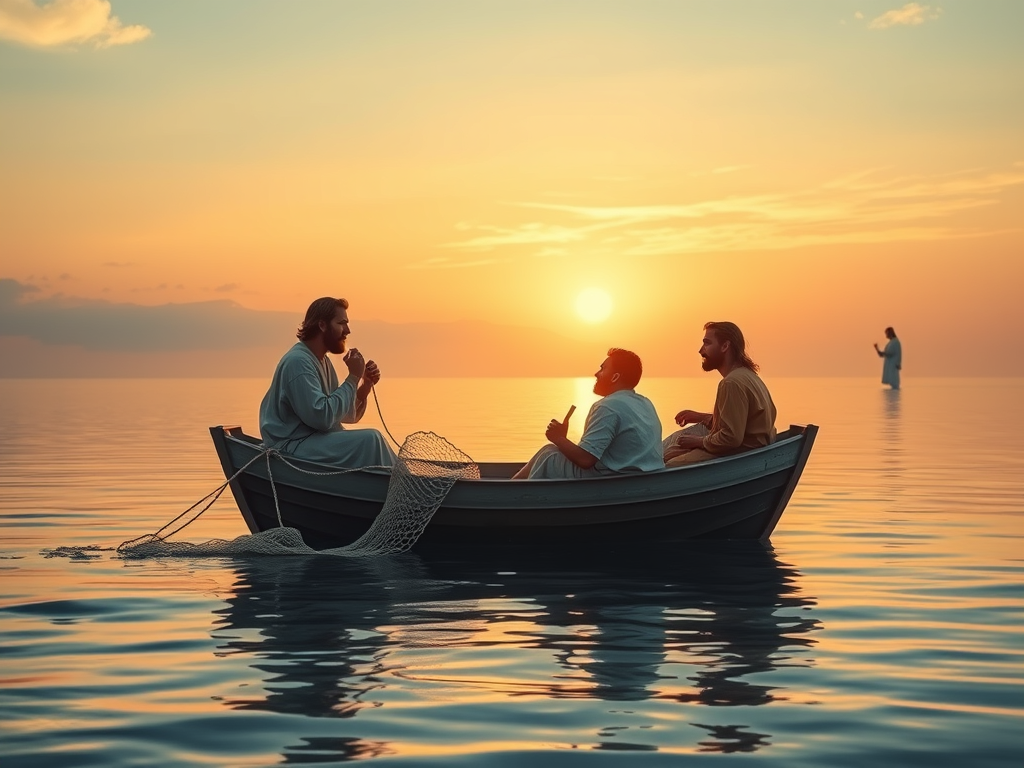
Image Generated by WordPress AI

Readings for May 4, 2025:

All in one place:

https://bible.usccb.org/bible/readings/050425.cfm

In the context of each Bible book:

  1. Acts 5:27-32, 40b-41
  2. Psalm 30:2, 4, 5-6, 11-12, 13
  3. Revelation 5:11-14
  4. John 21:1-19 

What stands out to me from this week’s readings:

In the gospel for May 4, Jesus calls the apostles, including Peter, “children” (John 21:5) as if they are elementary school students, and he’s the teacher. In the previous chapter, he called them “brothers” (John 20:17). What’s the reason for the difference? Well, maybe this video reflection with Jeff Cavins and Jonathan Roumie provides an answer. In going fishing, the apostles try to go back to where they started, as if they haven’t seen the empty tomb, as if they haven’t seen Jesus alive at least twice.

What I’m saying about the readings:

So if you still struggle to have faith and hope, if you’re tempted to give up, if it’s ever taken you a lot of study and a lot of mistakes before you learned or accepted something, you’re in the company of the apostles in the Gospel passage for May 4. And you haven’t seen Jesus the way they do in the passages that come before this one.

What someone else is saying about this week’s readings:

Jenny Jackson poses to us the question Jesus poses to Peter in the Gospel for May 4. I need time to reflect on the answer to this question. I trust that taking this time will allow the Holy Spirit to give to me what Jenny Jackson wanted during the time she describes in her reflection. Okay, so I don’t entirely trust, but I trust enough to declare my intention of trusting, of being open.

What I’m saying that doesn’t have to do with the readings:

As I’ve written so often here, I may not post next week. In fact, unless something surprising happens, I won’t. I feel like I’m just going through the motions on this blog lately. I do want to acknowledge that going through the motions when one doesn’t feel like it often has value. It builds perseverance. And I believe in a God who works behind the scenes and under the surfaces of life.

But I also read on another blog recently about prioritizing quality over quantity. That’s what I want to do. I’m seeing that the post on this blog that gets the most views is one that when I wrote it, I felt I had an insight to share that I wasn’t seeing in a lot of other places. Most weeks, I don’t feel that way. Most of my posts get one or two views.

Writing this blog has helped me appreciate in a new way the work that preachers and spiritual writers do. It’s quite a challenge to keep stories and messages that are so familiar feeling fresh and resonant. The challenge feels like an even greater one to face every week, as so many spiritual leaders do.

Now I’ve never published this blog to get followers or to go viral. I’ve always said that if what I write here resonates with one other person, it’s worth doing. And sometimes it has helped me feel like I’m getting my perspective out there in a world where it feels like homilies mainly have non-disabled married people with kids and without mental health struggles as their target audience. Other times, I’ve felt sure that despite my original vision for this blog, I’m not reaching spiritual seekers who may feel invisible in many spiritual communities. I’ve felt like I’m not really engaging with the texts, not bringing myself as I am to them.

So what now? I’ll tell you what I’m not doing. I’m not deleting this blog. Therefore, if there are posts that resonate with you, I want to let you know they aren’t going anywhere. I’m just going to come back to this blog when I have something I really need to share. As I was bothered by something yesterday and praying this morning, I got a couple ideas for spiritual essays. I may develop these ideas at my own pace and share them here if and when I’m ready.

I plan to journal whenever I feel prompted to and not put any pressure on myself to share what I write in my journal. Maybe this low-pressure practice will also generate writing I want to share here.

This week’s prayer:

Come, Holy Spirit! Bring my heart to life with Your love. Help me recognize it everywhere. Show me how to use the gifts You gave me to share it. Amen.

Works cited:

Cavins, Jeff, and Johnathan Roumie. “Holy Land: Easter Sunday.” Hallow, 20 Apr. 2025, hallow.com/prayers/1077275/.

Jackson, Jenny. “Third Sunday of Easter: May 04, 2025.” Catholic Women Preach, FutureChurch, 2025, www.catholicwomenpreach.org/preaching/05042025.

“Third Sunday of Easter — Lectionary: 48.” Daily Readings, Lectionary for Mass for Use in the Dioceses of the United States, Confraternity of Christian Doctrine, 2nd typical ed, United States Conference of Catholic Bishops, 2025, https://bible.usccb.org/bible/readings/050425.cfm.

Read Full Post »

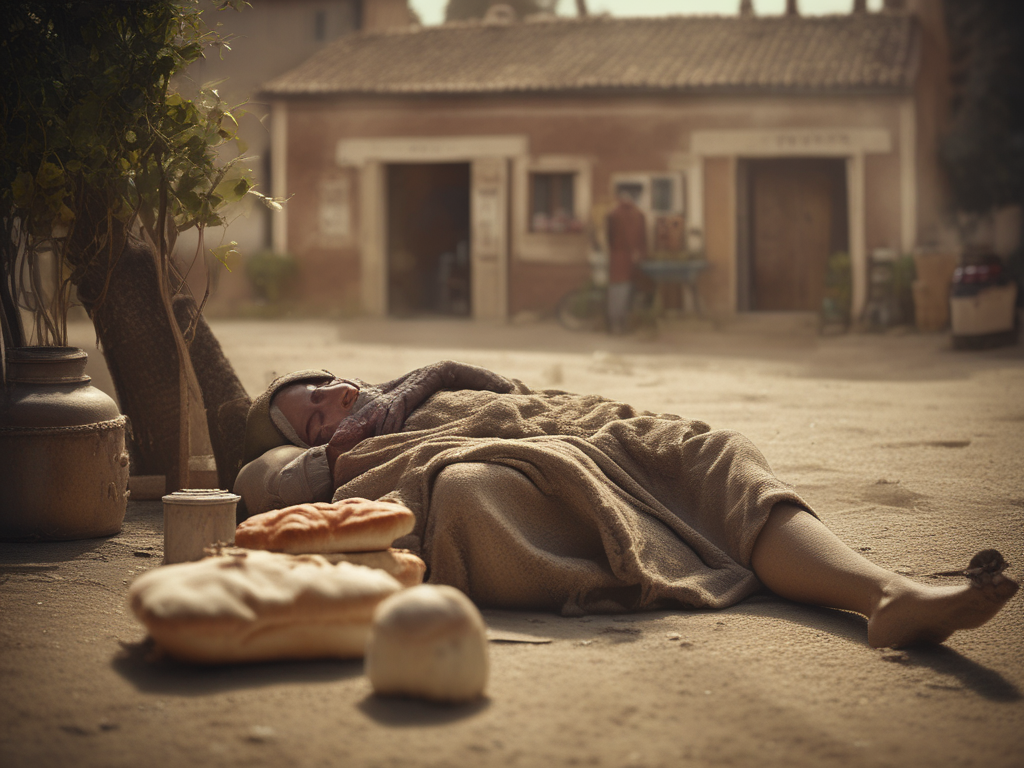
Image Generated by WordPress AI

Readings for August 11:

  1. 1 Kings 19:4–8
  2. Psalm 34:2–3, 4–5, 6–7, 8–9
  3. Ephesians 4:30—5:2
  4. John 6:41–51

What this week’s readings say to me:

I think I’ll use a very current term to distill what the first reading says to me this time. It’s about the importance of self-care. When the passage begins, it seems like Elijah is physically and spiritually depleted. He asks God to end his life because he’s “no better” than anyone who came before him. (1Kings 19:4). I imagine him thanking that realizing this must mean he’s failed at the mission God has given him. After all, how can someone who’s no better than anyone who came before him be an effective prophet?

The situation is a reminder that God is at work even when we’re depleted. Sometimes, we’re most open to God working within and around us precisely when we feel we have nothing left to give. If we turn to God at no other time, many of us do so when we can’t see anywhere else to turn. I acknowledge this truth of human experience not to say that God wants us to be depleted. The Old Testament passage gives evidence to the contrary.

God knows that we need food, drink, rest, and to feel cared about to do our work and to be whole. God usually doesn’t force what we need upon us. Instead, God offers it, and it’s up to us to receive it. It was up to Elijah to acknowledge to God that he felt defeated and depleted, to rest, and then to take the nourishment that God offered.

The psalm reinforces that God provides for those who are open to receiving what God offers and to doing God’s work. It also reinforces the role the speaker has in finding what he needs, but it does so in a different way than the Old Testament passage does. The speaker says, “I will bless the Lord at all times” (Psalm 34: 2).

I had a gut reaction to this line, especially because it’s the first one included in this week’s psalm reading. I thought, “I don’t, and I won’t because there’s a lot that happens in the world that doesn’t seem like the will of a loving God, and I don’t understand why God, who I choose to believe is love, would allow these things to happen.

Thankfully, because I believe God is love, I also believe that a lot of things that happen grieve God. And I believe that sharing my grief and anger at what happens around me built as much of a connection to God is giving praise for God’s providence does.

My gut reaction also begins to feel different when I read later in this week’s psalm excerpt that the speaker “sought the Lord, and he answered me and delivered me from all my fears” (Psalm 34:5). Maybe having a record and so being able to remind himself of the ways the Lord “answered [him] and delivered [him] from all [his] fears is the reason [“God’s] praise shall be ever in [his] mouth” (Psalm 34: 2; 5).

It might be helpful to consider the ways each of us can keep a record of times we’ve felt we’ve had what we needed and were seen and heard. Keeping such a record in whatever way makes sense for each of us may give us strength in those times when we don’t feel we have what we need or when we don’t feel seen and heard.

Maybe keeping a record of those experiences of abundance and connection, of grace, will help us glorify the Holy Spirit rather than “griev[ing]” it (Eph. 4:30). Maybe this practice will help us avoid what the epistle is urging us to avoid and to embrace what the epistle is asking us to embrace. I find the excerpt’s message easy to hear but difficult to put into practice. Maybe keeping track of empowering memories is a way of experiencing God’s presence with us when we find ourselves in situations that feel less empowering.

In the Gospel passage, Jesus’ contemporaries are having trouble recognizing that He’s God in their midst and that learning from Him, imitating him, and taking His words to heart would feed them, giving them life, not only in that moment, but eternally. Listening to Him and receiving what He provides leads to God, and recognizing how God has guided and provided in the past makes God present among us in the current moment. It points to Christ.

What someone else is sharing about this week’s readings:

When we are called on to make sacred sacrifices in order to ‘live in love’ – it is not our very self – our created self- that we are losing. It is the assumptions and projections of who we should be, the expectations and external pressures of others laid onto us by others.

Kasha L. Sanor — in her reflection on this week’s readings

This week’s prayer:

Lord, help us to recognize and to receive You so we can be who we are in You and do what You place on our hearts to do. Amen

Work cited:

The New American Bible Revised Edition, Kindle edition, Fairbrother, 2011.

Read Full Post »

Readings for the weekend of June 9:

  1. Genesis 3:9–15
  2. Psalm 130:1–2, 3–4, 5–6, 7–8
  3. 2 Corinthians 4:13—5:1
  4. Mark 3:20–35

What this week’s readings say to me:

The first reading says to me that even though God wants us to trust in who He is and what He says so that we can live without shame and without hurting ourselves and others, He understands how easily we can be tricked into not trusting in who He says he is and what He says about how to avoid hurting ourselves and others. He wants to defend us against and protect us from what distorts our vision of Him, of ourselves, and of others.

The psalm is a plea for that defense, that protection from the Lord. It reminds me not to let my weaknesses and the ways I fall short lead me to give up hope but instead, with patience, to ask the Lord to pick me up when I fall and to expect that God will do just that and is waiting to help me avoid falling into the same pits in the future, provided that I trust in the support God offers.

From my perspective, this week’s readings are about what God does in response to what I do and how I can respond so that God works in and through me; the passage from Corinthians is no exception. The passage reminds me to respond with trust in God and to let that trust be reflected in my words and actions. If I do, the letter promises, I’ll help grow a family that recognizes the presence of God and radiates it now and eternally. If I do, my actions will spread gratitude for the gifts and the graces God gives. My own physical and spiritual frailties won’t be able to tempt me to despair. Neither will anyone else’s choices or any other obstacle. Rather than being temptations, weaknesses and obstacles can be reminders that I’m dependent on God’s grace and that nothing the senses detect lasts forever. But God within and God and around me “is eternal” (2 Cor. 4:18).

The Gospel passage says to me that only my attempts and the attempts of others to place limits on what God can do have the ability to limit what God can do. I have the ability to put these limits on God because God isn’t in the habit of overriding free will. God can, and I suppose sometimes does, for the sake of the overall Plan, but God doesn’t seem to prefer to work this way. God is one God in three Persons — relationship by nature. Because God isn’t subject to the limits God has placed on the material realm, God calls me to nurture relationships not only with those connected to me by DNA or with those who can offer me something material, but with everyone who wants to be open to God’s grace and to live by it, and to share it.

What someone else is sharing about this week’s readings:

Find out how, in the words of Terresa M. Ford, this weekend’s readings remind us that “God doesn’t waste anything, even adversity.”

Beyond this week’s readings:

This week’s readings prompt me to ask myself some questions:

What does it mean to trust in God? Does it mean just letting life happen to me and assuming that whatever happens is God’s will?

I don’t think so. Maybe part of trusting in God means trusting that God has given me the ability to look at the effects of my choices, to evaluate the extent to which these effects are positive and negative and to reflect on how I might avoid certain circumstances in the future and/or modify my choices in the hope that their effects will be more positive in the future.

Can I always know whether the results of my choices will be positive or negative? No.

Is my perception of what’s positive and negative always crystal clear?

No.

Will I always see the results of what I do?

No.

My limited perspective is another reason trust, which is another word for faith, comes is important.

Do I have perfect faith?

No. Far from it.

The renewal of my inner self has a long way to go. I take comfort in the reminder this week’s readings provide: God knows I can’t renew myself, so with my help and permission, God is “renew[ing]” my inner self “day by day” (2 Cor. 4:16). What God asks of me is that I invite Him again and again to renew me.

I can’t see that day-by-day renewal right now, but I choose to act with trust that it’s happening by inviting God to work in me again and again.

This week’s prayer:

Come, Holy Spirit. Amen.

Work cited

The New American Bible Revised Edition, Kindle edition, Fairbrother, 2011.

Read Full Post »

Photo by Paul Jai on Unsplash

This Week’s Readings:

  1. Zechariah 9:9–10
  2. Psalm 145:1–2, 8–9, 10–11, 13–14
  3. Romans 8:9, 11–13
  4. Matthew 11:25–30

I read the first two readings and thought it would probably be good for me to read and reread them and internalize their expressions of faith and praise. Maybe if I read them enough, their words would feel more like they could be my own. However, where is my mind is right now, it can embrace them as true but my heart hesitates to do the same, even as I recognize the justice of praising God even when the praise feels inauthentic coming from me. The third reading seems to present the ideal response to faith in another way that I’m discouraged by not living up to.

The Good News for me this week is the Gospel’s affirmation of my feeling that I can’t live up to the ideals of the first two readings. I’m not meant live up to the ideals on my own strength. The ideals aren’t even about doing the right things on my own or even thinking the right things or understanding difficult situations or concepts on my own. Jesus speaks to his Father in Matthew Chapter 11, saying, “I give praise to you, Father, Lord of heaven and earth, for although you have hidden these things from the wise and the learned you [italics mine] have revealed them to little ones” (25-26). Once I revisited this verse, it helped me see in a new light two verses from the third reading. They say:

If the Spirit of the one who raised Jesus from the dead dwells in you, the one who raised Christ from the dead will give life to your mortal bodies also, through his Spirit that dwells in you. Consequently, brothers and sisters, we are not debtors to the flesh, to live according to the flesh.

Romans 8:11-12

I don’t give life to myself. The Spirit “that raised Christ from the dead” and “dwells in me” will give life to [my] mortal body” (Rom. 8:11).

I tend to think of the mind as more closely related to the Spirit than to the “mortal body” or “flesh,” and to sinful actions, what Romans calls “the deeds of the body” (Rom. 8: 13). I don’t think I’m alone in having this dualistic perspective.

However, the reality is that what the mind does is as much the result of brain activity as anything else the body does, whether consciously or unconsciously. And the brain is part of the mortal body. It isn’t necessarily more spiritual than anything else the body does. To say this is not to say that the body is inherently opposed to the Spirit. Rather, the body, which includes the workings of the mind, is healed by the Spirit of the effects of sin. The Spirit restores to each person—each body, mind, spirit combination— to his or her unique way of reflecting God’s image each, provided that the person invites the Spirit in by joining him or herself to His Body.

Because of the doctrine of the Trinity and because of Scriptures that characterize followers of Christ as members of His body, I understand the Spirit’s body in three ways: as the body of Jesus, the body of an individual believer, and as the community of believers. I unite myself to him and become this body, inviting the Spirit to work in my life whenever I trust in these realities and when my life reflects this trust. It reflects this trust when I share the joys and the burdens of Jesus and others, and I find the humility and courage to accept the offers of Jesus and others to share my joys and burdens.

It’s this communion, not being able to handle or understand everything on my own that gives life. I make this statement not to minimize the acquisition of knowledge and expertise or the pursuit of moral and ethical behavior but to reiterate that no knowledge increases or decreases a person’s value from God’s perspective. An article by Guy Consolmagno and Christopher M. Graney inspires me to offer this reminder. It also provides thought-provoking analysis of the justifications humans throughout history have used for thinking and behaving otherwise.

Lord, don’t let me forget your unconditional love for me and for everyone else, indeed for all of Your creation. Don’t let me forget that Your wisdom and understanding is greater than human wisdom and understanding. Also don’t let me forget that though Your wisdom and understanding are greater than human understanding and wisdom, You have given me places and people I can go to for wisdom and support. Thank You for giving life to all of me and to all of Your creation. Amen.

Works cited

Confraternity of Christian Doctrine, Inc. “Sunday 9 July 2023: Readings at Mass.” The New American Bible, 2001. Universalis for Windows, Version 2.179, Universalis Publishing Ltd., 26 Feb. 2023, https://universalis.com/n-app-windows.htm.

Consolmagno, Guy and Christopher M. Graney “Reject the cult of ‘intelligence.’ You’re worth more than that.” America: The Jesuit Review, 29 June 2023, https://www.americamagazine.org/faith/2023/06/29/consolmagno-graney-cult-intelligence-245530.

Read Full Post »

Photo by Catherine Kay Greenup on Unsplash

The LORD is my shepherd; I shall not want.
In verdant pastures he gives me repose;
beside restful waters he leads me;
he refreshes my soul.

Psalm 23: 1-3b, New American Bible, 2001 Edition

Last year, in the fourth week of Easter, I reflected on a verse from the Gospel of John, 10: 27. This verse comes not long after this week’s Gospel reading, and the theme remains the same. The theme is, “Who is the Good Shepherd, and how do the sheep respond to Him?” Because I’ve already taken a look at John’s answers to these questions, I’m going to sit with Psalm 23 for this post.

For most of my life, my experience with the psalm has been like watching a movie that deserves to win Oscars for set and costume design. It projected beautiful scenes in my mind. But I’ve learned in the last two years that these verses offer beauty that’s even more appreciated when I engage my curiosity with them in addition to my mind’s eye.

Admittedly, the first verse doesn’t provide as much visual inspiration as the next two do. I think this is why it’s been the verse that I sometimes felt like I had to pretend I believed. “The Lord is my shepherd; I shall not want” says the translation used in Mass today. At times, I’ve gotten into my head that if I believed the Lord was my shepherd, I had to hide that I wished some things were different. Having to do this is problematic whenever living with one’s mind, body, or external circumstances is painful. Nonetheless, I thought I had to wear a contented mask because if I believed the Lord was my shepherd, I’d be satisfied. I wouldn’t feel like I lacked anything.

Maybe the New American Bible Revised Edition translation I usually use contributed to this thinking. It says, “The Lord is my shepherd; there is nothing I lack.” Not including the word “shall” in the translation suggests that I lack nothing now. The trouble with this sentiment is that it’s in conflict with my experience. I’m tempted to try to avoid the discomfort of this conflict by saying that I do lack nothing even if I feel like I lack something, that I lack nothing as long as I open myself more and more to God and move toward union with God. Any lack only seems like lack because my relationship with God is isn’t yet unobstructed.

Still, even this understanding puts lacking nothing in the context of having greater clarity in the future. The lack of clarity itself, the limitations themselves, are a lack To some extent that lack isn’t my fault, isn’t the fault of any individual alone. I’m wounded not only by my choices but by the wounds others carry, by the frailty of the human condition, and by the fact that I’m limited by time and space, and God isn’t.

So including or not including the word “shall” has a major impact on what the verse means to me. Now, it occurs to me that I might not have always understood the “shall” to promise the ideal future. It can signify a command, as in, “You shall not kill.” It’s difficult to think of God commanding me not to want anything. It doesn’t even seem possible not to want anything. And doesn’t wanting something sometimes lead me to seek God and all the justice, peace, and love that can be found in the seeking? Yes, in my experience, and I think I’m far from alone in this experience.

Therefore, I see this verse in the psalm as a whole as a prophecy and a promise that if I trust the Lord as my shepherd, the Lord will lead me to a life that lacks nothing. Sometimes this life without lack is easier to perceive than at others. It’s an experience that doesn’t always feel out of reach.

The verses that follow are reminders of these moments when God’s grace and providence fill the senses. “In verdant pastures he gives me repose” says the 2001 edition of the New American Bible that the Mass and the Universalis software use. “In green pastures he makes me lie down” says the New American Bible Revised Edition. For a long time I thought this verse was just a verse about the Ultimate Shepherd, God, leading me to find rest in beautiful surroundings.

Then a few years ago, my spiritual director gave me the perspective that it’s not normal sheep behavior to lie down in a field of green grass. Sheep would normally graze in such a field. They’d have to be so full they couldn’t eat anymore to lie down in that green pasture. So the shepherd satisfies the sheep so completely that they can’t do anything but rest.

He doesn’t just lead them “beside restful waters” either (New American Bible, 2001 Edition). The shepherd and the flock aren’t taking this path just to admire and be calmed by the view that a walk along a shore provides. Why does a shepherd lead a flock “”to still waters” (New American Bible Revised Edition)? I think so its members can drink, so they can take those “restful waters” into their bodies. No living thing can survive more than a few days without fluids, and water is the best kind for us. But the Good Shepherd doesn’t just satisfy the thirst of the body. This Ultimate Shepherd satisfies the thirst of the soul. This satisfaction gives peace a home within us. It gives us a peace that is less displaced by external circumstances. It’s so much more than the serenity we might get from the most mirror-like lake view we can imagine.

My experience is that the feeling of having a “restore[d]” soul is fleeting in this life (New American Bible Revised Edition). But less peaceful experiences aren’t permanent either. Recording for myself the moments when I’ve been a sheep made to lie down in green pastures and have been taken to drink water that restores my soul helps me hope for brighter days when I’m in the midst of darker ones.

I think Psalm 23 uses vivid imagery of nature to give himself something to lean on in difficult times. Later versus explore those difficult times more directly, but I’ve decided that is a discussion for next week’s post. Without planning on it, I’ve begun a two- or probably three-part series on Psalm 23.

For now Lord, thank you for being my Shepherd and the Shepherd of all Your creation. Help me to see unexpected developments as opportunities to see how beautifully you will provide for me if I listen to Your voice in my heart and follow where You lead. Amen.

Works cited

The Bible. The New American Bible Revised Edition, Kindle edition, Fairbrother, 2011.

Confraternity of Christian Doctrine, Inc. “Sunday July, 2 2023: Readings at Mass.” The New American Bible, 2001. Universalis for Windows, Version 2.179, Universalis Publishing Ltd., 26 Feb. 2023, https://universalis.com/n-app-windows.htm

Read Full Post »

This post is a continuation of my Lenten reflections on the Scriptural Stations of the Cross. The station titles and scripture and verse citations, except where otherwise noted, are published on USCCB.org.

Photo by Francesco Alberti on Unsplash

Fifth Station: Jesus is Judged by Pilate

(Mark 15: 1-5, 15 [John 18:38 and Romans 8:31 — my insertions])

Jesus, as I read this passage, I imagine Pilate being focused on whether You seek power in the way that Pilate understands it. The power that Pilate is concerned about is a power that would come from an ambition to rule in Your place.

When You “You say so” to Pilate’s question about whether You are “the king of the Jews,” I imagine Pilate being reassured that You were no threat to his own power (Mark 15:2-3). He doesn’t see how You being “born . . . to testify to the truth” is a threat to his own power (John 18:38). He hasn’t been challenged by Your teachings as the Jewish authorities have. I imagine he hasn’t sought the true peace that comes from pursuing truth. He seeks only the appearance of peace that consists of making and keeping allies that suit different purposes at different times. This pseudo-peace concerns itself only with self-preservation. I imagine Pilate has this very limited perspective, and that’s why he reminds You of “how many things” the Sanhedrin accuse You of (Mark 15:4) I him.

But Jesus, You didn’t come to save yourself. You came to save creation. You are not concerned with others’ perception of you, except when that perception aligns with how God sees you. For You, the only approval that matters is approval given based on truth.

Jesus, help me to recognize the power of truth and to seek and find lasting peace that comes from its power. Help me to trust that You are embodied Truth and that because You are for me no one and nothing can be against me when I rest in You. Amen. (See Rom. 8:31)

Photo by Samuel Lopes on Unsplash

Sixth Station: Jesus is Scourged and Crowned with Thorns

(John 19: 1-3)

Jesus, open my mind and heart to the areas of my life in which I need to put up sturdier guardrails for myself. May I base my guardrails on the ones You have established for me — Your teachings and the Commandments by which you lived. Help me to remember that good can come from discipline, even though, when I first subject myself to it, it is uncomfortable. Sometimes, when I’m uncomfortable, I find strength not to flee from discomfort in remember that you endured not just discomfort but agonizing pain and that you gave the same Spirit to me that you possessed when you endured being scourged and crowned with thorns. The same Spirit that made you able to bear such pain and more enables me to face trials without being defeated in the long run — that is, if I trust in the Spirit and follow where it leads.

Holy Spirit, help me see the present moment clearly instead of letting regrets whip me. Show me how to use those regrets to make better choices.

Creator, Redeemer, and Sanctifier, help me not to make daydreams and entertainments into idols. Daydreams and entertainments are gifts of creativity. They can point me to You and to Your will for my life, but I need help to remember that pointing to You is not the same as being You. Help me to find rest and inspiration in creativity without being blinded or numbed by it. Help me to remember that You are the source of all creativity and beauty and to thank you for these gifts. Remind me that with You, I can embrace challenges and hardships. I can rest in daydreams and entertainments without hiding in them. I don’t have to use daydreams and entertainments to avoid hardships out of fear they are stronger than we are together. They are not stronger than we are together, and I can’t avoid hardships anyway. I can only delay facing them. Sometimes I can’t even delay facing them despite all the idols I try to put between me and them.

May I praise what You praise, and may my praise be sincere and thoughtful. Teach me to trust in the power that comes from You rather than in prestige and possessions. Amen.

The Bible. The New American Bible Revised Edition, Kindle edition, Fairbrother, 2011.

Confraternity of Christian Doctrine, Inc. “Sunday July, 2 2023: Readings at Mass.” The New American Bible, 2001. Universalis for Windows, Version 2.179, Universalis Publishing Ltd., 26 Feb. 2023, https://universalis.com/n-app-windows.htm

Read Full Post »

“. . .whoever is angry with his brother will be liable to judgment . . .”

Jesus— Matthew 5:22
Photo by Rohan Makhecha on Unsplash

The verse above and the reading from which it comes, Matthew 5:17-37, is one of those that I have visceral reactions to and not pleasant ones. Until I make myself focus on inhaling and exhaling a few times, I feel suffocated by darkness. I can’t see a sliver of light, and I feel nothing I can grab onto to move forward. I experience temporary despair when I revisit verses like the one I’ve highlighted, they awaken my anxiety and depression like the slightest unusual sound that can startle me out of a sound sleep at night.

I suppose such passages are meant to jar anyone who receives them out of complacency, and they do that. But I find it difficult to see what to do long-term after the jarring. I confess my anger, resentments, and wounds, and mentally, I surrender them to God again and again. Yet anger, resentment, envy, and self-service are such a part of my heart. They cut through every layer of my being. These emotions feel like thorny weeds embedded in a soul that’s filled with concrete. As time passes, uprooting them feels more and more impossible. I feel disappointed in myself for letting poison spread in my own heart and from there the world around me over and over despite repeated and sincere intentions to spread healing and light.

When I heard Matthew 5:17-37 again this weekend, I thought maybe this was one of the weeks I’d link to someone else’s reflection. I didn’t want to spread despair. After all, even though truths can be difficult to share and to receive, I have faith that despair is not truth. I asked God where I could find hope and the truth in the midst of the weeds in my heart and on the hamster wheel of my mind.

Two answers came to me:

  1. Imagine your emotions as electricity, and rather than thinking you need to make them go away, ask God to help you channel them toward creativity and the service of love, rather than simply unleashing them with the result being that they electrocute everyone and everything around you (by “you,” I mean me).
  2. Don’t give up on inviting the gardener of your heart to tend it. Maybe to be alive means not to give up.

It’s easier to imagine #1 coming to fruition for someone else, thanks to an individual being personally affected by a societal wound. Mothers Against Drunk Driving came to my mind. The Wikipedia article about the organization says MADD: “was founded on September 5, 1980, in California by Candace Lightner after her 13-year-old daughter, Cari, was killed by a drunk driver. There is at least one MADD office in every state of the United States and at least one in each province of Canada. These offices offer victim services and many resources involving alcohol safety. MADD has claimed that drunk driving has been reduced by half since its founding.”

The article goes on to say that “[a]ccording to MADD’s website, ‘The mission of Mothers Against Drunk Driving is to end drunk driving, help fight drugged driving, support the victims of these violent crimes and prevent underage drinking'” (qtd. in “Mothers Against Drunk Driving”).

But then there are the experiences that make people angry, that hurt them, that aren’t obviously catastrophic. There are the deep-seated wounds in ourselves, and by extension, in our relationships. I wonder if it’s true that the longer we’ve known someone, the more power they have to hurt us, and the more power we have to hurt the other person. The injuries from these connections may be older and deeper. They may have festered almost as long as we can remember. Elements of them are probably relatable to most people, and yet other aspects of them are unique to the people and situations involved. (Actually, even high-profile traumatic events probably share this quality of being a mixture of painful universality and uniqueness)

As I’ve wrestled with Matthew 5:22 the last few days, I’ve been reminded of the importance of naming emotions and then sitting with them, of saying to myself and to God, “Okay, I’ve just had an experience or an encounter that’s stirred some intense feelings. What are they? Anger, resentment, disappointment, sadness. In the past, I’ve tried to label them and then go on.

But earlier today, I found myself repeating, “I’m angry and hurt. I really wish things were different. I felt a lot more peace and relief when I vented to myself and to God about the feelings rather than hoping that I could simply name them and expect them to go away. Once I had allowed myself this time of confrontation and release, I felt for a good while that Jesus was with me in this pain and that I was a tiny bit grateful to share Jesus’ pain. I prayed that my accepting this pain would do some spiritual good I can’t understand yet. I really did feel like God had helped me harness at least some of the electricity, though the harnessing took a different form than the one that firs occurred to me when I asked for help.

I know that all too soon, I’ll forget to invite God into my struggles. Maybe the key as soon as I realize I’ve forgotten, is to extend the invitation again, to reopen the gate to the garden of my heart repeatedly. Thank You, Lord, for whispering gentleness to my mind when I forget You are there and for knocking on the gate of my heart. Amen.

Works cited

The Bible. The New American Bible Revised Edition, Kindle edition, Fairbrother, 2011.

“Mothers Against Drunk Driving.” Wikipedia: The Free Encyclopedia, Wikimedia Foundation Inc. 28 Nov. 2022, https://en.wikipedia.org/wiki/Mothers_Against_Drunk_Driving.

Read Full Post »

Photo by Claudia Soraya on Unsplash
. . . but the way of the wicked he thwarts.
Psalm 146:9

Matthew 5:1–12a (The Beatitudes)

Psalm 146:6-10 presents a word tapestry about the loving care of God. But given the disappointment, resentment, and selfishness that weigh down my own heart despite my desire to let go of these burdens, I find it a challenge to see this tapestry as anything more than an eloquent wish. Much of what I see in the news doesn’t help make the tapestry come alive either.

However, this post isn’t dedicated to bashing news media or news watching. My undergraduate major was mass communications. I wrote and edited for the university newspaper and took courses in other forms of information dissemination, including broadcast journalism and public relations.

I think it’s important (without consuming news all day) to follow current events every day. I also think it’s useful to consult different well-established new sources on different days, not just the ones that confirm the views I already hold. For me, this is one example of what it means to be in the world but not of it. (See John 17:14-15). News may not show me the world I want to see, but that doesn’t mean I should avoid seeing it — much the opposite. I have to know what’s going on in the world to have any hope of bringing the Good News to that world or indeed, communicating at all in a way that resonates.

Violence is very prevalent around us, and news sources reflect this reality because their job is not to reflect back to us our day-to-day routines or anyone else’s. The way I see it, this function of journalism is why it’s called “the news” and not “the expected” or “the desired.” This function is why a common phrase in journalism education (at least when I was receiving it) was “if it bleeds, it leads.” So often it’s violence, whether on the part of nature or humanity, that interrupts the status quo. This disruption is not the fault of news sources. Do inspiring events occur as well as tragic ones? Absolutely! News sources report on these too. Pretty much every television news broadcast I’ve ever seen ends with a positive story. I think this is done with the idea of leaving viewers with something positive to take away.

I see some common ground and some differences between news broadcasts and the Beatitudes. The Beatitudes acknowledge the difficult and often unjust realities of life, while at the same time, each one begins and ends by offering hope, For example, Jesus says that “those who mourn” are “blessed” (Matt. 5:4). Does this mean that someone should desire mourning over joy? I don’t think so. Does this mean that someone mourning should feel blessed? No. I hear this Beatitude as a promise that regardless of what someone who is mourning feels, they are blessed because Christ is close to them in a special way, as he is to anyone in need or going through a difficult time. He struggled and mourned during his passion, and when we join our suffering to the suffering of the cross, our suffering takes on the redemptive power of the cross, even in the many times when we can’t see how.

I’m not saying that everything happens for a reason, or that God pushes us around like pieces on a chessboard. We have free will. We also have bodies that come with a lot of biology and chemistry — survival instincts that sometimes end up translating into domination over others, physically, emotionally, and psychologically. Everyone around us is also influenced by these factors, to varying degrees. The Spirit and its domain, spirituality are about not letting these factors overtake the Spirit in us. This is not to say that our bodies and minds are bad and our souls are good. To say that would be heresy. I look at the relationship between physical and spiritual matters this way: God designed them to work together, as they do in Jesus and his gift of his body, blood, soul and divinity in his ministry, on the cross, and hidden within the forms of bread and wine. I’m saying that, thanks to Jesus’s life, death, and resurrection and his example during these stages of his mission, no difficulty, suffering, or instance of a situation not working out the way we wanted has to destroy our hope. As I think I’ve written before, we can use our experiences to prevent others from suffering similarly, we can accompany others going through similar experiences, or in the most challenging of circumstances, when neither of these opportunities seem available to us, we can choose to trust that the offering of our circumstances to God is redemptive in those ways I mentioned earlier, the ones we can’t see — yet.

Like most people, I’d like to see nothing but righteousness, mercy, satisfaction, comfort, and peace around me and within me right now. But to experience that would be to experience heaven, and I’m not there. Because I’m not already there, I take comfort in the fact that the second half of each Beatitude, offers a future blessing, not a present one. If the Beatitudes were presented to me in nothing but present tense, I would struggle with faith even more than I do I would wonder why God hadn’t kept the promises of the Beatitudes. After all, I look around me and within me and see not only the qualities opposites of the positive ones included in the Beatitudes but also imperfect versions of those positive qualities. In our broken humanity we thirst for righteousness without allowing for meekness or mercy, and we seek comfort and satisfaction without first being poor in spirit, without having a clear enough vision of reality to mourn with those around us. I think each positive quality included in the Beatitudes needs all the others to reach its fulfillment.

I don’t believe such ultimate fulfillment comes in this life. Our mission is to thirst for it, to do what we can to embody the combined Beatitudes, all the while knowing we do and will fall short. I find pain and comfort in this falling short — pain because I want to experience Heaven now, and comfort because in acknowledging that I fall short, I recognize poverty of spirit. I recognize that I need God and others, that I don’t have all the answers, and that nobody but God does.

Lord, help me to be more at ease with my lack of understanding and control and Your total understanding. Help me to turn to you and let you work in me as I thirst for the fulfillment of your promises. Amen.

Confraternity of Christian Doctrine, Inc. “Sunday July, 2 2023: Readings at Mass.” The New American Bible, 2001. Universalis for Windows, Version 2.179, Universalis Publishing Ltd., 26 Feb. 2023, https://universalis.com/n-app-windows.htm

Read Full Post »