Feeds:
Posts
Comments

Posts Tagged ‘bible’

Photo Generated by WordPress AI

Readings for December 29th:

  1. 1 Samuel 1:20–22, 24–28
  2. Psalm 84:2–3, 5–6, 9–10
  3. Colossians 3:12–17
  4. Luke 2:41–52

Reflection on the Gospel Passage for December 29th: Luke 2:41–52

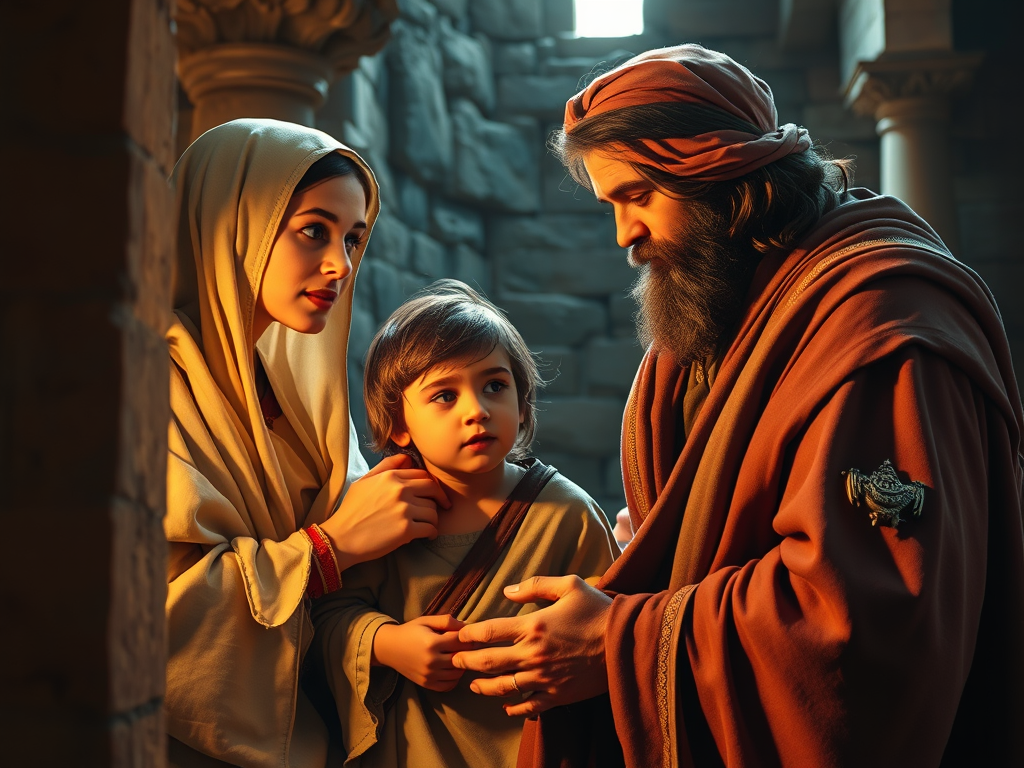
Like many of us, the family in this week’s gospel passage has been traveling as a part of its observance and celebration of a religious festival. Like many of us, this nuclear family has been sharing in traditions and customs with family and friends. The passage describes this nuclear family as having “completed [the] days” of the festival (Luke 2:46).

Perhaps this wording is simply a reflection of the culture in which the passage was written. Perhaps such observances represented obligations that needed to be fulfilled, tasks that needed to be completed. And yet, it was undoubtedly not just God that these rituals served. They also served the family members, providing welcome variance in their day-to-day routines and helping them to think not only in terms of days but in terms of centuries, maybe even millennia. They strengthened the connections between generations. And not just because people of different ages might share in these customs, not just because of what might be enjoyable about the customs either.

Holiday travel can be a pain these days, but I feel like any conception that I might come up with for how difficult it must’ve been in Jesus’ childhood would be woefully inadequate. Yet, this week’s gospel passage tells me, Jesus’ family and friends have traveled to Jerusalem and continued Passover traditions in what must have been a crowded city.

Then the time comes to head home, and, lo and behold, Joseph and Mary can’t find their boy. For a while, they assume he’s with their friends and extended family. It’s no wonder. They’ve been traveling with a large group.

And part of me imagines they just weren’t ready to grapple with the reality that their boy wasn’t with that group. This possibility would be beyond difficult for any parents to face. Add to that what the possibility would mean for Mary and Joseph — that they have lost God’s son, the Messiah Israel that has been promised and has been waiting for for so long.

I imagine them wondering why God would let this happen. Would God let their failures get in the way of God’s promises to his people being kept. How could it be God’s will that any son disobey his parents, let alone this Son?

We’re told that it takes Mary and Joseph three days to find Jesus. Yes, groups of three have symbolic importance in Scripture. I’m not sure what the official interpretation of the symbolism of three in the Bible is, and to be quite frank, I’m probably not going to look it up before I publish this post. I’m writing these particular words for days before Christmas and probably won’t get them published much before the twenty-ninth. I want to spend most of the time in between being present with my family and friends.

At some point in school, I learned that the triangle is the strongest shape, so the number three makes me think of strength. Its association with the Trinity makes me think of strong bonds. Its association with the time between Jesus’ Last Supper and his resurrection makes me think of perseverance in the face of suffering. It makes me think of how waiting itself can be a form of suffering. Time passing more quickly than I would like can bring suffering with it too.

I imagine Mary and Joseph experiencing many forms of suffering when they have to accept, after having traveled a day’s distance, that Jesus isn’t with them or any of their traveling companions. Maybe they didn’t even feel like they ought to take time to eat or sleep while they searched for Jesus. Maybe they didn’t have appetites anyway and couldn’t relax enough to rest even if they thought God wanted them to. These possibilities mean more suffering.

In the midst of their suffering, Mary and Joseph find Jesus in the temple. He’s listening to the teachers there, “and asking them questions” (Luke 2:46). The phrase in quotation marks stands out to me. It reminds me of how important listening and asking questions is to forming and growing relationships, even my relationship with myself. It reminds me that these are no less important components of my relationship with God.

After I read that Jesus is “sitting in the midst of the teachers, listening to them and asking them questions,” I read that “all who heard him were astonished at his understanding and his answers” (Luke 2:46-47). It seems like the listening and understanding are going in multiple directions. There’s a message about what it means to grow and to grow in all kinds of relationships in that detail as well. The same detail also says that God listens to and understands me. And by me, I mean you, too.

Maybe, at the age Jesus was when he found his way to the temple, didn’t understand human nature quite as well as he would come to as he “advanced in wisdom and age and favor before God and man” (Luke 2:52). After all, in the passage, he doesn’t seem to understand his parents’ anxiety and confusion. He seems to think they should have known why he left the group and where he went. Nevertheless, despite his young age, he seems to have a clearer grasp of who He is and what that means then they do.

Maybe Mary and Joseph have become comfortable in their day-to-day and annual duties and with their own ideas of what the future will hold for them and for Jesus. Maybe they’ve consoled each other by saying that the suffering they were warned about when he was eight days old hasn’t come yet. And then he disappears, and when they find him, he reminds them who he is. He invites them, once again, to trust God in the face of uncertainty — just when they’ve begun to believe they understood the parts they’d been given in that plan.

How many times have we acted and felt like Mary and Joseph, even though we haven’t been tasked with bringing up God’s son, and some of us haven’t been given children to bring up all? On the other hand, what about times we’ve wandered from the path of others thought we would follow on our quest to become the person God calls us to be and to do what God calls us to do? Do we have the courage to listen to the questions of others, as well as to their answers. Do we have the courage to learn from each other? Do we have the courage to ask the questions and listen to the answers? Do we have the courage to trust that God listens to us even when it’s hard for us to see the evidence of that listening. Lord, give us the courage. Holy family, pray for us. Amen.

Work cited:

The New American Bible Revised Edition, Kindle edition, Fairbrother, 2011.

Read Full Post »

Photo by Grant Whitty on Unsplash

Readings for December 22nd:

  1. Micah 5:1–4a
  2. Psalm 80:2–3, 15–16, 18–19
  3. Hebrews 10:5–10
  4. Luke 1:39–45

What stands out to me from this week’s readings:

What stands out to me from this week’s readings is a theme of gathering together.

The first reading describes the Messiah coming from

Bethlehem-Ephrathah,
too small to be among the clans of Judah . . . .

and yet the passage says of "one who is to be ruler in Israel":

". . . the rest of his kindred shall return
    to the children of Israel.
He shall stand firm and shepherd his flock . . . 

and they shall remain, for now his greatness
    shall reach to the ends of the earth;
    he shall be peace. (Micah 5:1-4)

The passage strikes me as a movement from the individual to the society, from the seemingly insignificant to the infinite. We read about the Messiah first and the flock second, but the movement of the passage is really in the other direction. The passage predicts the Messiah drawing all people to himself.

While the Old Testament reading strikes me as being about how the people will move toward God, the psalm strikes me as asking God to move toward the people. It asks God to protect and to save the people.

The epistle says that Christ is the fulfillment of what the Old Testament reading and the psalm foretell and ask for.

In the gospel passage, we read about Mary and Elizabeth being gathered together. God draws Mary to visit Elizabeth, and Elizabeth is drawn to the sound of Mary’s voice, as is John. Why? Because Mary brings Christ to Elizabeth and John.

What someone else is sharing about this week’s readings:

Sarah Simmons, CSJ, is inspired by the readings for December 22 to reflect on the role of bodies in bringing Christ to the world — Elizabeth’s body, Mary’s body, my body, and your body.

What I’m saying (to the readings and beyond) this week:

For we are a people of the incarnation, we believe that Christ is within all of us, including you.  How do you long to express it?

Sarah Simmons, CSJ

This question is delightfully attention grabbing for me. I would have expected a similar question to ask what I should do, what the Holy Spirit is prompting me to do? But how do I long to express Christ within me? That feels like a different question with a different answer. Longing to express something is a different experience than being expected to express something. Both experiences feel familiar. And how authentic is the expression of something that I’m saying because I’m expected to. Am I expressing what I am only because I think I’m expected to? What is my answer to the question that was actually the end of the reflection?

I long to express the incarnation of Christ within me by helping to create spaces where people feel safe. In these spaces, they can be honest with themselves and each other. This honesty happens because they recognize the many ways their experiences and desires overlap.

I believe the way a space is arranged and decorated can allow experiences of safety and connection. This belief is why many forms of design and decorating interest me. I also believe that how stories —both fictional and nonfictional ones — are told is crucial. They are key vehicles for creating spaces that allow room for growth and connection.

I’m always longing to share my own story more fully and more effectively, and to help others share theirs. It’s my experience that the storytelling journey is never a linear one, and it requires cooperation and vulnerability. It requires wrestling with what to hold on to and what to let go of. It invites a person to ponder when to take advice and when to follow God’s voice within. It involves gathering people together. It also celebrates the uniqueness of every person. Participating in stories is an intimate activity. It takes members of crowds who may start as strangers and builds relationships between them.

This week’s prayer:

Lord, work through us so that we draw each other to You. Help us recognize Your presence within us and in each other. May we recognize the people around us bringing You to us. Thank You, Lord, for our fellow Christ-carriers. Gather us together. Lead us on the path to peace both within and around us. Amen

Work cited (but Not Linked to):

Confraternity of Christian Doctrine, Inc. “4th Sunday of Advent — Sunday 22 December 2024: Readings at Mass.” The New American Bible, 2001. Universalis for Windows, Version 2.198, Universalis Publishing Ltd., 13 Dec. 2024, https://universalis.com/n-app-windows.htm.

Read Full Post »

Photo by KaLisa Veer on Unsplash

Readings for December 8th:

  1. Zephaniah 3:14–18a
  2. Isaiah 12:2–3, 4, 5–6
  3. Philippians 4:4–7
  4. Luke 3:10–18

What stands out to me from this week’s readings:

I generally think of the readings for this season being about God’s people rejoicing because God is with them, drawing them close. I especially think this about the readings for the third week of Advent. Or I did until I actually read the passages.

This week’s first reading says that God rejoices in God’s people. The psalm reflects what I expect to read in this week’s readings. Together, the readings describe the relationship between God and God’s people.

The epistle describes how prayer strengthens that relationship. It’s a relationship that needs trust, openness, and gratitude to thrive. It’s a relationship that when nurtured, calms anxieties and prompts rejoicing. It’s a relationship that spreads its qualities to other relationships. The gospel passage supports this message about the effects of a relationship with God on relationships with others. It also reminds me that my relationships with others, and indeed, with all of creation, affect the strength of my connection with God.

The strength of God’s love never changes. In other words, God never stops rejoicing over us because we are not our sins and shortcomings. We’re God’s children, expressions of God’s love. Imagine the connection between a person and God like the connection between two phones. God is represented by one of the phones, and God never cuts off communication. Rather, it’s the phones of our minds, hearts and souls that often don’t receive the strongest signals.

What I’m saying (to the readings and beyond) this week:

The truth of everything I typed above is just sitting on the surface of my consciousness. Lord, let Your love permeate my being.

What someone else is sharing about this week’s readings:

What great wisdom in the Church’s tradition, to put a day for joy in this season of stillness, to remind us that joy comes when we slow down, when we accept silence and waiting and inactivity, and when we remember that everything good is a gift from God. Yes, indeed, Advent is a time for joy.

Kate Ward

Check out the full reflection on the readings for December 15th that includes this quote.

This week’s prayer:

Lord, help me experience and share Your joy. Amen.

Read Full Post »

Readings for December 1st:

  1. Jeremiah 33:14–16
  2. Psalm 25:4–5, 8–9, 10, 14
  3. 1 Thessalonians 3:12—4:2
  4. Luke 21:25–28, 34–36

Readings for December 8th

  1. Baruch 5:1–9
  2. Psalm 126:1–2, 2–3, 4–5, 6
  3. Philippians 1:4–6, 8–11
  4. Luke 3:1–6

What this week’s readings say to me:

The first reading for December 1st foretells the arrival of the long-promised Messiah. The passage from Jeremiah promises that the Messiah will “do what is right and just” (Jer. 33:15). People who trust Him and follow Him will be able to live in safety and security.

The psalm for December 1st recognizes that God has the qualities described in the first reading. It also describes how those who trust God and follow God reflect those same qualities.

The epistle urges readers and listeners to treat each other with charity, as they have been taught to do. It calls us to be more and more vigilant in looking for opportunities to act with charity.

In the gospel passage, Jesus foretells that there will come a time when the world as we know it will be “shaken” (Luke 21:26). He says the events of this time will cause people to “die of fright” (Luke 21:26). But, he says, this doesn’t need to be the fate of His disciples. He teaches them that when they find themselves in the midst of disturbing events, He is near. “[R]edemption is at hand” (Luke 21:28). He says His spiritual family members will be prepared to receive this redemption if they keep returning to His teachings. They must also return to His example whenever life’s distractions, whether pleasant or worrisome, tempt them to lose sight of His Way. He reminds them that prayer is the source of focus and strength in the face of temptations and trials.


For me, the Old Testament reading for December 8th paints a beautiful word picture of the effect God’s salvation and the arrival of the Messiah will have on God’s people. Like the previous week’s Old Testament passage, the one chosen for December 8th is written in future tense.

The psalm selection for December 8th, in contrast, is written in past tense. The first two stanzas would fittingly describe the people’s reaction to the events foretold in the Old Testament reading. There is “laughter” and “rejoicing” (Psalm 126:2). People who trust in God will be lifted up, and everything will be made right. The visibility of the people’s joy gives glory to God, even among those who do not know the God of Israel, as well as the peoples who have been comforted, cared for, and freed by God. The third and fourth stanzas ask for God’s continued care. The narrator trusts that even in difficult circumstances, when he can’t see the fruits of his faith, it will, nonetheless, bear fruit.

In the epistle for December 8th, St. Paul writes to the Philippians about the content of his prayer. He writes about expressing joy in his prayer. His joy comes from the work the Philippians do with him for the sake of the gospel. He describes the affection he has for the recipients of this letter. He conveys that he experiences them not only as coworkers, but as as friends and family members brought together by Christ’s love. He assures them that God, who began the work of salvation in them will continue it and complete it. He prays that they continue to grow in “knowledge… perception” and “discern[ment]… the fruit of righteousness that comes through Jesus Christ for the glory and praise of God” (Phil. 1:9-11).

The Gospel passage for December 8 echoes the message of the Old Testament passage for the day and prepares to point to Jesus Christ as the fulfillment of the promises of both passages.

Combined, the message of the readings for these two weeks is that justice and security are coming. Don’t give up on this promise. Insist on believing that it’s possible with God. Keep looking for it — no matter how long it takes for you to see its fulfillment. While you cling to this promise, make room for each other. Make room for joy.

What I’m saying (to the readings and beyond) this week:

I feel called to more stillness and fewer words this Advent. I desire more focus, more intimacy with God — maybe more spontaneity with God.

So starting next week, I plan to focus on one passage. I may even concentrate on one word or phrase within the passage. The passage may even be one that’s not part of the Sunday readings. Maybe adjustments such as these will give me more time to sit with the divinely inspired words and to reflect on what they mean for me at the moment. Maybe this approach will allow me to do more listening to what God has to say to me. When I share what I hear, maybe you’ll be able to relate.

What someone else is sharing about this week’s readings:

December 1st

Valerie D. Lewis-Mosley, RN, OPA reflects on the theological theme for the first Sunday of Advent: hope.

December 8th

Colleen McCahill reflects on how, in the epistle for December 8th, St. Paul finds light in darkness. She also reflects on how Advent encourages us to seek light in times of darkness. It is a season that helps us do so.

This week’s prayer:

Lord, help me to seek and to find light amid the darkness that I experience around me and within me. Help me not to fear the brightness of the light but instead to let its fire shape me. Help me to follow the path it illuminates — the path of hope. Amen.

Works cited:

Confraternity of Christian Doctrine, Inc. “1st Sunday of Advent — Sunday 1 December 2024: Readings at Mass.” The New American Bible, 2001. Universalis for Windows, Version 2.196, Universalis Publishing Ltd., 6 Nov. 2024, https://universalis.com/n-app-windows.htm.

—. “2nd Sunday of Advent — Sunday 8 December 2024: Readings at Mass.” The New American Bible, 2001. Universalis for Windows, Version 2.196, Universalis Publishing Ltd., 6 Nov. 2024, https://universalis.com/n-app-windows.htm.

Read Full Post »

Image Generated by WordPress AI

Readings for November 24th:

  1. Daniel 7:13–14
  2. Psalm 93:1, 1–2, 5
  3. Revelation 1:5–8
  4. John 18:33b–37

What this week’s readings say to me:

In last year’s post for the Solemnity of Christ the King, I wrote about the name of the solemnity. The name highlights how difficult it is for humans to describe who God is. Despite this difficulty, we try to use language to describe who God is. By its nature as a human creation, language is limited and imperfect. And yet we have no other means but language to describe Someone who is both omnipotent and personal both the ultimate leader and the ultimate servant at the same time. So we give God a name that we would give to a powerful human leader — king.

Phrases and individual words stand out to me as I read the readings for the solemnity this year. And yes, I’ve heard many of these words used to describe a king. Why? What does the dictionary say these words mean? What do their definitions tell us about us and about God?

The words that stand out to me from the Old Testament passage are “like a Son of man,” “Ancient One,” and “dominion” (Dan. 7:13-14). The passage prefigures Christ, and the translation “Son of Man” highlights what Christ shares with us — Human nature. “Ancient One” points to what separates Christ from other men — His divinity. The combination of the two natures within Him gives Him dominion over everything. Miriam–Webster.com defines “dominion” as “supreme authority.” What do the other passages say about how He exercises this authority? What does it look like?

The word that first stood out from the psalm is “majesty” (Psalm 93:1 Merriam-Webster.com defines majesty as “impressive stateliness dignity, or beauty.” Merriam-Webster.com defines stateliness as “ marked by lofty or imposing dignity.” It defines dignity as “formal reserve or seriousness of manner, appearance, or language.” (And yet, books have been written about Jesus’ sense of humor as it is portrayed in the Gospels. Between Heaven and Mirth is one book that discusses the topic. It’s written by James Martin, SJ.)

Merriam-Webster.com defines dignity as also “the quality or state of being worthy, honored, or esteemed.” Additionally, the entry says dignity can mean “high rank, office, or position” or “a legal title of nobility or honor.” So majesty does carry associations with royalty, but it also carries associations with dignity and beauty. These are qualities each of us reflects in unique ways. Furthermore, in baptism, a person is anointed “[p]riest, [p]rophet, and [k]ing.” We use these titles to describe missions and ministries we share with Christ.

“Firm” and its synonyms also stand out to me from the psalm (93:2). God isn’t merciless and unyielding but does offer stability and is trustworthy.

The word that jumps out at me from the epistle is “firstborn”(Rev.1:5). It reminds me that God who is trustworthy and offers stability also offers constant renewal. God became one of us, suffered, and died to offer this stability and constant renewal. In His birth, His growth, His ministry, and His death, He showed us what we can become through Him. He offers us the gift of being reborn as priests, prophets, and kings.

The passage from Revelation recognizes Christ’s power and that that power has been shared with other human beings. It gives the power back to Christ willingly. The passage isn’t worded as if Christ has seized that power. Christ is Lord but doesn’t Lord over people.

Instead, He tells the truth and lives it. Nothing more, nothing less. He simply is who He has been, is and will be. It’s we who name things with our limited means. It is we who call Him king. The Gospel passage reinforces this message.

What someone else is sharing about this week’s readings:


When Jesus says, “everyone who belongs to the truth listens to my voice,” I think he’s asking for more than simple obedience and piety. He’s inviting us to create spaces of true belonging by connecting through shared stories and experiences. I believe he’s calling us, not just to spread his message through words, but to embody and live out his teachings in our actions and relationships. To belong to the truth is to form genuine connections, where love, empathy, and understanding bring the Gospel message to life in a way that reaches others deeply and meaningfully.

Olivia Catherine Hastie in her reflection on the readings for November 24th

What I’m saying (to the readings and beyond) this week:

Ms. Hastie says the above perspective “is best exemplified through the story of [her] adoption.” I encourage you to read more about that story here.

She concludes her reflection with these questions: What are your shared truths of belonging? And whom do you share them with?

Using Ms. Hastie’s examples as a guide, I’d say my “shared truths of belonging” are:

  • We all have lots of experiences with feeling like we don’t belong, with feeling rejected. Maybe many of us spend more time feeling like we don’t belong than that we do. Jesus did too.
  • We are all vulnerable, and this can be a difficult reality to come to terms with.
  • Each of us has different gifts and limitations. It’s helpful to recognize both.
  • Everything and everyone is interconnected, interdependent.
  • God loves everyone. Nothing anyone can do increases or decreases God’s love.

Whom do I share these truths with? You.

I considered not including this section in this post. Ms. Hastie’s concept of “shared truths of belonging” was difficult for me to reflect on. When I thought about this, I realized I spend much more time focusing on the ways I don’t belong. I spend less time considering the ways I do belong. I often feel like even my family is a collection of people with incompatible personalities and approaches to life. This perception bothers me. I have trouble letting my family members belong as they are. I pray to grow in the ability to be more accepting, and I would always appreciate your prayers.

I don’t think I’ll be posting on the readings for December 1. Or at least those readings won’t get their own post. I think I’ll make a combined post about the readings for December 1 and December 8. I’ll plan to post it before December 8.

We’ll see if the plan comes to fruition. It’s a busy time of year.

Between now and whenever I publish the next post, I want to focus on recognizing the “shared truths of belonging” in my life. I want to be present for others and for God.

I wish you and yours a happy Thanksgiving. This time of year can be one of joyful re-connection. I also recognize that it’s a very difficult time for so many people. My prayers are with you.

This week’s prayer:

Lord, Thank You for living, dying, and rising for us. Help us all to experience Your “shared truths of belonging.” Help us experience Your comfort and Your presence in times of loneliness and grief. Help us to work with Your graces to strengthen the bonds of the human family. Help us to see each other with Your eyes. Help us to build communities and societies that find their foundation in truth lived in love. Amen.

Work cited (but not linked to)

Confraternity of Christian Doctrine, Inc. “Christ the King — Solemnity — 24 Nov. 2024: Readings at Mass.” The New American Bible, 2001. Universalis for Windows, Version 2.195, Universalis Publishing Ltd., 29 Oct. 2024, https://universalis.com/n-app-windows.htm.

Read Full Post »

Image Generated by WordPress AI

Readings for November 17th:

  1. Daniel 12:1–3
  2. Psalm 16:5, 8, 9–10, 11
  3. Hebrews 10:11–14, 18
  4. Mark 13:24–32

What The Readings for November 17th Say to Me:

This week’s readings are about the Last judgment and the end times, the time when the material world ends.

The first reading tells us that this future time will be one “unsurpassed in distress” (Daniel 12:1). The passage continues:

“Many of those who sleep in the dust of the earth shall awake;
some shall live forever,
others shall be an everlasting horror and disgrace.

“But the wise shall shine brightly
like the splendor of the firmament,
and those who lead the many to justice
shall be like the stars forever.”

Daniel 12:2-3

The psalm promises that God guides and protects all who turn to God in times of great distress.

The epistle reminds us that Jesus’s sacrifice on the cross is God’s ultimate act of salvation. It’s the ultimate act to defend the human race and the human spirit against whatever opposes divine love. Christ’s sacrifice was offered once, and yet we can receive the graces of that sacrifice again and again. The key is that we seek those graces.

In the Gospel passage, Jesus describes what the end times will be like. They will be characterized by the destruction of the material world and by His return. He suggests there will be signs that these events are upon us, but signs are not definite indicators. No one can say for sure when these times will come. Therefore, we aren’t called to make looking for signs of the world’s end the purpose of our lives. We’re called to live according to Christ’s words and example.

What I’m Saying (to the Readings and Beyond) This Week:

In addition to prophesying about the end times, do this week’s readings invite me to see times of “distress” as times of purification? (Daniel 12:1) These are times to get a clearer vision of what’s fleeting and what lasts. These are times to reconnect with God, with each other and our purpose and through these connections, to grow stronger.

What Someone Else Is Sharing About This Week’s Readings:

When we feel the most despair, the most fear, the most anxiety, that is when God is the closest to us. That is when we are the least alone. That is when the Promised One is right at our door.

Martha Ligas in her reflection on the readings for November 17th

This Week’s Prayer:

Lord, help me to respond with greater charity. Grant me faith and hope whenever and wherever shadows get longer, and lights get harder to see. Amen.

Work Cited:

The New American Bible Revised Edition, Kindle edition, Fairbrother, 2011. T

Read Full Post »

Image Generated by WordPress AI

Readings for November 10th:

  1. 1 Kings 17:10–16
  2. Psalm 146:7, 8–9, 9–10
  3. Hebrews 9:24–28
  4. Mark 12:38–44

What this week’s readings say to me:

This week’s readings call us to:

  • Have hope, and be unafraid.
  • Share what you have.
  • Trust that when you give to God or give to others in God’s name, God will give back far more. You will receive more than what you gave.
  • Do your part, and when you do, give your best.
  • Be welcoming.
  • Be introspective.
  • Broaden your vision, and look beneath the surface of what’s around you.
  • Follow those who follow strive to live the practices described above.
  • Remember that only Christ — God incarnate — can live them perfectly.
  • Remember that Christ can help us do the same on the other side of death.

What I’m saying (to the readings and beyond) this week:

When I think of the messages from this week’s readings and the ways I just presented them, they seem wise. These messages read as reasonable lessons to live by.

But this week’s readings include uncomfortable, even disturbing details. I find myself wrestling with God about these details and the message their inclusion sends.

In the first reading, I notice Elijah asks a woman for the last bit of food she has. She doesn’t seem to be able to get the raw materials to make more meals once these materials are gone. She figures that she and her son will die once they’ve eaten all they have left.

Now I understand that the lesson is that they can give all they have left to Elijah. God will see their generosity and faith and will respond to it by providing for them. The same goes for the woman in the gospel passage who puts all the money she has into the treasury.

Maybe another teaching of these readings is that God is generous, even when people are less so. God is generous even when people forget God.

Maybe a third teaching is not to give for appearances’ sake only. Serve causes that are just by doing more than what is comfortable or convenient.

But I hesitate to suggest that God wants people to leave themselves none of the necessities for life. I do more than hesitate when I read the first reading and the gospel passage. If I’m honest, the examples these two readings set make me angry. These readings present a God who asks everything of God’s people.

And I suppose God does, giving everything back that the people can imagine and more. Christ did die for us. He died so that I, you, and whoever the ubiquitous “they” are could live forever with Him.

I don’t feel the need to pretend. Giving everything to God and in God’s name is a big ask. I can imagine the widows in both the Old Testament passage and Gospel passages experiencing anger before they gave. If not anger, they might have felt anxiety and doubt. They might have questioned whether they were acting with wisdom. As I imagine them wrestling with these emotions and then acting in spite of them, I’m reminded of a famous quote:

“Courage is not the absence of fear, but rather the assessment that something else is more important than fear.”

President Franklin D. Roosevelt

I think a modified version is true as well. Faith is not the absence of doubt or fear but acting in spite of the doubt and fear.

I think it’s valuable not to rush past the parts of these passages that trigger uncomfortable feelings. I believe it’s important to reflect on the “giv[ing] until it hurts.” It can be helpful not to skip to the parts in the passages that describe God giving in return. This can be helpful because we can’t fast-forward past the challenges in our own lives. But we can acknowledge them for what they are. And we can trust that God is with us as we navigate them.

Outside of these passages, we don’t know what the giving back is going to look like. Who will give us what we need? We don’t know what we’re going to go through before we receive or when the receiving is going to come.

I take comfort that most faith communities wouldn’t expect members to give until they had literally nothing left. Some ask this only when the members must choose between loyalty to a faith community and loyalty to another community. I’m not going to pretend like I’m comfortable with faith communities asking their members to make this choice. I’m also not going to pretend I’m comfortable with God asking people to make this choice.

I believe in a God who is personal and is the source of everything, including who each of us is. How can I betray the source of who I am, who each of us is?

Here’s a glimpse behind the curtain of this blog in case I haven’t made something clear before. I write most posts over the course of a week. After writing the previous paragraph, I went on about my day. Then, I remembered a verse. It says Jesus came so we could “have life and have it more abundantly” (John 10:10). After he remembered this verse, I remembered how the passage from Hebrews 4 November 10th ends. It says:

Just as it is appointed that human beings die once, and after this the judgment, so also Christ, offered once to take away the sins of many, will appear a second time, not to take away sin but to bring salvation to those who eagerly await him.

Hebrews 9:28

Calling to mind these verses remind me that God doesn’t want suffering. God desires to save. It’s injustice that creates suffering, and sometimes standing against injustice means a person acting with justice suffers. Jen Frazer, OSB reflects on this perspective.

What someone else is sharing about this week’s readings:

In the end what meaning should we take away from these readings? It is the very generosity of our two widows (in the first reading and in the Gospel) that highlights their social oppression. Even if the sacrifice is unjust, God who knows our hearts honors that sacrifice as the act of love that it is. God is on the side of the oppressed because they are in need of God’s protection.

Jen Frazer, OSB, in her reflection on the Mass readings for November 10th

This week’s prayer:

May I give for no other reasons than for love of God and neighbor. Help me to trust in Your presence wherever there is also injustice. Help me to experience that all things work “for good of those who love God” (Rom. 8:28). Amen.

Work cited (but Not Linked to)

The New American Bible Revised Edition, Kindle edition, Fairbrother, 2011.

Read Full Post »

Image Generated by WordPress AI

Readings for November 3rd:

  1. Deuteronomy 6:2–6
  2. Psalm 18:2–3, 3–4, 47, 51
  3. Hebrews 7:23–28
  4. Mark 12:28b–34

What this week’s readings say to me:

The first reading reminds me:

  • to approach the world around me with humility. Remember that I don’t yet have the fullness of God’s vision or understanding.
  • that God’s vision wants only the prosperity and growth of God’s family. God’s instructions serve only these purposes. With this understanding, we receive the words of Moses to the people of Israel:
  • “[Y]ou shall love the LORD, your God, with all your heart, and with all your soul, and with all your strength. (Deut. 6:5-6).

The psalm features the perspective of someone permeated by the above instruction from Moses. The permeation spills into the person’s recollections and words. I imagine voicing the recollections helps them keep their power for the narrator.

The epistle for October 26th focused on Jesus’ humanity in his role as the perfect high priest. The epistle for November 3rd focuses on his divinity in his role as the perfect high priest. He can live Moses’ his teaching more fully than any other human being because of his divine nature. This nature also allows Him to continue living Moses’ teaching. He has conquered death because he is fully human and fully divine. A priest who isn’t fully human and fully divine can’t conquer death on his own.

Often, Gospel passages provide insight into Old Testament passages. However, the November 3rd Gospel passage simply reminds hearers and readers of the central message of the Old Testament passage. It urges hearers and readers to put that message into practice.

What I’m saying (to the readings and beyond) this week:

The commandment from Deuteronomy is beyond hard to live out. If I said “I lov[ed] God with all [my] heart, all [my] soul, and with all [my] strength [emphasis mine],” I’d be lying to myself, to you, and to the Lord (Deut. 6:5-6) .

First, the verse prompts me to think about what it means to love. I’ve often heard in churches that love is an action, not just a feeling. But I experience love as a feeling. It’s a feeling that’s a response to an action or years of actions, but a feeling, nonetheless. And it’s beyond hard to have that feeling for Someone I can’t see. Sure, I can use my mind to accept what I’ve been told about the Lord. I can also accept what I’ve been told the Lord does and has done for me. My heart, however, seems to have a difficult time letting the reality of it all sink in. I have a hard time experiencing it, and I’m a person who wants to experience intense feelings. I long for concrete experiences of God’s presence.

As for a soul, how does it love? By obeying and imitating God? As I consider this as a possible answer, I think of the verse that talks about the disciples being friends of Jesus rather than his slaves (John 15:16). They’re his friends because they know what he’s doing. He’s shared everything with them. They know Him intimately. They collaborate with Him because they want what He does, not because they’re afraid of Him.

When I think of loving with all my strength, I imagine hanging onto the edge of a cliff. I hang there until I have no energy left to hold on. I suppose God is the cliff. However, I can’t lose my grip on God unless I shove myself away from the ledge.

It seems impossible to love God with every last drop of energy, endurance, and maybe even blood. Yet Jesus did it. And I remember reading that “nothing is impossible with God” (Luke 1:37). I try to think of times in my life when what seemed impossible became possible. Nothing comes to mind right now. I can think of times when I did what was difficult, but difficult is different than impossible.

I wonder when faith softens impossible into difficult and when the impossible becoming possible is nothing less than a miracle. But then I suppose faith is a type of miracle too. Maybe it often goes unappreciated for the miracle it is.

What someone else is sharing about this week’s readings:

Eilis McCulloh, HM reflects on how we can begin loving “the Lord your God with your whole being.”

This week’s prayer:

Lord, may we experience the grace of Your presence in our lives every day. May we recognize that You are the source of all that lives and all that provides. Help us to share everything with You and to receive everything you share with us. Help us to remember that love in all its forms begins with listening. It continues with discerning and is made authentic by responding to careful discernment with action. Amen.

Work cited:

The New American Bible Revised Edition, Kindle edition, Fairbrother, 2011.

Read Full Post »

Image Generated by WordPress AI

Readings for October 27th:

  1. Jeremiah 31:7–9
  2. Psalm 126:1–2, 2–3, 4–5, 6
  3. Hebrews 5:1–6
  4. Mark 10:46–52

What this week’s readings say to me:

This week’s readings are a reminder that we need a Savior and that we have one. In the first passage, the Lord unites the scattered tribes of Israel and leads them out of captivity and mourning. The psalm praises God for this liberation, this cause for joy. It expresses faith that God’s providence and never ceases. Working for the Lord, though often difficult, will bear good fruit. The epistle identifies Christ as the Savior whose liberating power, mercy, and providence are never-ending. The Gospel passage is a reminder. God wants us to be equally unrelenting. We should continuously ask for Divine liberation, mercy, and providence.

God wants us to participate in these gifts because participation, not passivity, allows for spiritual growth and relationships. So do the following:

  • recognizing that God is in our midst. This presence is reflected in so many ways and is recognizable to each of us in unique ways
  • recognizing the desire within us for God
  • continuing to call out to God despite fear, doubt, and other resistance from within and resistance from without.
  • trusting that God responds when we persevere in faith

What I’m saying (to the readings and beyond) this week:

I wish I were as persistent as the blind man in the Gospel passage. I also wish God’s responses to my prayers were as direct and as Jesus’ response is in the Gospel passage. I also wish God’s responses addressed my desires as clearly as Jesus does the blind man’s desire in the Gospel passage. Maybe part of the problem is my ability (or lack thereof) to perceive the response. Likely another factor is my inability to understand how my desires and God’s responses to them fit into God’s vision.

What someone else is sharing about this week’s readings:

In a reflection on this week’s gospel passage, Courtney Esteves explores the implications of the question, “What do you want?” She invites us to think about what it tells us about Jesus. It also reveals something about ourselves. Additionally, it informs us about others whom we ask the question. She encourages us to be open to various responses to that question. These responses offer insight we see them as significant or insignificant.

This week’s prayer:

Lord, help me to be persistent in turning to You to satisfy my desires. Help me to perceive Your responses and to recognize in them Your wisdom and love. Amen.

Read Full Post »

Photo Generated by WordPress AI

This week’s readings:

  1. Isaiah 53:10–11
  2. Psalm 33:4–5, 18–19, 20, 22
  3. Hebrews 4:14–16
  4. Mark 10:35–45

What this week’s readings say to me:

The theme I’m getting from this week’s readings is that God understands us. However, we don’t understand God, at least not fully.

The first reading is a reminder to me that Christ experienced the frailty that is inherent to the human condition. In the crucifixion, He also endured suffering that comparatively few have experienced. But His suffering isn’t in vain. His entry into death defeats death by because He’s life in the flesh. Because of this, he conquers his death and ours. This defeat of our deaths occurs when we surrender to Christ whatever comes between us and life.

The passage reminds me that Christ offered his life to God and to us as a healing balm for the effects of sin. I can do the same. I can offer my life and what I value for the same purpose.

The psalm reminds me that God is “trustworthy” (Psalm 33:4). The gifts that come from God’s goodness are everywhere. It also promises that the more I’m open to God’s presence and guidance, the more I’ll experience it. As I experience it more, I’ll become more open to it. This openness will continue regardless of the circumstances I find myself in. It reminds me to seek faith and to ask God for help in recognizing God’s care.

The epistle reminds me that God understands my weaknesses and is waiting for me to turn to Him so that I don’t mistake those weaknesses for sources of freedom. He recognizes that I need his help not to confuse those weaknesses for him, in other words.

The Gospel passage reminds me that while I want to experience Christ’s presence, I tend not prepared to do what it takes to experience that presence. I’m prone to confusing being in God’s presence with bowing to the imposter god of human pride.

The gospel passage shows the sons of Zebedee having the same tendency. This tendency means they don’t understand what their wants and needs will ask of them and of God. They understand that abiding in God with Christ will satisfy those wants and needs. But they don’t understand that abiding in God with Christ requires surrender more than attainment. And surrender is often uncomfortable to the human ego. Surrender often feels impossible.

What someone else is sharing about this week’s readings:

Rebecca Malone discusses two different understandings of glory. She explores how these understandings provide insight into this week’s readings.

This week’s prayer:

Lord, thank You for meeting me where I am. Help me meet You where You are. Amen.

Work cited

The New American Bible Revised Edition, Kindle edition, Fairbrother, 2011.
Read Full Post »

« Newer Posts - Older Posts »