Feeds:
Posts
Comments

Posts Tagged ‘Beattitudes’

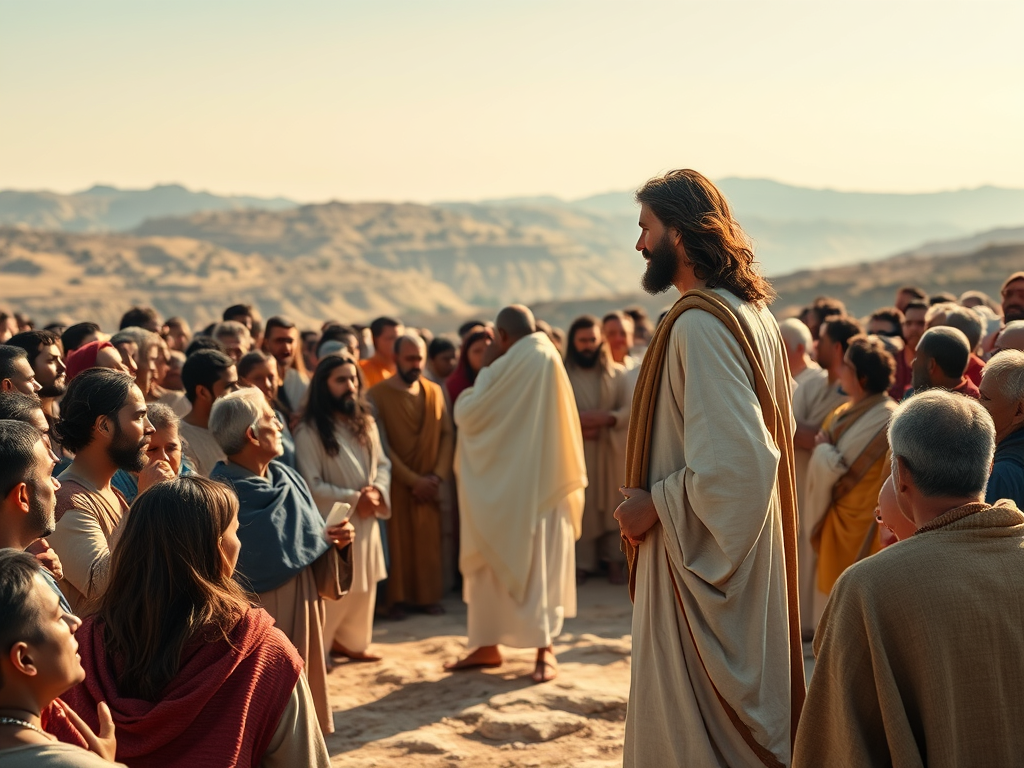
Image Generated by WordPress AI

Readings for February 16, 2025:

  1. Jeremiah 17:5-8
  2. Psalm 1:1-2, 3, 4 & 6
  3. 1 Corinthians 15:12, 16-20
  4. Luke 6:17, 20-26

What stands out to me from this week’s readings:

Contrasts stand out. I see contrasts between fertility and barrenness, between emptiness and fullness, and between sorrow and joy. The readings tell me that making room for God makes room for life and growth. In contrast, putting all one’s trust in the ways of human beings, especially in individual humans, is misleading. It prevents a person from being part of a circle that expands easily   so he she can grow and embrace life. It leads to dissatisfaction instead of openness and depth because no human is all-knowing or all-powerful.

What Someone Else Is Sharing about This Week’s Readings:

The readings for February 16 inspired Julia Murphy to reflect on the effect privilege can have on a person’s relationship with God. She reflects on this topic through the memory of a service immersion trip experience. She also points out that, regardless of how a person is or isn’t privileged, the Beatitudes aren’t telling the people who receive them to be passive. She reminds us that God calls us to wake up so we can tell the difference between wants and needs. Once we’ve discerned what’s needed, God calls us to cooperate with each other and with the prompting of the Holy Spirit to address our needs and the needs of others.

What I’m Saying:

Before I read Julia Murphy’s words, I didn’t know what to write in this section other than to repeat the themes of the text in different ways. The passages seem pretty self-explanatory, and especially in the case of the Beatitudes in the gospel passage, so familiar. What could I say about the Beatitudes that’s more than a list of “shoulds?” How does my gut react to the Beatitudes?

When I went back to this week’s gospel passage seeking answers to these questions, the passage reminded me of something that stood out when I first revisited it. The reading makes a point of telling us that when Jesus preached about the Beatitudes, he didn’t stand on a mountain or in a boat. He’s not depicted as looking down on the great crowd of his disciples. He’s not separated from them by the framework of a boat. Rather, we are told “he stood on a stretch of level ground” (Luke 6:17). I get the idea He was scanning the crowd as he spoke, meeting the eyes of this individual, then that one. I imagine Him seeming to each person as if he spoke only to him or her.

To anyone who sees him or herself in the blessed group, he offers encouragement. To anyone who recognizes him or herself in the opposite group, His warnings might imply questions:

If you’re rich, how did you get that way? Who helped you get there? Have they reaped the benefits as well? How can you show your appreciation? How can you share your more-than-enough with those who don’t have enough?

  • If you’re filled, what are you filled with? Does it take care of and treat kindly the body and mind God has given you? Where do you make room for God? For recognizing the injustice in your midst?
  • If you’re laughing now, what are you laughing at? Are you laughing at someone else’s expense? Someone else’s misfortune? Or can you laugh at your own frailty, imperfections, weaknesses? Can you left so that you don’t take them so seriously that you think God can’t work with you through them and despite them.

Many of us who can read these words might be rich by the standards of the much of the world. And yet lack of privilege can take different forms in different people’s lives at different times. Why? Because different factors contribute to each person’s sense of agency and independence. The truth is, a sense of independence isn’t permanent for anyone. We’re born needing others, and we die needing others. So many events in between lead us to ask God and one another for help. And that’s okay. That’s honest.

This Week’s Prayer:

Lord, grant us the grace to make room for You in our lives so we can see and hear as You do. Amen.

Scripture Translation Used:

Sixth Sunday in Ordinary Time — Lectionary: 78.” Daily Readings, Lectionary for Mass for Use in the Dioceses of the United States, Confraternity of Christian Doctrine, 2nd typical ed, United States Conference of Catholic Bishops, 2025, https://bible.usccb.org/bible/readings/021625.cfm.
Read Full Post »

Photo by Claudia Soraya on Unsplash
. . . but the way of the wicked he thwarts.
Psalm 146:9

Matthew 5:1–12a (The Beatitudes)

Psalm 146:6-10 presents a word tapestry about the loving care of God. But given the disappointment, resentment, and selfishness that weigh down my own heart despite my desire to let go of these burdens, I find it a challenge to see this tapestry as anything more than an eloquent wish. Much of what I see in the news doesn’t help make the tapestry come alive either.

However, this post isn’t dedicated to bashing news media or news watching. My undergraduate major was mass communications. I wrote and edited for the university newspaper and took courses in other forms of information dissemination, including broadcast journalism and public relations.

I think it’s important (without consuming news all day) to follow current events every day. I also think it’s useful to consult different well-established new sources on different days, not just the ones that confirm the views I already hold. For me, this is one example of what it means to be in the world but not of it. (See John 17:14-15). News may not show me the world I want to see, but that doesn’t mean I should avoid seeing it — much the opposite. I have to know what’s going on in the world to have any hope of bringing the Good News to that world or indeed, communicating at all in a way that resonates.

Violence is very prevalent around us, and news sources reflect this reality because their job is not to reflect back to us our day-to-day routines or anyone else’s. The way I see it, this function of journalism is why it’s called “the news” and not “the expected” or “the desired.” This function is why a common phrase in journalism education (at least when I was receiving it) was “if it bleeds, it leads.” So often it’s violence, whether on the part of nature or humanity, that interrupts the status quo. This disruption is not the fault of news sources. Do inspiring events occur as well as tragic ones? Absolutely! News sources report on these too. Pretty much every television news broadcast I’ve ever seen ends with a positive story. I think this is done with the idea of leaving viewers with something positive to take away.

I see some common ground and some differences between news broadcasts and the Beatitudes. The Beatitudes acknowledge the difficult and often unjust realities of life, while at the same time, each one begins and ends by offering hope, For example, Jesus says that “those who mourn” are “blessed” (Matt. 5:4). Does this mean that someone should desire mourning over joy? I don’t think so. Does this mean that someone mourning should feel blessed? No. I hear this Beatitude as a promise that regardless of what someone who is mourning feels, they are blessed because Christ is close to them in a special way, as he is to anyone in need or going through a difficult time. He struggled and mourned during his passion, and when we join our suffering to the suffering of the cross, our suffering takes on the redemptive power of the cross, even in the many times when we can’t see how.

I’m not saying that everything happens for a reason, or that God pushes us around like pieces on a chessboard. We have free will. We also have bodies that come with a lot of biology and chemistry — survival instincts that sometimes end up translating into domination over others, physically, emotionally, and psychologically. Everyone around us is also influenced by these factors, to varying degrees. The Spirit and its domain, spirituality are about not letting these factors overtake the Spirit in us. This is not to say that our bodies and minds are bad and our souls are good. To say that would be heresy. I look at the relationship between physical and spiritual matters this way: God designed them to work together, as they do in Jesus and his gift of his body, blood, soul and divinity in his ministry, on the cross, and hidden within the forms of bread and wine. I’m saying that, thanks to Jesus’s life, death, and resurrection and his example during these stages of his mission, no difficulty, suffering, or instance of a situation not working out the way we wanted has to destroy our hope. As I think I’ve written before, we can use our experiences to prevent others from suffering similarly, we can accompany others going through similar experiences, or in the most challenging of circumstances, when neither of these opportunities seem available to us, we can choose to trust that the offering of our circumstances to God is redemptive in those ways I mentioned earlier, the ones we can’t see — yet.

Like most people, I’d like to see nothing but righteousness, mercy, satisfaction, comfort, and peace around me and within me right now. But to experience that would be to experience heaven, and I’m not there. Because I’m not already there, I take comfort in the fact that the second half of each Beatitude, offers a future blessing, not a present one. If the Beatitudes were presented to me in nothing but present tense, I would struggle with faith even more than I do I would wonder why God hadn’t kept the promises of the Beatitudes. After all, I look around me and within me and see not only the qualities opposites of the positive ones included in the Beatitudes but also imperfect versions of those positive qualities. In our broken humanity we thirst for righteousness without allowing for meekness or mercy, and we seek comfort and satisfaction without first being poor in spirit, without having a clear enough vision of reality to mourn with those around us. I think each positive quality included in the Beatitudes needs all the others to reach its fulfillment.

I don’t believe such ultimate fulfillment comes in this life. Our mission is to thirst for it, to do what we can to embody the combined Beatitudes, all the while knowing we do and will fall short. I find pain and comfort in this falling short — pain because I want to experience Heaven now, and comfort because in acknowledging that I fall short, I recognize poverty of spirit. I recognize that I need God and others, that I don’t have all the answers, and that nobody but God does.

Lord, help me to be more at ease with my lack of understanding and control and Your total understanding. Help me to turn to you and let you work in me as I thirst for the fulfillment of your promises. Amen.

Confraternity of Christian Doctrine, Inc. “Sunday July, 2 2023: Readings at Mass.” The New American Bible, 2001. Universalis for Windows, Version 2.179, Universalis Publishing Ltd., 26 Feb. 2023, https://universalis.com/n-app-windows.htm

Read Full Post »