Psalm 28(29):1-4,9-10 or Psalm 104:1b–2, 3–4, 24–25, 27–28, 29–30
Acts 10:34–38 or Titus 2:11–14; 3:4–7
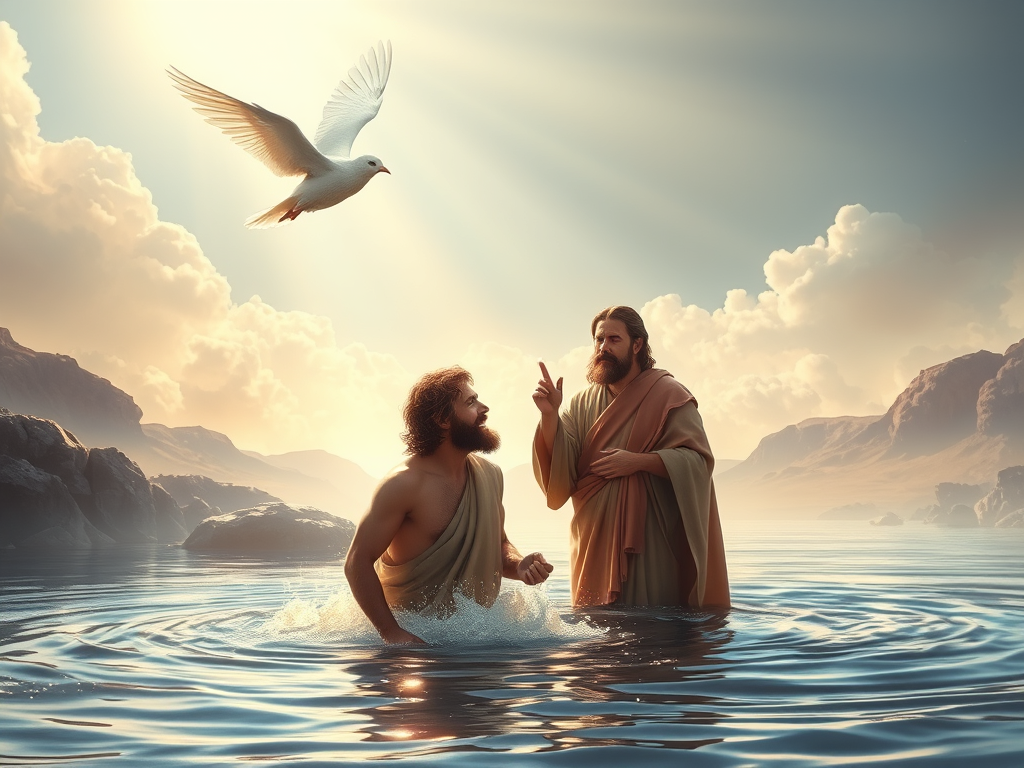
Luke 3:15–16, 21–22
What stands out to me from this week’s readings:
The feast we celebrate today commemorates a turning point. Today is the last day of the liturgical Christmas season. It’s the end of the beginning.
In today’s gospel passage, we see that Jesus has grown into a man. And yet the message of today’s readings is still the message of Christmas. That message is that God is with us. One of the ways God is with us is by being one of us.
In all the gospel passages associated with Christmas, including today’s, most people don’t understand who Jesus is until God reveals the identity of the only begotten Son in unusual ways. These unusual ways include an announcement from an angel, the radiance of a star, and, in the case of today’s story, a disembodied voice.
But the heavens don’t open, and that voice doesn’t speak until Jesus places himself among sinners — this time in a more conscious and open way than ever before. He’s no longer the infant visited by shepherds and astrologers. His ministry is no longer that of a carpenter in a single village. He’s a man now, free to go where He will without making his mother worry that she’s let God down.
Where He goes is to John. He goes to John to model repentance. He models of the death of the old self and the birth of a new one. His coming to John for baptism foreshadows His death and Resurrection that made ours possible. As part of His baptism, He allows Himself to be submerged in the Jordan River. He then lets the Holy Spirit, in the form of a dove, come to rest on Him. He offers himself to unite the natural world with God. He teaches that all of this world points to God. It points to God for those who are willing and able to follow where it leads.
All the options for this week’s readings do the same. They point to God being in our midst everywhere, at all times if we know how to look.
This week’s prayer:
Lord, help us. You call all people your beloved children. Guide us to treat ourselves and others the way You call us to. Amen.
In last year’s post for the Solemnity of Christ the King, I wrote about the name of the solemnity. The name highlights how difficult it is for humans to describe who God is. Despite this difficulty, we try to use language to describe who God is. By its nature as a human creation, language is limited and imperfect. And yet we have no other means but language to describe Someone who is both omnipotent and personal both the ultimate leader and the ultimate servant at the same time. So we give God a name that we would give to a powerful human leader — king.
Phrases and individual words stand out to me as I read the readings for the solemnity this year. And yes, I’ve heard many of these words used to describe a king. Why? What does the dictionary say these words mean? What do their definitions tell us about us and about God?
The words that stand out to me from the Old Testament passage are “like a Son of man,” “Ancient One,” and “dominion” (Dan. 7:13-14). The passage prefigures Christ, and the translation “Son of Man” highlights what Christ shares with us — Human nature. “Ancient One” points to what separates Christ from other men — His divinity. The combination of the two natures within Him gives Him dominion over everything. Miriam–Webster.com defines “dominion” as “supreme authority.” What do the other passages say about how He exercises this authority? What does it look like?
The word that first stood out from the psalm is “majesty” (Psalm 93:1 Merriam-Webster.com defines majesty as “impressive stateliness dignity, or beauty.” Merriam-Webster.com defines stateliness as “marked by lofty or imposing dignity.” It defines dignity as “formal reserve or seriousness of manner, appearance, or language.” (And yet, books have been written about Jesus’ sense of humor as it is portrayed in the Gospels. Between Heaven and Mirth is one book that discusses the topic. It’s written by James Martin, SJ.)
Merriam-Webster.com defines dignity as also “the quality or state of being worthy, honored, or esteemed.” Additionally, the entry says dignity can mean “high rank, office, or position” or “a legal title of nobility or honor.” So majesty does carry associations with royalty, but it also carries associations with dignity and beauty. These are qualities each of us reflects in unique ways. Furthermore, in baptism, a person is anointed “[p]riest, [p]rophet, and [k]ing.” We use these titles to describe missions and ministries we share with Christ.
“Firm” and its synonyms also stand out to me from the psalm (93:2). God isn’t merciless and unyielding but does offer stability and is trustworthy.
The word that jumps out at me from the epistle is “firstborn”(Rev.1:5). It reminds me that God who is trustworthy and offers stability also offers constant renewal. God became one of us, suffered, and died to offer this stability and constant renewal. In His birth, His growth, His ministry, and His death, He showed us what we can become through Him. He offers us the gift of being reborn as priests, prophets, and kings.
The passage from Revelation recognizes Christ’s power and that that power has been shared with other human beings. It gives the power back to Christ willingly. The passage isn’t worded as if Christ has seized that power. Christ is Lord but doesn’t Lord over people.
Instead, He tells the truth and lives it. Nothing more, nothing less. He simply is who He has been, is and will be. It’s we who name things with our limited means. It is we who call Him king. The Gospel passage reinforces this message.
What someone else is sharing about this week’s readings:
When Jesus says, “everyone who belongs to the truth listens to my voice,” I think he’s asking for more than simple obedience and piety. He’s inviting us to create spaces of true belonging by connecting through shared stories and experiences. I believe he’s calling us, not just to spread his message through words, but to embody and live out his teachings in our actions and relationships. To belong to the truth is to form genuine connections, where love, empathy, and understanding bring the Gospel message to life in a way that reaches others deeply and meaningfully.
What I’m saying (to the readings and beyond) this week:
Ms. Hastie says the above perspective “is best exemplified through the story of [her] adoption.” I encourage you to read more about that story here.
She concludes her reflection with these questions: What are your shared truths of belonging? And whom do you share them with?
Using Ms. Hastie’s examples as a guide, I’d say my “shared truths of belonging” are:
We all have lots of experiences with feeling like we don’t belong, with feeling rejected. Maybe many of us spend more time feeling like we don’t belong than that we do. Jesus did too.
We are all vulnerable, and this can be a difficult reality to come to terms with.
Each of us has different gifts and limitations. It’s helpful to recognize both.
Everything and everyone is interconnected, interdependent.
God loves everyone. Nothing anyone can do increases or decreases God’s love.
Whom do I share these truths with? You.
I considered not including this section in this post. Ms. Hastie’s concept of “shared truths of belonging” was difficult for me to reflect on. When I thought about this, I realized I spend much more time focusing on the ways I don’t belong. I spend less time considering the ways I do belong. I often feel like even my family is a collection of people with incompatible personalities and approaches to life. This perception bothers me. I have trouble letting my family members belong as they are. I pray to grow in the ability to be more accepting, and I would always appreciate your prayers.
I don’t think I’ll be posting on the readings for December 1. Or at least those readings won’t get their own post. I think I’ll make a combined post about the readings for December 1 and December 8. I’ll plan to post it before December 8.
We’ll see if the plan comes to fruition. It’s a busy time of year.
Between now and whenever I publish the next post, I want to focus on recognizing the “shared truths of belonging” in my life. I want to be present for others and for God.
I wish you and yours a happy Thanksgiving. This time of year can be one of joyful re-connection. I also recognize that it’s a very difficult time for so many people. My prayers are with you.
This week’s prayer:
Lord, Thank You for living, dying, and rising for us. Help us all to experience Your “shared truths of belonging.” Help us experience Your comfort and Your presence in times of loneliness and grief. Help us to work with Your graces to strengthen the bonds of the human family. Help us to see each other with Your eyes. Help us to build communities and societies that find their foundation in truth lived in love. Amen.
 Sitting with the Sacred