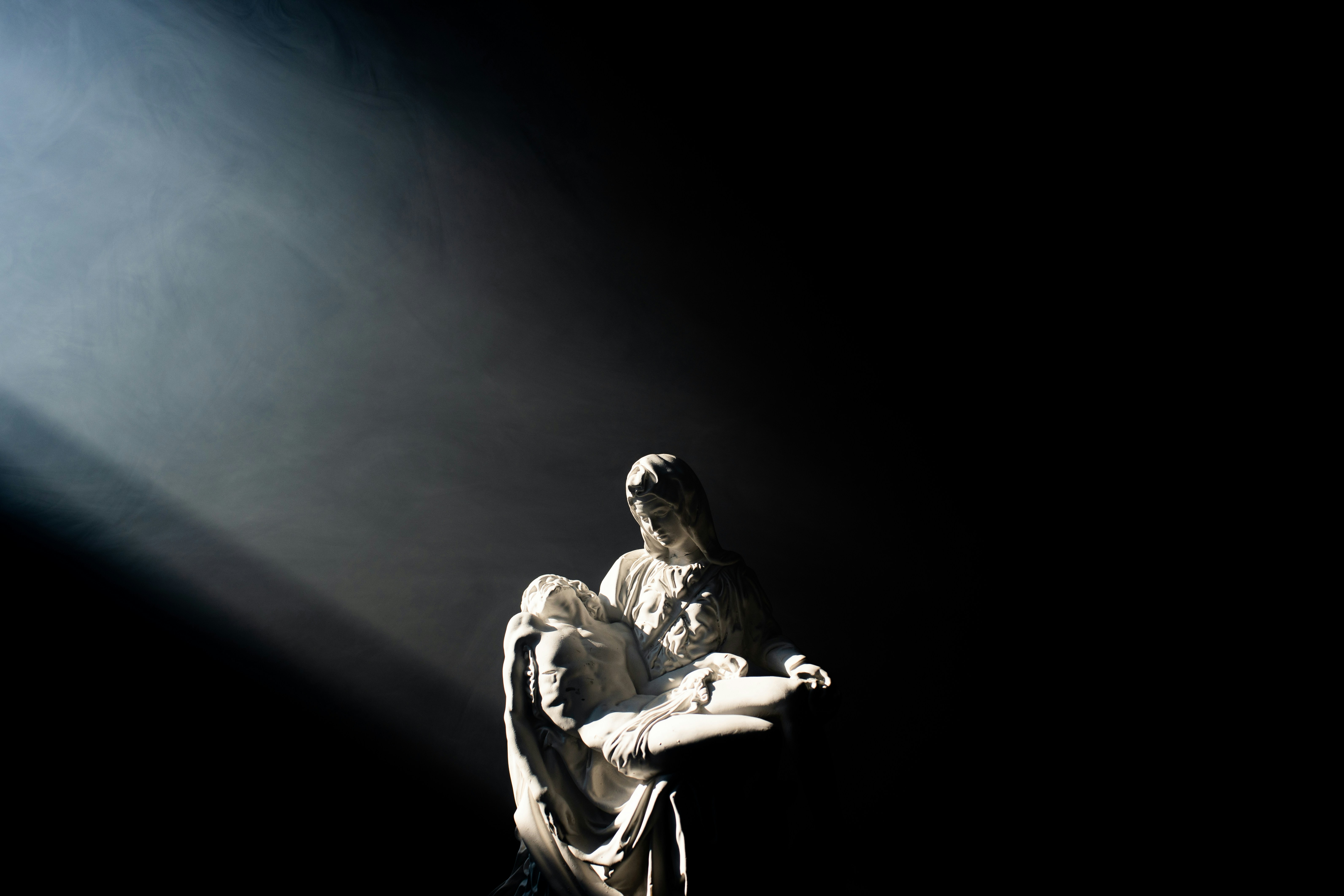
This week’s readings:
- Mark 11:1–10 John 12:12–16
- Isaiah 50:4–7
- Psalm 22:8–9, 17–18, 19–20, 23–24
- Philippians 2:6–11
- Mark 14:1—15:47
What this week’s readings say to me:
As I sit with these passages again this year, I find myself paraphrasing something my pastor said. It was in 2021, I think. He said that at various moments in our lives, we are every character in the passion story. I’ve been many of them. I’ve been open about my faith when I was in a crowd who made it easy to be open because they were being just as open. I’ve been silent about my faith when being open felt threatening — even just socially. I’ve asked God to get me out of a difficult situation, and God didn’t. I’ve said, “Thy will be done,” though I doubt I’ve ever been able to mean it without reservation as Jesus did.
Simon of Cyrene was “pressed into service” to help Jesus carry the cross (Mark 15:21). At most, I’ve been volunteered for some tasks I wouldn’t have chosen to do on my own. They were a lot less strenuous and my circumstances a lot less dangerous, yet I doubt I allow myself to be changed for the better as much as Simon must have allowed himself to be for his name to be remembered in accounts of Jesus’ passion (Matt.27:32; Mark 15:21; Luke 23:26). I’ve betrayed people in my life and been betrayed by them. I’ve thought that if God is real and cares about His children and His creation, why doesn’t He save them from harm in easily recognizable ways all the time? Why would he allow them to suffer? I’ve also been asked the same questions when I’ve undertaken something or accepted a circumstance, and someone else didn’t understand why. I’ve asked now and then why God has abandoned me.
I’ve never been accused and/or sentenced unjustly by anyone charged with enforcing laws, but too many people have been. So many others have stood by someone unjustly sentenced and/or condemned, just as the people at the foot of the cross did for Jesus.
In this week’s readings shows the power of knowing who we are and what our purpose is in pursuing a purpose, regardless of the cost of doing so. The path of learning who we are, of fulfilling that purpose, of sacrificing for it looks different for everyone.
For Jesus, this path meant giving of Himself again and again in prayer, teaching, feeding, and healing. The darkest part of his journey brought him every kind of suffering brought him death. Why did He surrender to suffering and death? Not because God required His suffering and death to save us, but because we required his suffering and death to bring us back into union with God. We walk away from that relationship. God doesn’t. In fact, He never stops pursuing a relationship with us. The cross was the ultimate example of that pursuit, of going after us as we are — in all our fears, doubts, greed, fickleness, cruelty, violence, and even in our mortality.
What someone else is sharing about this week’s readings:
Sheila Leocádia Pires reflects on Palm Sunday and the holy days that follow it.
Beyond this week’s readings:
Another reflection, “Jesus Did Not Die to Appease an Angry God,” even though it was published as a reflection on earlier Lenten readings, helps me make sense of this week’s readings in light of one core belief that’s been handed on to me — that God is love.
In the last few years, I’ve made my own the prospective on atonement and on the crucifixion that Fr. Terrance Klein expresses in the previous paragraph’s link. It’s been more than a week now since I first read his reflection, but I may have used some of his words in my reflection without realizing it. He explains so well, in my opinion, what I’ve wanted to communicate on this blog, but I never thought my way of communicating it made as much sense.
I hope you can access Fr. Klein’s reflection. I came across it on the website of America Magazine. I think viewing a certain number of articles on that website is free each month before the website invites visitors to subscribe to read more. I’ve tried to put this perspective into my own words at the end of the first section in case you are unable to read Fr. Klein’s words, but I hope you’ll be able to. If you are able to, I encourage you to do so. Fr Klein isn’t the only person I’ve encountered who offers this perspective or a similar one on atonement and the crucifixion, but his article is the one I have most recently encountered on the subject.
This perspective is important because it has the potential to recast who we say God is, what God does, and how God sees us. This perspective helps me see God as a rescuer and a healer, someone who wants to save us from what our own distorted vision, weaknesses and injustices do to us, rather than someone who punishes out of anger, jealousy, or a desire to exact revenge upon us for our lack of obedience. It’s a perspective on the relationship between God and humanity that has taken humanity time to develop. By using the word “develop,” I don’t tend to suggest that humans came up with it, but that each of us is on an ongoing journey to understand reality more fully and thus to know God better.
I also don’t mean to suggest that sins don’t matter to God. I think they matter to God precisely because God understands better than we do how sin hurts the sinner and others affected by the sin. It’s precisely because of this supreme understanding that God goes to battle with all of sin’s damage in the generations before Christ and during Christ’s conception, hidden life, ministry, and passion. God wills restorative justice.
Thank you, Lord for coming to rescue us by living a human life so You could be an example for us and could heal us through Your Divinity, Your human relationships with others, Your ministry, Your intercession, Your suffering, and Your death. Amen.
Work cited (but not linked to)
The New American Bible Revised Edition, Kindle edition, Fairbrother, 2011.

 Sitting with the Sacred