Feeds:
Posts
Comments

This week’s readings:

  1. 2 Samuel 7:1–5, 8b–12, 14a, 16 ·
  2. Psalm 89:2–3, 4–5, 27, 29
  3. Romans 16:25–27
  4. Luke 1:26–38

What this week’s readings say to me:

This week’s readings say to me that God has always accompanied humanity in all its joys and sorrows. As part of that accompaniment, God gave the tribes of Israel the special mission of bringing awareness of God’s accompaniment to the rest of humanity by being chosen to receive and to live God’s commandments. Eventually, a king from one of the tribes would be the ancestor of the Savior. This Savior would be for humanity the ultimate model of how to live God’s commandments and would offer humanity the Spirit for help living those commandments.

We can become God’s children and inherit God’s life because one of God’s daughters was given the grace and cooperated with that grace of being the dwelling place for God’s perfect son. Because she cooperates with that grace, God and humanity become one again, and I share in that oneness if I offer myself as a dwelling place for the Holy Spirit — just like she did. The challenge of this opportunity is that being the Spirit’s dwelling place is a gift that is neither easy to give nor to receive,

That gift most wasn’t an easy one for Mary to receive. She’s described as “greatly troubled” by the Gabbriel’s greeting alone, and for me it’s no wonder that her mental and emotional state is described this way when she hears the angel’s salutation (Luke 1: 29). Having a messenger of heaven suddenly appear before her and speak wouldn’t be anything like choosing a tree-topper from a store. A visit from an angel is an experience that few have, and she would’ve been no exception. Angels in Scripture aren’t quaint decorations. They’re overwhelming and disruptive attention-grabbers. Furthermore, Mary’s culture has taught her that finding favor with God carries with it indispensable work — not a comfortable life. I imagine her having thought all this before Gabriel got past “the Lord is with you” (Luke 1:28).

That announcement would bring plenty more difficulties along with the wonder that we perhaps associate with it today. Then again, I wonder how often awe accompanies it these days. It’s another one of those passages people tend to know by heart, even if they aren’t very familiar with others Scripture passages. I find that the more familiar something is, the more complete my numbness to its specialness becomes, and I know I’m not alone in this experience. That’s why I wanted to reflect in a way that removes the sugarcoating, and perhaps a little of the over-familiarity from this week’s Gospel passage.

Having this goal in mind doesn’t mean I don’t see these passages as bringing Good News. Rather, this goal is an exercise in remembering that not all that is good is sweet. Sometimes this is a challenging reminder to receive. At other times it’s comforting. It might be the latter at this time of year because expectations for this season can get so high. Given this reality, looking at the Gospel passages associated with this season, beginning with this week’s, without the lenses of what we think they should feel like can provide some very helpful perspective, a perspective that makes us feel less alone if we feel sad, alone, overwhelmed, afraid, or uncertain this time of year.

With this encouragement in mind, let’s go back to sitting with Mary as she receives the angel’s message. Sure, she’s being offered a role in history more important and unlike any other, and yes that’s an honor and a gift, but it’s a gift that comes at a higher price than she could’ve guessed from the angel’s greeting. For one, nowhere are we told that Gabriel included in his message that Mary’s parents were told of her role in God’s plan before she was. I imagine her being awestruck by the announcement but also but also dreading how people would treat her when her pregnancy became apparent. Remember that in this culture, the law evidently said she could be stoned to death for adultery for being unmarried and yet found to be with child — and not by her betrothed. Remember also that she would likely have been a young teenager, given her culture and that she hadn’t lived with her betrothed yet. I imagine she must have participated in the basics of managing a household and caring for a family for as long as she could remember, under the guidance of older female relatives. Still, being the wife and the mother in a household had to be different than being the daughter, the niece, or the cousin. And that’s just in terms of responsibility. Then there are the massive physical and emotional changes that motherhood entails. On top of all that, her calling was to be the mother of God. I imagine her feeling so small upon learning that this was her call. I imagine her finding comfort in a few thoughts as she received it:

  • If this news wasn’t just a hallucination (maybe she’d been out in the sun too long, she might have thought), what an amazing call it was. She could bring hope and righteousness to her people, to the world. And the role was hers to accept or to refuse.
  • The angel hadn’t left her without a way to test the truth of the announcement. She could visit her cousin Elizabeth, and see if the older woman was, in fact, pregnant.
  • If Elizabeth was, she would know the message was from God, and she already trusted that whatever the Divine Plan was, it would be brought to fruition, regardless of whatever obstacles were placed in its path, whatever hardships she’d have to weather as a result of being so central to it. I imagine that, in any circumstance, and especially given these consolations, she discerned the best and right course of action was to cooperate with the Divine Plan. I imagine her thinking she could never go wrong by declaring her intention to do that. God would use her proclamation of faith to do whatever God willed.

What someone else is sharing about this week’s readings:

Karen Sue Smith ties this week’s readings together in greater detail than I have.

Beyond this week’s readings:

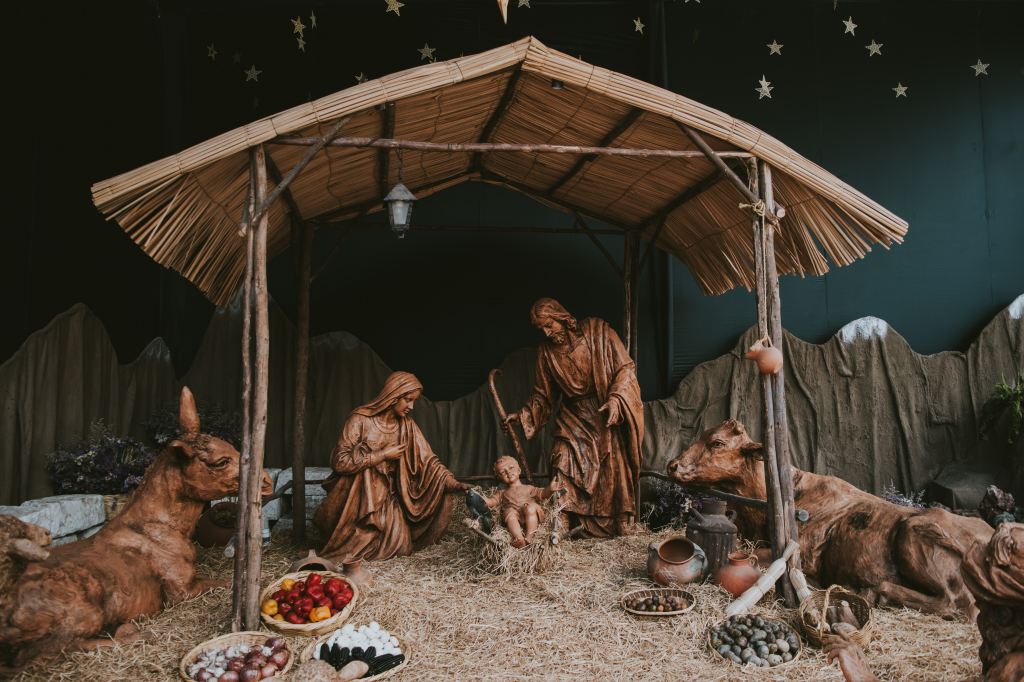
Tonight is Christmas Eve, so I’m considering this post to be my reflection for both the fourth week of Advent and Christmas Eve/Christmas Day. If you’re juggling a lot this Christmas, you’re not alone. So did Mary, Joseph, and the innkeeper.

I see innkeepers getting bad raps in interpretations of biblical accounts of the Nativity. In so many stage adaptations, several innkeepers turn Mary and Joseph away before one offers a stable to the couple. The innkeepers who turn the Holy Family away are characterized as unyielding, heartless. If Mary and Joseph did inquire at more than one inn, maybe the proprietors wouldn’t have thought they were being heartless. Maybe they thought they had no accommodations to offer the couple that wouldn’t offend them, especially given Mary’s condition and that many animals were considered unclean. Maybe the last innkeeper was better at staying calm under the pressure of the influx of travelers. Maybe he saw the wisdom, under the circumstances, of dispensing with expectations, tradition, and rules, and offering the best he had left, humble though that offering is said to have been. (And for the record, Luke’s account mentions the inn whose stable the couple was provided with as if there were only one inn in town. We aren’t told that anyone turned Mary and Joseph away.)

May I be more like that innkeeper, wisely discerning what actions are best based on what situations require from moment to moment. May I see the value in what I have and what I have to offer.

May I remember that whatever my circumstances are this Christmas, God is with me. The accounts of Jesus’s earliest years remind me that:

  • If traveling, especially at peak travel times stresses you out, Mary, Joseph, and countless others understand.
  • If you are “greatly troubled” by unexpected events that are disrupting what you hoped to give the people in your life, Mary, Joseph, and the innkeeper understand (Luke 1:28).
  • If you are headed home after a long time away or are away from home this Christmas, Mary and Joseph can relate.
  • If you are grieving this Christmas or someone you love is, Mary and the weeping mothers of the Gospel can relate.
  • If you’re setting off on a journey with an uncertain destination, the Wise Men can relate. The Holy Family can too.
  • If you feel like you don’t fit in, the shepherds and the Holy Family can relate. Check out this reflection on shepherds from last year.
  • If you are a parent-to-be or a new parent, Mary and Joseph can relate to whatever you’re feeling.
  • If you are living amid or fleeing violence or are a refugee for another reason, the Holy Family can relate.

God is with us in each aspect of and participant in the Nativity story and in the stories unfolding around us this Christmas — the ones involving strife and struggle and the ones that are sappy and sugar-coated.

Lord, help us recognize your presence among us, especially when doing so feels most difficult. Amen.

Work cited

Confraternity of Christian Doctrine, Inc. “4th Sunday of Advent, Sunday 24 December 2023: Readings at Mass.” The New American Bible, 2001. Universalis for Windows, Version 2.183, Universalis Publishing Ltd., 31 Oct. 2023, https://universalis.com/n-app-windows.htm.

Photo by KaLisa Veer on Unsplash

This week’s readings:

  1. Isaiah 61:1–2a, 10–11
  2. Luke 1:46–48, 49–50, 53–54
  3. 1 Thessalonians 5:16–24 
  4. John 1:6–8, 19–28

What this week’s readings say to me:

This week’s readings remind me that we’re all called to be a mirror for the Holy Spirit, and like Jesus, to share the mind, the heart, and the eyes of God. We are called to use this mind, this heart, these eyes, and the rest of our bodies to do God’s work rather than to be a boulder the Holy Spirit has to go around. While each of our callings has what I just mentioned in common, none of us can know all that God knows, I see all that God sees, or can have compassion on all that God has compassion on. Unlike God, we’re limited — not omnipotent. We can’t be everywhere, do everything, and know everything all at once.

But this isn’t bad news. Rather, it points to the Good News. One way aspect of this Good News is that the limitations mean we need each other and God. Another aspect of this Good News is that, as Richard Rohr said, God’s nature is relationship, and as we are made in God’s image, we are made for relationships — with God and one another. We were made to depend on God and one another and, by being open to the movement of the Holy Spirit within us, to be dependable for God and each other. We are dependable for each other and God when we reflect the unique combination of God’s qualities that each of us is able to.

This week’s readings show how four different people will read with God so they can reflect Divine qualities in different ways. Perhaps the first reading demonstrates how two people do this. Through a prophet, this passage foretells what life will be like when God takes on a human existence and when God reigns over the “. . . new heavens and a new earth in which righteousness dwells” that we were promised in the third reading last week (2 Peter 3:13). In the second reading, Mary proclaims that despite her apparent insignificance in her culture, God has blessed her. God’s ways are not like human ways, and so she rejoices in who God is and what God and will do. In the fourth reading, John the Baptist reflects who God is by demonstrating humility, honesty, and an unflinching dedication to the mission God has given him. The readings themselves illustrate better than I can by just pointing to specific verses how Isaiah, Mary, John the Baptist and Jesus each invited the Holy Spirit to work through them in ways that are unique to who they are in the situations in which they find themselves.

Yes, I’ve skipped the third passage so forth because it doesn’t show us how a famous biblical figure invited God to work through him or her (except that the passage comes from a letter a letter attributed to Paul who is letting God work through him and reflecting God in a way that only he can by composing the letter). Instead, it instructs us in how to invite the Holy Spirit to work through us. It urges us to become a link in the chain of love, some other links of which we’ve met in the rest of this week’s readings.

No link in this chain is a copy of the others around it. It’s not a dull, rough restraint that rubs skin raw. I propose it’s more like a bracelet on which each charm or jewel is unique, each reflecting the light in a different way and reflecting a different, significant moment.

What someone else is sharing about this week’s readings:

Bridget McDermott Flood reflects on a theme given to the third Sunday of Advent every year — joy — and how to experience it.

Beyond this week’s readings:

This reflection from Jeff Cavins was released in response to last week’s readings. However, I heard it right before I looked into this week’s readings as I prepared to draft this post, and I heard influenced how I read this week’s passages. You’ll need to login to listen to the reflection, and even after you login, this particular session may not be available on the free version of the Hallow app. In case you are unable to listen to it without subscribing to the paid version of the app, the gist of Mr. Cavins’ message is that each of us is called to “Prepare the way of the Lord,” even though each of us may not be called to do so in the same way as the person next to us (Isa. 40:3).

When I hear “prepare,” I think of doing something, but I’m realizing how often changing my habits would involve not doing something. Yes, I say hurtful things, and a version of me in perfect union with God wouldn’t. But as I reflect on this blaming, these barbs, I realize that even they come from my wanting to make the pieces around me fit where I want them to, instead of accepting that I can’t make them fit.

Maybe I and the people around me aren’t connected like precious charms on a bracelet, but more like pieces of broken, yet beautiful differently colored pieces of glass that God brings together to form a beautiful picture. A few days ago, I saw a Christmas movie whose title I’ll only link to here so that anyone who wants to can avoid having me spoil its plot. For these readers, I just want to acknowledge that the plot of that movie inspired my colored-glass metaphor. In my life and in any life, the pieces are the shapes and colors they are. All I can do is accept the pieces as they are, let God polish the piece that is me, and seek where I fit best.

It’s difficult enough to seek where I belong in the mosaic and to let God polish me. I didn’t come up with the concept for the overall picture the picture or any of its elements, nor do I know what the whole picture looks like, so its components usually don’t connect the way I’d like them to, I feel frustrated and embarrassed that I can’t complete the picture as I would like because I can’t see the whole picture. I respond to these feelings by lashing out and making edges on the multicolored, reflective shards sharper and the gaps between them wider. I scatter the pieces, accomplish the opposite of what I want by trying to force what I want to happen, to make it take place when and how I want it to. What would do the most good is surrendering instead. In addition to the prayers I linked to last week, this prayer is one I find myself turning to for help with surrendering:

Take, Lord, and receive all my liberty,
My memory, my understanding
And my entire will,
All I have and call my own.
You have given all to me.
To you, Lord, I return it.
Everything is yours; do with it what you will.
Give me only your love and your grace.
That is enough for me.
Amen.

Prayer of St. Ignatius of Loyola

Lord, help me experience Your love and grace as enough for me. Help me to mean the words of the above prayer, trusting that when I offer the gifts You’ve given me back to You, You’ll remove any distortion caused by sin from them and they’ll do the good you intend them to do. Amen.

Work cited (but not linked to)

Confraternity of Christian Doctrine, Inc. “3rd Sunday of Advent, Sunday 17 December 2023: Readings at Mass.” The New American Bible, 2001. Universalis for Windows, Version 2.183, Universalis Publishing Ltd., 31 Oct. 2023, https://universalis.com/n-app-windows.htm.


Photo by KaLisa Veer on Unsplash

This week’s readings:

  1. Isaiah 40:1–5, 9–11
  2. Psalm 85:9–10, 11–12, 13–14
  3. 2 Peter 3:8–14
  4. Mark 1:1–8

What this week’s readings say to me:

This week’s readings remind me that for God there are no obstacles. It’s on account of the Divine Nature, which is love, that God doesn’t override our freedom to reject God or to invite God into our lives.

Comfort, give comfort to my people . . . .
A voice cries out:
In the desert prepare the way of the LORD!
Make straight in the wasteland a highway for our God!
Every valley shall be filled in,
every mountain and hill shall be made low . . .

Isaiah 40:1 and 4

No canyons or soaring peaks can get in God’s way. God is neither held back, nor propelled forward, nor weighed upon by time.

Like a shepherd he feeds his flock;
in his arms he gathers the lambs,
carrying them in his bosom . . . .

Isaiah 40:11

And yet you and I are. And so we wait for God to level the steep climbs and fill in the craters, wondering when the Prince of Peace is going to see to it that justice and peace reign. We wish God weren’t delaying so long in making this reign happen.

The third reading suggests the delay is thanks to God’s love. The landowner hasn’t returned to call for an how we’ve managed his resources because he wants as many people as possible to have the chance to use them to heal and to grow. He knows that if we do our part to bring about the world we want to see, the effort will bring about peace and justice within us. Figurative and literal mountains may be obstacles for us, but obstacles can be good for us if we ask God to help us look at them with clear, eternal eyes and to see them as opportunities to give, to depend on God, and to open ourselves to the Holy Spirit.

Kindness and truth shall meet;
justice and peace shall kiss.

Psalm 85:10

That’s what this week’s readings say to me, but the readings themselves express their message were beautifully than I can. I think there are verses in this week’s passages that are familiar and cherished by many, regardless of how regularly someone revisits Scripture passages. So I decided to include pull quotes of my favorite verses from these readings in this post. Also, I suggest that the readings as a whole might be sat with throughout Advent.

. . .we await new heavens and a new earth in which righteousness dwells.

2 Peter 3:13

What someone else is sharing about this week’s readings:

Sarah Hansman reflects on how practicing patience doesn’t conflict with taking an active part in prepar[ing] the way” for Christ to renew all that is by entering into it (Isa. 40:3).

Beyond this week’s readings:

Fr. Roderick Vonhogen shares what it means to have the grace of an Advent mindset year-round.

The theme of waiting for God’s coming to live among us and offering salvation, even as we are invited to take part in bringing about that salvation calls to my mind “The Serenity Prayer,” especially the well-known first stanza. It also brings to mind “A New Serenity Prayer” by Fr. James Martin. To give proper credit to the sources of these prayers, rather than typing them here, I’m just going to link to them and close this post by wishing you a fruitful, grace-filled week of active waiting. As I write this prayer, also on my mind is anyone waiting in suffering and grief. Come to those who are sorrowing. Comfort them with Your presence, Lord Amen.

Work cited (but not linked to)

Confraternity of Christian Doctrine, Inc. “Sunday 10 December 2023: Readings at Mass.” The New American Bible, 2001. Universalis for Windows, Version 2.183, Universalis Publishing Ltd., 31 Oct. 2023, https://universalis.com/n-app-windows.htm.

This week’s readings:

  1. Isaiah 63:16b–17, 19b; 64:2–7
  2. Psalm 80:2–3, 15–16, 18–19
  3. 1 Corinthians 1:3–9
  4. Mark 13:33–37

What this week’s readings say to me:

I’ve heard of the stages of grief, and after revisiting this week’s readings, I’m wondering if any professionals have ever identified stages for processing guilt. The narrator in the first reading seems to begin processing guilt by blaming God for misdeeds. Why do you allow me to sin, he asks? Come stop me.

Upon making this request, he seems wary about having it granted. And why wouldn’t he be? God’s gaze isn’t a social media filter that can erase any blemishes. It doesn’t allow him to delude himself into thinking he can escape the truth of the life he lives in its combination of ugliness and beauty. Taking an honest look at his life brings him to the next stages in the process of addressing his guilt: asking for God for the grace to become the best version of himself and being open to the possibility of receiving this grace.

The psalmist asks for these graces, and the psalm concludes with an expression of trust that the speaker will receive what he asks for.

The third reading expresses faith that those who live with Christ and in Christ receive all the graces they need to find unending union with God and with other partakers in that union.

I find it difficult to trust in the promises of the third passage. Contrary to its message, I experience that I am, in fact, “lacking in [plenty of spiritual gift[s]” (1 Cor. 1:7). Furthermore, my memory tells me that I haven’t been kept “firm” in any of them in the past, so I find it difficult to believe that I will be firm “to the end” and will be found “irreproachable on the day of our Lord Jesus Christ” (1 Cor. 1:8). Paul concludes the promises of the passage by reminding us that “God is faithful, and by him you were called to fellowship with his son, Jesus Christ our Lord (1 Cor. 1-9). The implication of these reminders seems to be that God will complete the journey toward union among all who are connected to the divine.

Yet we’ve seen in wedding feast parables that symbolize that union that not everyone who is invited accepts the invitation and not even everyone who accepts it is prepared for it. These parables suggest that neither those who reject the invitation to the feast nor those who are unprepared for it are able to enjoy the feast.

And even those who accept and respond to the invitation cannot prepare themselves for the celebration. They need God’s help.

I need God’s help — to accept the invitation to the feast, to light the way to it, and to make room for it within. I can trust in this help, but it often doesn’t feel like I can. I often don’t recognize it being extended, so I reject the invitation. I don’t always lead others along the path to it by letting God’s light shine through my words and actions. I let fragile imitations of that Light block its reach, its warmth and radiance. My choices and the choices of others mean that sometimes I can’t sense its radiance and warmth. At these times, I’m spiritually asleep and need the Gospel passage’s wake-up call.

What someone else is sharing about this week’s readings:

Ma. Marilou S. Ibita, PHD, STD uses her areas of expertise to offer a deeper reflection on the Gospel passage and the work we’re called to than the one I have shared.

Beyond this week’s readings:

I want to share three podcast episodes that gave me additional perspective on the Sunday readings for the three weeks before today. You may want to have headphones on when you click the play buttons on the pages where the following links lead:

The third link not only looks back at past weeks’ readings but also offers some considerations for how we might look at the weeks ahead.

Lord, may the material world awaken us to Your presence and to Your coming in the past, present, and future rather than numbing us to the reality that You have come, are here, and will come again. Amen.

Work cited

Confraternity of Christian Doctrine, Inc. “1st Sunday of Advent: Readings at Mass.” The New American Bible, 2001. Universalis for Windows, Version 2.183, Universalis Publishing Ltd., 31 October 2023, https://universalis.com/n-app-windows.htm.

This Week’s Readings:

  • Ezekiel 34:11-12, 15-17
  • Psalm 23:1-2, 2-3, 5-6
  • 1 Corinthians 15:20-26, 28
  • Matthew 25:31-46

Carol Zinn, SSJ, offers a reflection that invites each of us to a reflection of our own this week.

What Fruit Will I Eat?

Photo by engin akyurt on Unsplash

This week’s readings:

  1. Proverbs 31:10–13, 19–20, 30–31
  2. Psalm 128:1–2, 3, 4–5
  3. 1 Thessalonians 5:1–6
  4. Matthew 25:14–30

What this week’s readings say to me:

. . . [Y]ou shall eat the fruit of your handiwork . . .

Psalm 128: 2

This week’s readings say to me that the above fragment of a verse from the psalm could be a statement of theme for this week.

In today’s Gospel Acclamation, the Lord tells us:

Remain in me as I remain in you, says the Lord.
Whoever remains in me bears much fruit.

John 15:4a, 5b

Most of this week’s readings concern themselves with giving examples of the fruits that come from remaining under God’s metaphorical wing. The first reading says to me that someone who remains in God perseveres in the tasks that God calls her to every hour and every day. In my mind, going about one’s business well in this way is often appreciated only when someone else doesn’t go about the same duties with quite as much diligence and skill. Such work done behind the scenes makes the projects that are more widely visible come together more smoothly than they otherwise would. And as someone who remains in God, the woman in the first reading is indispensable to both her family and her community. Her life reflects God both privately and publicly.

The psalm offers a reminder that God offers life — in both human and plant forms — as a blessing. (Animals are blessings to, but they aren’t mentioned in this psalm.) It’s up to me to look for ways to see my life and the lives of others as blessings and by living with compassion and clarity to help others to experience their own lives as blessings.

The third reading, I’d say, reinforces that those who journey with God receive clarity and keep resetting their sights on their ultimate purpose — union with God and others who have sought and entered God’s embrace. Those who trust in the Divine embrace can go about the work and play that God invites them to despite life’s uncertainties. What matters isn’t certainty but remembering to look for, to invite, and to thank God as often as I remember to do so.

The parable in this week’s Gospel reading teaches that a person who trusts in God’s embrace and settles into it has a mindset of growth and possibility. Rather than comparing what he has to what someone else has, he makes the best of his gifts. He knows that the way he sees himself and his surroundings, circumstances, and limitations isn’t set in stone. Perhaps because he has a growth mindset, he’s not afraid of the master but rejoices in his connection to the master and the trust he has placed in his servant. Or perhaps he’s able to have the perspective on life that he does because he rejoices in her connection to the master and his trust.

The third servant doesn’t seem to have the same view of the master. He certainly doesn’t have the same response to what the master gives him the as the others do, and when I read the master’s reaction to the servant this time, it surprised me. The master doesn’t contradict what the servant says about his leadership style. He doesn’t respond by reminding the servant of the work he’s done to give his workers the opportunities they have.

Instead, the master’s response says to me that the servant isn’t acting as if he believes what he says about the master. If he did believe his own words, why did he behave as if the master wouldn’t ask for an accounting of his original coin? Maybe, like Adam in the garden, the third servant wants someone to blame for his being unhappy with the situation in which he finds himself. Maybe he wants someone to blame because fear, selfishness, and greed feel more powerful than trust and gratitude. Maybe this perception of life keeps him stuck on comparing what he has to what others have. Maybe it keeps him from doing what he can, from sharing whatever abilities and material goods he has to grow toward the best version of himself and to help others do the same. He’s “eat[ing] the [rotten] fruit of [his envy, resentment, and entitlement-fueled] handiwork.” He’s remaining in himself rather than in God. He is and does the opposite of the wife from the first reading.

What someone else is sharing about this week’s readings:

Rosemary Johnston moves the characters from this week’s readings from their allegorical and historical settings into 21st-century life and into a place I didn’t expect. Check out her reflection to find out more.

Beyond this week’s readings:

It’s human nature to be some combination of the “worthy wife” and the “lazy servant,” to refer to this week’s contrasting characters the way the readings do. (Prov. 31: 10; Matt 25:26) I feel like there’s far more of the first character in me then the second.

Lord, help me to understand how to grow and to help others grow with what you give me. Help me to put this understanding into practice. Also help me to appreciate my opportunities and gifts and to recognize that they come from the ultimate generosity, which is Your nature. Amen

P.S.: This week’s readings are not those assigned to Thanksgiving in the U.S. Nonetheless, I’ve noticed that their message is fitting for the holiday. Part of that message might be that gratitude makes a person experience what they have as more and to grow what he or she has by putting it to work, investing it, and sharing it. Perhaps, on the other hand, ingratitude makes what a person has seem like less. Perhaps it also makes a person disposed to increased fear of losing what here she has and as a result, to hide and to hoard what she has.

I suppose living the Thanksgiving spirit means looking at life and living it with gratitude. So how do I do that? I’ll start with the prayers I’ve just offered. Next, a lot of people would recommend making a gratitude list or keeping a gratitude journal. I’ll move in that direction by simply calling to mind what I have to be thankful for.

Then I might try the mental version of an activity you might not expect me to pursue if I want to grow my gratitude. It’s an activity I heard about on a podcast yesterday — creating it ingratitude list or journal. The point of this activity isn’t to dwell on the things I can’t change that frustrate me or that I think are unfair or aren’t going right. The point is to name these things, with the idea being that getting them out can start the process of letting them go. This is a process I definitely want to work through.

When I think of this process, I think of all the psalms that bring anger, frustration, and sorrow to God. Some psalms express praise and thanksgiving, but not all do. If the psalmists can express all facets of their experience to God, so can I, and so can you.

I was going to wind this post down by wishing you a happy Thanksgiving. I do wish that for you, but I also wish you an honest and authentically peaceful Thanksgiving. I have faith as I write this that honesty founded on God’s wisdom will light the way to gratitude.

I share these Thanksgiving desires for myself and for you in this post because while, in an ideal world, I would at least post the readings for next weekend and for the holiday, I’m not sure I will manage to do either. After all, my plans for next week and the weekend after won’t fit into my usual routine. So in case I don’t get in touch with you again until the week after next, I wanted to wish you well now. Every blessing to you and yours until we meet again here again.

Work cited

Confraternity of Christian Doctrine, Inc. “Sunday 19 November 2023 33rd Sunday in Ordinary time: Readings at Mass.” The New American Bible, 2001. Universalis for Windows, Version 2.183, Universalis Publishing Ltd., 31 October 2023, https://universalis.com/n-app-windows.htm.

Photo by Gadiel Lazcano on Unsplash

This week’s readings:

  1. Wisdom 6:12–16 
  2. Psalm 63:2, 3–4, 5–6, 7–8
  3. 1 Thessalonians 4:13–18
  4. Matthew 24:42a, 44

What this week’s readings say to me:

This week’s readings say to me that God’s wisdom, born of God’s unconditional, self-emptying love transcends gender, time, and even death. It’s alive, a guiding light and a relationship sought and found through alertness, preparation, perseverance and patience. It can’t be faked or borrowed and returned. It has to be kept and nurtured. The path to it cannot be rushed, and the process of encountering and journeying with it comes with a cost that’s worth paying to make it my own. Knowing and not knowing it affect my mind, body, and soul. Being open to it, living with it, and following words leads would make me the undistorted version of myself, while closing my mind, body, and soul to it would leave me lonely and unrecognizable to anyone acquainted with the best version of me.

What someone else is sharing about this week’s readings:

Paula Rush explores what the symbolism of this week’s readings has to say. I found her perspective on the parable in the Gospel reading particularly refreshing and inspiring. I would say her reflection ends with a twist. Go to this page out to find out what her hope-filled perspective on the foolish virgin is.

Beyond this week’s readings:

Until the evening two days ago, I was traveling, and I got sick at both the beginning and the end of my trip. Then I came to my desk to work on this post yesterday. I didn’t feel like moving a muscle, and congestion meant talking to my dictation software wasn’t as comfortable as usual, not to mention that the software probably wouldn’t have understood me as well as it usually does. I set my timer, and when it went off, only the headings and the locations of the Scripture passages had been added to this post. I decided to spend the rest of the day catching up on shows I missed while I was gone and playing games on my phone. And when I got up this morning, I still felt like I had nothing to offer.

Then I let Hallow app guide me through an imaginative prayer session and a St. Jude novena centering around the feeding of the 5,000, a.k.a. the multiplication of loaves and fishes (Matt. 14:13-21; Mark 6:30-44; Luke 9:10-17; and John 6:1-15). When the apostles thought there was no way they had enough food to feed the crowd who had been listening to Jesus was so long, that’s when I realized I could relate, in a way.

As I write, I’m wrestling with doubts that anything I put in this post will feed you intellectually, spiritually, or emotionally. If something I’ve included here does resonate with you, I’d be interested to know what, if you’d like to share a comment.

But also as I write this after sitting with the readings, I’m reminded that it isn’t I who do the feeding. It’s God. I have only to desire God’s wisdom and to take one step at a time to prepare for and to receive its movement.

Come to me, Oil for my lamp, Wisdom of God. Give me the wisdom to recognize You so You can recognize in me the person I am in You. Amen.

Photo by Gregoire Jeanneau on Unsplash

Good morning! I hope you’re having a great Sunday, and I hope you have a great week. I’m taking a break from the blog again this week.

Here are today’s Scripture readings:

  • Malachi 1:14b—2:2b, 8–10
  • Psalm 131:1, 2, 3
  • 1 Thessalonians 2:7b–9, 13 
  • Matthew 23:1–12

I welcome your comments if you’d like to share what the readings are saying to you.

Photo by Mayur Gala on Unsplash

Good morning! I hope you’re having a great Sunday, and I hope you have a great week. I’m taking a break from the blog this week.

Here are today’s Scripture readings:

  • Exodus 22:20–26 
  • Psalm 18:2–3, 3–4, 47, 51
  • 1 Thessalonians 1:5c–10
  • Matthew 22:34–40

I welcome your comments if you’d like to share what the readings are saying to you.

Photo by Priyansh Patidar on Unsplash

This week’s readings:

  1. Isaiah 45:1, 4–6 
  2. Psalm 96:1, 3, 4–5, 7–8, 9–10
  3. 1 Thessalonians 1:1–5b
  4. Matthew 22:15–21

What this week’s readings say to me:

This week’s readings praise and honor God and advocate for my never ceasing to do the same. They also remind me that everyone and everything exists because of God’s power and with God’s consent. Without this power and consent, nothing would exist and nothing would be held together. But there is life, and there is relationship because God is life and relationship. There is life through relationship to God and one another.

The third reading continues to praise God while also highlighting the relationality of life in God. It also highlights how virtues are related to one another, saying:

We [Paul, Silvanus, and Timothy] give thanks to God always for all of you, remembering you in our prayers, unceasingly calling to mind your work of faith and labor of love and endurance in hope of our Lord Jesus Christ, before our God and Father, knowing, brothers and sisters loved by God, how you were chosen.

1 Thessalonians 2-4 [italics mine]

While nothing exists without God allowing it to, God wants us to love freely, and anything not done freely isn’t done in the love, so God doesn’t force us to bend to the Divine will. God gives us the freedom to be co-creators. The result of this freedom is that God isn’t the creator of everything. Some things are created by the tempter and accuser. Others are created by humans. We can use the things humans have created for good or ill.

Upon this reading of the Gospel passage, I feel like Jesus is asking me to think about what I value and to ask God to help me value my life-giving relationships more than the things I can use to benefit those relationships. It also challenges me to discern how the things I use affect my relationships with God and others. To what extent are these effects positive and negative?

What someone else is sharing about this week’s readings:

Chanelle Robinson’s reflection offers one possible response to the question with which I ended the previous section.

Beyond this week’s readings:

Lord, grant me the grace to recognize what belongs to you and to employ it to bring myself and others into union with you. Give me a deep awareness that this union is the source of all beauty, growth, and peace. Help me to remember to thank you for inviting everyone to share these gifts. Thank you, Lord. Amen.