Jesus said to his disciples: “You are the salt of the earth. But if salt loses its taste, with what can it be seasoned? It is no longer good for anything but to be thrown out and trampled underfoot.
Matthew 5:13
I am the salt of the earth. Hearing this, I’m inclined to wonder if a little bit of me goes a long way. Am I overpowering if someone relies on me too much? Does too much of me contribute to high blood pressure? Undoubtedly, the answer to these questions is sometimes “yes.”
But I don’t think salt had these associations for people in Jesus’ time. Wikipedia’s entry, “Salt in the Bible,” says salt is used in the Scriptures “signify permanence, loyalty, durability, fidelity, usefulness, value, and purification . . . . Salt was widely and variably used as a symbol and sacred sign in ancient Israel Numbers 18:19 and 2 Chronicles 13:5 illustrate salt as a covenant of friendship. In cultures throughout the region, the eating of salt is a sign of friendship.” (Yes, I know Wikipedia is not a foolproof source of information, but I’d like to be able to make this post available to you sometime this week.)
Before embarking on this post, I was aware that humans have used to salt as a preservative for a long, long time, so it makes sense to me that, especially before the advent of refrigeration, salt would be associated with permanence, durability, usefulness, and value. The association with fidelity also makes sense in that food must be preserved to remain what it is.
The human body requires a small amount of sodium to conduct nerve impulses, contract and relax muscles, and maintain the proper balance of water and minerals. It is estimated that we need about 500 mg of sodium daily for these vital functions. But too much sodium in the diet can lead to high blood pressure, heart disease, and stroke. It can also cause calcium losses, some of which may be pulled from bone. Most Americans consume at least 1.5 teaspoons of salt per day, or about 3400 mg of sodium, which contains far more than our bodies need.
Some people believe that salt needs be replaced during hot weather or strenuous exercise to avoid muscle cramps. This is not correct. What you need to replace is water.
The human body can happily survive on just one gram of salt a day, as hormones keep a check on sodium levels and make adjustments for hot weather. A genuine sodium shortage brought on by hot weather or exercise is extremely rare, even among hard-working athletes.
When salt is used judiciously, when one might say it’s treated like it has value rather than used carelessly, it brings out the best not only in our bodies but in our food. It enhances other flavors rather than overpowering them. Maybe the ability of salt to have a positive effect on other flavors is good to remember as we seek to have healthy relationships with the people around us. Our call and our challenge is not to take charge all the time but to journey with one other and to work on building communities that bring out and benefit from the best qualities of their members.
I’m sorry to say I don’t always bring out the best qualities in the people around me. Why? Because I’m not the pure salt. A footnote in my Bible says the following: “The unusual supposition of salt losing its flavor has led some to suppose that the saying refers to the salt of the Dead Sea that, because chemically impure, could lose its taste” (Mat. 5:13n).
The websiteNatural Pioneers has this to say about Dead Salt’s limited effectiveness for flavoring food: “Dead Sea Salts are made up of about 60% magnesium and potassium, 8% sodium and some rare minerals. . . .While a small percentage of extracted Dead Sea salts are washed and processed to edible salt, the majority is not” (Dead Sea Salts Vs. Sea Salt Are They The Same? [Studies]).
Lord, help me to come to You so that You can wash me. Refine me into the pure salt You created me to become. Grant me the grace to treat others as my valued brothers and sisters rather than carelessly. Help me to cooperate with those around me to flavor our surroundings with Your Love. In other words, grant me the grace to be salt for the world but not salty. Amen.
Works cited
The Bible. The New American Bible Revised Edition, Kindle edition, Fairbrother, 2011.
Psalm 146:6-10 presents a word tapestry about the loving care of God. But given the disappointment, resentment, and selfishness that weigh down my own heart despite my desire to let go of these burdens, I find it a challenge to see this tapestry as anything more than an eloquent wish. Much of what I see in the news doesn’t help make the tapestry come alive either.
However, this post isn’t dedicated to bashing news media or news watching. My undergraduate major was mass communications. I wrote and edited for the university newspaper and took courses in other forms of information dissemination, including broadcast journalism and public relations.
I think it’s important (without consuming news all day) to follow current events every day. I also think it’s useful to consult different well-established new sources on different days, not just the ones that confirm the views I already hold. For me, this is one example of what it means to be in the world but not of it. (See John 17:14-15). News may not show me the world I want to see, but that doesn’t mean I should avoid seeing it — much the opposite. I have to know what’s going on in the world to have any hope of bringing the Good News to that world or indeed, communicating at all in a way that resonates.
Violence is very prevalent around us, and news sources reflect this reality because their job is not to reflect back to us our day-to-day routines or anyone else’s. The way I see it, this function of journalism is why it’s called “the news” and not “the expected” or “the desired.” This function is why a common phrase in journalism education (at least when I was receiving it) was “if it bleeds, it leads.” So often it’s violence, whether on the part of nature or humanity, that interrupts the status quo. This disruption is not the fault of news sources. Do inspiring events occur as well as tragic ones? Absolutely! News sources report on these too. Pretty much every television news broadcast I’ve ever seen ends with a positive story. I think this is done with the idea of leaving viewers with something positive to take away.
I see some common ground and some differences between news broadcasts and the Beatitudes. The Beatitudes acknowledge the difficult and often unjust realities of life, while at the same time, each one begins and ends by offering hope, For example, Jesus says that “those who mourn” are “blessed” (Matt. 5:4). Does this mean that someone should desire mourning over joy? I don’t think so. Does this mean that someone mourning should feel blessed? No. I hear this Beatitude as a promise that regardless of what someone who is mourning feels, they are blessed because Christ is close to them in a special way, as he is to anyone in need or going through a difficult time. He struggled and mourned during his passion, and when we join our suffering to the suffering of the cross, our suffering takes on the redemptive power of the cross, even in the many times when we can’t see how.
I’m not saying that everything happens for a reason, or that God pushes us around like pieces on a chessboard. We have free will. We also have bodies that come with a lot of biology and chemistry — survival instincts that sometimes end up translating into domination over others, physically, emotionally, and psychologically. Everyone around us is also influenced by these factors, to varying degrees. The Spirit and its domain, spirituality are about not letting these factors overtake the Spirit in us. This is not to say that our bodies and minds are bad and our souls are good. To say that would be heresy. I look at the relationship between physical and spiritual matters this way: God designed them to work together, as they do in Jesus and his gift of his body, blood, soul and divinity in his ministry, on the cross, and hidden within the forms of bread and wine. I’m saying that, thanks to Jesus’s life, death, and resurrection and his example during these stages of his mission, no difficulty, suffering, or instance of a situation not working out the way we wanted has to destroy our hope. As I think I’ve written before, we can use our experiences to prevent others from suffering similarly, we can accompany others going through similar experiences, or in the most challenging of circumstances, when neither of these opportunities seem available to us, we can choose to trust that the offering of our circumstances to God is redemptive in those ways I mentioned earlier, the ones we can’t see — yet.
Like most people, I’d like to see nothing but righteousness, mercy, satisfaction, comfort, and peace around me and within me right now. But to experience that would be to experience heaven, and I’m not there. Because I’m not already there, I take comfort in the fact that the second half of each Beatitude, offers a future blessing, not a present one. If the Beatitudes were presented to me in nothing but present tense, I would struggle with faith even more than I do I would wonder why God hadn’t kept the promises of the Beatitudes. After all, I look around me and within me and see not only the qualities opposites of the positive ones included in the Beatitudes but also imperfect versions of those positive qualities. In our broken humanity we thirst for righteousness without allowing for meekness or mercy, and we seek comfort and satisfaction without first being poor in spirit, without having a clear enough vision of reality to mourn with those around us. I think each positive quality included in the Beatitudes needs all the others to reach its fulfillment.
I don’t believe such ultimate fulfillment comes in this life. Our mission is to thirst for it, to do what we can to embody the combined Beatitudes, all the while knowing we do and will fall short. I find pain and comfort in this falling short — pain because I want to experience Heaven now, and comfort because in acknowledging that I fall short, I recognize poverty of spirit. I recognize that I need God and others, that I don’t have all the answers, and that nobody but God does.
Lord, help me to be more at ease with my lack of understanding and control and Your total understanding. Help me to turn to you and let you work in me as I thirst for the fulfillment of your promises. Amen.
Confraternity of Christian Doctrine, Inc. “Sunday July, 2 2023: Readings at Mass.” The New American Bible, 2001. Universalis for Windows, Version 2.179, Universalis Publishing Ltd., 26 Feb. 2023, https://universalis.com/n-app-windows.htm
For Christ did not send me to baptize but to preach the gospel, and not with the wisdom of human eloquence, so that the cross of Christ might not be emptied of its meaning.
1 Corinthians 1:17
This verse from the readings for this past weekend is the one that grabbed my attention. It did so because it left me with questions.
What does Paul have to say to me with the words “Christ did not send me to baptize but to preach the gospel” (1 Cor. 1:17)?
He did baptize people, didn’t he? Verses 14 through 16 say he did. So why does he say Christ didn’t send him to baptize? It seems to me that he provides the answer in verse 13. One question in that verse reminds the flock in Corinth it isn’t in his name that they come together. It isn’t in his name that they share what they have with those who have less. It isn’t in his name that they forgive one another and love and pray for those who persecute them. It isn’t in his name that they share their spiritual gifts. Rather, it’s in Christ’s name that they do all these things, as it was in Christ’s name that they were baptized, not in Paul’s. Christ worked through earthly leaders of the Church in Corinth to baptize people. None of those leaders were acting on their own behalf.
This first part of the verse also reminds me that while different members of Christ serve different functions within his mystical body, (for example, some regularly baptize new members, while others normally don’t) all members are called to preach the gospel — and not just with words. Conveying the limitations of language seems part of the message of the verse’s second half: “and not with the wisdom of human eloquence, so that the cross of Christ might not be emptied of its meaning”[italics mine] (1 Cor.1:17).
Even Christ’s words, by themselves, didn’t keep sin and the suffering that resulted from having the final say. The words themselves didn’t unite to himself and to one another anyone who wanted to be united. His death on the cross and the resurrection that followed made that possible. He carried our wounds and our weaknesses to the fullest extent he could — to the point of death. He was victorious after he offered his life on the cross. But in the final hours of that pre-resurrection life, when he spoke at all, he didn’t tell parables or give sermons as he once had. He spoke in short phrases.
Jesus’ words prepared hearers to receive the union with the Divine that he would offer through his body on the cross and through His Spirit on Pentecost.
The words themselves didn’t complete the adoption, yet they paved the way for the proceedings. Nevertheless, despite the important role words sometimes play in bringing us closer together as members of Christ’s family, and of the human family Paul writes that “human eloquence” can empty the cross “of its meaning (1 Cor. 1:17).
How can this happen?
One answer is that words themselves are a means of dividing the people, ideas, and objects they represent into categories that separate one thing from another. Language distinguishes between an apple and an orange, between people from one tribe or place and another. Language defines an “us” and a “them.” It names God and the elements of God’s creation. Such differentiation has its place because recognizing our differences can help us learn from each other and grow in humility. Certainly recognizing that we are not God can help with the latter.
But problems arise when we let ourselves believe that the ways we are different from other people make us better than them. This belief won’t let us celebrate others as the unique reflections of God that they are. Problems also arise when we get so focused on the challenges that our differences present that we don’t recognize what we have in common. Third, problems arise when we focus so much on our separateness from God that we don’t grow in our relationship with God. These problems are some forms sin can take.
The effects of sin are the opposite of the effect of the cross of Christ, which has the power to close the painful gaps we create between ourselves and others and between ourselves and God. Is this closure complete? No, because each of us has to receive healing (the reception of which sometimes means carrying crosses of our own) so that we can share it again and again. Also, this healing is not complete because we haven’t yet reached the end of time as we know it.
And there’s another reason besides the frequent divisiveness of “human eloquence” that can empty the cross “of its meaning” (1 Cor. 17). Human eloquence can have this effect when it isn’t supported by action — which is not to say that words cannot be actions in and of themselves. Sometimes words can help us comprehend the full meaning of actions. Yet they can also be attractive but devoid of meaning. Presenting an eloquent argument in favor of one solution to a problem doesn’t, in fact, solve the problem. For that to happen, someone has to put the solution into action. Talking about giving someone a meal or a drink of clean water is not the same as actually providing it. Eloquent prayers and reflections by themselves are empty unless they are accompanied by actions. And yet, it can feel so much easier to talk about doing something and to tell someone else to do something than to participate in doing it myself
Lord, help me to recognize how I can be an answer to prayers today. Amen.
The Bible.The New American Bible Revised Edition, Kindle edition, Fairbrother, 2011.
Confraternity of Christian Doctrine, Inc. “Sunday July, 2 2023: Readings at Mass.” The New American Bible, 2001. Universalis for Windows, Version 2.179, Universalis Publishing Ltd., 26 Feb. 2023, https://universalis.com/n-app-windows.htm
Click this link to read, to listen to, and/or to watch Lisa Frey’s reflection on this week’s readings. God willing, I’ll be back to posting my own reflections next week. Thanks for visiting Sitting with the Sacred. I hope you’ll come again soon.
What looked like an unusual planetary alignment started me and my two brothers on a journey west. Our traditions had taught us that such an alignment signaled the birth of a new ruler. It would be our duty to inform the influential people we served if they should shift their alliances. We we did our part to encourage prudent alliances by acquainting ourselves with as many leaders in as many places and areas of life as we could. Because many leaders in the region consulted us before making business, personal, and political decisions, we set off to follow the movement of the disturbance in the heavens.
We took with us gifts for the leader to whom we felt certain the disturbance would lead us. Along with supplies for our own sustenance, we took gifts of gold, frankincense, and myrrh. We knew all leaders needed gold for their coffers. We also knew that all leaders needed Someone greater than themselves to turn to when strategies and alliances failed to bears much fruit as they hoped. Therefore, they sought incense to accompany their supplications to this Higher Power. Finally we knew that all leaders faced much loss as a consequence of their responsibilities. Indeed all leaders themselves will one day die and are well-served by being reminded of their mortality, and so we carried with us the myrrh — a perfume for anointing a body after its soul is no longer bound by this world.
Ours was a jarring journey, and not just because of the swaying and lurching of the camels on which we rode. The disturbance exuded a light that overpowered nights to an extent we had never before seen — and we had been studying the skies since before we could remember. It made the night almost as bright as day so that anyone who wanted the cover of darkness to hide their unsavory activities put a moratorium on doing business. Dusty, rocky roads were empty. No whispering escaped from alleyways to reach my ears. The clop of the camels hooves did not seem to send silhouettes scurrying.
Yet as we passed the opposite limits of our city, we saw sheep in the fields awakened from their nightly rest by the brightness. Some fled toward it as if toward an unseen shepherd while others fled from it, wild-eyed as if desperate to escape a growing conflagration.
To our surprise, when we reached the gates of the palace in Jerusalem, the planetary alignment was still moving. We’d agreed to stop at the palace in order request an audience with the current occupant, despite the continued advancement of our guiding light. The palace guards that would need to be consulted first in order to request an audience could provide valuable background information about any power shifts that were underway.
“Have there been murmurs of rebellion? Is someone challenging Herod’s rule?” I asked a guard.
“We would not tolerate so much as a thought of treason if we know about it. Why? What have you heard? And from whom? You will be rewarded handsomely for your information.”
“I have heard nothing out of the ordinary, except that the villages towns and cities have sounded like their outskirts. I have heard only the braying and bleating of animals unsettled by the bright heavenly body that has become visible.” I told him what its appearance meant to my brothers and me.
To my surprise, the man led the three of us straight to Herod, to whom I repeated what I’d told his guard.
“Many of my people do not put much faith in such signs. He gave a gesture of dismissal, and I thought this would be the end of our audience, but he continued. They’ve hardly left their villages and have not traveled beyond Jerusalem. I, however, am privileged to have enjoyed the delights of Rome on many occasions, to have dined with Caesar. I do not dismiss ideas such as yours so easily. Still, I am concerned only if the people have reason to believe the Chosen One of God has been born. Guard! Call the priests and scholars of the law.
As far as I could tell, every priest and scholar in the kingdom arrived, though they must have been called out of sleep.
“Where is the anointed one to be born?” The king asked them.
One of the summoned subjects answered for the rest. “In Bethlehem of Judea, for it has been written through the prophet:
‘And you, Bethlehem, land of Judah, are by no means least among the rulers of Judah; since from you shall come a ruler, who is to shepherd my people Israel. ‘”
(Mat. 2:5-6).
The king scratched his chin. “I see.” He waved both arms. You are dismissed, priests and scholars.”
They rushed to remove themselves from the palace.
The king turned to me and my brothers. “Where does this heavenly convergence seem to be positioned.”
“It does seem to be moving toward Bethlehem of Judea,” I said.
“Follow it. Then return here, and I will see and reward you immediately. I must know what you find. As the leader of my people, I must maintain peace. I need to know if a coup is afoot in Bethlehem. Or if you find the Anointed One, as the leader of my people, I must be the first to do him homage — in order to keep the peace — by letting the people know I still honor the One True God.”
To my eyes and ears, Herod had made it clear that he hadn’t wanted his priests and scholars to know how we interpreted the developments in the heavens. He didn’t want to plant a seed of the idea that the prophecy was being fulfilled. He perceived even such a seed would be a threat to his power. I had been consulted by enough leaders like Herod to know what their fears and ways of dealing with them often were. Despite his pious words, Herod lived as a friend of Caesar, not as a son of Abraham.
I had a dream that night that confirmed what I had suspected — and more. The dream told me that the brilliant convergence in the heavens would lead me to a simple craftsman, his wife, and their child. The child would put our gifts to use because he would lead in three ways — as a priest, a prophet, and a king. He would lead through wisdom and service, not by instilling fear and using it to exert control. My brothers and I had always endeavored to exercise our influence in this way. What better way to continue on this path than for me and my brothers to submit ourselves to the Source of these virtues and to heed the warnings of the sacred messenger that had come to me in the dream?
We did not go back the way we had come.
The Bible.The New American Bible Revised Edition, Kindle edition, Fairbrother, 2011.
Confraternity of Christian Doctrine, Inc. “Sunday July, 2 2023: Readings at Mass.” The New American Bible, 2001. Universalis for Windows, Version 2.179, Universalis Publishing Ltd., 26 Feb. 2023, https://universalis.com/n-app-windows.htm
The LORD bless you and keep you! The LORD let his face shine upon you, and be gracious to you! The LORD look upon you kindly and give you peace!
Numbers 23-25, New American Bible
I’m beginning this post with the verses from Numbers because I can’t think of a better New Year’s blessing.
The psalm expands the message of the Old Testament blessing. It might be helpful to make a note of these verses for those times when you need a pick-me-up throughout the year. If you look up the psalm verses listed above, it might also be helpful to remember that when we read or hear that we should fear God, it’s a reminder to guard against arrogance, to maintain openness to God’s desires and to recognize our dependence on God. God’s nature isn’t to harm us. For evidence of this statement, Jeremiah 29:11.
The epistle (the third reading) refers to the New Testament events we’ve been and will be revisiting. It also brings to mind the words of the Lord’s Prayer and the events of Pentecost.
The New Testament reading offers the blessing from Numbers using more than words. The shepherds find exactly what the angel promised they would. God’s glory has shined on them not only through the presence of the angels but through the little face of the baby Jesus.
Looking at the Old Testament reading and the New Testament reading together made me wonder why it seems so much easier for the shepherds to see the fulfillment of God’s promises than it does for me? Then I remembered some things:
The shepherds play important supporting roles in a unique event. It’s understandable that they might need more clarity to play the parts God was inviting them to play. On the other hand, for me to grow spiritually it might be necessary to look for God’s presence without the help of the clear signage the angel gives the shepherds. I say the signage was clear, but as I write this, it strikes me that the angel doesn’t say where in Bethlehem the manger cradling Jesus; therefore,
The shepherds probably had to take more time and effort to get from the fields to the manger than I realize.
The shepherds had been waiting for the Messiah their whole lives, however long that had been, and their ancestors had been waiting their whole lives, as had the people who came before that generation. This was true going back thousands of years.
In short, I find it helpful to remember that the characters in the Bible didn’t get to fast-forward to the parts of their stories that I know. There was undoubtedly a lot of waiting, and struggling, and struggling to wait in those segments of their lives that haven’t been handed down to us.
The New Testament passage gives some hints about what I can do while I wait to better understand what’s unfolding in my life. Luke 2:19 says “Mary kept all these things, [the unique events she’s playing a central role in] reflecting on them in her heart (New American Bible Revised Edition). Perhaps “reflecting on [these events] in her heart” describes a process of taking note of what she’s experienced, considering what the experiences have taught her, and of reminding herself of those lessons frequently over time (Luke 2:19). Perhaps this process results in the lessons becoming part of her so that she can then reflect them, and in doing so, him can bless the lives that intersect with her own. She and the shepherds can live their lives “glorifying and praising God for all they [have] seen and heard, just as it [has] been told to them” (Luke 2:20).
Will their praise always look and sound glorious to those around them? Will their praise look and sound as extraordinary as God coming into the world as a baby boy? Not necessarily. Right after Luke tells us how the shepherds responded to finding Jesus, the book tells us that Mary and Joseph did what other Jewish parents of a newborn son did. They circumcised Jesus and announced his name, the name Gabriel had given him (Luke 2:21). These ordinary acts of faith and of honoring those who came before are as much fulfillment of what had been foretold as our the angelic appearances and the miraculous conception.
Maybe these readings invite me to take note of and to reflect in my own heart on God’s promises and presence so that I can reflect both. Lord, help me to accept this invitation and challenge. Help me to trust in Your promises and to discern and to surrender to Your will more often. Amen.
Confraternity of Christian Doctrine, Inc. “Sunday July, 2 2023: Readings at Mass.” The New American Bible, 2001. Universalis for Windows, Version 2.179, Universalis Publishing Ltd., 26 Feb. 2023, https://universalis.com/n-app-windows.htm
The Bible.The New American Bible Revised Edition, Kindle edition, Fairbrother, 2011.
Confraternity of Christian Doctrine, Inc. “Sunday July, 2 2023: Readings at Mass.” The New American Bible, 2001. Universalis for Windows, Version 2.179, Universalis Publishing Ltd., 26 Feb. 2023, https://universalis.com/n-app-windows.htm
I first heard the reflection that inspired today’s post as part of the Hallow App’s Advent #Pray25 Challenge. Though I’ll be writing about the reflection from Day 24 of the prayer challenge, which was released on December 21, I decided I’d go back to it for this week’s post because it invites me to imagine I’m one of the shepherds from the Christmas story.
The reflection reminded me that the Old Testament “is full of” shepherds — David for one— who were also leaders of their people. However, by the time of Jesus’s birth the life of a shepherd was not an esteemed one. Shepherds spent much of their time not within communities but outside of them and in the company not of other people but of smelly, dirty animals. One of the narrators of the reflection, Jonathan Roumie, the actor who plays Jesus in the series The Chosen, says that because of the isolation and company (or lack thereof) associated with their occupations, shepherds were often thought of as “coarse” and assumed to be criminals.
Now that I’ve shared this context, I’m going to listen to the reflection again. As I do, I’ll share what comes to me. You can listen to the reflection here. (If the link doesn’t give you access to the reflection, please let me know.)
My first thought is that, given the historical, it’s no wonder the translation of Luke 2:9 included in the reflection says they were terrified. Not only are they confronted with sights and sounds they’ve never seen before and don’t have the words to describe, but also they’re being given news that it seems they’re meant to share with “everyone.”
In response to this message, I can imagine a first-century shepherd thinking, “Of all people, why has God chosen me to receive this news now, and why would anyone listen to me if I repeat it? Why would anyone believe me if they listen?
God understands where these questions are coming from. At the same time, God strengthens their faith by telling them, through an angel, what the Divine Presence looks like and where He could be found in the most complete and tangible way on that night.
The shepherds being chosen as the first people outside Jesus’ family to receive the news of his birth is a reminder that God doesn’t use the criteria that humans sometimes use when making choices. God doesn’t rely on sight or any other biological sense when God chooses someone, nor is God’s ability to choose wisely negatively affected by past experiences with other people or even with the person God chooses. It’s often said there is no linear time for God the way there is for us. I take this to mean that there is no past or future in God’s perception. In some way that I can’t understand as I experience linear time, past, present, and future are all unfolding at once for God. And yet, Luke tells us, God entered time by being born of Mary in a stable.
At the invitation of reflection, I imagine myself a shepherd who approaches that stable and the holy family in it. I imagine Mary turning toward the sound of my approach and trying to rise from lying in the straw. I tell her not to trouble herself, that I’ve heard something of what she’s been through. I recount what the angel said.
Mary says nothing, but despite my protests, she sits up and gestures for me to come to her. I do as she asks, and she lifts her baby from the manger. Before I have a chance to step back, she’s placing the baby into my arms.
Dear God, help me hold him gently but firmly. Don’t let me hurt him. What would become of me? Of him? Of this sorrowful world if I dropped him?
He begins to cry.
The sound brings me back into the present of that stable. I focus on making him feel secure. In doing so, I relish his soft solidness and the warmth of him as he wriggles out of the cloths in which his mother has wrapped him. I see to it that he is swaddled snugly once again.
He already smells like the donkey who’s been watching over him. The smell is not unlike that of the sheep whose odor I carry.
Jesus, thank you for trusting me to come to you, to hold you. You were so vulnerable at your birth and at your death so that I could approach you when I am at my most vulnerable. Thank you for the gift of vulnerability — mine and yours. Amen.
Joseph her husband, since he was a righteous man, yet unwilling to expose her to shame, decided to divorce her quietly. Such was his intention when, behold, the angel of the Lord appeared to him in a dream and said, “Joseph, son of David, do not be afraid to take Mary your wife into your home.
Matthew 1:19-20
This isn’t the post I was working on last week before I realized it needed more time. I’ll come back to that one when the readings lend themselves to the ideas and experiences I was wrestling with. This week, I’d like to sit with Joseph, as the Gospel reading, Matthew 1-18-24 invites me to.
Joseph is caught in the middle of what must have seemed like a huge no-win situation. The woman he intends to take into his home as his wife is carrying a child, and he isn’t the father of that child. I imagine Joseph thinking he should divorce Mary because all the evidence—except for I imagine what she’s told him about the visit from the angel — says she’s been unfaithful to the covenant made between him and her father. If the usual explanation for Mary’s condition is the truth and not the explanation she has given, the Law says Joseph has a right — and is probably expected — to divorce her.
But we’re told Joseph is a righteous man. Given this information, I like to think that his internal comes not only from not wanting to expose Mary to a public disgrace that might result in her being stoned. I’d like to think that deep down, he’d rather not divorce her quietly. Really, he’d rather not divorce her at all. I imagine him having had such high hopes for the future of his marriage and family. I imagine he cherished Mary’s deep love for God, her family, her friends, and her village. I imagine him having trouble believing Mary would betray that love and fearing that Mary’s pregnancy has come about as a result of violence on the part of an occupying soldier. (I don’t think I’m the first writer to put these thoughts in Joseph’s head. I think the movie The Nativity Story depicts him asking Mary if a Roman soldier is the father of her child, but I could be thinking of a different adaptation.) I imagine him thinking that if Mary is a survivor of such violence, who knows how the trauma has changed her. No wonder she’s not making sense. Maybe her mind is telling her this story about a visit from an angel because she blocked out what really happened. If this is the case, he wants to offer her and her child the shelter of his good name and his home even more than he did before he found out she was pregnant.
This train of thought leads Joseph back to the reality that people will talk. No matter how he handles the situation, people will talk. The life of a workman striving to nurture and to support a godly family was always going to be challenging. No matter what choice he makes, he now knows that his life will be exponentially more challenging than he thought it would. This situation is an invitation to be more concerned with living righteously than with worrying about offending the sensibilities of influential people.
These are all thoughts I imagine cycling through Joseph’s mind before the angel enters his dream. And then what does the angel have to say to him? “Do not be afraid to take Mary your wife into your home” (Matt. 1: 20). I’ll continue by paraphrasing Mathew 1:20-24: “Mary hasn’t broken any covenant. The child she carries was conceived by the Spirit of God and is the Son of God, God with Creation.”
The angel’s message lays to rest Joseph’s doubts and calms his fears about what has happened to Mary. In other words, he has received consolation regarding troubling developments in his own life. He has also been chosen as one of the first to witnesses to the fulfillment God’s promise to send a Messiah.
Nonetheless, the angel’s message doesn’t promise that Joseph’s life will be any easier, thanks to his role in salvation history. He had to have wondered how he could teach the Son of God how to be a righteous man. He had to have wondered who would be the student and who would be the teacher, and I wonder if, on some level, he knew the answer was that he and Jesus would be both to each other. He had to wonder how people would accept a Messiah who had been brought up by a humble workman. I’m imagining Joseph wondering whether God would expect him to change how he supported his family so that the Messiah would be better prepared to lead his people.
The answer to this question seems to have been “No.” God is going to work through and to grow up with the help on the man who Joseph is. This process isn’t going to be smooth. The world that Jesus comes into — our world — is very broken by sin. And yet, God loves each of us as much as Mary, Joseph, and Jesus.
In reflecting on this reading, I’m reminded that in becoming human, God didn’t end suffering. He entered into it and took it upon Himself so that it wouldn’t have the last word. Perfect love will. It’s a Love that doesn’t forget anyone. It holds close those who are afraid, ostracized, overlooked, ashamed, lonely, and vulnerable.
Confraternity of Christian Doctrine, Inc. “Sunday July, 2 2023: Readings at Mass.” The New American Bible, 2001. Universalis for Windows, Version 2.179, Universalis Publishing Ltd., 26 Feb. 2023, https://universalis.com/n-app-windows.htm
What I thought would be this week’s post is taking longer to get ready than my posts normally do. The readings I’m currently reflecting on are taking my writing in all different directions. Not being open to where each one takes me doesn’t feel right. So for this week’s post, while I’m seeing where multiple trails lead and how they are connected, I’ll link to a reflection from Julie Hanlon Rubio and one of my favorite websites, Catholic Women Preach.
If and when what I thought would be this week’s post feels ready to share, I’ll be so excited to share it with you.
In the meantime, my experience with writing for this space this week has taught me that part of patience might be a willingness to take detours from what seems like the surest road to a destination. Maybe what seems at the beginning of a journey to be the best route to follow actually isn’t. Maybe I’m not always called to take the most direct route to where I think I’m called to go — especially in writing. Maybe getting sidetracked is an important part of some journeys.
I want to go to the place described in Isaiah 11:1-10. The passage describes what a kingdom united to one on whom “the spirit of the Lord shall rest” will look like (Isa. 11:2). I’ve just quoted a single verse from the passage, but the excerpt in its entirety offers such beautiful imagery. Read the entire passage. If you’re like me, you’ll come away feeling all kinds of warm fuzzies.
In case you don’t have time to look the passage up right now, I still want this post to make sense, so I’ll summarize the verses. The Anointed One is wise, humble, and just. He “lifts up” every valley and makes every hill “low” (Isa. 40:4). In other words, he smooths everything out. His virtues effect eternal peace among and within all that is. The psalm further expands on the presentation of what this peace will look and feel like.
So does the third reading, even though it doesn’t paint an idyllic picture of the future and instead instructs the members of the early Christian community in Rome about how to conduct themselves. They are to look to the Scriptures for “encouragement that [they] might have hope” as they endure successive present moments that fall short of the promises that the first two readings make (Rom. 15:4).
When I first heard the third reading this time around, I don’t think I actually got its message. I found it difficult to see Paul’s instructions as part of fulfilling those promises. Romans 15:5 says to “think in harmony with one another, in keeping with Christ Jesus that with one accord you may with one voice glorify the God and Father of our Lord Jesus Christ.” The source of my struggle was that between most recently hearing this reading and returning to it as I prepared to write this post, I remembered it including a verse that tells Christians to be “of one mind.” These aren’t the words I’m seeing either in publications of the Sunday Readings or in my Bible. Nevertheless, a quick Google search for where “of one mind” appears in the New Testament letters brings up Philippians 2:2, whose message is very similar to Romans: 15:5.
I’m glad the epistle for this week was the passage from Romans and wasn’t a passage including Philippians 2:2. My gut reaction is that the instruction to be “of one mind” means that to be united with God and with each other means to agree about everything, to be essentially the same person, or maybe to be multiple robots produced by following one blueprint. But contrary to this (lack of) understanding, Paul assures the flock in Corinth that “there are different kinds of spiritual gifts but the same Spirit” (1 Cor. 12:4).When I went back to Romans 5:5 in light of this message, I noticed that the verse wants us to be in “harmony with one another. [Italics mine]”
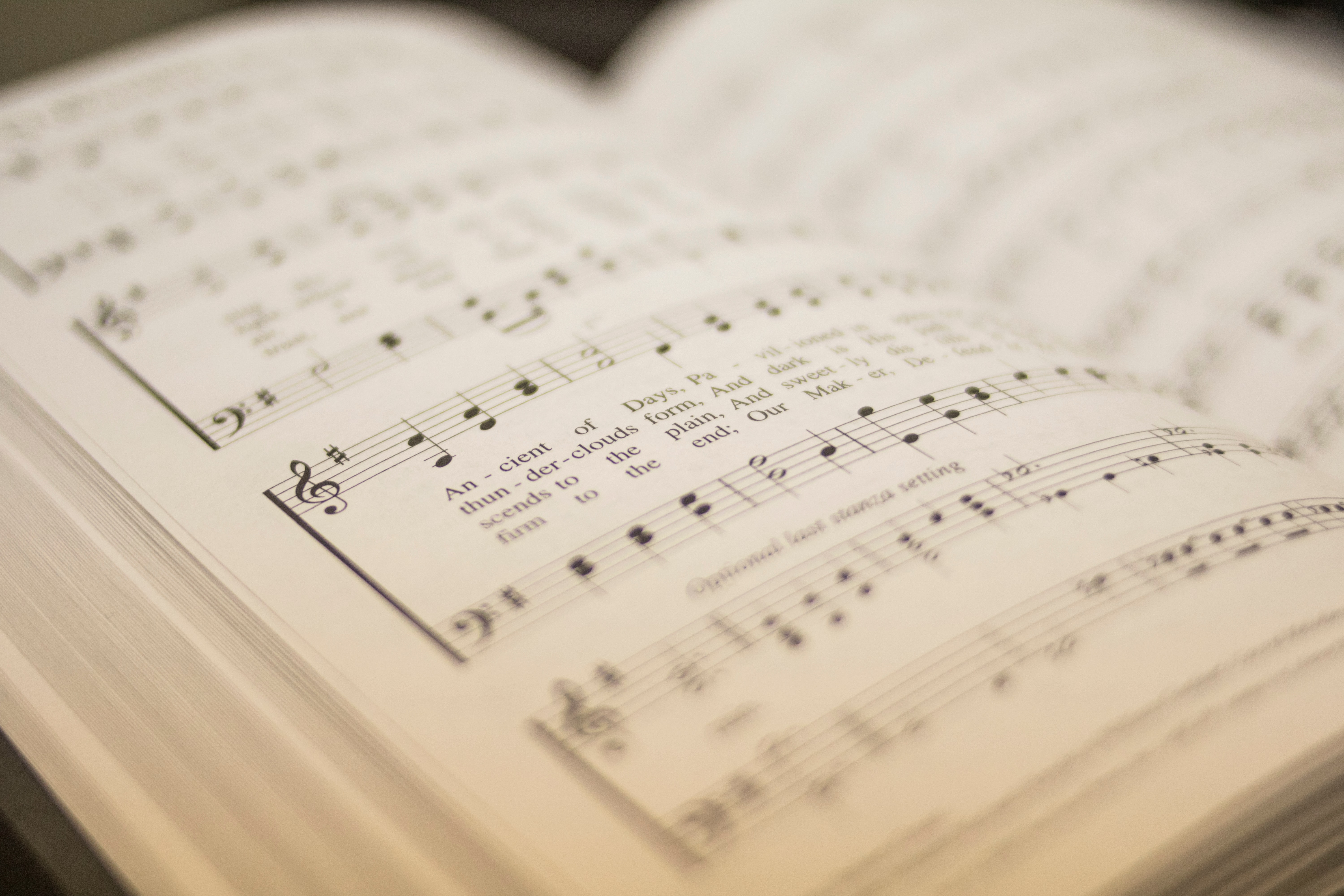
Here’s what I’ve learned from my time in school and church choirs about what it means to be in harmony: it means one singing part blending with another so that the parts enrich each other’s qualities. When I hear a choir, my ears don’t perceive the parts as separate components unless I work hard to distinguish the individual parts. Instead, I perceive the components as one, rich sound that would be missing something without each part. Harmony fills out a musical competition, giving it movement, depth, and nuance. A musical composition without harmony sounds thinner and flimsier than one with it.
Applying my limited musical knowledge and skills to the third reading reminds me that being in harmony doesn’t mean that we must never disagree, nor does it mean that we should all be the same. Rather, it means being open to each other’s gifts. Being open to each other’s gifts is essential for each of us to reflect who we are in God. We can think differently and be different from each other and still “[w]elcome one another” (Rom. 15:7). We don’t have to distance ourselves from those who are different from us. To “welcome one another” is not to let fear disrupt the harmony God wants us to enjoy with each other and with Him. It is to recognize the truth that God works through each of us because of our differences — differences that, when employed for “produc[ing] good fruit,” blend to make one sound that’s all the richer for being layered (Mat. 3:8).
The Bible.The New American Bible Revised Edition, Kindle edition, Fairbrother, 2011.
Confraternity of Christian Doctrine, Inc. “Sunday July, 2 2023: Readings at Mass.” The New American Bible, 2001. Universalis for Windows, Version 2.179, Universalis Publishing Ltd., 26 Feb. 2023, https://universalis.com/n-app-windows.htm








 Sitting with the Sacred