This week’s readings praise and honor God and advocate for my never ceasing to do the same. They also remind me that everyone and everything exists because of God’s power and with God’s consent. Without this power and consent, nothing would exist and nothing would be held together. But there is life, and there is relationship because God is life and relationship. There is life through relationship to God and one another.
The third reading continues to praise God while also highlighting the relationality of life in God. It also highlights how virtues are related to one another, saying:
We [Paul, Silvanus, and Timothy]give thanks to Godalways for all of you, remembering you in our prayers, unceasingly calling to mind your work of faith and labor of love and endurance in hope of our Lord Jesus Christ, before our God and Father, knowing, brothers and sisters loved by God, how you were chosen.
1 Thessalonians 2-4 [italics mine]
While nothing exists without God allowing it to, God wants us to love freely, and anything not done freely isn’t done in the love, so God doesn’t force us to bend to the Divine will. God gives us the freedom to be co-creators. The result of this freedom is that God isn’t the creator of everything. Some things are created by the tempter and accuser. Others are created by humans. We can use the things humans have created for good or ill.
Upon this reading of the Gospel passage, I feel like Jesus is asking me to think about what I value and to ask God to help me value my life-giving relationships more than the things I can use to benefit those relationships. It also challenges me to discern how the things I use affect my relationships with God and others. To what extent are these effects positive and negative?
What someone else is sharing about this week’s readings:
Lord, grant me the grace to recognize what belongs to you and to employ it to bring myself and others into union with you. Give me a deep awareness that this union is the source of all beauty, growth, and peace. Help me to remember to thank you for inviting everyone to share these gifts. Thank you, Lord. Amen.
This week’s readings and Casey Stanton’s reflection on them offer me five different lenses through which to find hope. I’ve heard the spiritual understanding of hope defined as “joyful expectation.” I’m not sure who I received this understanding from — maybe my spiritual director. So if you’re reading this, and you shared this understanding with me — thanks — because that understanding of hope comes to mind as I read this week’s readings.
The Old Testament reading gives me a glimpse of the future — when everything reflects nothing but God’s nature, which is love, and which I sometimes grasp partially — as justice and mercy — with the line between the two virtues being indistinct because one can’t be separated from the other. This reading contains one of those verses familiar both to people with a lot of background in Scripture and without that background. The verse says:
The Lord GOD will wipe away the tears from every face; the reproach of his people he will remove from the whole earth; for the LORD has spoken.
Isaiah 25:8
The psalm this week is also familiar favorite, Psalm 23. As I’ve written in a series on this blog, I see this psalm as a proclamation of faith and a promise, and faith and promises are founded on the joyful expectation that is hope. If you’d like to visit or revisit that series, it starts here.
The third reading tells me that holding onto hope allows a person to maintain trust in God’s love regardless of what his or her circumstances are. The third reading also includes a verse that can be helpful for inspiring hope:
I can do all things in him who strengthens me.
Philippians 12:13
Now no one is called to do everything. Rather, we’re called to have hope and faith that we can do what each of us is called to do. Each of our vocations involves some activities and experiences that others also share in and other activities and experiences that are unique to each of us. So the third reading urges me to have confidence that when I trust in God, I’ll be able to do and be what I’m called to do and be, whether I find myself in pleasant or unpleasant circumstances. This message gives me hope.
As I read this week’s Gospel passage with the theme of hope in mind, its words remind me that authentic hope comes from accepting God’s invitation to a healthy relationship with God and one another. Hope comes from viewing whatever I do in terms of how it contributes to the health of those relationships. Nothing I do or want can replace a healthy relationship with God, and I can’t have healthy relationships with others, or with my goals if I don’t have healthy relationship with God.
The passage also tells me that an authentic — a.k.a. healthy — relationship with God can’t be faked. Hope can’t be faked either — at least not in the eyes of God. This is important to keep in mind because it’s authentic hope that solves problems and allows for harmony with one another and with God.
Lord, please strengthen my hope; help me cling to it regardless of my circumstances. Amen.
What someone else is sharing about this week’s readings:
While I looked at the Gospel passage as I considered the theme of hope, I’ll be honest — I’m bothered by the amount of violence the featured parable includes. So was Casey Stanton. Then some current events inspired her to relate to the parable differently than she had before. Click here to find out how.
Beyond this week’s readings:
Ms. Staton reflects on events unfolding in the Catholic Church. Her reflection prompts me to ask how a listening and sharing approach to relating to others, how an attitude of stillness and openness with regard to my circumstances, can be lived outside those events. Lord, open my senses, my heart, and my soul. Amen.
Work cited
Confraternity of Christian Doctrine, Inc. “Sunday 15 October 2023 28th Sunday in Ordinary time: Readings at Mass.” The New American Bible, 2001. Universalis for Windows, Version 2.181, Universalis Publishing Ltd., 8 Aug. 2023, https://universalis.com/n-app-windows.htm.
This week’s readings prompt me to imagine a high wall with a door in it. I’m on one side of that door, and God is on the other. God is knocking, asking me to open that door, to come in and work in the parts of God’s vineyard that occupy the space outside my body and soul. Opening this door will also allow God to work in the parts of the vineyard that God placed within my body and soul. God planted the vineyard, and the human tendency to sin created the weeds in the vineyard and the wall around it. This tendency also created walls within it. These are the walls of pride, anger, and envy.
I couldn’t enter the vineyard, and God couldn’t enter the vineyard of my body and soul if God hadn’t created doors into both. Why? Because “[God’s] thoughts are not [my] thoughts, nor are [my] ways [God’s] ways” (Isa. 55:8). The psalm goes so far as to describe God’s “grandeur” as “unsearchable” (Psalm 145:3). Yet God has created doors so that if I let God move freely in in the vineyards within and around me, whether I live or die, I won’t do so alone, but with God. And if I live or die with God, I do so for God and in God, as the end of Philippians 1:20 says.
The same door stands that stands between me and God stands between God and everyone else. It’s up to each of us how wide we open that door. What can be found through that opening is the same for everyone, regardless of when each person opens the door while he or she lives on this earth. Once we no longer live on this earth, we live on, we are eternal, in God to the extent that we have allowed God, the Eternal, to live in us.
What someone else is sharing about this week’s readings:
In Darlene Jasso’s reflection on this week’s readings, she asks how our world would be different if we treated each other the way God treats us. As last week’s readings told us, God doesn’t treat us the way we sometimes treat God and each other. God doesn’t draw close to us only when He asks something of us or only in difficult times. God doesn’t give us back only what we give to God. God withholds no part of Himself that we are open to receiving.
Beyond this week’s readings:
Ms. Jasso makes important and thought-provoking points about God and us. She says God shows everyone the same generosity. This truth can be difficult to keep in mind. I don’t know about you, but when I don’t make a conscious effort to alter my mindset, I tend to think that God loves and answers the prayers of the people who do the things that God wants when He wants and doesn’t do the same for the people who don’t do what He wants.
And it’s a worthy ideal for me to show everyone the same generosity. I suppose the true ideal would be to withhold nothing good from anyone. It’s easiest to want to do this with nonmaterial goods, such as justice and mercy. But my mind can’t quite ignore that what the landowner in the parable offers is monetary payment.
I realize that parables are highly metaphorical, that what the landowner, who represents God, gives represents more than money. Yet parables also don’t shy away from teaching us about what we should do with our material goods — material goods that none of us have an unlimited supply. Most of us have far less than an unlimited supply of material goods, and some of our brothers and sisters don’t have even what they need to survive, let alone be healthy.
Imagine if all of us found ourselves in this situation of need. Imagine if we all received the same level of generosity that too many societies show those who like the most basic necessities — which is not enough. On the other hand, what if we showed everyone unlimited material generosity? My human mind says resources would run out, that God has unlimited resources, but the physical world doesn’t. Another preachy voice in my head says that this reality is the reason we need to trust God to supply what we lack. And yet God doesn’t always supply what people lack, materially. Otherwise, food insecurity and famine wouldn’t exist. Yet they do, so God wants us to provide for each other and to share what we have.
God also knows having everything we want wouldn’t be good for us because excess lets us believe that we don’t need God and each other, that what we have is a substitute for interdependency on each other and dependence on God. God also knows that once humans have more than we need, we tend to want even more than that, and the more we have, the more we want, and we tend to confuse what we want what we need and to fear losing what we have wanted and received.
I suppose the realization I’ve come to as I write this post is that generosity means discerning what we truly need versus what we want and sharing what we have but don’t need. That which gives some of us what we want can supply what others need.
God doesn’t need us or any other part of creation, but God wants us, and so He distributes what He doesn’t need — all of creation — among various members of His family.
Lord, help me to discern the difference between what I want and what I need and to share my surpluses. This is the generosity you ask of me. Help me to practice it. Amen.
Work cited
The New American Bible Revised Edition, Kindle edition, Fairbrother, 2011.
This week’s readings are about the value of wisdom, what wisdom looks like — and what it doesn’t look like. They tell me that wisdom means wanting to know right from wrong. It also means knowing that without God’s grace, I can’t know right from wrong. It means having hope because the ultimate form of the many forms this grace takes is that God was carried and delivered by a woman, entering personally into the human experience. God entered into the darkest parts of that experience, giving everything possible to those darkest experiences so the Light could overpower them. Nowhere the Light breaks through can remain as dark as it was before Light’s entry, and the more Light is allowed in, the more darkness is pushed out. The way I’m thinking about this in terms of Jesus is that once the Spirit had left his human body, suffering and death no longer had metaphorical fingers on God.
They still have fingers on God’s creation, but those fingers no longer have a chokehold on it because the darkness cannot be stronger than unfettered Light. Because Light’s now unfettered, it shines on all of creation — or it would if it could shine through everyone.
But we all block the Light in some ways; I know I do. My desire to have only what I want when I want it and nothing I don’t gets in the way of the light shining through me. This desire lets ingratitude and covetousness spread in my heart. From my heart, it spreads to my mouth and comes out as criticism and self-righteousness fueled by unchecked anger and resentment. Fears about not getting only what I want when I want also get in the way of me being a conduit for the Light.
Such desire and fear is selfishness. It’s the result of looking at myself, others, and God only through the lens of my own pain and my desire to avoid it. I can’t honestly say I’m willing to sell everything that seems to allow me to avoid it so that I can make room for the Kingdom of God that Jesus has purchased for me. I don’t honestly trust myself to protect the treasure of the kingdom that is within and around me. I’m not even sure I can honestly say I want to. But I know that I want to want to. So my prayer for this week is for the Spirit to give me true wisdom so that I can recognize in a personal, heart-based way what a treasure the Kingdom of God is. Amen.
I sense that I received one answer to this prayer before putting it into words here. I sense that I may find what I’m seeking by approaching this blog differently in the future. One part of my idea – we’ll see if it’s God’s idea too — is to post links to others’ reflections on the readings each Sunday after this one. I don’t mean to say that I envision this blog becoming merely a place where I post links to other people’s writing and videos. On the contrary, the other part of my idea is to make this blog a place where I journal and pray through what ever form of expression seems most meaningful at a given time.
I feel called to shift what I write here from being focused on interpretation and application to being focused on conversation with God and with you. I suspect I’ll find it helpful to use prayer journaling prompts as inspiration for some future posts here. I hope they’ll inspire me to ask questions and to listen to and look for God. I also hope my exploration will encourage you to explore with God too. I’m discerning that I need more time for this exploration.
Taking this time may mean posting links to weekly reflections from others here and sharing journaling prompts and responses of my own more or less often than I have posted so far. I don’t know which. How often I post will probably vary what I’m wrestling with or sitting with. I’m looking forward to this new approach, this approach of noticing how the Spirit moves within and around me and not being in a rush to interpret what I notice or to tie it up in a very defined bow. Join me on this new adventure of following where the Wind blows and seeking the Light within and at each end of every tunnel. Lead me, Lord. Help me to dive deeper into love of You and everything and everyone that You love. Amen.
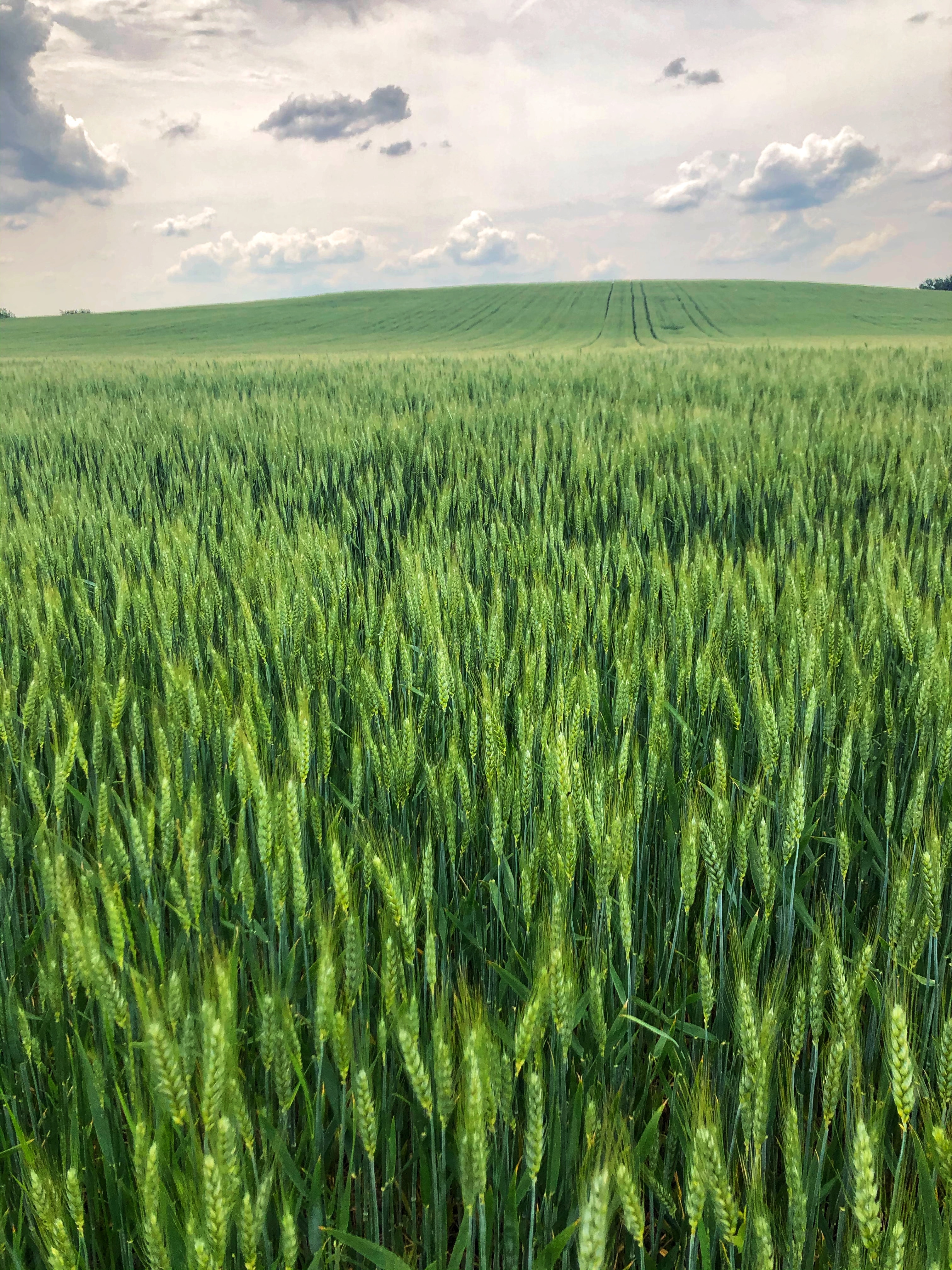
Last week, I wrote about how, being human, I have a tendency to turn flowers into plans that stunt growth. Either that, or I tend to expect weeds to be ugly, and when they aren’t, I let them choke growth. This week’s readings have more to say about these tendencies and how God responds to them. The readings also concerning the weeds I didn’t plant or allow to takeover and yet they still pop up in the fields and gardens of life.
I invite you also to join me in this prayer: Lord, I surrender the weeds within me to Your gardening. Thank You for your patience with me. Help me to extend this patience to the people and experiences in my life and to discern how to be just and merciful as You are just and merciful. Amen.
Photo by K. Mitch Hodge on Unsplash This picture was one of the results when I searched Unsplash.com for “God’s-Eye View.”
This week’s readings:
2 Kings 4:8–11, 14–16a
Psalm 89:2–3, 16–17, 18–19
Romans 6:3–4, 8–11
Matthew 10:37–42
I’d say this week’s readings are about how seeing the world through God’s eyes affects a person’s outlook and behavior. They’re also about how seeing this way reaps rewards, though often not one’s that come quickly or easily.
It seems a reward for virtue hasn’t come quickly or easily for the woman in the Old Testament reading. She’s promised a gift that she must worry she won’t receive —a son. The passage tells me “her husband is getting on in years,” and the couple doesn’t have a son yet, so there’s reason to doubt that would change as the husband ages (2 Kings 4:14). And not having a son could mean loss of financial security and social standing for the wife as she gets older, since, it seems, her husband is considerably older than she is. If he dies before she does, and she doesn’t have a son, she won’t have a home or support unless another male relative takes her in or she remarries.
The woman in the story isn’t going to be facing this situation though. Because of the hospitality she shows Elisha, he promises her that “by the same time next year, [she’ll] have a son” (2 Kings 4:16). The next verse reveals the woman’s life changes as Elisha has promised it will , but I think the fact that the reading ends before the prophecy comes true provides a lesson, which is that we can take Elisha at his word because word comes from God. The further message of the passage is that the woman receives her gift from God because she has supported God’s work in recognizing Elisha’s holiness and in offering him hospitality on account of it. In other words, good things happen to people who see the world through the eyes of God and respond to the needs that this way of seeing reveals to them.
This week’s psalm sends a similar message with the following words:
Blessed the people who know the joyful shout; in the light of your countenance, old LORD, they walk. At your name they rejoice all the day, and through your justice they are exalted.
Psalm 89: 16-17
The thing is, if a person doesn’t see through God’s eyes, someone “exalted” through God’s justice may not look “raise[d] on high; elevate[d], as the New World College Dictionary defines “exalted.” After all, Jesus was exalted by God’s justice and yet he grew up in circumstances that were humble, to say the least, and he worked hard, traveling long distances on foot. Then he was subjected to an agonizing death. Furthermore, relatively few people were physical witnesses to the signifiers of his exaltation, the resurrection and the ascension. Not even Paul witnessed these events in the way that people who walked with Jesus while he was alive did. And yet Jesus allowed him to see with God’s eyes and to write:
Brothers and sisters: Are you unaware that we who were baptized into Christ Jesus were baptized into his death? We were indeed buried with him through baptism into death, so that, just as Christ was raised from the dead by the glory of the Father, we too might live in newness of life.
Romans 6: 3-4
I don’t know about you, but I usually don’t feel like I’m living in “newness of life” or that I’m going to, so I don’t feel like the people described in the psalm as “rejoicing all the day at [the] name” of God (Romans 6:4). I’ve heard some believers say that the times I least feel like doing this are the times I most need to do it anyway. Come to think of it, a lot of activities and mindsets feel like less of a struggle to me — writing I’m thinking of you here—when I make myself do them even when I don’t feel like it. I suppose this approach to life builds perseverance and resilience. Maybe being intentional about offering gratitude and praise would remind me that God has a broader view of life than I do. God sees which path is best. I can’t on my own, but sometimes, with God’s help, I can. Yet even in situations where the best path seems clear, I need to allow that God sees and knows things I don’t and can’t.
The reality that I’m limited in ways God is why I need God’s help to have healthy relationships. What’s best for relationships and the people in them isn’t always what’s preferred by the people involved. However, when I don’t love God first so that I can see my relationships through God’s eyes, and love the people as God loves them, I distort who the people are. I turned them Into idols. To do so is to give all of us less than we deserve, which is to be seen and treated like the unique reflection of God that each of us is.
Lord, help me to see the world around me as You see it so that I can recognize what reflects You in myself and others and nurture it. Plans whatever is in me and others that doesn’t reflect You, and help me to trust that surrendering to Your vision and Your cleansing will result in an exultation that surpasses anything this world can offer or imagine. Amen.
Work cited
Confraternity of Christian Doctrine, Inc. “Sunday July, 2 2023: Readings at Mass.” The New American Bible, 2001. Universalis for Windows, Version 2.179, Universalis Publishing Ltd., 26 Feb. 2023, https://universalis.com/n-app-windows.htm
When I read the first reading, the Old Testament reading, I thought, It’s easy to zero in on the last sentence of the passage: “You shall be to me a kingdom of priests, a holy nation (The New American Bible, 2001 Edition, Exod. 19:6). It seems we humans are naturally tempted to put ourselves in God’s “in crowd” and to assume that others who aren’t part of our group are not a part of that “in crowd.”
But Isaiah, sacred scripture to both Christian and Jewish people, says that “The Servant of the Lord” is “a light to the nations,” not to just one group or one nation” (The New American Bible, 2001 Edition, 42:6a). And the second-to-last sentence of this week’s Old Testament reading gives me a different way of thinking about who belongs to God than Exodus 19:6a does. “If you hearken to my voice,” it says, “and keep my covenant, you shall be my possession, dearer to me than all other people, though all the earth is mine (The New American Bible, 2001 Edition, Exod. 19:5). What matters to God is that we “hearken to [the Lord’s] voice,” that we resolve again and again to do what that voice asks of us, to share it, and so offer back to God what God has given to us.
When our response to God falls short of what’s best, God is there to renew the covenant by reminding us of what He has done and inviting us to reenter into the covenant with Him. He has never abandoned it; it is we who have done that, not allowing God to possess us. He doesn’t prevent us from wriggling out of His embrace when we find it uncomfortable, even though “all the earth is [His],” and “[h]is kindness endures forever,/ and his faithfulness to all generations” (The New American Bible, 2001 Edition, Psalm 100:5). God wants everyone to enter the Divine flock, so much so that “Christ, while we were still helpless, yet died at the appointed time for the ungodly” (The New American Bible, 2001 Edition, Romans 5:6).
Considering that He went so far as to die, in the words of Romans “for the ungodly,” His instruction to His disciples “not to go into pagan territory” seems incongruous (Matt.10:5). It seems even more confusing when we recall that Jesus praised that faith of a Roman centurion and “stated that, in heaven, many Gentiles will dine together with Abraham, Isaac, and Jacob” (Matt. 8: 10; qtd. in Newman). (Check out the source I just linked to. It gives great background on Jewish-Gentile relations in biblical times and what the New Testament says about Jesus’ perspective on Jewish-Gentile interactions. Furthermore, after the resurrection, a disciple and apostle—Paul—discerned that he was called to do the opposite of Jesus’ instructions in Matthew 10.5. (See Galatians 2:7.)
The contrast between Jesus’ instruction in Matthew 10:5 and the inclusion of Gentiles in His teaching on other occasions, as well as Paul’s ministry to non-Jewish people, reminds me that who, what, when, why, and how are key questions to ask when seeking to do God’s will and to follow in Jesus’ footsteps. The mission of each follower of Christ and each person of goodwill has certain things in common. And yet, each person’s vocation is different in some ways than the calling anyone else receives. In addition, what we shouldn’t do in one moment may be something that we should do at a different time. These lessons bring to mind Ecclesiastes 3:1-8, the verses that, in the King James Version, start with, “to every thing, there is a season . . . “The translation I usually turn to begins these verses with “There is an appointed time for everything (Ecc. 3:1-8, The New American Bible Revised Edition).
So as I conclude my time sitting with this week’s readings for now, I’m reminded that God’s timing isn’t my timing, and my timing may not coincide with God’s.
Lord, help me to get out of my own way. Help me not to get in the way of Your work, the work of giving all of Yourself, the work of true love. Help me to remember that when I don’t get in Your way, when I instead imitate You in word and deed, I’ll be on the path of growth and of helping others grow, as this week’s readings remind me that God wants me to do by allowing Him to guide and to care for me. Amen.
The Bible.The New American Bible Revised Edition, Kindle edition, Fairbrother, 2011.
Confraternity of Christian Doctrine, Inc. “Sunday July, 2 2023: Readings at Mass.” The New American Bible, 2001. Universalis for Windows, Version 2.179, Universalis Publishing Ltd., 26 Feb. 2023, https://universalis.com/n-app-windows.htm
The grace of the Lord Jesus Christ and the love of God and the fellowship of the Holy Spirit be with all of you.
2 Corinthians 13:13
Today, we arrive again at Trinity Sunday. Here’s what I posted in honor of Trinity Sunday last year. I wanted to link to it because Richard Rohr’s reflection on the Trinity, which I included in the post, is insightful and helpful. But my plan from here on out is not simply to repost or to link to other posts.
This year, I feel prompted to sit with the Trinity by reflecting on 2 Corinthians 13:13. As I revisit this verse, it’s tempting to put dividers that are too solid between the Persons of the Trinity, to get the impression that the Lord Jesus Christ offers grace, God offers love, and the Holy Spirit offers fellowship, as if each of the Persons has a separate role. Yet I trust that my Creator, my Redeemer, and my sanctifier, a.k.a. my Father, my Brother, and the “love between them” extend grace, sacrificial love, and fellowship (Rohr). This one God in three Persons always has. The redemption began as soon as sin did. I trust that no part of God’s nature has ever not existed, and that the very nature of the Divine Being is grace, love, and fellowship. The theology of the Trinity reminds me that God is so intimate with me as to abide in my soul and body. At the same time, it reminds me that God’s nature and ways are above mine because God is the source and sustainer of all that lives and/or provides, all that is good. God is the ultimate intimacy and the ultimate transcendence. I’d say the way these qualities are entwined with each other like the strands of a braid is expressed as the Trinity.
What can this entwinning of seemingly opposite qualities, this Trinity, mean for my life and yours? As I’ve been mulling over this post the last couple of weeks, John 17 has been among the Gospel readings for each day. In this chapter, Jesus prays and teaches us what the Trinity can do and mean in our lives because of what it does and means in His. It means there’s no distance between Him and His father. is in His father and His father is in him. ( John 14:11). This abiding allows him to draw as near to other people as they will allow. If they don’t put up walls between themselves and him, and thus between themselves and the Father, they will be one with each other and will do God’s work. Their reflection of God and doing of God’s work will glorify the Father, and through the reflection and work the Father will glorify them.
Such glorification will result in those who allow the oneness standing out from whatever isn’t compatible with the life-giving, growth-supporting nature of the oneness. Whatever and whoever embraces and is embraced by this oneness opposes what is not embraced by it and is opposed by whatever or whoever doesn’t welcome the Divine Embrace that is the Trinity. Because Jesus knows the world needs the ones the Father has given to him and that they will face opposition both inside and outside themselves, He asks the Father not “to take [the ones He has given to the Son] out of the world but to keep them “from the evil one” because “[t]hey do not belong to the world anymore than [the Son] belong[s] to the world (John 17:9, 15).
The Son opened the Way to eternal life, and He leads us to it by his life, death, and resurrection. Thanks to his life, death, and resurrection, we are invited into the same embrace of the Trinity in which He lives. I invite this Love of the Trinity into my heart as I join my prayer to the one Jesus offers in John 17.
As another closing prayer, I’m looking to what is sometimes called “St. Patrick’s Breastplate Prayer” because, according to the version of this prayer that’s included with the Hallow app, it is prayed in Ireland not only on St. Patrick’s Day but on Trinity Sunday.
Deliver us deliver us from evil, Lord and protect us in times of temptation. Amen.
The Bible.The New American Bible Revised Edition, Kindle edition, Fairbrother, 2011.
Confraternity of Christian Doctrine, Inc. “Sunday July, 2 2023: Readings at Mass.” The New American Bible, 2001. Universalis for Windows, Version 2.179, Universalis Publishing Ltd., 26 Feb. 2023, https://universalis.com/n-app-windows.htm
Confession (or a peek behind the curtain): as I’m writing these words, it’s May 9. Since my Lenten Stations of the Cross series wrapped up, I’ve been writing the posts ahead. I hoped that by doing this, I’d have more time to reflect on the readings, and I’d be able to publish reflections that refer to the Mass readings for the day
Well, I got the first benefit with this post, but not the second. This post isn’t going to refer to this week’s readings because I just realized I looked at the wrong day’s readings when I started working on this post. The result is that this post makes a connection to last week’s readings — the readings for May 7 — not the readings for May 14.
Still, I enjoyed the connection I encountered between a verse in the May 7 Gospel reading and Psalm 23. So, with the exception of this introduction, I’m going to publish this post in what I previously thought would be its final form. The next post may relate to the readings for May 21, but then again, knowing me, it may not. Thanks for coming along with me on the adventure that is this blog.
“Believe me that I am in the Father and the Father is in me, or else, believe because of the works themselves”
John 14:11
You spread the table before me in the sight of my foes; you anoint my head with oil; my cup overflows. Indeed, goodness and mercy* will pursue me all the days of my life; I will dwell in the house of the LORD for endless days.
Psalm 23:5-6, The New American Bible Revised Edition
The readings for this Sunday don’t include Psalm 23, but I’ve found a point of intersection between the next two verses of the psalm and John 14:11, a verse from today’s Gospel reading. To me, verses 5 and 6 of Psalm 23 have something to say about how the Shepherd’s service shows even those who are not members of His fold just how powerful authority employed for care is. This care holds a power that everyone recognizes and wants to benefit from, even though not everyone recognizes the Foremost and Ultimate Shepherd and Host for who He is. Few people wouldn’t marvel at a host setting a banquet before a guest. According to the New American Bible Revised Edition, the banquet would signal to the psalmist’s enemies that he’s a “friend and guest” of God (Psalm 23: 5n).
But this host doesn’t just prepare a feast that would be enticing to anyone. He prepares his guests for this feast the likes of which they’ve never seen and can’t imagine or prepare themselves for. He helps them present the best version of ourselves to the world by anoint[ing] [their] head[s] with oil” (Psalm 23:5). The New American Bible Revised Edition says “a perfumed ointment made from olive [was] used especially at banquets” (23:5n). The third line of verse 5 and the note that accompanies it remind me of how someone is anointed with oil at baptism. According to information about the liturgy of baptism from the Diocese of Savannah, Georgia, “The celebrant anoints the person to be baptized with the Oil of Catechumens (an oil that has been blessed by the bishop for the candidates for Baptism) or imposes hands on the person. In this way, the person is being called to renounce sin and to leave behind the domination of the power of evil.” Artza adds that “Biblically, to be anointed was something of great significance, as it symbolized the Lord’s favor.” This Divine call and favor prepares the person for the heavenly feast, a gathering (communion) of the Host and His guests that satisfies their every desire and fills them with joy they can’t contain. I imagine it overflowing so that it can be shared among the guests and the host.
Many guests haven’t yet arrived at this feast, yet they aren’t totally cut off from its delights. They encounter “green pastures” and “still waters” that restore their souls after they’ve walked through “dark valley[s],” “the valley of the shadow of death” even (Psalm 23:2 and 4, The New American Bible Revised Edition; New American Bible, 2001 edition). These gifts help them endure the next valley they must pass through on the way to the feast as well. He doesn’t just lead them to these delights, either. These delights are both behind and ahead — for looking forward to and back upon for reassurance. They are ahead and behind because the Shepherd is always ahead, beside, and behind the members of His flock (Psalm 23: 4, The New American Bible Revised Edition). He is with them, and He “pursue[s]” them (Psalm 23:6, The New American Bible Revised Edition). [They are] “in the father, and the father is in [then]” (John 14:11).
Lord, remind me to look for You behind me, beside me, and ahead of me so that I may abide in You and so that You and Your works may be glorified because of my life. Amen.
Confraternity of Christian Doctrine, Inc. “Sunday 30 April 2023: Readings at Mass.” The New American Bible, 2001. Universalis for Windows, Version 2.179, Universalis Publishing Ltd., 26 Feb. 2023, https://universalis.com/n-app-windows.htm.
He guides me in right paths for his name’s sake. Even though I walk in the dark valley I fear no evil; for you are at my side, with your rod and your staff that give me courage.
— New American Bible, 2001 Edition
He guides me along right paths* for the sake of his name. Even though I walk through the valley of the shadow of death, I will fear no evil, for you are with me; your rod and your staff comfort me.
— New American Bible Revised Edition, 2011
Psalm 23: 3b-4
He guides me in right paths for his name’s sake. Even though I walk in the dark valley I fear no evil; for you are at my side, with your rod and your staff that give me courage.
— New American Bible, 2001 Edition
He guides me along right paths* for the sake of his name. Even though I walk through the valley of the shadow of death, I will fear no evil, for you are with me; your rod and your staff comfort me.
— New American Bible Revised Edition, 2011
As I announced at the end of last week’s post, I’m continuing to sit with Psalm 23 this week. The first line of this week’s excerpt paints a different picture in my mind than the “green pastures” or “still waters” of last week (Psalm 23: 2). I picture Jesus walking with me in a canyon. He’s behind me, actually. He has one hand on each shoulder, and I know that, using power I trust though I don’t understand it, he will guide me along the often steep, rocky path between the river at the bottom of this canyon and its rim. There will be times when I roll backwards (I use a wheelchair, remember?), many times, but he won’t let me fall the several stories into the raging river that carved the canyon. I won’t get lost in this place and be trapped forever. This is what being guided “in” or “along right paths” looks like to me (New American Bible, 2001 Edition; New American Bible Revised Edition). Maybe the canyon is this life.
So what’s with this line about “for his name’s sake”? (New American Bible, 2001 Edition).
To me, this phrase is a reminder of who God is. God is all that’s good: God is presence rather than absence, truth rather than lies, self-giving love rather than apathy. God cannot be what and who God isn’t, so the Shepherd of Psalm 23 can only lead sheep along the path that not only protects them but also allows them to thrive.
The path that allows them to thrive is often not well lit. The sheep’s view of the Light Source is blocked by the high canyon walls that surround the valleys through which the Shepherd leads them. Yet being surrounded by darkness is no reason to fear it because the Shepherd is with them in it. He isn’t guiding the herd through the darkness from a distance. He became a sheep himself and allowed himself to be slaughtered so he could walk alongside others facing slaughter and show them how to avoid this fate.
The rod was used to fight off wild animals and to count the sheep and direct them. The rod prodded them during the day in the fields and at night into the sheepfold. A willing sheep would respond to the prodding, but a stubborn, strong-willed sheep would not.
While sheep might not be as dumb as often suggested, they do have characteristics that give some merit to that claim. They’ll indiscriminately eat just about anything, regardless whether it is something that could harm or kill them. They endlessly wander, seemingly without direction. And many sheep stubbornly resist the shepherd’s prodding. That’s why the staff, with a crook at the end, is needed. The shepherd uses the staff to more strongly exert his authority and to gently, but firmly, pull the sheep back to the fold and keep the sheep moving in the right direction. He can also use the crook of the staff to pull the sheep from harm.
You can view a picture of these tools here. I think of a staff as a support for something else, but it’s apparently not just a supportive device, such as a cane is. It can be used to grasp and pull wandering sheep back to the shepherd if they won’t come back on their own, Abbot writes.
Being prodded back to the right path or pulled to it may not feel very comforting or courage-infusing when it happens. But sometimes it’s necessary to endure temporary pain to prevent longer-term pain. The cross is the ultimate example of this truth. The Shepherd submitted to it to deliver us from eternal pain, and because he didn’t want the pain of being eternally separated from us. In accepting the cross, he promised that any pain we face won’t last forever if we also accept his cross. In surrendering to the cross, he offers us courage and comfort through it, despite the pain it inflicts.
Other ways life follows the pattern of this truth come to my mind:
A medical treatment has difficult side effects but slows or halts the process of a life-threatening disease.
A Good Samaritan performs CPR, and this action causes bruising or popped ribs, (This can happen. Click here to see my source for this example.) but a person’s life is saved, and he or she eventually makes a full recovery.
Parents set boundaries for their children’s technology and media usage, or we set boundaries for our own indulgence in the things we enjoy, and the boundaries aren’t enjoyable in the short term, but living within them makes for healthier lives and means having time to learn important lessons and to build, repair, and strengthen relationships.
Someone misses an occasion he or she is look forward to, choosing instead to get started on a school project or to look after his or her health or someone else’s. Missing out is unpleasant but serves a greater good and pays off in the long term.
So the rods and the staffs of life keep us, the sheep, from wandering off, getting lost and likely getting attacked and killed in the process. We may not experience the rod or the staff as pleasant, but the Shepherd is aware of dangers that sheep aren’t. The shepherd knows the rod and the staff protect his sheep from the greater suffering — or worse — that they’d face if he didn’t use them.
And sometimes, even at the times they’re used, the rod and the staff don’t feel like punishments to the sheep, according to Jack Albright, retired clinical chaplain and freelance writer:
It is used in drawing sheep together into an intimate relationship. He will use his staff to gently lift a newborn lamb and bring it to its mother if they become separated. He does not use his bare hands for fear that the ewe will reject her offspring if it bears the odor of his hands upon it.
“[The staff] is also used for guiding sheep through a new gate or along a dangerous, difficult route. He will use the slender stick to press gently against the animal’s side, and this pressure guides the sheep in the way the owner wants it to go. Thus the sheep is reassured of its proper path . . .”The staff is also used for guiding sheep through a new gate or along a dangerous, difficult route. He will use the slender stick to press gently against the animal’s side, and this pressure guides the sheep in the way the owner wants it to go. Thus the sheep is reassured of its proper path . . . Keller says that he has seen a shepherd walk beside a pet or favorite sheep with his staff gently resting on its back. It appears that they are in touch or walking hand-in-hand. Sheep are not easily trained but this may be a method of training her as a leader.
The Shepherd’s staff – a source of comfort
This excerpt reminds me that, yes, a shepherd reassures his or her sheep. The Good Shepherd does this better than any other. It also reminds me that the Good Shepherd came not just to walk alongside us, amid his flock, but to teach us to be a leader like him. Thank You, Lord, for being the Foremost and Ultimate Shepherd.
And Lord, even when Your protection and your training aren’t experiences I’d like to repeat, help me to recognize You loving me through these difficult times. Help me to respond eagerly to Your efforts to shape me into a leader with Your eyes, Your heart, Your mind, and Your will. Amen.
The Bible. The New American Bible Revised Edition, Kindle edition, Fairbrother, 2011.
Confraternity of Christian Doctrine, Inc. “Sunday, 7 May 2023: Readings at Mass.” The New American Bible, 2001. Universalis for Windows, Version 2.179, Universalis Publishing Ltd., 26 Feb. 2023, https://universalis.com/n-app-windows.htm.








 Sitting with the Sacred