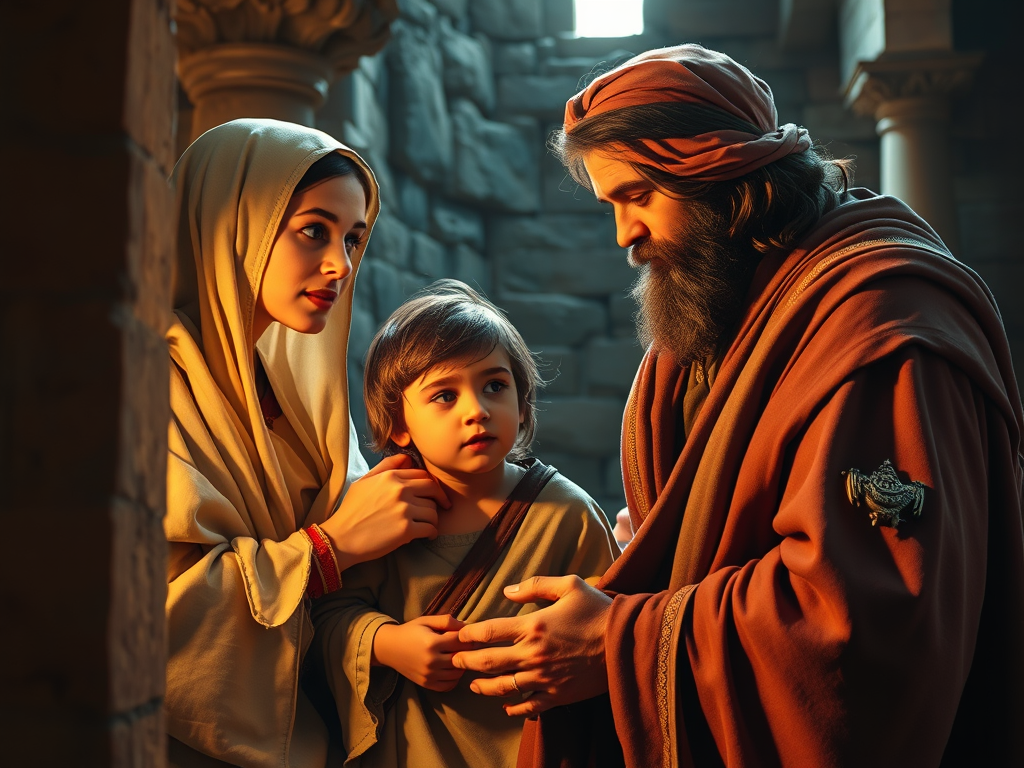
Readings for December 29th:
- 1 Samuel 1:20–22, 24–28
- Psalm 84:2–3, 5–6, 9–10
- Colossians 3:12–17
- Luke 2:41–52
Reflection on the Gospel Passage for December 29th: Luke 2:41–52
Like many of us, the family in this week’s gospel passage has been traveling as a part of its observance and celebration of a religious festival. Like many of us, this nuclear family has been sharing in traditions and customs with family and friends. The passage describes this nuclear family as having “completed [the] days” of the festival (Luke 2:46).
Perhaps this wording is simply a reflection of the culture in which the passage was written. Perhaps such observances represented obligations that needed to be fulfilled, tasks that needed to be completed. And yet, it was undoubtedly not just God that these rituals served. They also served the family members, providing welcome variance in their day-to-day routines and helping them to think not only in terms of days but in terms of centuries, maybe even millennia. They strengthened the connections between generations. And not just because people of different ages might share in these customs, not just because of what might be enjoyable about the customs either.
Holiday travel can be a pain these days, but I feel like any conception that I might come up with for how difficult it must’ve been in Jesus’ childhood would be woefully inadequate. Yet, this week’s gospel passage tells me, Jesus’ family and friends have traveled to Jerusalem and continued Passover traditions in what must have been a crowded city.
Then the time comes to head home, and, lo and behold, Joseph and Mary can’t find their boy. For a while, they assume he’s with their friends and extended family. It’s no wonder. They’ve been traveling with a large group.
And part of me imagines they just weren’t ready to grapple with the reality that their boy wasn’t with that group. This possibility would be beyond difficult for any parents to face. Add to that what the possibility would mean for Mary and Joseph — that they have lost God’s son, the Messiah Israel that has been promised and has been waiting for for so long.
I imagine them wondering why God would let this happen. Would God let their failures get in the way of God’s promises to his people being kept. How could it be God’s will that any son disobey his parents, let alone this Son?
We’re told that it takes Mary and Joseph three days to find Jesus. Yes, groups of three have symbolic importance in Scripture. I’m not sure what the official interpretation of the symbolism of three in the Bible is, and to be quite frank, I’m probably not going to look it up before I publish this post. I’m writing these particular words for days before Christmas and probably won’t get them published much before the twenty-ninth. I want to spend most of the time in between being present with my family and friends.
At some point in school, I learned that the triangle is the strongest shape, so the number three makes me think of strength. Its association with the Trinity makes me think of strong bonds. Its association with the time between Jesus’ Last Supper and his resurrection makes me think of perseverance in the face of suffering. It makes me think of how waiting itself can be a form of suffering. Time passing more quickly than I would like can bring suffering with it too.
I imagine Mary and Joseph experiencing many forms of suffering when they have to accept, after having traveled a day’s distance, that Jesus isn’t with them or any of their traveling companions. Maybe they didn’t even feel like they ought to take time to eat or sleep while they searched for Jesus. Maybe they didn’t have appetites anyway and couldn’t relax enough to rest even if they thought God wanted them to. These possibilities mean more suffering.
In the midst of their suffering, Mary and Joseph find Jesus in the temple. He’s listening to the teachers there, “and asking them questions” (Luke 2:46). The phrase in quotation marks stands out to me. It reminds me of how important listening and asking questions is to forming and growing relationships, even my relationship with myself. It reminds me that these are no less important components of my relationship with God.
After I read that Jesus is “sitting in the midst of the teachers, listening to them and asking them questions,” I read that “all who heard him were astonished at his understanding and his answers” (Luke 2:46-47). It seems like the listening and understanding are going in multiple directions. There’s a message about what it means to grow and to grow in all kinds of relationships in that detail as well. The same detail also says that God listens to and understands me. And by me, I mean you, too.
Maybe, at the age Jesus was when he found his way to the temple, didn’t understand human nature quite as well as he would come to as he “advanced in wisdom and age and favor before God and man” (Luke 2:52). After all, in the passage, he doesn’t seem to understand his parents’ anxiety and confusion. He seems to think they should have known why he left the group and where he went. Nevertheless, despite his young age, he seems to have a clearer grasp of who He is and what that means then they do.
Maybe Mary and Joseph have become comfortable in their day-to-day and annual duties and with their own ideas of what the future will hold for them and for Jesus. Maybe they’ve consoled each other by saying that the suffering they were warned about when he was eight days old hasn’t come yet. And then he disappears, and when they find him, he reminds them who he is. He invites them, once again, to trust God in the face of uncertainty — just when they’ve begun to believe they understood the parts they’d been given in that plan.
How many times have we acted and felt like Mary and Joseph, even though we haven’t been tasked with bringing up God’s son, and some of us haven’t been given children to bring up all? On the other hand, what about times we’ve wandered from the path of others thought we would follow on our quest to become the person God calls us to be and to do what God calls us to do? Do we have the courage to listen to the questions of others, as well as to their answers. Do we have the courage to learn from each other? Do we have the courage to ask the questions and listen to the answers? Do we have the courage to trust that God listens to us even when it’s hard for us to see the evidence of that listening. Lord, give us the courage. Holy family, pray for us. Amen.
Work cited:
The New American Bible Revised Edition, Kindle edition, Fairbrother, 2011.




 Sitting with the Sacred