Readings for September 15th:
- Isaiah 50:4c–9a
- Psalm 116:1–2, 3–4, 5–6, 8–9
- James 2:14–18
- Mark 8:27–35
What this week’s readings say to me:
The first reading presents someone who trusts receives God’s guidance and doesn’t rebel against it. He goes where God’s Spirit prompts him to go, and he hasn’t “turned back” (New American Bible Isa. 50:5). He hasn’t “turned back” even though he’s treated the way Christ will be treated during his passion (New American Bible Isa. 50:5). He never wavers from the path God leads him on despite his being treated this way. Why? Because, as a newer translation of the same addition of the Bible says, “He who declares my innocence is near” (New American Bible Revised Edition, Isa. 50:8). So in this passage, God is the best defense attorney. God knows God’s own law better than the people who are wrongly accusing and abusing Isaiah. The case of the accusers has no foundation.
In the psalm, the narrator explains why he loves the Lord. He says he loves the Lord because the Lord has heard his cries for help. He was in danger of death. His spirit was threatened by other spirits that have rebelled against the Holy Spirit. God saw how vulnerable he was in the face of these forces and stopped them from causing him to stumble and from weeping in hopelessness (New American Bible Revised Edition, Psalm 116:8). As a result, [he] “shall walk before the Lord in the land of the living” (New American Bible Revised Edition, Psalm 116:9). According to a note in the New American Bible Revised Edition, “walk[ing] before the Lord in the land of the living” “probably refers to being present to God in the Temple” (Psalm 116:9; 116:9n). This explanation prompts me to ask the question: what can we do to be active in living with faith?
The first two verses of the Old Testament reading give one answer and the third reading, the epistle, develops that answer further, telling us that wanting others to have what they need doesn’t bring faith to life. It’s taking part in providing what others need that brings faith to life. Faith isn’t demonstrated by prayer alone. Prayer opens us to the guidance that helps us discern how best to respond to the needs around us. Whatever the needs are, God brought us into being to meet them, even in the face of extreme opposition, as is the case in the Old Testament passage.
None of us is alone and having been given this work to do. God has done this work first and has called prophets to take part in it. God has also taken on a human life and suffered for it.
We will struggle. and sometimes suffer when we imitate Him. Why? Because humans have a tendency to want to hold onto power by keeping it to themselves and using it for themselves. Christ’s power, on the other hand, comes from his willingness to share and to surrender it. If we trust that surrendering is the true source of power, we receive that power as well. We receive that life. Turning inward in fear and holding on tightly to what we have isn’t the source of life, the Gospel passage says. Being able to hold loosely to what we have because we trust in God is the source of life.
What I’m saying (to the readings and beyond) this week:
To the first reading I say that I wonder if it’s my experience that “God opens my ear” (New American Bible, Isa. 50-4c). Maybe God does but like a door, I close it again because when my spiritual ear is open, so many voices come in and none of them is perfect, and that includes my own, of course. So when I choose what voices to listen to when and I act accordingly, I’m not sure it’s God or everything less than God that I rebel against.
Because of this experience, I take comfort that Christ encountered both opposition and support from every corner. He didn’t encounter opposition or support from only one group or another that He seemed to belong to or not to belong to or that seemed to some of his contemporaries to have spiritual and/or temporal authority over Him.
It’s a challenge to internalize that God defends me and that “I am not disgraced” when I have trouble recognizing this (New American Bible Revised Edition, Isa. 50:7). It’s a challenge not to be controlled by fear and not to be held back by walls in my mind and the walls I want to build around me to protect myself.
As I reread the psalm excerpt, I see that it’s written from the perspective of someone who feels trapped — “helpless” even (New American Bible Revised Edition Psalm 116: 6). It’s God who saves this person when he cries out to God. This person alone can’t save his own life.
Reaching out to God in the midst of fear is the key to not letting the fear kill the soul. It’s a key that’s most difficult to take hold of in life’s most difficult times, but that’s why God became one of us and then allowed Himself to be killed. He took the worst parts of us onto Himself so that we could become our best selves, so that we could become more and more like Him. That’s why the name for Christ that resonates most deeply with me is “God with us” (New American Bible Revised Edition, Mat. 1:23).
What someone else is sharing about this week’s readings:
Zulma Tellez reflects on Christ on the cross as a profound a profound expression of God with us.
This week’s prayer:
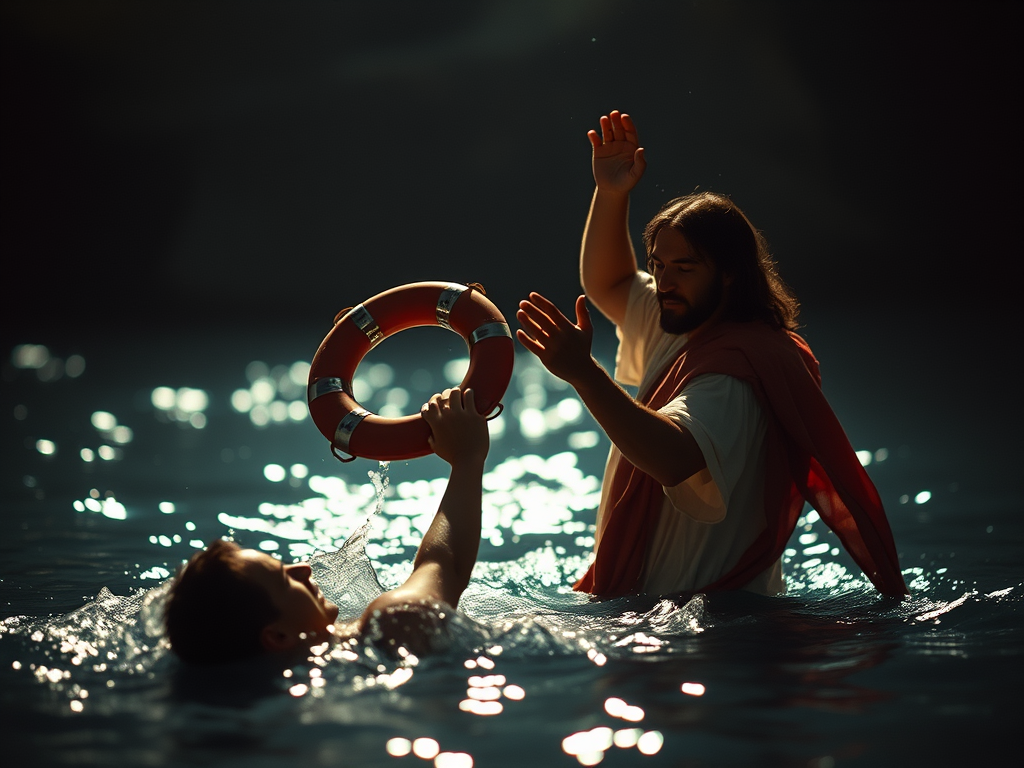
Lord, You have thrown me many spiritual life preservers, the greatest of which is Your sacrifice on the cross. Don’t let me close my spiritual ears to the sound of your voice. Instead, help me tear down any walls that fear has built in my mind and heart to keep me from reaching out to You and my neighbors. Amen.
Works cited (but not linked to):
Confraternity of Christian Doctrine, Inc. ” 24nd Sunday in Ordinary Time — 15 Sept. 2024: Readings at Mass.” The New American Bible, 2001. Universalis for Windows, Version 2.192, Universalis Publishing Ltd., 30 July 2024, https://universalis.com/n-app-windows.htm.
The New American Bible Revised Edition, Kindle edition, Fairbrother, 2011.
 Sitting with the Sacred
Leave a comment