Readings for September 8:
- Isaiah 35:4–7a
- Psalm 146:7, 8–9, 9–10
- James 2:1–5
- Mark 7:31–37
What this week’s readings say to me:
The readings for September 8 give me more to work with in the exploration of what justice means that I began in last week’s post. The passages tell me that doing justice means making sure that everyone has what they need to thrive physically, mentally, and spiritually.
Justice serves what gives life by looking beneath the surface for signs of that life. It doesn’t serve that which is fleeting or artificial—except when what is fleeting or artificial serves what’s good and eternal.
Beyond this week’s readings:
In the previous section, I wrote that justice removes barriers rather than that justice heals, even though the readings for September 8 contain more than one reference to what are often called healings. I wrote to “removes barriers” because I’d like to propose that the references to physical healing in the readings don’t have to be as much about removing this physical impairment or that one – any physical impairment, for that matter — as we may be accustomed to thinking they are. (By the way, these perspectives on physical impairment and their relationship to well-known accounts in Scripture are far from unique to me. Ms. Iozzio, whose reflection is linked in the next section, offers a perspective that relates to my own.)
Healing is involved, but I propose that more is being healed than seems apparent. A man’s physical Deafness is removed, and his difficulties with speech are removed so that he can connect with and contribute to his community in different ways than he has before. The event inspires his faith in Jesus as God incarnate.
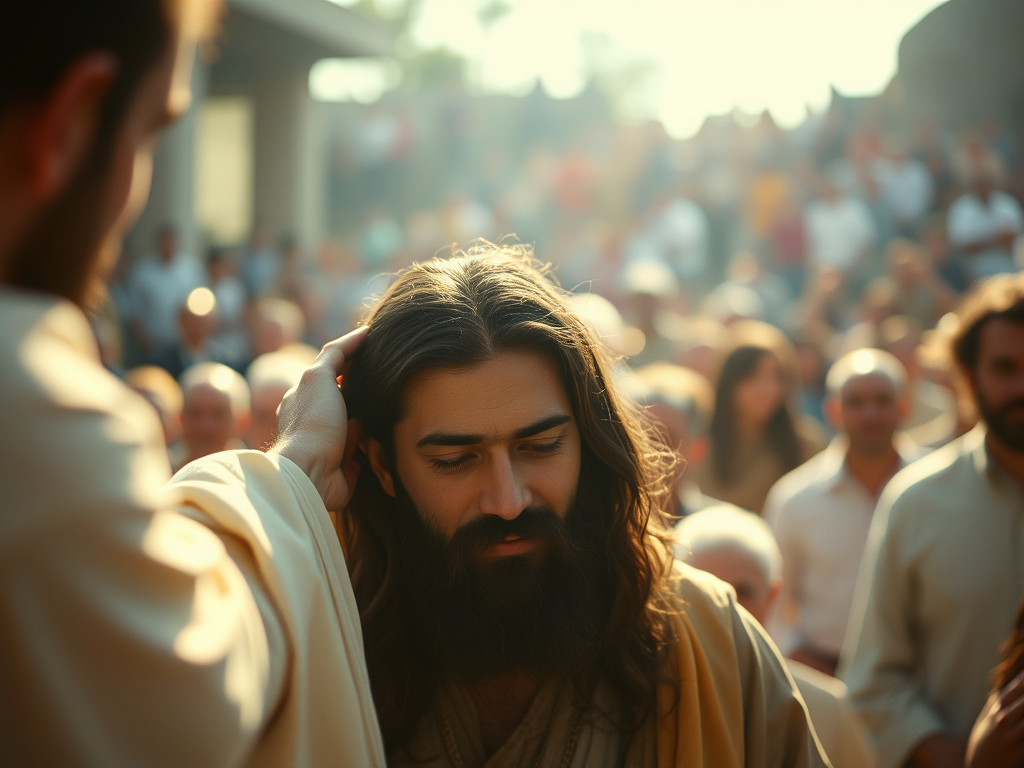
I find it revealing that Jesus doesn’t say to the man “hear” and “speak clearly” when he lays hands on the man. Instead, He says, “Be opened!” (Mark 7:34). Granted, I can imagine ancient peoples explaining Deafness as being caused by the ears being closed. But I can also see “Be opened!” meaning, “Be open to faith.” For this man, Jesus is also opening the door to relating to his community in a new way. I invite you to read more about that new way of relating by clicking the link in the next section.
Each of us, regardless of what our limitations are and what causes them, are our most God-like selves when we’re open to faith and community. There are multiple ways to facilitate this openness. Healing impairments is only one of them. We can remove barriers. We can also be open to alternate ways of communicating and seeing. Impairments do no mean that a person reflects God’s image any less clearly than someone who seems to be without impairments. Being a member of the Deaf community or having a disability or illness doesn’t make anyone any less complete than anyone else. This perspective affects everyone because no one on this side of heaven has an invincible body.
New Testament support passages support the perspective that, though we are called to do our best to take care of what we have, and God is present to us to us so that we can share our desire to be well, having certain abilities isn’t the ultimate goal of the spiritual life. Consider that:
- Jesus tells his apostles that a man’s blindness is not reflection of his own sinfulness or the sinfulness of his parents (John 9:1-3).
- Saul, who will become Paul, goes blind when Jesus speaks to him on the road to Damascus (Acts 9:7).
- Jesus heals a paralyzed man, telling him to get up and walk so that [onlookers] “may know [He has] the authority to forgive sins (Mark 2:9-12).
- After healing a woman who’s had a hemorrhage for years, Jesus says to her, “your faith has saved you (Luke 7:50).
The human conditions in the examples above aren’t punishments. Even in Paul’s case, I think it’s the brightness of the light that blinds him, and the blindness helps him rely on God and the people around him (Acts 9:8). Blindness means the loss of physical vision for Paul, but it also means the acquisition of clearer spiritual vision for him.
However, it’s important to note that, in the same way that having an impairment doesn’t make a person less complete, than a person without that impairment, the condition also doesn’t necessarily make a person more spiritually insightful than a person without the same impairment. It’s also important to note that God is at work in different ways in different situations and to be cautious about presuming to understand why circumstances are what they are. Every situation presents its own challenges and its own opportunities for grace.
In each of the examples above, the physical healing isn’t the only or even the primary gift Jesus offers. The miracles treat sick souls, and not just the soul of the person who experiences a physical impact, but also the souls of the people who witness the impact or learn of it more than 2,000 years later.
What someone else is sharing about this week’s readings:
Mary Jo Iozzio brings contemporary perspectives on Deafness and disability into conversation with the Gospel passage for September 8. She helps us consider that that the passage isn’t about just one person “[b]e[ing] opened,” one person receiving the physical abilities that many his neighbors have.
This week’s prayer:
Lord, help us to be open to You and to one another. Help us to respond to Your invitation to healthy relationships, which are two-way streets that can be built in many ways. Amen.
Work cited (but Not Linked to)
The New American Bible Revised Edition, Kindle edition, Fairbrother, 2011.
 Sitting with the Sacred
Leave a comment