Yes, this post responds to more readings than my posts usually do. I won’t have much time for the blog in the next couple of weeks. That’s the reason for this change. So I’m going to handle this reality by reflecting on two weeks’ passages in one post. What will it be like to look at two weeks’ worth of passages in one week? Let’s see.
Readings for September 29 and October 6:
Numbers 11:25–29
Psalm 19:8, 10, 12–13, 14
James 5:1–6
Mark 9:38–43, 45, 47–48
Genesis 2:18–24
Psalm 128:1–2, 3, 4–5, 6
Hebrews 2:9–11
Mark 10:2–16
What this post’s readings say to me:
The action of the Spirit defies human categories and divisions. It brings us breath and clarity of vision that we don’t have without it. It makes us brothers and sisters of Christ who can speak and act as He does. It allows us to recognize one another as children of God. It allows us to recognize that we all need one another’s gifts. It allows us to recognize that we need the gifts of nature, and the grace of God’s love and mercy. The movement of the Spirit unites us to God and to one another. At the same time, it gives different gifts to each of us.
What I’m saying (to the readings and beyond) this week:
I’m saying to the readings, “I feel left out of your message. It’s not obvious how to find a way to apply your message to my life.” The readings for October 6th have a lot to say about marriage. I’ve never been married, so it doesn’t seem helpful for me to reflect on what the passages say about marriage. I encourage reading the passages for both weeks and reflecting on what they say to you and about marriage.
What someone else is sharing about this week’s readings:
Lord, help us to honor the commitments that are not harmful to us. Help us to be loyal and compassionate in the relationships that are not harmful to us and those around us. Help us to celebrate each other’s differences and to remember that unity and equality don’t mean sameness. Grant us the grace to care for the resources around us and to use them wisely. Thank you for your providence, Lord, and for making us for relationship and communion. Amen.
The first thing this week’s readings say to me is something I heard in the homily last week: (I paraphrase here, even though I’m putting the following in quotation marks): “Read all Scripture in light of Christ.” If I apply this instruction, Jesus Christ is “the just one” and “the wicked” are those who crucified Him (The New American Bible, Wisd. 2:12) It also characterizes “the wicked” as:
finding it extremely distasteful when someone else takes a stand against the self-serving things they do and voices opposition to these activities, holding them accountable and wanting their actions to reflect the good they’ve been taught to do
trying to trap the person who does justice, make that person look untrustworthy and to stop others from doing what he does and says
taking the name of God in vain, in a way, by talking about God as if their faith in God excused them from acting with justice themselves
Plotting to break the resolve of just one through violence and then justifying their actions by saying that God would spare him from this violence if, in fact, God were on his side.
The psalm is written from the perspective of a person of faith who strives to act with justice. It acknowledges the power of God — even the power of God’s name. It calls out to that power for help. The speaker is frank with God about the suffering he’s experiencing. But after talking to God about his suffering, he reminds himself that God “is [his] helper, by resolving to give of himself to God and to just causes, and to recall God’s faithfulness even in the midst of circumstances that tempt him to doubt.
The epistle gives answers as to what leads to the “wicked” behavior described in the first reading: “jealousy and selfish ambition” (Wisd. 2:12; Jas. 3:16).
Behavior that’s inspired by wisdom from above, on the other hand, is “first of all pure, then peaceable, gentle, compliant, full of mercy and good fruits, without inconstancy or insincerity and the fruit of righteousness is sown in peace for those who cultivate peace” (Jas. 3:17).
Conflicts great and small come from “passions” — selfish desires, the passage says (Jas. 4:1). The footnote on James 4:1-3 in The New American Bible Revised Edition says:
Passions: the Greek word here (literally, “pleasures”) does not indicate that pleasure is evil. Rather, as the text points out (Jas 4:2–3), it is the manner in which one deals with needs and desires that determines good or bad. The motivation for any action can be wrong, especially if one does not pray properly but seeks only selfish enjoyment.
In the Gospel passage, I see the apostles struggling with letting their “passions” get the better of them (Jas. 4:1). When Jesus tells them he “is to be handed over to man and they will kill him” (Mark 9:31). I imagine the apostles’ primary response to have been fear. Maybe doubt and discouragement joined the fear.
Maybe their desire to counteract these uncomfortable feelings tempts them to be jealous and selfishly ambitious. The passage tells us that after Jesus warns them that he won’t resist the violence of his opponents, and this lack of resistance will lead to his suffering and death, they discuss “among themselves…who is the greatest” (Mark 9:34). Jesus tells them that the one who is “the greatest” is the one who doesn’t wish or strive to be and instead serves everyone else, especially those who are humblest and most vulnerable.
What I’m saying (to the readings and beyond) this week:
I’ve heard or read most of the passages often enough that I accept their teachings as truth, even though my desires don’t always counteract what the first reading describes as “wicked[ness] (New American Bible, Wisd. 2:12). The first reading feels less familiar. It also uses the sharpest language. Maybe that’s why I reacted most strongly to it.
The passage prompts me to ask myself when someone rubs me the wrong way, why is that? Is he or she mirroring my flaws, and some part of me knows that? Sometimes that’s what’s going on.
Am I tempted to highlight or to bring out someone else’s flaws to avoid confronting my own flaws and to make me feel better about myself? Too often.
How often do I think of prayer as a substitute for doing something to solve a problem rather than as a way of discerning how I can take part in solutions? Sometimes – because I like comfort. I get extremely anxious about the cost of taking stands. At other times, the problems just seem too big, and I can’t see how to break them into small parts, to take part in the small steps.
Are my decisions based on wanting to be a minister of justice? What does being a minister of justice means to me? It means being fair and merciful, seeking to take part in righting wrongs. As I’ve written on this blog before, the quest to right wrongs must be about more than punishing the person who makes poor choices and harms others.
What someone else is sharing about this week’s readings:
While often translated as “betray,” the meaning of “to be handed over” [in the Gospel passage] can be understood—as one scripture scholar notes—“as the idea of God’s plan unfolding.”
Ms. Wright explores what the way we translate that phrase means for our understanding of God and the roles in bringing about God’s vision.
This week’s prayer:
Lord, You know I’m neither totally wicked nor perfectly just. Thank You for allowing me and everyone around me to bear Your image. Grant us the grace to become better and better servant-leaders. Thank You for the servant-leaders among us, of which You are the foremost. Amen.
The first reading presents someone who trusts receives God’s guidance and doesn’t rebel against it. He goes where God’s Spirit prompts him to go, and he hasn’t “turned back” (New American Bible Isa. 50:5). He hasn’t “turned back” even though he’s treated the way Christ will be treated during his passion (New American Bible Isa. 50:5). He never wavers from the path God leads him on despite his being treated this way. Why? Because, as a newer translation of the same addition of the Bible says, “He who declares my innocence is near” (New American Bible Revised Edition, Isa. 50:8). So in this passage, God is the best defense attorney. God knows God’s own law better than the people who are wrongly accusing and abusing Isaiah. The case of the accusers has no foundation.
In the psalm, the narrator explains why he loves the Lord. He says he loves the Lord because the Lord has heard his cries for help. He was in danger of death. His spirit was threatened by other spirits that have rebelled against the Holy Spirit. God saw how vulnerable he was in the face of these forces and stopped them from causing him to stumble and from weeping in hopelessness (New American Bible Revised Edition, Psalm 116:8). As a result, [he] “shall walk before the Lord in the land of the living” (New American Bible Revised Edition, Psalm 116:9). According to a note in the New American Bible Revised Edition, “walk[ing] before the Lord in the land of the living” “probably refers to being present to God in the Temple” (Psalm 116:9; 116:9n). This explanation prompts me to ask the question: what can we do to be active in living with faith?
The first two verses of the Old Testament reading give one answer and the third reading, the epistle, develops that answer further, telling us that wanting others to have what they need doesn’t bring faith to life. It’s taking part in providing what others need that brings faith to life. Faith isn’t demonstrated by prayer alone. Prayer opens us to the guidance that helps us discern how best to respond to the needs around us. Whatever the needs are, God brought us into being to meet them, even in the face of extreme opposition, as is the case in the Old Testament passage.
None of us is alone and having been given this work to do. God has done this work first and has called prophets to take part in it. God has also taken on a human life and suffered for it.
We will struggle. and sometimes suffer when we imitate Him. Why? Because humans have a tendency to want to hold onto power by keeping it to themselves and using it for themselves. Christ’s power, on the other hand, comes from his willingness to share and to surrender it. If we trust that surrendering is the true source of power, we receive that power as well. We receive that life. Turning inward in fear and holding on tightly to what we have isn’t the source of life, the Gospel passage says. Being able to hold loosely to what we have because we trust in God is the source of life.
What I’m saying (to the readings and beyond) this week:
To the first reading I say that I wonder if it’s my experience that “God opens my ear” (New American Bible, Isa. 50-4c). Maybe God does but like a door, I close it again because when my spiritual ear is open, so many voices come in and none of them is perfect, and that includes my own, of course. So when I choose what voices to listen to when and I act accordingly, I’m not sure it’s God or everything less than God that I rebel against.
Because of this experience, I take comfort that Christ encountered both opposition and support from every corner. He didn’t encounter opposition or support from only one group or another that He seemed to belong to or not to belong to or that seemed to some of his contemporaries to have spiritual and/or temporal authority over Him.
It’s a challenge to internalize that God defends me and that “I am not disgraced” when I have trouble recognizing this (New American Bible Revised Edition, Isa. 50:7). It’s a challenge not to be controlled by fear and not to be held back by walls in my mind and the walls I want to build around me to protect myself.
As I reread the psalm excerpt, I see that it’s written from the perspective of someone who feels trapped — “helpless” even (New American Bible Revised Edition Psalm 116: 6). It’s God who saves this person when he cries out to God. This person alone can’t save his own life.
Reaching out to God in the midst of fear is the key to not letting the fear kill the soul. It’s a key that’s most difficult to take hold of in life’s most difficult times, but that’s why God became one of us and then allowed Himself to be killed. He took the worst parts of us onto Himself so that we could become our best selves, so that we could become more and more like Him. That’s why the name for Christ that resonates most deeply with me is “God with us” (New American Bible Revised Edition, Mat. 1:23).
What someone else is sharing about this week’s readings:
Zulma Tellez reflects on Christ on the cross as a profound a profound expression of God with us.
This week’s prayer:
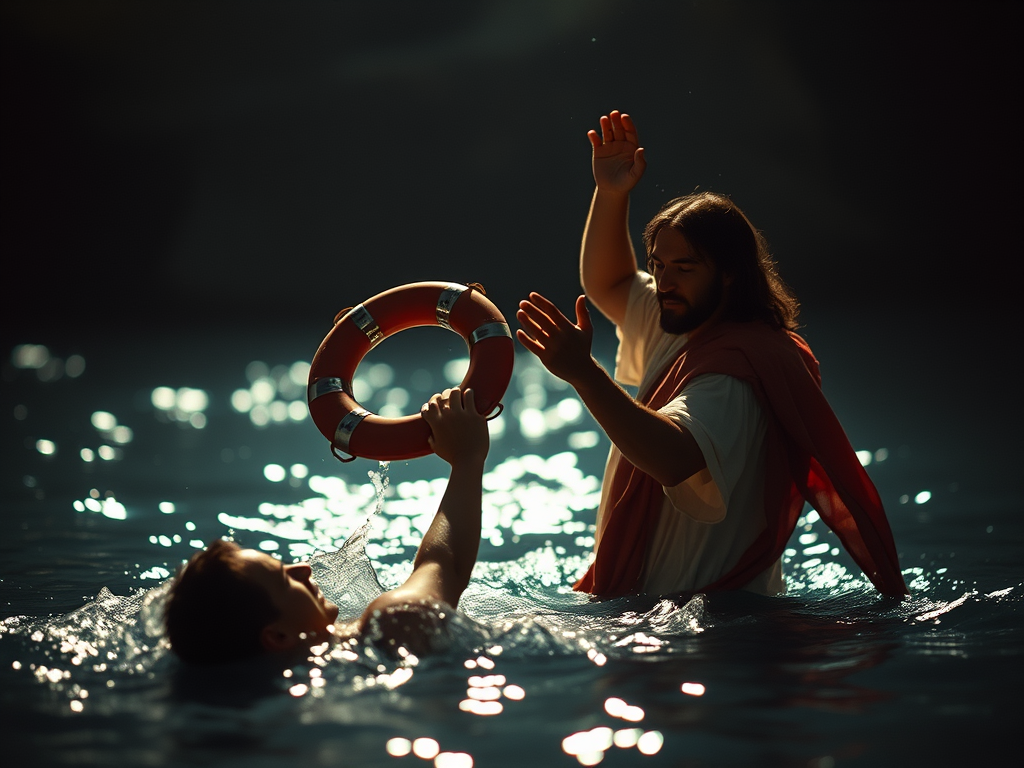
Lord, You have thrown me many spiritual life preservers, the greatest of which is Your sacrifice on the cross. Don’t let me close my spiritual ears to the sound of your voice. Instead, help me tear down any walls that fear has built in my mind and heart to keep me from reaching out to You and my neighbors. Amen.
The readings for September 8 give me more to work with in the exploration of what justice means that I began in last week’s post. The passages tell me that doing justice means making sure that everyone has what they need to thrive physically, mentally, and spiritually.
Justice serves what gives life by looking beneath the surface for signs of that life. It doesn’t serve that which is fleeting or artificial—except when what is fleeting or artificial serves what’s good and eternal.
Beyond this week’s readings:
In the previous section, I wrote that justice removes barriers rather than that justice heals, even though the readings for September 8 contain more than one reference to what are often called healings. I wrote to “removes barriers” because I’d like to propose that the references to physical healing in the readings don’t have to be as much about removing this physical impairment or that one – any physical impairment, for that matter — as we may be accustomed to thinking they are. (By the way, these perspectives on physical impairment and their relationship to well-known accounts in Scripture are far from unique to me. Ms. Iozzio, whose reflection is linked in the next section, offers a perspective that relates to my own.)
Healing is involved, but I propose that more is being healed than seems apparent. A man’s physical Deafness is removed, and his difficulties with speech are removed so that he can connect with and contribute to his community in different ways than he has before. The event inspires his faith in Jesus as God incarnate.
I find it revealing that Jesus doesn’t say to the man “hear” and “speak clearly” when he lays hands on the man. Instead, He says, “Be opened!” (Mark 7:34). Granted, I can imagine ancient peoples explaining Deafness as being caused by the ears being closed. But I can also see “Be opened!” meaning, “Be open to faith.” For this man, Jesus is also opening the door to relating to his community in a new way. I invite you to read more about that new way of relating by clicking the link in the next section.
Each of us, regardless of what our limitations are and what causes them, are our most God-like selves when we’re open to faith and community. There are multiple ways to facilitate this openness. Healing impairments is only one of them. We can remove barriers. We can also be open to alternate ways of communicating and seeing. Impairments do no mean that a person reflects God’s image any less clearly than someone who seems to be without impairments. Being a member of the Deaf community or having a disability or illness doesn’t make anyone any less complete than anyone else. This perspective affects everyone because no one on this side of heaven has an invincible body.
New Testament support passages support the perspective that, though we are called to do our best to take care of what we have, and God is present to us to us so that we can share our desire to be well, having certain abilities isn’t the ultimate goal of the spiritual life. Consider that:
Jesus tells his apostles that a man’s blindness is not reflection of his own sinfulness or the sinfulness of his parents (John 9:1-3).
Saul, who will become Paul, goes blind when Jesus speaks to him on the road to Damascus (Acts 9:7).
Jesus heals a paralyzed man, telling him to get up and walk so that [onlookers] “may know [He has] the authority to forgive sins (Mark 2:9-12).
After healing a woman who’s had a hemorrhage for years, Jesus says to her, “your faith has saved you (Luke 7:50).
The human conditions in the examples above aren’t punishments. Even in Paul’s case, I think it’s the brightness of the light that blinds him, and the blindness helps him rely on God and the people around him (Acts 9:8). Blindness means the loss of physical vision for Paul, but it also means the acquisition of clearer spiritual vision for him.
However, it’s important to note that, in the same way that having an impairment doesn’t make a person less complete, than a person without that impairment, the condition also doesn’t necessarily make a person more spiritually insightful than a person without the same impairment. It’s also important to note that God is at work in different ways in different situations and to be cautious about presuming to understand why circumstances are what they are. Every situation presents its own challenges and its own opportunities for grace.
In each of the examples above, the physical healing isn’t the only or even the primary gift Jesus offers. The miracles treat sick souls, and not just the soul of the person who experiences a physical impact, but also the souls of the people who witness the impact or learn of it more than 2,000 years later.
What someone else is sharing about this week’s readings:
Lord, help us to be open to You and to one another. Help us to respond to Your invitation to healthy relationships, which are two-way streets that can be built in many ways. Amen.

 Sitting with the Sacred