Readings for August 11:
- Proverbs 9:1–6
- Psalm 34:2–3, 4–5, 6–7 (and 9)
- Ephesians 5:15–20
- John 6:51–58
What this week’s readings say to me:
The first reading presents wisdom as a nurturing homemaker, someone who provides shelter and food. Perhaps the extended metaphor of the passage says something about how practical wisdom is necessary for meeting basic needs and how having basic needs met is necessary for a person to grow in “understanding” (Prov. 9:6).
This week’s psalm, the same as last week’s, continues to call us to recognize that God provides for our physical, emotional, and spiritual needs. God doesn’t run out all the means to provide for all of these needs. Ever.
Maybe because I focused on some of the psalm verses last week, the psalm refrain stands out to me more than the verses this week: “Taste and see the goodness of the Lord (Psalm 34:9). It invites us to use our physical senses — particularly taste and vision — to receive “the goodness of the Lord . . .” (Psalm 34:9).
Now there’s the old cliché “seeing is believing.” While it is cliché, it’s also often true for people. So it’s powerful to be able to see concrete signs of God’s goodness around us. How can the way each of us lives offer those concrete signs, not just by showing compassion, helping people see it, but by helping people experience it with their other senses.
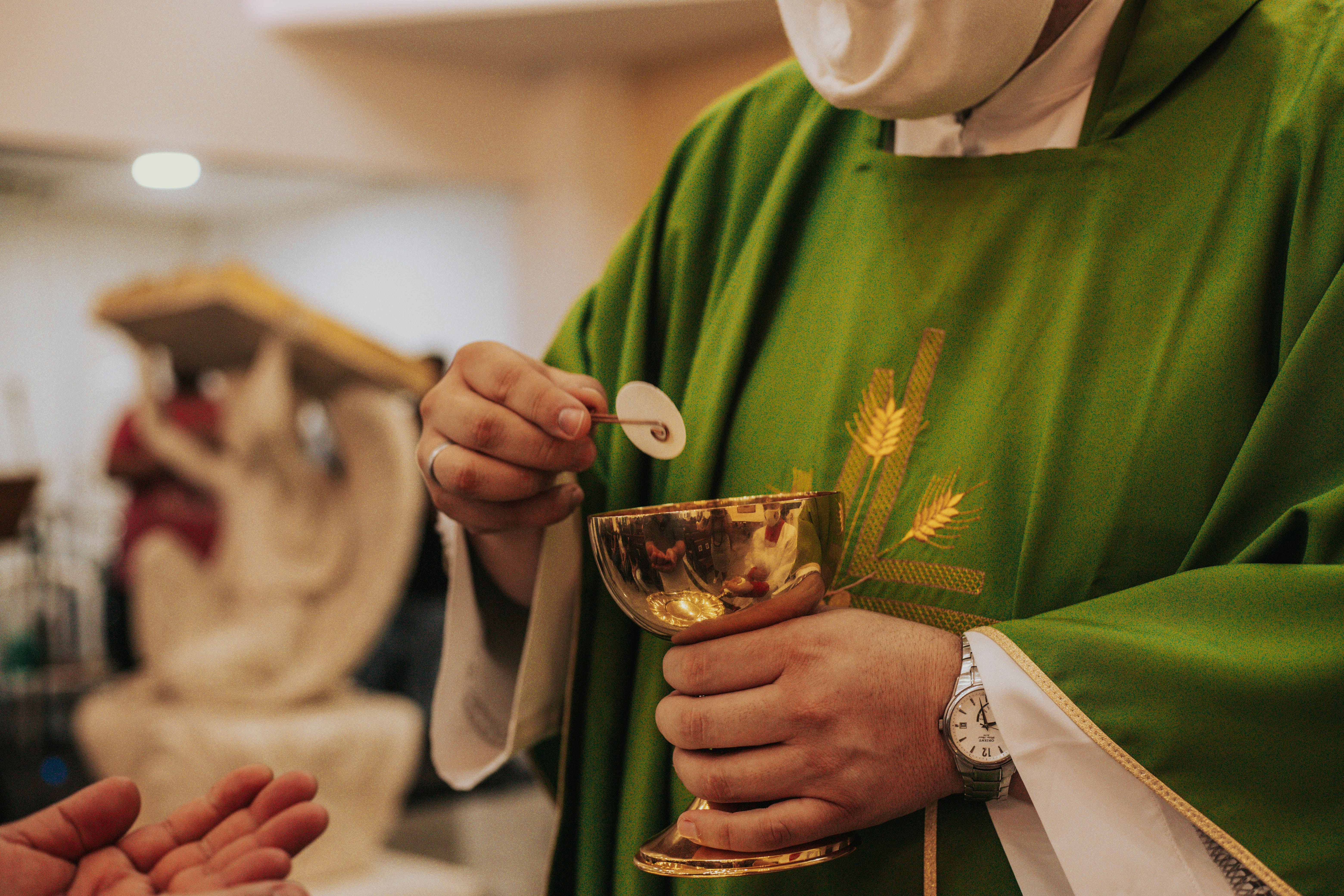
Think what a powerful sense taste is. It’s inextricably linked to smell. Think of what emotions can be invoked by the taste and smell of a meal that reminds a person of a past special occasion. Without smell, it’s very difficult, if not impossible to taste. Think of how powerful it is to smell or taste something that you smelled or taste in the past not long before becoming sick. Given the power of these associations, the psalm refrain says to me that truly engaging with God and what God gives involves all the senses. This reality is why the celebration of the Eucharist and other sacraments engages all the senses.
This week’s epistle urges readers and listeners to engage all the senses as well and to be careful to engage all of them in the movement of the spirit, and the pursuit of wisdom, rather than dulling the senses with activities that make it more difficult for the spirit to move within and among us.
The Gospel passage reminds readers that Christ’s message engages all the senses, and in doing so, challenges them. To the crowds, he says that he’s bread, and that whoever eats this bread “will live forever” (John 6:51). The crowds see a man speaking to them. They were already wondering how this could be, and he was going to challenge them even further (John 6:52). He goes on to say that “the bread that [He] will give is [His] flesh for the life of the world and that “[w]hoever eats [His] flesh and drinks [His] blood remains in me and I in him” (John 6:51 and 56).
Christ had to give all of himself — body, blood, soul, and divinity, “for the life of the world” and for every individual in the world who will receive that life (Jon 6:56). Receiving that life in its fullness will involve all the physical senses — taste, touch, sight, and hearing — of individuals open to receiving it. It will also engage the mind and the spirit. It will challenge all of these by inviting them to enter into what self-preservation instincts tell us to run away from.
What someone else is sharing about this week’s readings:
Sarah Hart’s reflection on this week’s readings looks at different ways to “remain in” Christ, as the Gospel passage asks us to do, with none of the ways of doing so being separate from each other or less essential than another (John 6:56).
Beyond this week’s readings:
Thinking about how important smell is for taste and how important engaging all the senses is to relationship with God and others reminds me of a phrase from last week’s excerpt from Ephesians about being “imitators of God,” liv[ing] in love” (Eph. 5:1-2). This way of living that Christ modeled is described as making oneself a “sacrificial offering to God for a fragrant aroma” (Eph. 5:2).
This week’s prayer:
Lord, grant me the grace of courage to remain in You as You remain in the Father. Help me not to turn away when You challenge me with what You offer and with Your vision for the Kingdom of God. Amen (John 6:56-58).
Work cited:
Confraternity of Christian Doctrine, Inc. ” 20th Sunday in Ordinary Time — 18 Aug. 2024: Readings at Mass.” The New American Bible, 2001. Universalis for Windows, Version 2.192, Universalis Publishing Ltd., 30 July 2024, https://universalis.com/n-app-windows.htm.
 Sitting with the Sacred
Leave a comment