In this interval in which time is in shorter supply than usual, the following quotations stand out to me from the readings for June 30:
God did not make death, nor does he rejoice in the destruction of the living. For he fashioned all things that they might have being; and the creatures of the world are wholesome. . . .
Wisdom 1:13-14
For you know the gracious act of our Lord Jesus Christ, that though he was rich, for your sake he became poor, so that by his poverty you might become rich . . . . Not that others should have relief while you are burdened, but that as a matter of equality your abundance at the present time should supply their needs, so that their abundance may also supply your needs, that there may be equality.
2 Corinthians 9 and 13
On this readthrough of the Gospel passage, I’m reminded of how important each of us is to God and to the world around us, even when we feel invisible and insignificant. I’m also reminded of how important journeys are. So many opportunities come up when we’re on the way to do something else. This passage teaches that even what looked like death can be a passageway to a new experience of life.
Beyond this week’s readings:
It looks like I’m not going to get a chance to write a post for next week, so I’ll see you back here in two weeks.
This week’s prayer:
Lord, thank you for the goodness of the natural world and for caring about the concerns of everyone in it. Thank you for meeting us where we are and for helping us to do good and to appreciate the beauty around us — sometimes when we least expect to receive opportunities or to be reminded of Your presence. Amen.
Note: I won’t have much time for the blog for the next two or three weeks. Until I have more time to devote to Sitting with the Sacred, I’m planning on keeping this section brief, perhaps by pointing out an overall theme or lesson that stands out to me. So, what’s going to come to me this week?
On my first read-through of the readings for June 23, I noticed lots of imagery relating to stormy seas, the Lord having power over them, and as a result, people being kept safe amid destructive forces.
But the passage from 2 Corinthians doesn’t immediately seem to fit in with this theme. I’ve struggled to unpack it’s meaning, but I think the gist of its meaning is familiar: because Christ withheld nothing from us — not even His life so that he could conquer death and stop it from having the final say, we should withhold nothing from Him. We must instead ask for the grace not to see others only in terms of what is transitory, such as looks and abilities, or in terms of what they can do for us. All of these can and do change.
We are also being encouraged to ask for the grace not to view others in terms of the harm they’ve caused. Looks, abilities, what we can do for each other, and the ways we can hurt each other — none of these things remain as they are. They’re transformed by Christ’s resurrection. So are understandings of what it means to be saved and to die. I suppose that’s why, in the Gospel passage, Jesus is able to sleep while the apostles are terrified of drowning in the storm. He knows that neither the storm nor death have ultimate power over anyone in the boat. He and our free will have the ultimate power — because He and God are one, and it is God’s love that gives life and the freedom to receive God’s love or reject it.
It’s not trusting that love that brings about spiritual death. At one time or another, each of us will undergo physical death. But whenever we trust in God’s love and share it, we receive new life in our spirits.
This week’s prayer:
Lord, protect us as we face the literal and figurative storms of life on Earth. Thank You for being with us in the midst of the storms of all kinds that life sends our way. Help us to experience that storms don’t have the final say — no matter how much they hurt us. Help us to experience that it’s okay to have questions and be angry and afraid when they hurt us.
This week especially, we bring to prayer residents of coastal communities, seafarers, police, firefighters, healthcare workers, lifeguards, pastors, ministers, counselors, aid workers and many others who offer rescue in all its forms. Amen. We offer this prayer in the name of the Father, the Son, and the Holy Spirit.
The theme I’m getting from this week’s readings is that authentic, nurturing strength comes from God. Like last week’s passage from 2 Corinthians, this week’s Old Testament reading reminds me that nothing visible will remain as it is forever. The passage says branches of a cedar tree can break off and become shoots that will grow into a new tree able to shelter everything. A towering tree can also be struck down, a green tree can wither, and a withered tree can bear fruit. All of the above can happen because God allows it. The passage closes by reminding me that God keeps God’s word. God is trustworthy.
This week’s psalm excerpt begins with the following words:
It is good to give thanks to the LORD, to sing praise to your name, Most High, to proclaim your kindness at dawn and your faithfulness throughout the night.
Psalm 92:2-3
It says that those who are just will “flourish” (Psalm 92:13-14). It says those who have deep roots of faith in God will remain with God eternally. They’ll never cease to bear fruit. They can sway in high winds without breaking. They proclaim the perfect love of the Lord without hesitation.
The epistle, like the psalm, presents the ideal attitude and behavior of someone who places his or her trust in God. This person is “courageous,” always seeking to live the life God has called him or her to live with the help of the Holy Spirit (2 Cor. 5:8). He or she lives this way despite the struggles and obstacles involved in living this life and despite desiring to be free of these troubles and obstacles. Why? Because the person has faith that on the other side of death, he or she will reap what he or she has sown, “whether good or evil” (2 Cor. 5:10).
The Gospel reading uses a parable to remind me that I’ll reap what I sow. I find the way the Gospel passage shares this message to be more relatable and encouraging than the way the epistle teaches the same. The Gospel passage says to me that I don’t have to know every step of the path forward for the journey to be worth taking and to bear fruit. The smallest seed can grow into a tree that will serve so many good purposes. And God gave that seed the innate ability to grow when it’s cared for and to become so much more than it appears to be able to become.
What someone else is sharing about this week’s readings:
Kathleen O’Brien acknowledges that it’s natural for all of us to imagine the end results of processes we begin and journeys we set out on. At the same time, her reflection on this week’s readings uses the lifecycle of the mustard seed to invite us to recognize God’s presence in each stage of the process or journey. She encourages us not just to focus on imagining the end result we want but also to recognize that each stage is important for growth and contributes to the end result. Furthermore, she invites us to recognize that the end result may be different from what we had imagined, but differences don’t reduce the value of the result.
Beyond this week’s readings:
“. . . I want to . . . invite you to recall and reflect on something you have or are tending to. . . .Now, when you reflect here, what do those different stages in consistently tending to something look like for you? How did you feel when you first started your big project . . .? Maybe your feelings would swing from feeling confident and in control to then feeling inadequate and not enough. What were your imagined expectations of the end result?
When it comes to tending the current iteration of my novel manuscript, the first stage feels like knowing something no one else does yet. It’s an exciting experience because it’s the experience of starting something new. It’s a journey no one can get in the way of yet because no one else knows about it yet. What grows out of my seat of an idea can’t yet fall short of resonating with someone else the way it does with me. It’s good enough for me, and that’s all that matters. The seed feels safe cocooned in darkness.
In the second stage, the drafting stage, the seed of an idea struggles to break the surface of the soil, which in this case, means it struggles to transform from the dialogue-and-image snippets in my mind to sentences, paragraphs, and pages in my word processor, And I want so much for those pages to describe a coherent and satisfying series of events experienced by empathetic characters. This stage means relying on determination — faith by another name — in the face of frustration.
In the third stage, my seed will be exposed to the elements. The elements, in this, case will be the feedback of others and of editing software. The plant may be pruned. It will likely have more done to it than pruning. It will have branches removed from it. It may even be cut back to the point of being no more than a seedling again. It may need to be planted elsewhere and to grow into a different shape than the one my constantly shifting vision had of it as a mature plant.
Only a couple of my fictional plants have ever grown beyond their first exposure to the elements. None of my ideas for novels have ever grown beyond the third stage. I’ve felt overwhelmed by the feedback, the revision process it necessitated, and the time the process required of me. I couldn’t figure out how to make my seedlings for novels hardy enough to survive, let alone thrive. I couldn’t see how to manage their networks of roots that grew, seemingly, in every direction. Their sprawling root systems tripped readers and blocked their paths so that no one, not even I, could get close enough to benefit from what they might have had to offer.
This week’s prayer:
Lord, help me to trust that You are at work in both the consolations and desolations I experience on this journey of life. With the power and guidance of Your spirit, I can allow both joy and pain to bring me into union with You. I can become and do more than I imagine. Help me trust in Your vision and that You have a plan for achieving it, even though I can’t see the plan or the realization of it yet. I pray this prayer in the name of the Father, the Son, and the Holy Spirit. Amen.
The first reading says to me that even though God wants us to trust in who He is and what He says so that we can live without shame and without hurting ourselves and others, He understands how easily we can be tricked into not trusting in who He says he is and what He says about how to avoid hurting ourselves and others. He wants to defend us against and protect us from what distorts our vision of Him, of ourselves, and of others.
The psalm is a plea for that defense, that protection from the Lord. It reminds me not to let my weaknesses and the ways I fall short lead me to give up hope but instead, with patience, to ask the Lord to pick me up when I fall and to expect that God will do just that and is waiting to help me avoid falling into the same pits in the future, provided that I trust in the support God offers.
From my perspective, this week’s readings are about what God does in response to what I do and how I can respond so that God works in and through me; the passage from Corinthians is no exception. The passage reminds me to respond with trust in God and to let that trust be reflected in my words and actions. If I do, the letter promises, I’ll help grow a family that recognizes the presence of God and radiates it now and eternally. If I do, my actions will spread gratitude for the gifts and the graces God gives. My own physical and spiritual frailties won’t be able to tempt me to despair. Neither will anyone else’s choices or any other obstacle. Rather than being temptations, weaknesses and obstacles can be reminders that I’m dependent on God’s grace and that nothing the senses detect lasts forever. But God within and God and around me “is eternal” (2 Cor. 4:18).
The Gospel passage says to me that only my attempts and the attempts of others to place limits on what God can do have the ability to limit what God can do. I have the ability to put these limits on God because God isn’t in the habit of overriding free will. God can, and I suppose sometimes does, for the sake of the overall Plan, but God doesn’t seem to prefer to work this way. God is one God in three Persons — relationship by nature. Because God isn’t subject to the limits God has placed on the material realm, God calls me to nurture relationships not only with those connected to me by DNA or with those who can offer me something material, but with everyone who wants to be open to God’s grace and to live by it, and to share it.
What someone else is sharing about this week’s readings:
This week’s readings prompt me to ask myself some questions:
What does it mean to trust in God? Does it mean just letting life happen to me and assuming that whatever happens is God’s will?
I don’t think so. Maybe part of trusting in God means trusting that God has given me the ability to look at the effects of my choices, to evaluate the extent to which these effects are positive and negative and to reflect on how I might avoid certain circumstances in the future and/or modify my choices in the hope that their effects will be more positive in the future.
Can I always know whether the results of my choices will be positive or negative? No.
Is my perception of what’s positive and negative always crystal clear?
No.
Will I always see the results of what I do?
No.
My limited perspective is another reason trust, which is another word for faith, comes is important.
Do I have perfect faith?
No. Far from it.
The renewal of my inner self has a long way to go. I take comfort in the reminder this week’s readings provide: God knows I can’t renew myself, so with my help and permission, God is “renew[ing]” my inner self “day by day” (2 Cor. 4:16). What God asks of me is that I invite Him again and again to renew me.
I can’t see that day-by-day renewal right now, but I choose to act with trust that it’s happening by inviting God to work in me again and again.
This week’s prayer:
Come, Holy Spirit. Amen.
Work cited
The New American Bible Revised Edition, Kindle edition, Fairbrother, 2011.
The transition from spring to summer and the changes in schedules that it brings has invited me to be open to new routines. But I’ve never been naturally inclined toward this kind of openness, and this week has been no exception. It’s Saturday afternoon, and I haven’t worked on this post since I typed this week’s readings above a week ago. I’m short on time, so I’m going to write what’s been on my mind to write in honor of this week’s Solemnity of the Most Holy Body and Blood of Christ.
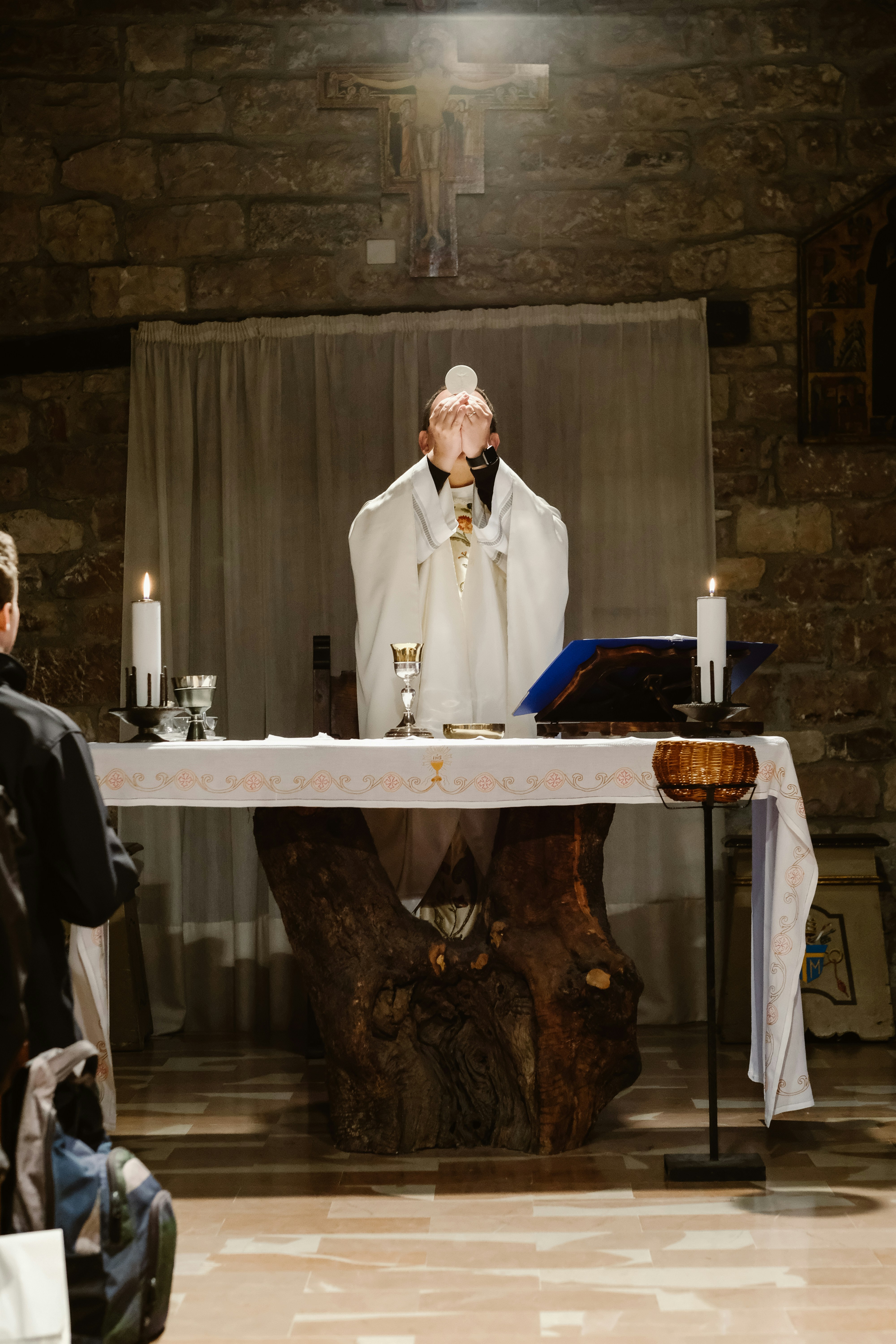
I’ve been thinking about this solemnity in light of last week’s solemnity, thinking that this weekend we celebrate the sacrificial love of the Trinity’s incarnation. It’s a love is willing to live for others to the point of suffering and dying for them. This death allows the sacrificial love of the Trinitarian God to take a different form, one I can see, touch, taste, and consume, even though I’m not living during Jesus’ earthly ministry.
Of course, I’m not the only one who can receive this gift. It’s been available to Jesus’ spiritual family members since the Last Supper—before Christ made His final sacrifice on the cross, and it continues to be offered and will continue to be offered until the end of time. The offerings of the Trinitarian God aren’t limited by time and space.
Yet these gifts are not merely abstract, spiritual, and mystical, though they can have all of these qualities. They’re tangible and consumable. These physical qualities allow the incarnate Trinity to become part of the physical body of anyone who takes and eats them. The physical forms of bread and wine allow us to receive the Body, Blood, Soul, and Divinity of the Trinity, and when we live lives that make our souls homes for these gifts, more and more, we become what we eat and carry it into the world around us.
What someone else is sharing about this week’s readings:
Sr. Julia Walsh. FSPA reflects on how this week’s solemnity reminds us that what’s ordinary is also sacred. She tells of times when this reality has been particularly palpable for her, times when she’s experienced it in communion with others.
This week’s prayer:
Lord, thank You for feeding me spiritually and physically. Restore in my body and soul a dwelling place for You so that You can be recognized in me, and I can do my part to heal the wounds in Your Body. I ask this in the name of the Father, and of the Son, and of the Holy Spirit. Amen.


 Sitting with the Sacred