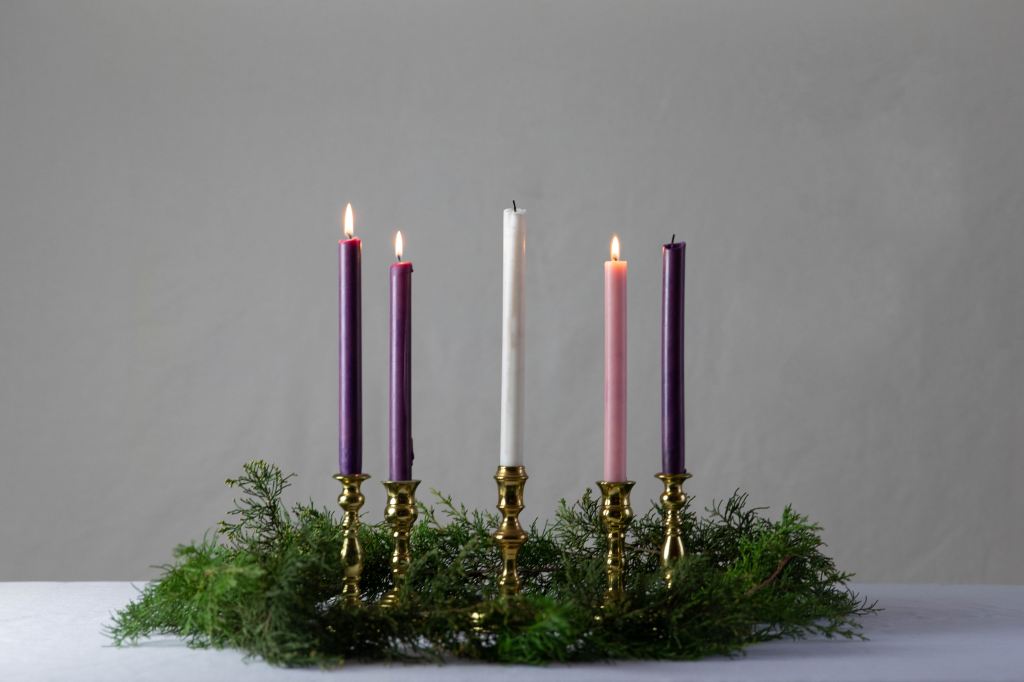

This week’s readings:
- Isaiah 61:1–2a, 10–11
- Luke 1:46–48, 49–50, 53–54
- 1 Thessalonians 5:16–24
- John 1:6–8, 19–28
What this week’s readings say to me:
This week’s readings remind me that we’re all called to be a mirror for the Holy Spirit, and like Jesus, to share the mind, the heart, and the eyes of God. We are called to use this mind, this heart, these eyes, and the rest of our bodies to do God’s work rather than to be a boulder the Holy Spirit has to go around. While each of our callings has what I just mentioned in common, none of us can know all that God knows, I see all that God sees, or can have compassion on all that God has compassion on. Unlike God, we’re limited — not omnipotent. We can’t be everywhere, do everything, and know everything all at once.
But this isn’t bad news. Rather, it points to the Good News. One way aspect of this Good News is that the limitations mean we need each other and God. Another aspect of this Good News is that, as Richard Rohr said, God’s nature is relationship, and as we are made in God’s image, we are made for relationships — with God and one another. We were made to depend on God and one another and, by being open to the movement of the Holy Spirit within us, to be dependable for God and each other. We are dependable for each other and God when we reflect the unique combination of God’s qualities that each of us is able to.
This week’s readings show how four different people will read with God so they can reflect Divine qualities in different ways. Perhaps the first reading demonstrates how two people do this. Through a prophet, this passage foretells what life will be like when God takes on a human existence and when God reigns over the “. . . new heavens and a new earth in which righteousness dwells” that we were promised in the third reading last week (2 Peter 3:13). In the second reading, Mary proclaims that despite her apparent insignificance in her culture, God has blessed her. God’s ways are not like human ways, and so she rejoices in who God is and what God and will do. In the fourth reading, John the Baptist reflects who God is by demonstrating humility, honesty, and an unflinching dedication to the mission God has given him. The readings themselves illustrate better than I can by just pointing to specific verses how Isaiah, Mary, John the Baptist and Jesus each invited the Holy Spirit to work through them in ways that are unique to who they are in the situations in which they find themselves.
Yes, I’ve skipped the third passage so forth because it doesn’t show us how a famous biblical figure invited God to work through him or her (except that the passage comes from a letter a letter attributed to Paul who is letting God work through him and reflecting God in a way that only he can by composing the letter). Instead, it instructs us in how to invite the Holy Spirit to work through us. It urges us to become a link in the chain of love, some other links of which we’ve met in the rest of this week’s readings.
No link in this chain is a copy of the others around it. It’s not a dull, rough restraint that rubs skin raw. I propose it’s more like a bracelet on which each charm or jewel is unique, each reflecting the light in a different way and reflecting a different, significant moment.
What someone else is sharing about this week’s readings:
Bridget McDermott Flood reflects on a theme given to the third Sunday of Advent every year — joy — and how to experience it.
Beyond this week’s readings:
This reflection from Jeff Cavins was released in response to last week’s readings. However, I heard it right before I looked into this week’s readings as I prepared to draft this post, and I heard influenced how I read this week’s passages. You’ll need to login to listen to the reflection, and even after you login, this particular session may not be available on the free version of the Hallow app. In case you are unable to listen to it without subscribing to the paid version of the app, the gist of Mr. Cavins’ message is that each of us is called to “Prepare the way of the Lord,” even though each of us may not be called to do so in the same way as the person next to us (Isa. 40:3).
When I hear “prepare,” I think of doing something, but I’m realizing how often changing my habits would involve not doing something. Yes, I say hurtful things, and a version of me in perfect union with God wouldn’t. But as I reflect on this blaming, these barbs, I realize that even they come from my wanting to make the pieces around me fit where I want them to, instead of accepting that I can’t make them fit.
Maybe I and the people around me aren’t connected like precious charms on a bracelet, but more like pieces of broken, yet beautiful differently colored pieces of glass that God brings together to form a beautiful picture. A few days ago, I saw a Christmas movie whose title I’ll only link to here so that anyone who wants to can avoid having me spoil its plot. For these readers, I just want to acknowledge that the plot of that movie inspired my colored-glass metaphor. In my life and in any life, the pieces are the shapes and colors they are. All I can do is accept the pieces as they are, let God polish the piece that is me, and seek where I fit best.
It’s difficult enough to seek where I belong in the mosaic and to let God polish me. I didn’t come up with the concept for the overall picture the picture or any of its elements, nor do I know what the whole picture looks like, so its components usually don’t connect the way I’d like them to, I feel frustrated and embarrassed that I can’t complete the picture as I would like because I can’t see the whole picture. I respond to these feelings by lashing out and making edges on the multicolored, reflective shards sharper and the gaps between them wider. I scatter the pieces, accomplish the opposite of what I want by trying to force what I want to happen, to make it take place when and how I want it to. What would do the most good is surrendering instead. In addition to the prayers I linked to last week, this prayer is one I find myself turning to for help with surrendering:
Take, Lord, and receive all my liberty,
Prayer of St. Ignatius of Loyola
My memory, my understanding
And my entire will,
All I have and call my own.
You have given all to me.
To you, Lord, I return it.
Everything is yours; do with it what you will.
Give me only your love and your grace.
That is enough for me.
Amen.
Lord, help me experience Your love and grace as enough for me. Help me to mean the words of the above prayer, trusting that when I offer the gifts You’ve given me back to You, You’ll remove any distortion caused by sin from them and they’ll do the good you intend them to do. Amen.
Work cited (but not linked to)
Confraternity of Christian Doctrine, Inc. “3rd Sunday of Advent, Sunday 17 December 2023: Readings at Mass.” The New American Bible, 2001. Universalis for Windows, Version 2.183, Universalis Publishing Ltd., 31 Oct. 2023, https://universalis.com/n-app-windows.htm.
 Sitting with the Sacred
Leave a comment