As I wrapped up this year’s reflections on the Way of the Cross, I started to think about Easter and the sights and sounds the word “Easter” brings to mind.
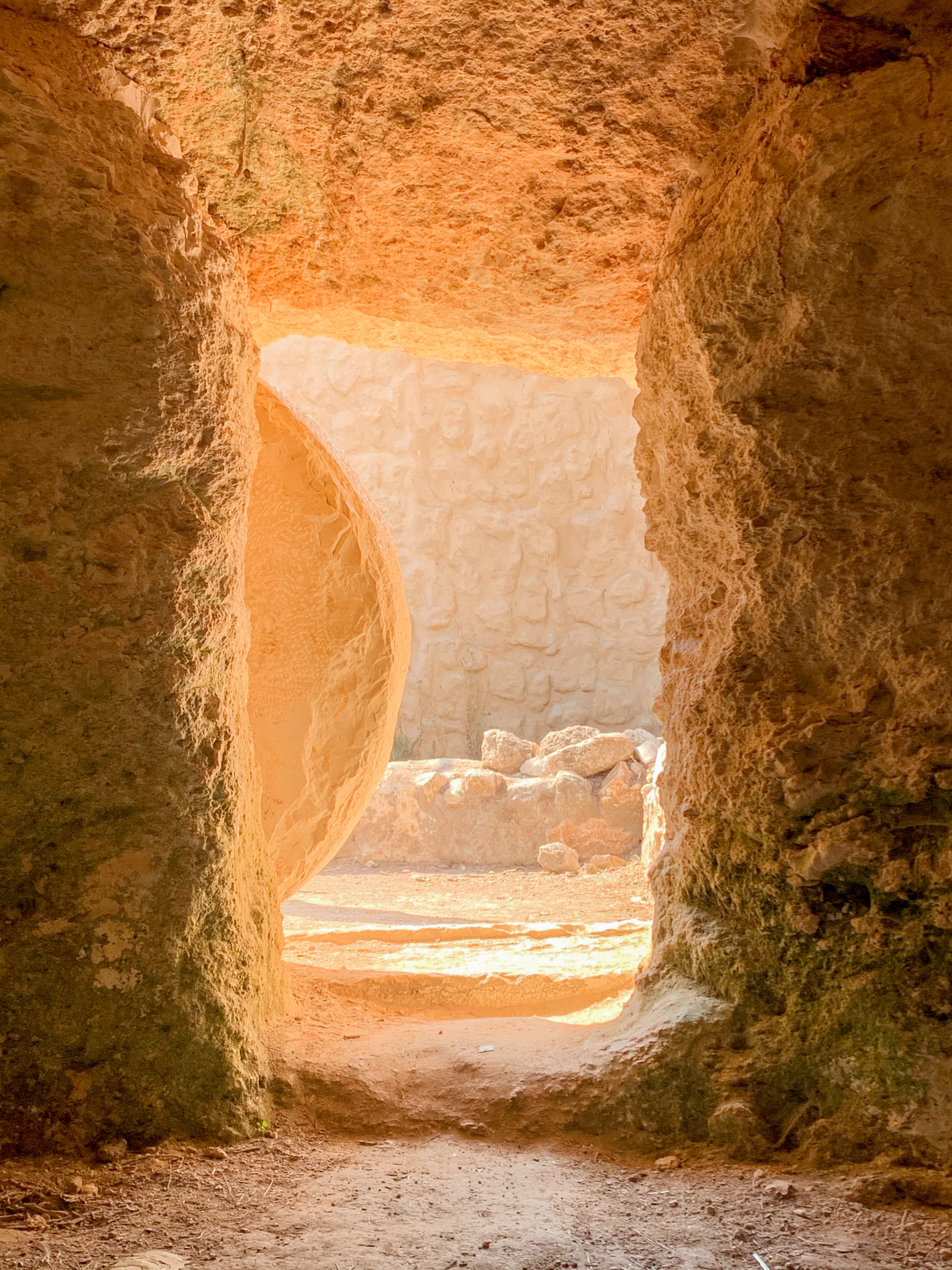
I imagined a stone rolled aside and and a cave-like tomb lit from an unknown source. The light is so bright it’s painful to the eyes — or maybe it ought to be painful but isn’t somehow. I can’t describe the light or explain it. I can’t describe how I can make out the outlines of a figure within its brightness. The figure is discernible, but I can’t see most of its features amid all the radiance.
The voice that comes from it is clear, however. It asks, “Why do you search for the living among the dead?” He is not here, for he has been raised.” It turns out that by including this quotation, my imagination is quoting Luke 24:5 almost verbatim but not quite. Matthew and Mark start their final chapters with similar scenes and related quotations. These accounts are dramatic, so it’s no wonder that movie scenes depicting that Sunday morning look and sound like the one I just imagined.
But what the Gospel reading for this Easter morning, John 20: 1-9, prompts me to see, hear, and think about is different from the other accounts of the ways Jesus’s first followers initially experienced the resurrection.
John 20:1-9 doesn’t present me with a story that is as obviously miraculous.
Mary sees the stone that had guarded the entrance to the tomb moved aside, and she runs to get Peter and “the other disciple whom Jesus loved,” announcing that Jesus’ body has been stolen (John 20:2-3). I learned somewhere that “the disciple whom Jesus loved” was John, so I’m going to refer to that person by this name to make this post easier to read, even though I don’t remember where I learned to identify the disciple this way.
In response to this news, Peter and John run back to the tomb. John gets there first but doesn’t go inside (20:5). Apparently, he just bends down and sees the burial cloths. I wonder why he acts this way. I wonder if some part of him was telling himself that if he doesn’t look any closer, he doesn’t have to see anything he doesn’t want to see. He could tell himself Jesus’ body hadn’t been stolen, that it was still hidden by the darkness. If he can’t yet face the memories and the reality of Jesus’ death (a reality that would’ve been difficult enough to grapple with had he not stood at the foot of the cross), he can go through the motions of looking without really seeing. Maybe he wants to show deference to Peter, or to let Peter be the one to confirm the worst. Peter seems ready to do that. He goes in and sees the cloth that had covered Jesus’ head rolled up in “a separate place” from the other burial wrappings (20:7). I always thought the details about the separate and apparently careful placement of the wrappings were meant to point to the resurrection. And maybe these details were included in hindsight to do just that, but on this reading of the text, I realized that in this scene, Jesus’ followers don’t yet believe he is risen. John 20:9 says “they [don’t] yet understand the scripture that he had to rise from the dead.”
This realization reminded me in a new way that the resurrection doesn’t erase all confusion or pain from the present or the past. The burial cloths haven’t disappeared. They’re still bloody, too, because in verse 19, Jesus shows his disciples the wounds in his hands and his side.
But that moment is for revisiting in future weeks. In this week’s reading, I’m not shown the words themselves, but I’m given reminders of them in the wrappings that no longer bind Jesus. If I take John 20:1-9 without the stories that follow it, I’m not reminded that pain doesn’t have the final word. Yet the Good News is that pain doesn’t have the final say, even if some of life’s experiences tempt me to think it will. Because Jesus is risen, I’m offered future resurrection. I’m neither promised resurrection now (though there are signs of it everywhere in nature’s spring awakening), nor am I to let the past behind me as the burial wrappings bound Jesus.

The experience of reading John 20:1-9 without the stories that follow these verses remind me of what it’s like to celebrate Easter present. It will take time to understand a lot of things in this life. I won’t fully understand or experience what resurrection means while I’m here. My time-bound experience of Easter won’t feel as extraordinary as the one I imagined at the beginning of this post. It won’t mean forgetting things I don’t want to remember. It won’t banish disappointment or grief. And now I remember I’m not alone in this reality. The experience Jesus’ earliest followers had before sunrise that first Easter morning was not one of perfect clarity and joy.
You were risen, but neither You nor Your loved ones were in Heaven yet that first Easter. Neither am I on this Easter. Thank You, Lord, for the reminder from John 20:1-9 about what it means to practice patience and to hope. Amen
The Bible. The New American Bible Revised Edition, Kindle edition, Fairbrother, 2011.
Confraternity of Christian Doctrine, Inc. “Sunday July, 2 2023: Readings at Mass.” The New American Bible, 2001. Universalis for Windows, Version 2.179, Universalis Publishing Ltd., 26 Feb. 2023, https://universalis.com/n-app-windows.htm
 Sitting with the Sacred
Leave a comment