This Lent, I’ve decided to pause reflecting on the weekly readings. Instead, I’m going to reflect on the Scriptural Stations of the Cross in a different way than I have before. (The readings and traditional prayers that go with these stations are here.) Beginning this Friday and continuing through Good Friday, I’ll follow Jesus along the way to the cross as it’s presented in the Gospels. If life and God didn’t have other plans, and if I’ve done the math the calendar right (and these are big ifs), I’ve calculated that I can share two reflections each week and arrive at the tomb with Jesus’s body during Holy Week. Still, may God’s will be done and not mine. Thank you for joining me on this journey.
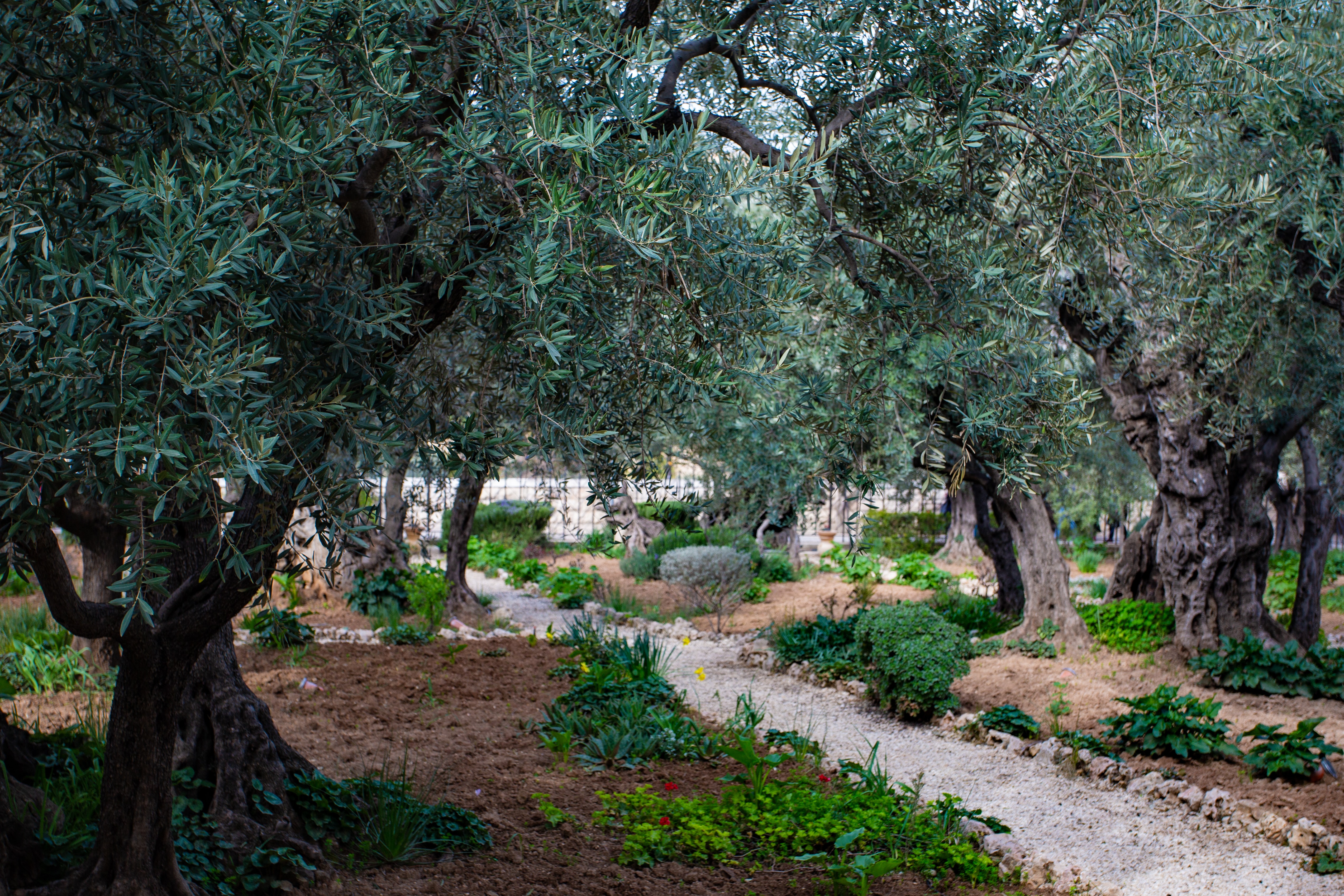
First Station: Jesus in the Garden of Gethsemane
(Matthew 26:36-41)
You reveal your heart to me, Lord, and yet I can’t comprehend the depth and weight of that heart. My soul wants to learn from you, to be Your companion and Your coworker, but my clouded mind and frail body aren’t equipped to satisfy holy desires. Thank you for the times that, despite my weaknesses You have made me and will make me able to cooperate with You anyway.
Thank You for surrendering to the will of our Father at this stage of Your journey. Place Your surrender in my soul, and help me to remember that when I dread a challenge or hardship, when I’d like to avoid something, You have felt what I’m feeling more than I’ve ever felt it because You’ve had to prepare to bear the weight of all the world. Thank you for understanding that neither I, nor any other disciple alone could bear that weight. Thank you for giving me an example of the power of preparing with prayer, of the power of waiting, and of making room for both silence and conversation. Thank you for showing that prayer means not only surrendering to the Divine Will but sharing Your deepest desires and most vulnerable moments with that Love and the people that Love has placed in my life. Thank you for placing Your creation in our care, and for placing us in the care of Your creation.
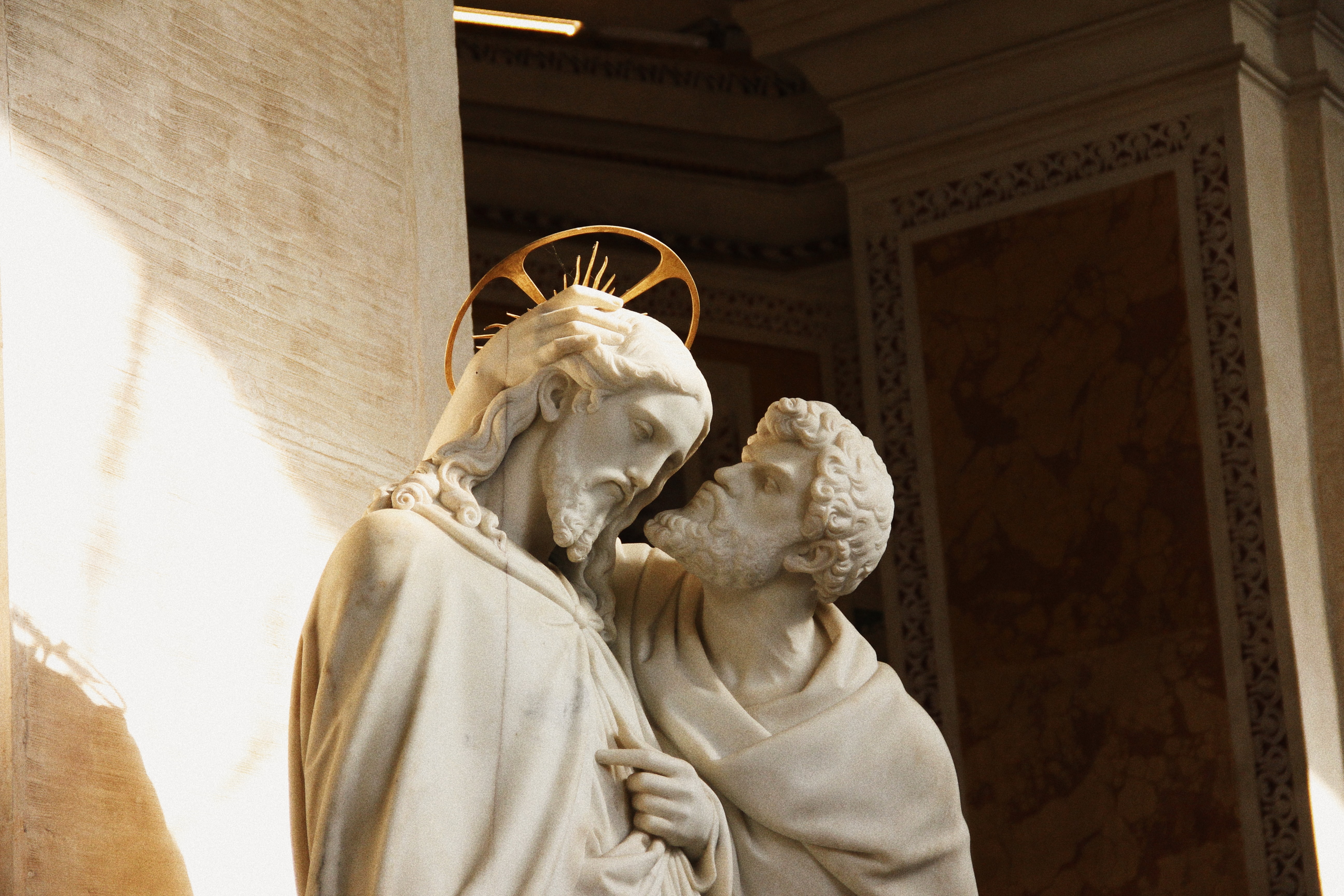
Second Station: Jesus, Betrayed by Judas, is Arrested
This experience reminds me to let my words and actions reflect the One whose image I am and You are. It reminds me to [l]et [my} ‘yes’ mean ‘yes’ and [my] ‘no’ mean ‘no’ — nothing more and nothing less (Mat. 5:37). Help me to love unselfishly and without possessiveness or covetousness. Help me to love in ways that respect spiritual freedom — my freedom and the freedom of others. Amen.
The Bible.The New American Bible Revised Edition, Kindle edition, Fairbrother, 2011.
Confraternity of Christian Doctrine, Inc. “Sunday July, 2 2023: Readings at Mass.” The New American Bible, 2001. Universalis for Windows, Version 2.179, Universalis Publishing Ltd., 26 Feb. 2023, https://universalis.com/n-app-windows.htm
The verse above and the reading from which it comes, Matthew 5:17-37, is one of those that I have visceral reactions to and not pleasant ones. Until I make myself focus on inhaling and exhaling a few times, I feel suffocated by darkness. I can’t see a sliver of light, and I feel nothing I can grab onto to move forward. I experience temporary despair when I revisit verses like the one I’ve highlighted, they awaken my anxiety and depression like the slightest unusual sound that can startle me out of a sound sleep at night.
I suppose such passages are meant to jar anyone who receives them out of complacency, and they do that. But I find it difficult to see what to do long-term after the jarring. I confess my anger, resentments, and wounds, and mentally, I surrender them to God again and again. Yet anger, resentment, envy, and self-service are such a part of my heart. They cut through every layer of my being. These emotions feel like thorny weeds embedded in a soul that’s filled with concrete. As time passes, uprooting them feels more and more impossible. I feel disappointed in myself for letting poison spread in my own heart and from there the world around me over and over despite repeated and sincere intentions to spread healing and light.
When I heard Matthew 5:17-37 again this weekend, I thought maybe this was one of the weeks I’d link to someone else’s reflection. I didn’t want to spread despair. After all, even though truths can be difficult to share and to receive, I have faith that despair is not truth. I asked God where I could find hope and the truth in the midst of the weeds in my heart and on the hamster wheel of my mind.
Two answers came to me:
Imagine your emotions as electricity, and rather than thinking you need to make them go away, ask God to help you channel them toward creativity and the service of love, rather than simply unleashing them with the result being that they electrocute everyone and everything around you (by “you,” I mean me).
Don’t give up on inviting the gardener of your heart to tend it. Maybe to be alive means not to give up.
It’s easier to imagine #1 coming to fruition for someone else, thanks to an individual being personally affected by a societal wound. Mothers Against Drunk Driving came to my mind. The Wikipedia article about the organization says MADD: “was founded on September 5, 1980, in California by Candace Lightner after her 13-year-old daughter, Cari, was killed by a drunk driver. There is at least one MADD office in every state of the United States and at least one in each province of Canada. These offices offer victim services and many resources involving alcohol safety. MADD has claimed that drunk driving has been reduced by half since its founding.”
The article goes on to say that “[a]ccording to MADD’s website, ‘The mission of Mothers Against Drunk Driving is to end drunk driving, help fight drugged driving, support the victims of these violent crimes and prevent underage drinking'” (qtd. in “Mothers Against Drunk Driving”).
But then there are the experiences that make people angry, that hurt them, that aren’t obviously catastrophic. There are the deep-seated wounds in ourselves, and by extension, in our relationships. I wonder if it’s true that the longer we’ve known someone, the more power they have to hurt us, and the more power we have to hurt the other person. The injuries from these connections may be older and deeper. They may have festered almost as long as we can remember. Elements of them are probably relatable to most people, and yet other aspects of them are unique to the people and situations involved. (Actually, even high-profile traumatic events probably share this quality of being a mixture of painful universality and uniqueness)
As I’ve wrestled with Matthew 5:22 the last few days, I’ve been reminded of the importance of naming emotions and then sitting with them, of saying to myself and to God, “Okay, I’ve just had an experience or an encounter that’s stirred some intense feelings. What are they? Anger, resentment, disappointment, sadness. In the past, I’ve tried to label them and then go on.
But earlier today, I found myself repeating, “I’m angry and hurt. I really wish things were different. I felt a lot more peace and relief when I vented to myself and to God about the feelings rather than hoping that I could simply name them and expect them to go away. Once I had allowed myself this time of confrontation and release, I felt for a good while that Jesus was with me in this pain and that I was a tiny bit grateful to share Jesus’ pain. I prayed that my accepting this pain would do some spiritual good I can’t understand yet. I really did feel like God had helped me harness at least some of the electricity, though the harnessing took a different form than the one that firs occurred to me when I asked for help.
I know that all too soon, I’ll forget to invite God into my struggles. Maybe the key as soon as I realize I’ve forgotten, is to extend the invitation again, to reopen the gate to the garden of my heart repeatedly. Thank You, Lord, for whispering gentleness to my mind when I forget You are there and for knocking on the gate of my heart. Amen.
Works cited
The Bible. The New American Bible Revised Edition, Kindle edition, Fairbrother, 2011.
Jesus said to his disciples: “You are the salt of the earth. But if salt loses its taste, with what can it be seasoned? It is no longer good for anything but to be thrown out and trampled underfoot.
Matthew 5:13
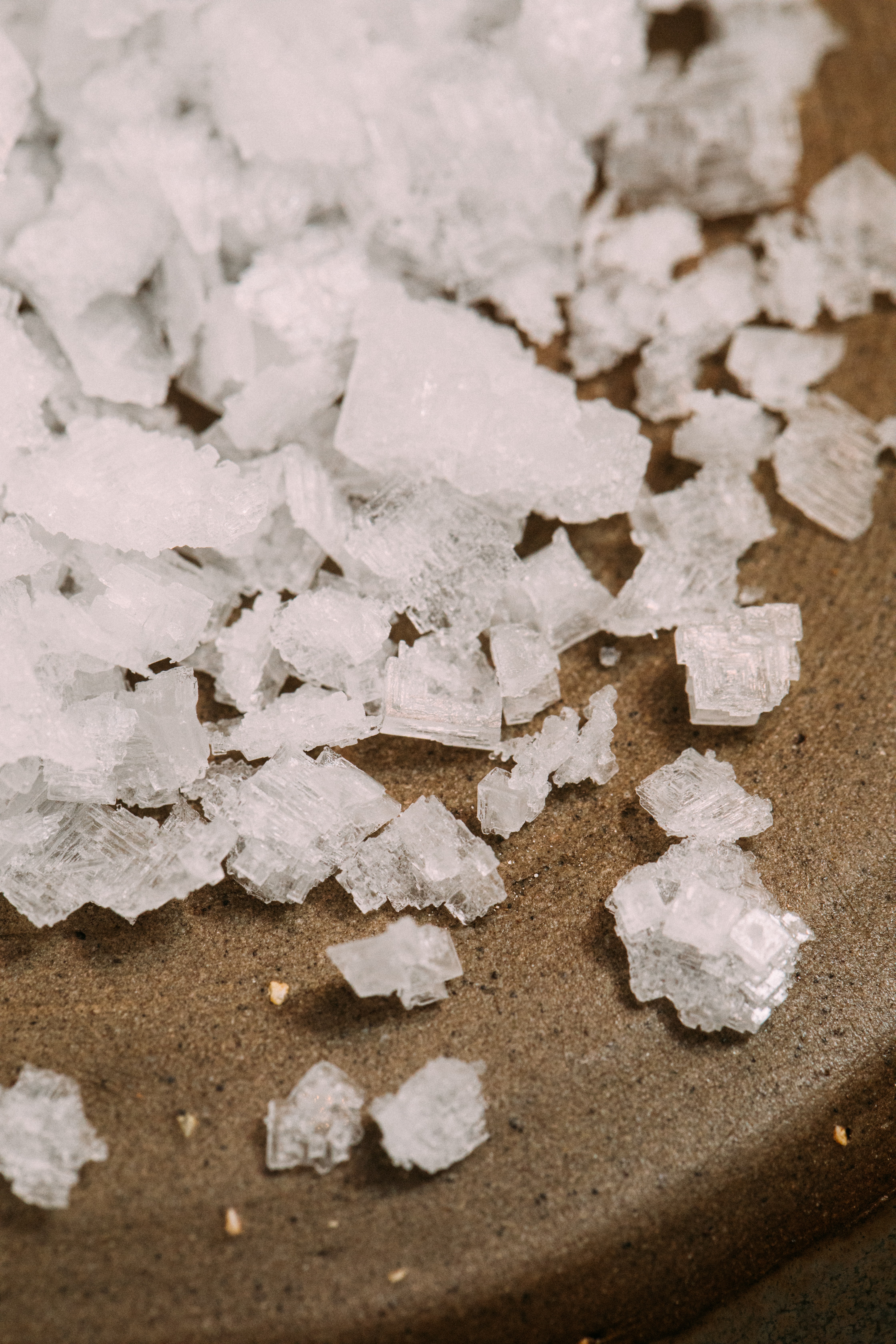
I am the salt of the earth. Hearing this, I’m inclined to wonder if a little bit of me goes a long way. Am I overpowering if someone relies on me too much? Does too much of me contribute to high blood pressure? Undoubtedly, the answer to these questions is sometimes “yes.”
But I don’t think salt had these associations for people in Jesus’ time. Wikipedia’s entry, “Salt in the Bible,” says salt is used in the Scriptures “signify permanence, loyalty, durability, fidelity, usefulness, value, and purification . . . . Salt was widely and variably used as a symbol and sacred sign in ancient Israel Numbers 18:19 and 2 Chronicles 13:5 illustrate salt as a covenant of friendship. In cultures throughout the region, the eating of salt is a sign of friendship.” (Yes, I know Wikipedia is not a foolproof source of information, but I’d like to be able to make this post available to you sometime this week.)
Before embarking on this post, I was aware that humans have used to salt as a preservative for a long, long time, so it makes sense to me that, especially before the advent of refrigeration, salt would be associated with permanence, durability, usefulness, and value. The association with fidelity also makes sense in that food must be preserved to remain what it is.
The human body requires a small amount of sodium to conduct nerve impulses, contract and relax muscles, and maintain the proper balance of water and minerals. It is estimated that we need about 500 mg of sodium daily for these vital functions. But too much sodium in the diet can lead to high blood pressure, heart disease, and stroke. It can also cause calcium losses, some of which may be pulled from bone. Most Americans consume at least 1.5 teaspoons of salt per day, or about 3400 mg of sodium, which contains far more than our bodies need.
Some people believe that salt needs be replaced during hot weather or strenuous exercise to avoid muscle cramps. This is not correct. What you need to replace is water.
The human body can happily survive on just one gram of salt a day, as hormones keep a check on sodium levels and make adjustments for hot weather. A genuine sodium shortage brought on by hot weather or exercise is extremely rare, even among hard-working athletes.
When salt is used judiciously, when one might say it’s treated like it has value rather than used carelessly, it brings out the best not only in our bodies but in our food. It enhances other flavors rather than overpowering them. Maybe the ability of salt to have a positive effect on other flavors is good to remember as we seek to have healthy relationships with the people around us. Our call and our challenge is not to take charge all the time but to journey with one other and to work on building communities that bring out and benefit from the best qualities of their members.
I’m sorry to say I don’t always bring out the best qualities in the people around me. Why? Because I’m not the pure salt. A footnote in my Bible says the following: “The unusual supposition of salt losing its flavor has led some to suppose that the saying refers to the salt of the Dead Sea that, because chemically impure, could lose its taste” (Mat. 5:13n).
The websiteNatural Pioneers has this to say about Dead Salt’s limited effectiveness for flavoring food: “Dead Sea Salts are made up of about 60% magnesium and potassium, 8% sodium and some rare minerals. . . .While a small percentage of extracted Dead Sea salts are washed and processed to edible salt, the majority is not” (Dead Sea Salts Vs. Sea Salt Are They The Same? [Studies]).
Lord, help me to come to You so that You can wash me. Refine me into the pure salt You created me to become. Grant me the grace to treat others as my valued brothers and sisters rather than carelessly. Help me to cooperate with those around me to flavor our surroundings with Your Love. In other words, grant me the grace to be salt for the world but not salty. Amen.
Works cited
The Bible. The New American Bible Revised Edition, Kindle edition, Fairbrother, 2011.
Psalm 146:6-10 presents a word tapestry about the loving care of God. But given the disappointment, resentment, and selfishness that weigh down my own heart despite my desire to let go of these burdens, I find it a challenge to see this tapestry as anything more than an eloquent wish. Much of what I see in the news doesn’t help make the tapestry come alive either.
However, this post isn’t dedicated to bashing news media or news watching. My undergraduate major was mass communications. I wrote and edited for the university newspaper and took courses in other forms of information dissemination, including broadcast journalism and public relations.
I think it’s important (without consuming news all day) to follow current events every day. I also think it’s useful to consult different well-established new sources on different days, not just the ones that confirm the views I already hold. For me, this is one example of what it means to be in the world but not of it. (See John 17:14-15). News may not show me the world I want to see, but that doesn’t mean I should avoid seeing it — much the opposite. I have to know what’s going on in the world to have any hope of bringing the Good News to that world or indeed, communicating at all in a way that resonates.
Violence is very prevalent around us, and news sources reflect this reality because their job is not to reflect back to us our day-to-day routines or anyone else’s. The way I see it, this function of journalism is why it’s called “the news” and not “the expected” or “the desired.” This function is why a common phrase in journalism education (at least when I was receiving it) was “if it bleeds, it leads.” So often it’s violence, whether on the part of nature or humanity, that interrupts the status quo. This disruption is not the fault of news sources. Do inspiring events occur as well as tragic ones? Absolutely! News sources report on these too. Pretty much every television news broadcast I’ve ever seen ends with a positive story. I think this is done with the idea of leaving viewers with something positive to take away.
I see some common ground and some differences between news broadcasts and the Beatitudes. The Beatitudes acknowledge the difficult and often unjust realities of life, while at the same time, each one begins and ends by offering hope, For example, Jesus says that “those who mourn” are “blessed” (Matt. 5:4). Does this mean that someone should desire mourning over joy? I don’t think so. Does this mean that someone mourning should feel blessed? No. I hear this Beatitude as a promise that regardless of what someone who is mourning feels, they are blessed because Christ is close to them in a special way, as he is to anyone in need or going through a difficult time. He struggled and mourned during his passion, and when we join our suffering to the suffering of the cross, our suffering takes on the redemptive power of the cross, even in the many times when we can’t see how.
I’m not saying that everything happens for a reason, or that God pushes us around like pieces on a chessboard. We have free will. We also have bodies that come with a lot of biology and chemistry — survival instincts that sometimes end up translating into domination over others, physically, emotionally, and psychologically. Everyone around us is also influenced by these factors, to varying degrees. The Spirit and its domain, spirituality are about not letting these factors overtake the Spirit in us. This is not to say that our bodies and minds are bad and our souls are good. To say that would be heresy. I look at the relationship between physical and spiritual matters this way: God designed them to work together, as they do in Jesus and his gift of his body, blood, soul and divinity in his ministry, on the cross, and hidden within the forms of bread and wine. I’m saying that, thanks to Jesus’s life, death, and resurrection and his example during these stages of his mission, no difficulty, suffering, or instance of a situation not working out the way we wanted has to destroy our hope. As I think I’ve written before, we can use our experiences to prevent others from suffering similarly, we can accompany others going through similar experiences, or in the most challenging of circumstances, when neither of these opportunities seem available to us, we can choose to trust that the offering of our circumstances to God is redemptive in those ways I mentioned earlier, the ones we can’t see — yet.
Like most people, I’d like to see nothing but righteousness, mercy, satisfaction, comfort, and peace around me and within me right now. But to experience that would be to experience heaven, and I’m not there. Because I’m not already there, I take comfort in the fact that the second half of each Beatitude, offers a future blessing, not a present one. If the Beatitudes were presented to me in nothing but present tense, I would struggle with faith even more than I do I would wonder why God hadn’t kept the promises of the Beatitudes. After all, I look around me and within me and see not only the qualities opposites of the positive ones included in the Beatitudes but also imperfect versions of those positive qualities. In our broken humanity we thirst for righteousness without allowing for meekness or mercy, and we seek comfort and satisfaction without first being poor in spirit, without having a clear enough vision of reality to mourn with those around us. I think each positive quality included in the Beatitudes needs all the others to reach its fulfillment.
I don’t believe such ultimate fulfillment comes in this life. Our mission is to thirst for it, to do what we can to embody the combined Beatitudes, all the while knowing we do and will fall short. I find pain and comfort in this falling short — pain because I want to experience Heaven now, and comfort because in acknowledging that I fall short, I recognize poverty of spirit. I recognize that I need God and others, that I don’t have all the answers, and that nobody but God does.
Lord, help me to be more at ease with my lack of understanding and control and Your total understanding. Help me to turn to you and let you work in me as I thirst for the fulfillment of your promises. Amen.
Confraternity of Christian Doctrine, Inc. “Sunday July, 2 2023: Readings at Mass.” The New American Bible, 2001. Universalis for Windows, Version 2.179, Universalis Publishing Ltd., 26 Feb. 2023, https://universalis.com/n-app-windows.htm


 Sitting with the Sacred