This week’s readings:
- Isaiah 11:1–10
- Psalm 72:1–2, 7–8, 12–13, 17
- Romans 15:4–9
- Matthew 3:1–12
Also cited:
- Isaiah 40:4
- 1 Corinthians 12:4
- Philippians 2 2
I want to go to the place described in Isaiah 11:1-10. The passage describes what a kingdom united to one on whom “the spirit of the Lord shall rest” will look like (Isa. 11:2). I’ve just quoted a single verse from the passage, but the excerpt in its entirety offers such beautiful imagery. Read the entire passage. If you’re like me, you’ll come away feeling all kinds of warm fuzzies.
In case you don’t have time to look the passage up right now, I still want this post to make sense, so I’ll summarize the verses. The Anointed One is wise, humble, and just. He “lifts up” every valley and makes every hill “low” (Isa. 40:4). In other words, he smooths everything out. His virtues effect eternal peace among and within all that is. The psalm further expands on the presentation of what this peace will look and feel like.
So does the third reading, even though it doesn’t paint an idyllic picture of the future and instead instructs the members of the early Christian community in Rome about how to conduct themselves. They are to look to the Scriptures for “encouragement that [they] might have hope” as they endure successive present moments that fall short of the promises that the first two readings make (Rom. 15:4).
When I first heard the third reading this time around, I don’t think I actually got its message. I found it difficult to see Paul’s instructions as part of fulfilling those promises. Romans 15:5 says to “think in harmony with one another, in keeping with Christ Jesus that with one accord you may with one voice glorify the God and Father of our Lord Jesus Christ.” The source of my struggle was that between most recently hearing this reading and returning to it as I prepared to write this post, I remembered it including a verse that tells Christians to be “of one mind.” These aren’t the words I’m seeing either in publications of the Sunday Readings or in my Bible. Nevertheless, a quick Google search for where “of one mind” appears in the New Testament letters brings up Philippians 2:2, whose message is very similar to Romans: 15:5.
I’m glad the epistle for this week was the passage from Romans and wasn’t a passage including Philippians 2:2. My gut reaction is that the instruction to be “of one mind” means that to be united with God and with each other means to agree about everything, to be essentially the same person, or maybe to be multiple robots produced by following one blueprint. But contrary to this (lack of) understanding, Paul assures the flock in Corinth that “there are different kinds of spiritual gifts but the same Spirit” (1 Cor. 12:4).When I went back to Romans 5:5 in light of this message, I noticed that the verse wants us to be in “harmony with one another. [Italics mine]”
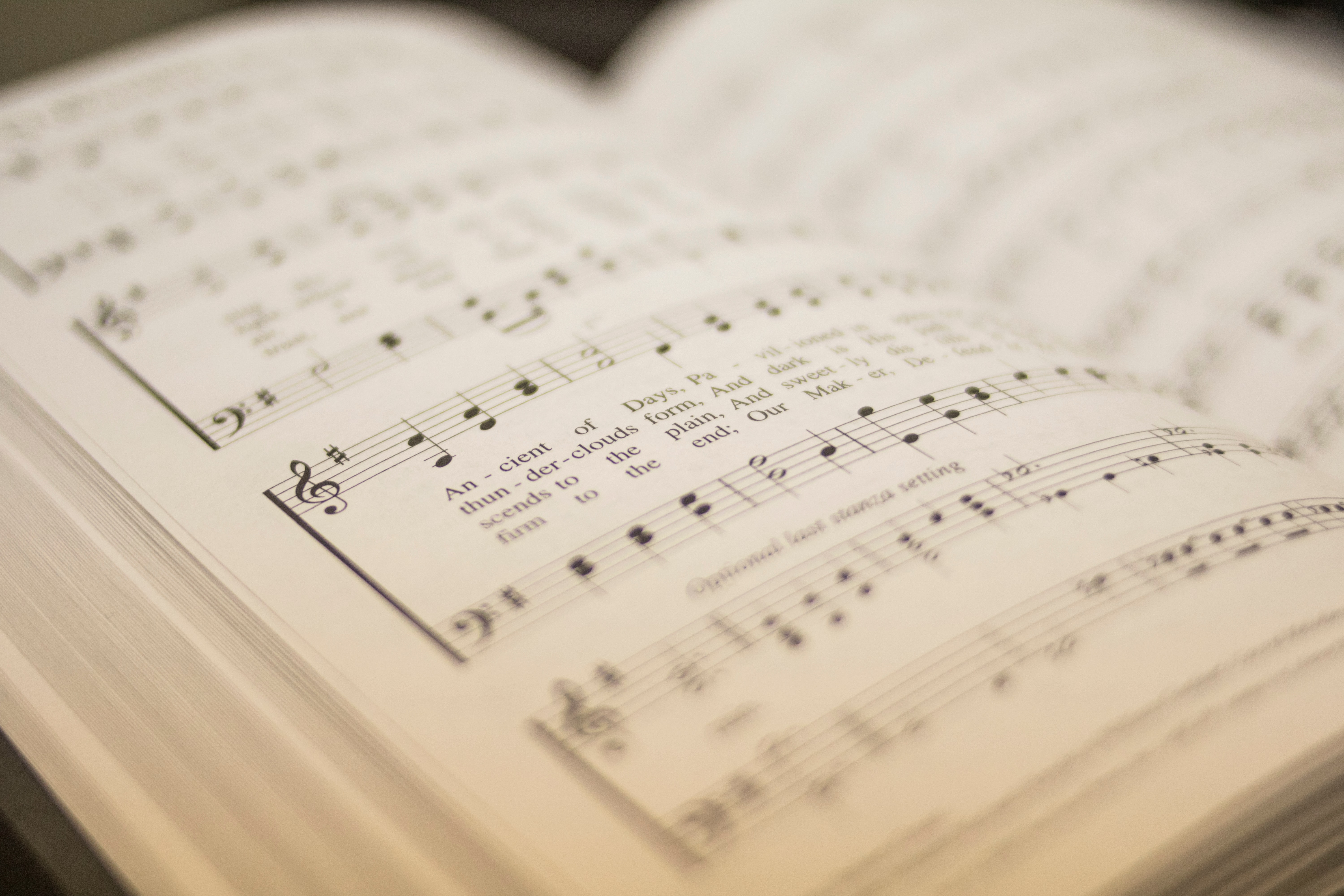
Here’s what I’ve learned from my time in school and church choirs about what it means to be in harmony: it means one singing part blending with another so that the parts enrich each other’s qualities. When I hear a choir, my ears don’t perceive the parts as separate components unless I work hard to distinguish the individual parts. Instead, I perceive the components as one, rich sound that would be missing something without each part. Harmony fills out a musical competition, giving it movement, depth, and nuance. A musical composition without harmony sounds thinner and flimsier than one with it.
Applying my limited musical knowledge and skills to the third reading reminds me that being in harmony doesn’t mean that we must never disagree, nor does it mean that we should all be the same. Rather, it means being open to each other’s gifts. Being open to each other’s gifts is essential for each of us to reflect who we are in God. We can think differently and be different from each other and still “[w]elcome one another” (Rom. 15:7). We don’t have to distance ourselves from those who are different from us. To “welcome one another” is not to let fear disrupt the harmony God wants us to enjoy with each other and with Him. It is to recognize the truth that God works through each of us because of our differences — differences that, when employed for “produc[ing] good fruit,” blend to make one sound that’s all the richer for being layered (Mat. 3:8).
The Bible. The New American Bible Revised Edition, Kindle edition, Fairbrother, 2011.
Confraternity of Christian Doctrine, Inc. “Sunday July, 2 2023: Readings at Mass.” The New American Bible, 2001. Universalis for Windows, Version 2.179, Universalis Publishing Ltd., 26 Feb. 2023, https://universalis.com/n-app-windows.htm
 Sitting with the Sacred
Leave a comment