Feeds:
Posts
Comments

Archive for December, 2022

Photo by Isaac Quesada on Unsplash

I first heard the reflection that inspired today’s post as part of the Hallow App’s Advent #Pray25 Challenge. Though I’ll be writing about the reflection from Day 24 of the prayer challenge, which was released on December 21, I decided I’d go back to it for this week’s post because it invites me to imagine I’m one of the shepherds from the Christmas story.

The reflection reminded me that the Old Testament “is full of” shepherds — David for one— who were also leaders of their people. However, by the time of Jesus’s birth the life of a shepherd was not an esteemed one. Shepherds spent much of their time not within communities but outside of them and in the company not of other people but of smelly, dirty animals. One of the narrators of the reflection, Jonathan Roumie, the actor who plays Jesus in the series The Chosen, says that because of the isolation and company (or lack thereof) associated with their occupations, shepherds were often thought of as “coarse” and assumed to be criminals.

Now that I’ve shared this context, I’m going to listen to the reflection again. As I do, I’ll share what comes to me. You can listen to the reflection here. (If the link doesn’t give you access to the reflection, please let me know.)


My first thought is that, given the historical, it’s no wonder the translation of Luke 2:9 included in the reflection says they were terrified. Not only are they confronted with sights and sounds they’ve never seen before and don’t have the words to describe, but also they’re being given news that it seems they’re meant to share with “everyone.”

In response to this message, I can imagine a first-century shepherd thinking, “Of all people, why has God chosen me to receive this news now, and why would anyone listen to me if I repeat it? Why would anyone believe me if they listen?

God understands where these questions are coming from. At the same time, God strengthens their faith by telling them, through an angel, what the Divine Presence looks like and where He could be found in the most complete and tangible way on that night.

The shepherds being chosen as the first people outside Jesus’ family to receive the news of his birth is a reminder that God doesn’t use the criteria that humans sometimes use when making choices. God doesn’t rely on sight or any other biological sense when God chooses someone, nor is God’s ability to choose wisely negatively affected by past experiences with other people or even with the person God chooses. It’s often said there is no linear time for God the way there is for us. I take this to mean that there is no past or future in God’s perception. In some way that I can’t understand as I experience linear time, past, present, and future are all unfolding at once for God. And yet, Luke tells us, God entered time by being born of Mary in a stable.

At the invitation of reflection, I imagine myself a shepherd who approaches that stable and the holy family in it. I imagine Mary turning toward the sound of my approach and trying to rise from lying in the straw. I tell her not to trouble herself, that I’ve heard something of what she’s been through. I recount what the angel said.

Mary says nothing, but despite my protests, she sits up and gestures for me to come to her. I do as she asks, and she lifts her baby from the manger. Before I have a chance to step back, she’s placing the baby into my arms.

Dear God, help me hold him gently but firmly. Don’t let me hurt him. What would become of me? Of him? Of this sorrowful world if I dropped him?

He begins to cry.

The sound brings me back into the present of that stable. I focus on making him feel secure. In doing so, I relish his soft solidness and the warmth of him as he wriggles out of the cloths in which his mother has wrapped him. I see to it that he is swaddled snugly once again.

He already smells like the donkey who’s been watching over him. The smell is not unlike that of the sheep whose odor I carry.


Jesus, thank you for trusting me to come to you, to hold you. You were so vulnerable at your birth and at your death so that I could approach you when I am at my most vulnerable. Thank you for the gift of vulnerability — mine and yours. Amen.


Read Full Post »

Photo by Zoltan Tasi on Unsplash

Joseph her husband, since he was a righteous man, yet unwilling to expose her to shame, decided to divorce her quietly. Such was his intention when, behold, the angel of the Lord appeared to him in a dream and said, “Joseph, son of David, do not be afraid to take Mary your wife into your home.

Matthew 1:19-20

This isn’t the post I was working on last week before I realized it needed more time. I’ll come back to that one when the readings lend themselves to the ideas and experiences I was wrestling with. This week, I’d like to sit with Joseph, as the Gospel reading, Matthew 1-18-24 invites me to.

Joseph is caught in the middle of what must have seemed like a huge no-win situation. The woman he intends to take into his home as his wife is carrying a child, and he isn’t the father of that child. I imagine Joseph thinking he should divorce Mary because all the evidence—except for I imagine what she’s told him about the visit from the angel — says she’s been unfaithful to the covenant made between him and her father. If the usual explanation for Mary’s condition is the truth and not the explanation she has given, the Law says Joseph has a right — and is probably expected — to divorce her.

But we’re told Joseph is a righteous man. Given this information, I like to think that his internal comes not only from not wanting to expose Mary to a public disgrace that might result in her being stoned. I’d like to think that deep down, he’d rather not divorce her quietly. Really, he’d rather not divorce her at all. I imagine him having had such high hopes for the future of his marriage and family. I imagine he cherished Mary’s deep love for God, her family, her friends, and her village. I imagine him having trouble believing Mary would betray that love and fearing that Mary’s pregnancy has come about as a result of violence on the part of an occupying soldier. (I don’t think I’m the first writer to put these thoughts in Joseph’s head. I think the movie The Nativity Story depicts him asking Mary if a Roman soldier is the father of her child, but I could be thinking of a different adaptation.) I imagine him thinking that if Mary is a survivor of such violence, who knows how the trauma has changed her. No wonder she’s not making sense. Maybe her mind is telling her this story about a visit from an angel because she blocked out what really happened. If this is the case, he wants to offer her and her child the shelter of his good name and his home even more than he did before he found out she was pregnant.

This train of thought leads Joseph back to the reality that people will talk. No matter how he handles the situation, people will talk. The life of a workman striving to nurture and to support a godly family was always going to be challenging. No matter what choice he makes, he now knows that his life will be exponentially more challenging than he thought it would. This situation is an invitation to be more concerned with living righteously than with worrying about offending the sensibilities of influential people.

These are all thoughts I imagine cycling through Joseph’s mind before the angel enters his dream. And then what does the angel have to say to him? “Do not be afraid to take Mary your wife into your home” (Matt. 1: 20). I’ll continue by paraphrasing Mathew 1:20-24: “Mary hasn’t broken any covenant. The child she carries was conceived by the Spirit of God and is the Son of God, God with Creation.”

The angel’s message lays to rest Joseph’s doubts and calms his fears about what has happened to Mary. In other words, he has received consolation regarding troubling developments in his own life. He has also been chosen as one of the first to witnesses to the fulfillment God’s promise to send a Messiah.

Nonetheless, the angel’s message doesn’t promise that Joseph’s life will be any easier, thanks to his role in salvation history. He had to have wondered how he could teach the Son of God how to be a righteous man. He had to have wondered who would be the student and who would be the teacher, and I wonder if, on some level, he knew the answer was that he and Jesus would be both to each other. He had to wonder how people would accept a Messiah who had been brought up by a humble workman. I’m imagining Joseph wondering whether God would expect him to change how he supported his family so that the Messiah would be better prepared to lead his people.

The answer to this question seems to have been “No.” God is going to work through and to grow up with the help on the man who Joseph is. This process isn’t going to be smooth. The world that Jesus comes into — our world — is very broken by sin. And yet, God loves each of us as much as Mary, Joseph, and Jesus.

In reflecting on this reading, I’m reminded that in becoming human, God didn’t end suffering. He entered into it and took it upon Himself so that it wouldn’t have the last word. Perfect love will. It’s a Love that doesn’t forget anyone. It holds close those who are afraid, ostracized, overlooked, ashamed, lonely, and vulnerable.

Confraternity of Christian Doctrine, Inc. “Sunday July, 2 2023: Readings at Mass.” The New American Bible, 2001. Universalis for Windows, Version 2.179, Universalis Publishing Ltd., 26 Feb. 2023, https://universalis.com/n-app-windows.htm

Read Full Post »

Photo by Benjamin Elliott on Unsplash

What I thought would be this week’s post is taking longer to get ready than my posts normally do. The readings I’m currently reflecting on are taking my writing in all different directions. Not being open to where each one takes me doesn’t feel right. So for this week’s post, while I’m seeing where multiple trails lead and how they are connected, I’ll link to a reflection from Julie Hanlon Rubio and one of my favorite websites, Catholic Women Preach.

If and when what I thought would be this week’s post feels ready to share, I’ll be so excited to share it with you.

In the meantime, my experience with writing for this space this week has taught me that part of patience might be a willingness to take detours from what seems like the surest road to a destination. Maybe what seems at the beginning of a journey to be the best route to follow actually isn’t. Maybe I’m not always called to take the most direct route to where I think I’m called to go — especially in writing. Maybe getting sidetracked is an important part of some journeys.

Read Full Post »

Photo by Michael Maasen on Unsplash

This week’s readings:

  • Isaiah 11:1–10
  • Psalm 72:1–2, 7–8, 12–13, 17
  • Romans 15:4–9
  • Matthew 3:1–12

Also cited:

  • Isaiah 40:4
  • 1 Corinthians 12:4
  • Philippians 2 2

I want to go to the place described in Isaiah 11:1-10. The passage describes what a kingdom united to one on whom “the spirit of the Lord shall rest” will look like (Isa. 11:2). I’ve just quoted a single verse from the passage, but the excerpt in its entirety offers such beautiful imagery. Read the entire passage. If you’re like me, you’ll come away feeling all kinds of warm fuzzies.

In case you don’t have time to look the passage up right now, I still want this post to make sense, so I’ll summarize the verses. The Anointed One is wise, humble, and just. He “lifts up” every valley and makes every hill “low” (Isa. 40:4). In other words, he smooths everything out. His virtues effect eternal peace among and within all that is. The psalm further expands on the presentation of what this peace will look and feel like.

So does the third reading, even though it doesn’t paint an idyllic picture of the future and instead instructs the members of the early Christian community in Rome about how to conduct themselves. They are to look to the Scriptures for “encouragement that [they] might have hope” as they endure successive present moments that fall short of the promises that the first two readings make (Rom. 15:4).

When I first heard the third reading this time around, I don’t think I actually got its message. I found it difficult to see Paul’s instructions as part of fulfilling those promises. Romans 15:5 says to “think in harmony with one another, in keeping with Christ Jesus that with one accord you may with one voice glorify the God and Father of our Lord Jesus Christ.” The source of my struggle was that between most recently hearing this reading and returning to it as I prepared to write this post, I remembered it including a verse that tells Christians to be “of one mind.” These aren’t the words I’m seeing either in publications of the Sunday Readings or in my Bible. Nevertheless, a quick Google search for where “of one mind” appears in the New Testament letters brings up Philippians 2:2, whose message is very similar to Romans: 15:5.

I’m glad the epistle for this week was the passage from Romans and wasn’t a passage including Philippians 2:2. My gut reaction is that the instruction to be “of one mind” means that to be united with God and with each other means to agree about everything, to be essentially the same person, or maybe to be multiple robots produced by following one blueprint. But contrary to this (lack of) understanding, Paul assures the flock in Corinth that “there are different kinds of spiritual gifts but the same Spirit” (1 Cor. 12:4).When I went back to Romans 5:5 in light of this message, I noticed that the verse wants us to be in “harmony with one another. [Italics mine]”

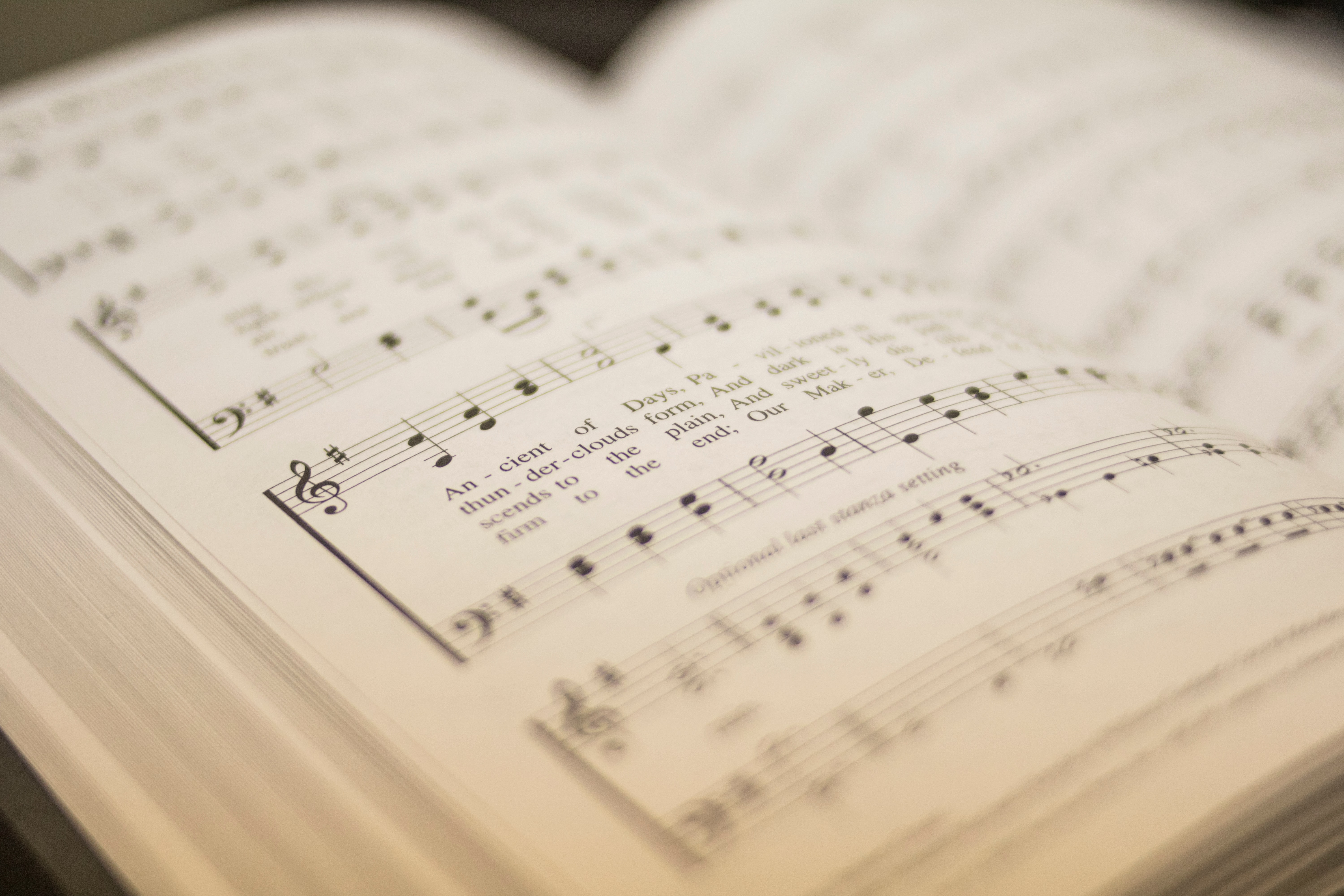
Here’s what I’ve learned from my time in school and church choirs about what it means to be in harmony: it means one singing part blending with another so that the parts enrich each other’s qualities. When I hear a choir, my ears don’t perceive the parts as separate components unless I work hard to distinguish the individual parts. Instead, I perceive the components as one, rich sound that would be missing something without each part. Harmony fills out a musical competition, giving it movement, depth, and nuance. A musical composition without harmony sounds thinner and flimsier than one with it.

Applying my limited musical knowledge and skills to the third reading reminds me that being in harmony doesn’t mean that we must never disagree, nor does it mean that we should all be the same. Rather, it means being open to each other’s gifts. Being open to each other’s gifts is essential for each of us to reflect who we are in God. We can think differently and be different from each other and still “[w]elcome one another” (Rom. 15:7). We don’t have to distance ourselves from those who are different from us. To “welcome one another” is not to let fear disrupt the harmony God wants us to enjoy with each other and with Him. It is to recognize the truth that God works through each of us because of our differences — differences that, when employed for “produc[ing] good fruit,” blend to make one sound that’s all the richer for being layered (Mat. 3:8).

The Bible. The New American Bible Revised Edition, Kindle edition, Fairbrother, 2011.

Confraternity of Christian Doctrine, Inc. “Sunday July, 2 2023: Readings at Mass.” The New American Bible, 2001. Universalis for Windows, Version 2.179, Universalis Publishing Ltd., 26 Feb. 2023, https://universalis.com/n-app-windows.htm

Read Full Post »

Photo by Florian Klauer on Unsplash

This Week’s Readings:

  • Isaiah 2:1–5
  • Psalm 122:1–2, 3–4, 4–5, 6–7, 8–9
  • Romans 13:11–14
  • Matthew 24:37–44

Also Cited

  • Isaiah 55: 8-9
  • Colossians 3:2

As a whole, the readings above offer a lot of hope. They tell me that people from every nation, regardless of their circumstances, are invited to enter God’s kingdom. They remind me that “[my] salvation is nearer now than when [I] first believed” (Rom 13:11, The New American Bible Revised Edition).

Yet even as these readings inspire me, I find them daunting. The first reading tells me that its promises won’t be fulfilled without me first fighting a battle that won’t just be an uphill one. It will be an “upmountain” one. Isaiah envisions the place where God dwells as being on the summit of a mountain because the Jewish people had a long history of meeting God on peaks. These settings seem fitting because Scripture reminds me that God’s ways are not my ways. They are high above [my] own (Isa. 55:8-9). In Paul’s letter to the Colossians, he reminds me to “think about what is above” (3:2).

However, if I take the concept of “climb[ing] the Lord’s mountain” out of the context of the rest of the passage, the words carry connotations of a meeting with God being the result of an achievement on my part (Isa. 2:3, The New American Bible, 2001) It isn’t. Isaiah calls me to make the trip “that [God] may instruct [me] in his ways and [I] may walk in his paths (Isa. 2:3). I have a lot left to learn and to do. The learning and doing will mean letting go in order to transcend “what is on earth” (Col. 3:2). It will mean letting go of the weights of selfishness and self-centeredness. It will mean recognizing that whatever is not God or does not share God’s character is temporary and may act like a weight that holds down the balloon of my soul and keep it from ascending to God. The heavier the weight, the harder it is to get out from under. I can’t just shrug it off. Only Someone above me can lift it, and that Someone is God. But God often doesn’t pry out of my hands what I have a white-knuckle grip on. Instead God waits for me to release to Him the burdens of selfishness that I clutch to myself, though His cross would lift them from me if I let it.

Still, it feels like another kind of burden to lay the burden of selfishness on the cross because it can be hard to recognize selfishness for what it is. It can feel like a weighted blanket I hide under. To come out from under this blanket is to be at my most vulnerable, to be naked, to stand out rather than be camouflaged by the temporary trappings of day-to-day life.

I won’t have forever to act as the Divine reflection on earth that I was born to be — that each of us is born to be. My time on earth may well end when I least expect it to end, on a day that previously seemed as uneventful as the one before it. May I recognize opportunities to act selflessly, to build community, and to make peace while I have these opportunities. This is the prayer that the New Testament reading I cite at the beginning of this post inspires me to offer. Amen.

The Bible. The New American Bible Revised Edition, Kindle edition, Fairbrother, 2011.

Confraternity of Christian Doctrine, Inc. “Sunday July, 2 2023: Readings at Mass.” The New American Bible, 2001. Universalis for Windows, Version 2.179, Universalis Publishing Ltd., 26 Feb. 2023, https://universalis.com/n-app-windows.htm

Read Full Post »