- Malachi 3:19–20a
- Psalm 98:5–6, 7–8, 9
- 2 Thessalonians 3:7–12
- Luke 21:28
This week, I feel prompted to reflect on the readings listed above as a unit and to discuss them generally, for the most part. I sense that focusing on a verse or two in just one of these readings might be to miss their point, to do, in a way, exactly what they are advising us not to do. Nonetheless, I encourage you to go to these passages yourself and see what they say to you.
I think they’re telling us that, yes, everything but God is passing away. But they’re also warning us not to fixate on what passes or on the signs that it’s passing. We can get so focused on the future that we neglect what the present asks of us. If we never consider what the present asks of us, we don’t become who we are in God, and we don’t do what God has given us the ability to do. Such not becoming and not doing would be tragic because to become who we are in God and to do what each of us is uniquely suited to do is the reasons were alive. Such not doing and not becoming means not entering through the “narrow gate” that leads to union with God and with those who have entered that union before us (Matt. 7-14).
There are so many gates that can look like they lead us toward the one the one each of us is called to move toward, when, in fact, they stop our progress toward that ultimate gate. As a result, it can be tempting not to seek the ultimate gate at all, to think somehow that if we don’t engage with the present, for fear of choosing the wrong gate, the gate we seek will come to us. But it won’t — unless we seek it.
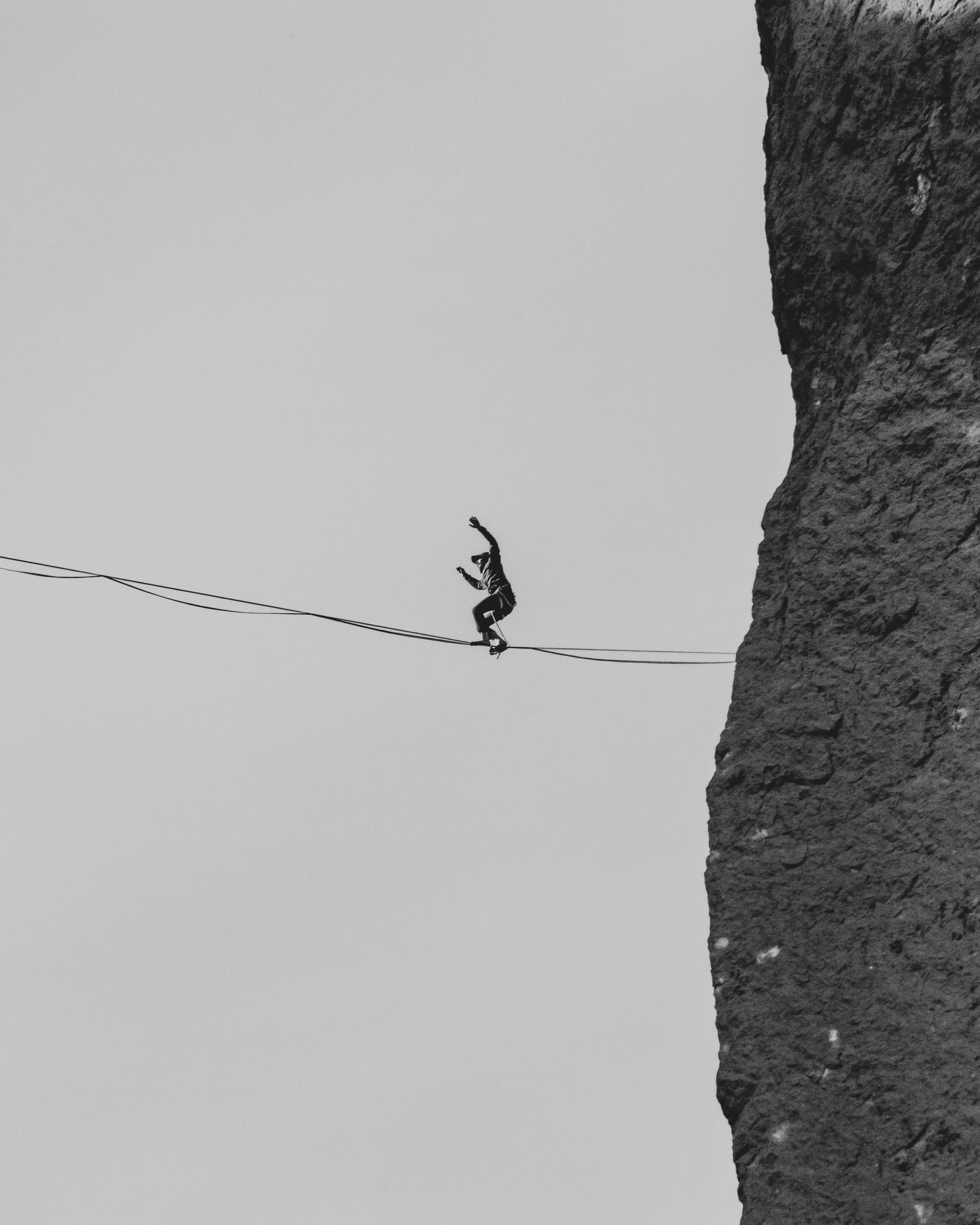
The process of seeking the ultimate gate will be a mixed experience. When we travel the thin wire that is using the gifts God has given us without forgetting that those gifts are not the ultimate gate but a means to it, the wire leading toward the ultimate gate will feel able told our weight, even if, to someone else, the wire looks flimsy. On the other hand, when all we can see is the thinness of the wire, or all we can focus on is our desire for a shortcut to the gate, the necessity of crossing the wire will feel more like an impossible trial. Furthermore, when we operate under the illusion that there are shortcuts to and through the gate, we’ll forget what we’ve learned about what the wire looks like and how to navigate it. As a result, we’ll fall off the wire. Acknowledging resistance and desire for shortcuts will help to keep us from falling off.
While each of us can benefit from knowing our weaknesses, we also need not to assume that someone else is surrendering to resistance or seeking shortcuts. We should not use 2 Thessalonians 3:10 to judge others. The verse instructs that anyone who is “unwilling to work should not eat” [italics mine]. Let’s not assume that someone isn’t working because he or she is unwilling. A person may face limits keeping him or her from working, limits only he or she and God can understand and that the rest of us cannot see. Let’s also be open to the work each of us is called to looking different than the work of the next person.
I’d like to wrap up this week’s post by moving from the third to fourth reading — that is, the Gospel reading. I find it significant that the reading mentions natural disasters, wars, and persecutions but the references aren’t presented in a way that points to a specific disaster, war, or persecution. I think this presentation reminds us that nothing is eternal but God and those who are united to God. Everything but God will be created, destroyed, and re-created. This process happens in our lives over and over and again then at the end of our earthly lives. It also happens to any systems we have, whether within our bodies, within systems we create, or within systems recognized by us as patterns in the universe. It happens to cells and to solar systems. It happens on the smallest and grandest scales. It’s not a one-time event. The challenge is trusting God to lead us through this recurring process until trust leads us through the “narrow gate,” and that which is eternal is all that remains (Matt. 7-14).
The Bible. The New American Bible Revised Edition, Kindle edition, Fairbrother, 2011.
Confraternity of Christian Doctrine, Inc. “Sunday July, 2 2023: Readings at Mass.” The New American Bible, 2001. Universalis for Windows, Version 2.179, Universalis Publishing Ltd., 26 Feb. 2023, https://universalis.com/n-app-windows.htm
 Sitting with the Sacred
Leave a comment